
Lake Como without a car is not only possible—it is the preferred way to explore this inverted-Y-shaped lake. The public ferry network, operated by Navigazione Laghi, connects the mid-lake triangle of Bellagio, Varenna, and Menaggio with frequent, scenic crossings. For travellers aged 50–70, the key is understanding the three vessel types, buying the right ticket, and planning around the summer queues that catch many visitors off guard.
 AI-edited
What ferry types are there, and which should I choose?
Three distinct vessels serve Lake Como: the slow battello for sightseeing, the fast aliscafo (hydrofoil) for speed, and the traghetto car ferry that also carries pedestrians. For leisurely exploration, choose the slow boat; for time-sensitive connections, the hydrofoil; for short hops across the central basin, the car ferry is your most frequent option.
The battello (slow passenger ferry) is the workhorse of the lake. It stops at nearly every pier, offers outdoor deck space, and takes 55 minutes to two and a half hours from Como to Bellagio depending on the number of stops. Recent guests praise the views from the front deck, especially on the short mid-lake crossing between Varenna and Bellagio. The aliscafo (hydrofoil) does the same Como–Bellagio run in 40 to 55 minutes, calling at no pier in between. In the summer 2026 timetable eight fast services leave Como between 7:33 and 19:10 from Monday to Saturday, six on Sundays and public holidays. The traghetto (car ferry) connects Bellagio, Varenna, Menaggio, and Cadenabbia roughly every half hour through the morning in summer, with hour-long gaps in the afternoon and evening, and pedestrians pay the same fare as on the slow boat.
How do I buy tickets and avoid the notorious queues?
Buy your tickets at the pier ticket office before boarding, or tap a contactless card on the validator once aboard with NaviTap. The free-circulation day pass for the central lake costs €17.50 for adults under the fare table valid from 1 April 2026. Navigazione Laghi asks passengers to reach the office about twenty minutes before departure.
Navigazione Laghi says as much itself: in summer and on public holidays there can be considerable traffic and therefore queues at the ticket offices. For single tickets you can use the NaviTap contactless system: tell the crew, tap your card on the validator once aboard, and always tap out again when you disembark. It works on most ordinary boats but not on the fast services, and it cannot apply a reduced fare. Forget the tap-out and the system charges the full-network daily fare of €32.00, because it cannot tell where you left the boat.
What are the key routes and travel times?
The central lake triangle—Bellagio, Varenna, Menaggio—is the heart of car-free travel. The car-ferry timetable gives 15 minutes for these crossings, 30 on runs that call elsewhere first. Como to Bellagio takes 40 to 55 minutes by fast service, up to two and a half hours by slow boat; Como to Colico takes 1 hour 30.
| Route | Duration | Frequency | One-way fare (€) |
|---|---|---|---|
| Bellagio ↔ Varenna | 15 min (30 via Menaggio) | 16 car-ferry sailings daily | €5.50 |
| Bellagio ↔ Menaggio | 15 min (30 on some runs) | ~30 min a.m., sparser later | €5.50 |
| Como → Bellagio (slow) | 55 min–2 h 35 | About 19 daily | €12.00 |
| Como → Bellagio (hydrofoil) | 40–55 min | 8 daily Mon–Sat, 6 Sun/hols | €17.00 |
| Varenna → Como | 1 h fast, up to 3 h 05 slow | 18 daily | €13.50 (+€5.50 fast) |
On summer weekdays the Bellagio–Cadenabbia–Menaggio–Varenna line runs from 5:40 to 23:55; the vehicle-carrying ferries themselves run from about 6:35 to 22:05. Towards Como the last two sailings from Varenna leave at 18:45 and 19:08, and the crossing takes anything from an hour to over three hours. Check the official timetables before building a day around one boat.
Where are steps and gangway gaps an issue?
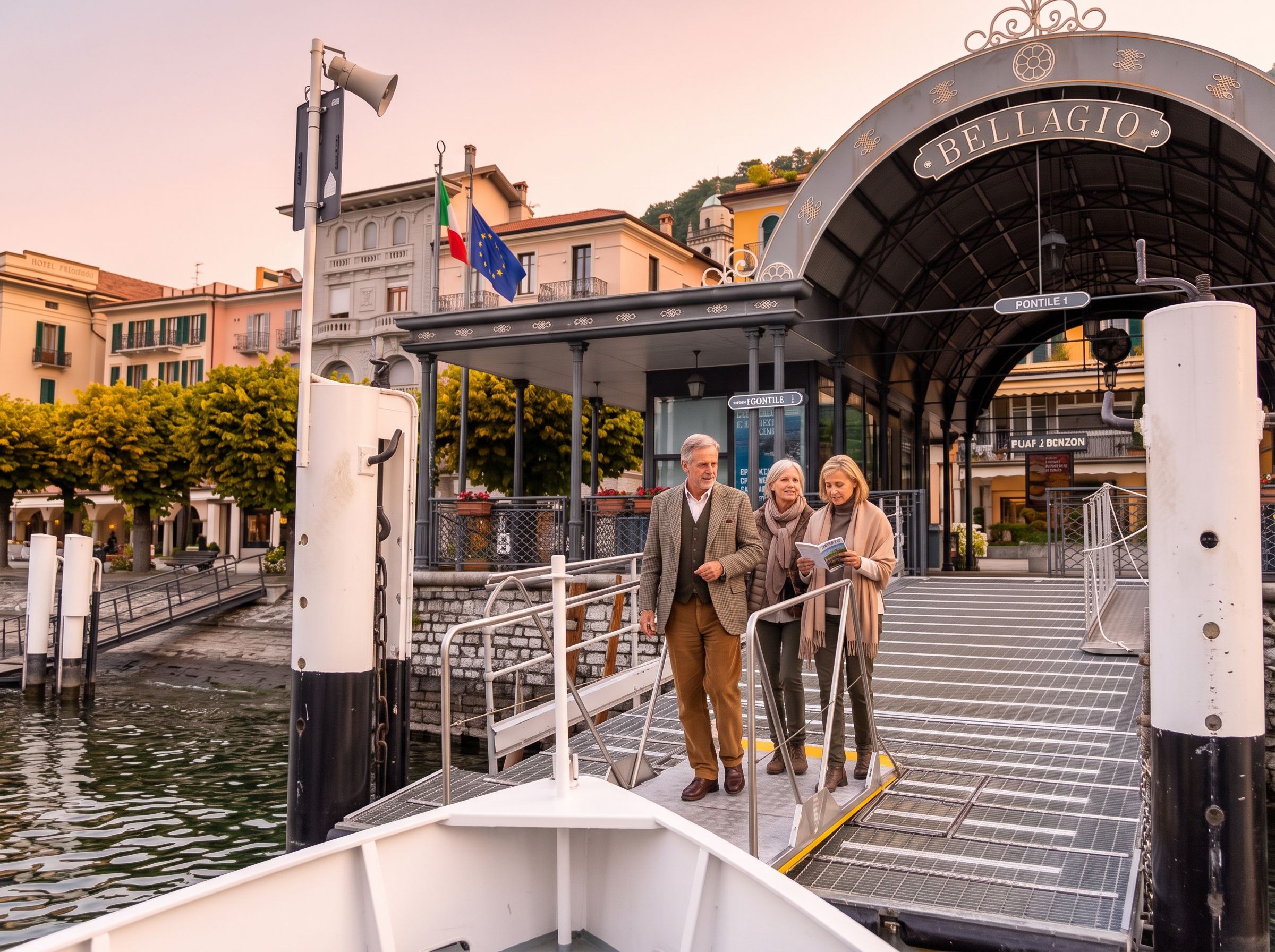
Boarding is always assisted by the crew. Navigazione Laghi puts its gangways at a minimum width of 80 cm with a non-slip surface and a slope that changes with the level of the lake, and has fitted ships and main piers with stepless ramps since 2016. Its own advice: ring 800 551 801 first.
For travellers with mobility concerns the pier matters more than the vessel. Navigazione Laghi states that most of its fleet is easy to board and that the newer ships have lifts and adapted toilets. It also names the landing stages that are not easily accessible — Villa Carlotta, Blevio, Pognana and Santa Caterina among them — and marks the runs it recommends for wheelchair users with a symbol in the printed timetable. At Bellagio and Varenna the docks sit at water level, but the historic centres above them involve steep, cobbled climbs, and local reporting has documented steps and level changes on Como’s own new lakefront — treat no promenade as step-free until you have walked it.
What about luggage on the ferries?
One piece of hand luggage travels free on Navigazione Laghi boats if no side is longer than 0.60 m and its volume stays under 40 cubic decimetres. Anything larger, and every additional item whatever its size, is charged at the set baggage fare. Pack a small case or a backpack and leave the rest at your hotel.
There is a second reason to travel light: NaviTap cannot be used at all when you are carrying a suitcase, a bicycle or a pet, so with luggage you are back at the ticket window. If you are moving between towns, the central-lake car ferry is the roomiest option, and its shortest leg, Bellagio to Cadenabbia, takes ten minutes. Our guide to Small-Group and Guided Tours of Lake Como offers alternatives that include luggage transfer services.
What other transport options exist: funicular, buses, and taxi-boats?
The Como–Brunate funicular takes seven minutes and leaves every fifteen minutes from 6:00 until around midnight, every twelve minutes between 7:00 and 9:00. ASF Autolinee buses cover the coastal hamlets and the Greenway del Lago. Taxi-boats reach villa docks such as Villa del Balbianello, but they are private charters.
The funicular to Brunate makes simultaneous departures from both stations and stops at Carescione on request, and neither the funicular company nor ASF documents wheelchair access either way. The ASF bus network reaches the Greenway del Lago, and the path’s operator is blunt about it: 11.2 kilometres from Colonno to Griante, mixing asphalt with unmade track and cobbled steps, and expressly not passable with a wheelchair or a pushchair. Taxi-boats are charters, not shuttles: an hour with Barindelli at Bellagio starts at €350, while Taxi Boat Varenna’s shared central-lake tour taking in Villa del Balbianello starts at €90. From Lenno the walk up to that villa is 1 kilometre, partly gravel, about 25 minutes, and the Fondo Ambiente calls it unsuitable for anyone with mobility difficulties. For more on the best times to visit these sites, see Lake Como Through the Year: Festivals and Quiet Seasons.
Is there a senior discount on the ferries?
Passengers over 65 pay the reduced fare 1.20 on single tickets and 3.20 on day passes — those are tariff codes, not prices. On the central lake the day pass falls from €17.50 to €14.00, and the reduction applies Monday to Friday only, weekends and holidays excluded. Bring photo ID.
The fare table valid from 1 April 2026 sets the over-65 rate at 80 per cent of the adult fare: Bellagio–Varenna falls from €5.50 to €4.40, Como–Bellagio from €12.00 to €9.60, and the whole-lake Como–Colico day pass from €32.00 to €25.60. NaviTap cannot apply any reduced fare, so buy at the ticket office or on board and bring photo ID. The weekday-only condition matters more than the amounts: on a Saturday, Sunday or public holiday you pay the full adult fare.
"Such a convenience to have the ferry available to get around Lake Como … easy to buy tickets and navigate the schedule. They seem to do a great job of keeping the schedule on time as well. Plenty of areas above ferry to sit and keep warm if it's a windy day." — a guest wrote on Google in October 2022
What should I know about the Cadenabbia pier closure?
Cadenabbia is back in service. The pier stayed out of the ferry timetable from November 2025 until 30 June 2026, but the timetable running from 1 July to 4 October 2026 is headed Bellagio–Cadenabbia–Varenna–Menaggio again, with 27 sailings a day to Bellagio and a crossing of ten minutes.
If you are heading for Villa Carlotta, note that Navigazione Laghi lists the Villa Carlotta landing stage among the piers that are not easily accessible, and that its timetable gives the walk to the entrance as about 450 metres through the Tremezzo arcades or 900 metres along the lakefront. From Cadenabbia the car ferry reaches Bellagio in ten minutes and Varenna in thirty. For those considering a stay at the Grand Hotel Tremezzo, which is near Cadenabbia, our A Closer Look: Grand Hotel Tremezzo dossier covers the approach in detail.
How do I handle the return ticket issue?
Return tickets cost exactly double the one-way fare and are sold at any staffed ticket office, for fast services as well as slow boats. A day pass is valid on a fast service too, provided you pay the supplement — €5.00 between Como and Bellagio, €3.00 between Bellagio and Varenna. No fast-service ticket allows an intermediate stop.
The real trap is a different one: a fast-service ticket or supplement is valid only on the day it is issued and permits no intermediate stops, so a hydrofoil leg cannot be broken to look at a village on the way. Advance reservation of a fast service is offered only to season-ticket holders. The practical strategy follows: take the day pass, ride the ferries and slow boats freely, and add the supplement for the one leg where speed matters.
What is the best base town without a car?
Regione Lombardia’s accessible-tourism itinerary for Lake Como covers five towns, not one: Como, Lecco, Bellagio, Varenna and Menaggio. Menaggio’s lakefront is flat and easy going, and Varenna’s trains reach Milano Centrale in 64 minutes. Bellagio offers iconic views but its historic centre is steep and cobbled.
For travellers aged 50–70, Menaggio is an easy base: Regione Lombardia’s Lombardia Facile portal notes that around Lake Como the lakefront and the streets beside it are usually level and easily walkable even for people with mobility difficulties. Varenna is hillier but has a direct train to Milano Centrale, 64 minutes, roughly hourly, from €7.40 second class. Bellagio is beautiful and its cobbled streets climb steeply from the water; stay there and you will keep to the waterfront. For food-focused travellers, our roundup of Lake Como Hotels Worth Booking for the Food includes properties in all three towns with excellent on-site dining.
The Lecco–Colico–Tirano railway is running normally again: the suspension ran from 15 June to 14 September 2025 and the line is absent from the 2026 summer works programme. Boats remain a real alternative there — the summer 2026 timetable carries a separate Lecco–Bellagio line with five sailings each way — and ASF runs free evening buses on line C110 between Argegno and Menaggio from 19:00 daily until 13 September 2026.
For a deeper dive into the schedules and how they change by season, download the operator’s own PDFs — separate sheets cover the Como–Colico ships, the Lecco–Bellagio line and the central-lake car ferry — from Navigazione Laghi, where the current fares are published too.


