
Arriving at Lake Como for the first time can feel like stepping into a painting, but the journey there requires a bit of planning. For travellers aged 50 to 70, the key is knowing which airport suits your flight, which train avoids changes, and when a private transfer is worth every euro. This guide covers the three Milan airports, the direct train to Como San Giovanni, station accessibility, and the most comfortable door-to-lake routes. We will not dive into the ferry system here—that subject has its own dedicated guide—but we will mention it once where it naturally connects to your arrival.
 AI-edited
Which Milan airport should I fly into?
Milan Malpensa (MXP) is the most practical choice for Lake Como, handling the bulk of international flights and offering the most direct transfer options. Linate (LIN) is closer to Milan but has fewer connections, while Bergamo (BGY) works best for budget carriers but requires a longer journey.
Malpensa is about 50 kilometres from Como itself, roughly 45 minutes to an hour by road. The mid-lake towns are further out: Welcome Pickups gives the distance from the airport to Lake Como as around 90 kilometres and 1 hour 20 minutes by car or taxi, which matches the run to Bellagio rather than to Como. Linate is smaller and closer to the centre, and since the M4 metro opened it reaches San Babila in central Milan in about 12 minutes, with an interchange there onto the red M1 line. Bergamo, popular with low-cost airlines like Ryanair, lies roughly 90 kilometres by road east of Como; FlixBus runs nine buses a day between the airport and Como, taking about 1 hour 45 minutes, with fares from €12.98 as of August 2026.
For most seniors, Malpensa offers the best balance of flight choice and transfer simplicity. If you are arriving on a budget airline, Bergamo is workable but adds travel time. Linate is a good option if you plan to spend a night in Milan before heading to the lake.
What is the easiest train from Milan to Lake Como?
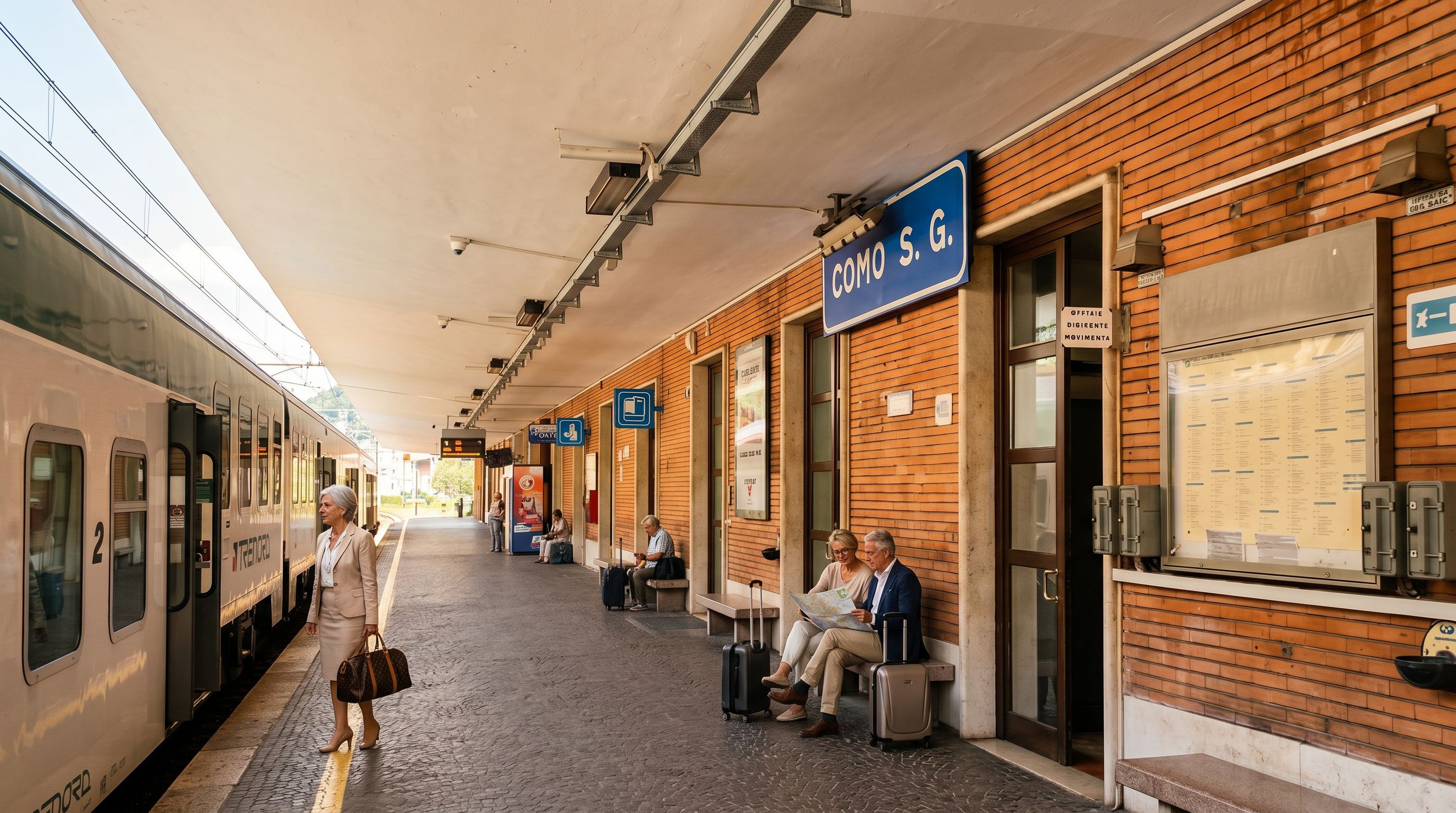
The direct Trenord regional train from Milano Centrale to Como San Giovanni is the fastest and most senior-friendly option, taking just 40 minutes with no changes required. A standard second-class ticket costs €5.20, and discounted rates are available for travellers over 65.
Trenord’s own route page puts the line at 47 kilometres with about 17 trips a day and departures almost every hour. The train is comfortable, with luggage racks at the end of each carriage and space between seat backs for smaller bags. Second class is what most travellers use; Trenord sells a first-class supplement separately, and it buys more room on the same train rather than a faster journey.
For those heading to the eastern shore, the train from Milano Centrale to Varenna-Esino takes about 1 hour 4 minutes over 72 kilometres, with a second-class ticket from €7.40 and reduced fares for over-65s. Trenord lists about 16 direct trains a day, the first leaving Milano Centrale at 06:20 and the last at 21:20. The Lecco–Colico line that serves Varenna was closed from 15 June to 14 September 2025 while RFI upgraded the infrastructure ahead of the 2026 Winter Olympics, with replacement buses from Lecco; it has run normally since, and it does not appear in Trenord’s summer 2026 engineering programme. Service alerts are still worth a look on Trenord’s website before you travel.
How accessible are the train stations?
Como San Giovanni is step-free: RFI lists a barrier-free route with a lift to platforms 2, 3, 4 and 6, a level or ramped route to platform 1, and a taxi rank on Piazzale San Gottardo outside. Varenna-Esino also has lifts to both platforms, but RFI lists it as a station without staffed assistance for passengers with reduced mobility.
There is no single accessibility rating for Lake Como, and conditions differ sharply from one town to the next; the recurring obstacles are uneven cobblestones, steep hills and narrow pavements. At Como San Giovanni the taxi rank is on Piazzale San Gottardo directly outside, and the walk to Piazza Cavour on the lakefront is about 900 metres, paved and gently downhill, losing some 20 metres of height. At Varenna-Esino the station sits above the village, in the commune of Perledo; the ferry pier is about 400 metres away and roughly 15 metres lower, so the descent is short and the return is the harder half.
Many hotels in the region have lifts and walk-in showers, but some charming properties—especially in Varenna and Bellagio—are accessed by steps. Always confirm accessibility features directly with your accommodation before booking.
When should I book a private transfer?
A private transfer from Malpensa is the most comfortable option if you have mobility concerns, heavy luggage or a late arrival. Allow 45 to 60 minutes to Como itself and about 1 hour 20 minutes to the mid-lake towns; Welcome Pickups quotes €160 to €200 to Bellagio or Lenno, and less for the near shore.
Private transfers are door-to-door, meaning you are met at arrivals, helped with your bags, and driven directly to your hotel. This is particularly valuable if you are staying in a hilltop village or a property with limited parking. As of August 2026, Welcome Pickups quotes around €160–€200 from Malpensa to Bellagio or Lenno and €100–€160 to Laglio or Cernobbio, and puts the average taxi fare to the lake at €160. Transfeero’s fixed price to Como itself started lower on the same date, at about €116.
If you are arriving at Linate or Bergamo, private transfers are also available but will cost more due to the longer distance. Splitting the fare helps: a fixed transfer to Como at about €116 works out near €39 a head for three, against roughly €20 for the two train legs plus a share of a taxi at the other end. You are paying for the door-to-door service rather than saving money, and you avoid navigating stations with luggage.
Are buses a good alternative?
Buses are the budget option but are less comfortable, with narrow aisles, limited luggage space and no guaranteed step-free boarding. The Como–Bellagio bus was renumbered C130 in June 2025 and is no longer the C30; it leaves from Como San Giovanni and reaches Bellagio in about 1 hour 10 minutes.
FlixBus runs nine buses a day from Malpensa to Como, with an average journey of 35 minutes and fares from €6.48 as listed on flixbus.it in August 2026; the first departure is at 06:45. The bus sets down at Piazzale San Gottardo, the forecourt of Como San Giovanni station, which leaves the same 900-metre walk down to the lakefront. For travellers with mobility issues that walk can be challenging, especially with luggage.
Local buses around the lake, such as the C130 to Bellagio, are used by many travellers but are not designed for comfort. ASF Autolinee, which runs them, says that not all of its fleet is yet equipped to carry wheelchair users and asks passengers on the extra-urban lake routes to call 031 247111 at least the day before so the journey can be arranged; only one wheelchair can be carried at a time. If you are travelling light and are at ease with public transport, buses work; otherwise, stick to trains or private transfers.
What should I pack for the journey and the lake?
Pack light, wheeled luggage, comfortable walking shoes with good grip, and layers for changing weather. A crossbody bag keeps your hands free, and mosquito repellent is essential for lakeside evenings.
Summer on Lake Como is warm, with daytime highs in the mid-70s to low-80s Fahrenheit (24–28°C), but sudden rain showers are common. Pack a packable rain jacket or a small umbrella. For shoes, white sneakers with good grip are ideal for cobblestones—avoid stilettos entirely. A light knit or cardigan is useful for cool evenings on the lake.
Health-wise, bring blister pads, your prescription medications, and a basic first-aid kit. Pharmacies (farmacie) with a green cross sign are found in every major town, including Como, Bellagio and Varenna. The public hospital for Como is the Ospedale Sant’Anna in San Fermo della Battaglia, about six kilometres from Como San Giovanni station. For emergencies, dial 112: in Lombardy that is the single number for every emergency.
| Item | Why it matters |
|---|---|
| Wheeled suitcase (light) | You will haul it up train steps and over cobblestones |
| Comfortable sneakers | Cobblestones are uneven and slippery when wet |
| Packable rain jacket | Summer showers are short but frequent |
| Crossbody bag | Keeps valuables secure and hands free |
| Mosquito repellent | Essential for lakeside evenings from May to September |
| Prescription meds + blister pads | Pharmacies exist but may not stock your brand |
How do I handle luggage on trains and at stations?
There are no porters for hire, but RFI’s free assistance service at Como San Giovanni will meet you, walk you to the train and carry one piece of hand luggage if you book it in advance. Everywhere else you lift your own bags up the two or three steep steps into the train, so pack light and choose sturdy wheels.
On regional trains, luggage can be stored in the racks at the end of each carriage or between seat backs if your bag is small. Keep an eye on your bags, as theft can occur on busy routes: a case wedged between the seat backs in front of you stays in view for the whole journey, which a rack at the carriage end does not.
At Como San Giovanni, lifts serve platforms 2, 3, 4 and 6 and platform 1 is reached on the level, but you still need to wheel your bag across the concourse. Varenna-Esino has lifts to both platforms too; what it does not have is staffed assistance, so nobody there is on hand to help you off the train. If you have difficulty lifting or walking, book assistance at Como or take a private transfer.
Do I need to validate my train ticket?
Not on this route. Trenord states that its railway tickets do not require validation; only the paper rechargeable ticket has to be tapped against a validator or a turnstile before you board, and a ticket bought in the app or online needs nothing at all. A rail ticket is valid for six hours.
On the Milano Centrale to Como San Giovanni run this is the easiest part of the trip: buy the ticket in the app or online and you board with nothing else to do. If you buy a paper rechargeable ticket at a machine or a shop, hold it against a validator or a turnstile before boarding. Where a station has no suitable validator, Trenord allows you to write the departure station, date and time on the ticket by hand instead.
Travelling without a valid ticket is costly rather than catastrophic. Trenord reduces the statutory penalty to €35 if you pay the inspector on the spot or within five days, and to €50 if you pay between six and sixty days later; in both cases €12 in procedure costs and the price of the fare are added on top.
Are there senior discounts on trains?
Yes. Trenord sells single tickets at 20 per cent off the Lombardy regional tariff to anyone aged 65 or over, and takes 25 per cent off ordinary monthly and annual season tickets. Carry a passport or identity card as proof of age when you buy and when you travel.
The standard second-class ticket from Milano Centrale to Como San Giovanni is €5.20, but the over-65 discount reduces this further. You can buy tickets at the station ticket office, from automated kiosks, or online via the Trenord website. The kiosks have an English-language option and are easy to use. If you are unsure, ask at the ticket counter—staff are generally helpful.
Trenitalia, which runs the long-distance trains rather than the Como service, has its own over-60 fares: FrecciaSENIOR tickets on the Frecce from €29 for CartaFreccia holders, and up to 50 per cent off Intercity and Intercity Notte for X-GO members aged over 60. The Carta Argento has not been on sale since 1 April 2026, although cards issued before that date stay valid until they expire. None of this touches the regional train to Como, but it is worth knowing if you travel on across Italy.
What are the walking conditions like around the lake?
Walking conditions vary significantly by town. Varenna and Lecco have relatively flat lakeside promenades, while Bellagio and Menaggio involve steep hills and cobblestone streets. Rest benches are sparse on inclines, so plan for frequent stops.
Lake Como’s historic towns are beautiful but not designed for easy walking. Cobblestones are uneven and can be slippery when wet, especially after a summer shower. In Bellagio, the walk from the ferry dock to the town centre is uphill on narrow streets. In Varenna, the main promenade along the lake is flat and paved, making it one of the most senior-friendly towns. Lecco, at the southern end of the lake, also offers flat walking paths and good access to amenities.
If you have mobility concerns, consider staying in a town with a flat lakefront, such as Varenna or Lecco, and use ferries to visit other towns. The ferry system is covered in its own guide, but note that some ferry docks have ramps while others require stepping over gaps. Check the Navigazione Laghi website for accessibility details.
The Varenna stop is worth planning around. The station stands above the village, in the commune of Perledo, and RFI lists lifts to both platforms and a bus stop at the station itself; the pier is about 400 metres and some 15 metres below. The descent is short. The climb back at the end of the day is the half to arrange in advance.
Where can I find healthcare if I need it?
Pharmacies are found in every major town and are the fastest point of contact for minor health issues. The public hospital for Como is the Ospedale Sant’Anna at Via Ravona 20 in San Fermo della Battaglia, and its emergency department is open around the clock. Dial 112 for all emergencies.
Pharmacies (farmacie) display a green cross sign and sell over-the-counter medications, sunburn relief, and mosquito treatments. They are open during standard business hours, with a rotating schedule for late-night and Sunday service. In Bellagio the pharmacy is on Via Roma, a few steps back from the lakefront; in Varenna, Farmacia Pedrani sits on Via Corrado Venini, about 550 metres from the ferry pier. For medical help that is not an emergency, dial 116117, the harmonised European number that Lombardy uses as the single access point for non-urgent care.
For serious emergencies, dial 112. AREU, the Lombardy emergency agency, states that 112 is the single number for all emergencies and that any emergency call should go there first. The Ospedale Sant’Anna is about a ten-minute taxi ride from Como San Giovanni, and ASF’s urban bus line N2 runs from the station to the hospital. If you are staying in a remote village, confirm the nearest hospital with your hotel on arrival.
When is the best time to visit for comfortable travel?
Late April to June offers pleasant temperatures (18–25°C) and blooming gardens, making it ideal for walking and sightseeing. September and October are also excellent, with fewer crowds and mild weather.
July and August are the hottest months, with daytime highs up to 30°C, and the lake is crowded with tourists. Train services are busier, and ferry queues can be long. If you visit in summer, book train tickets in advance and travel early in the morning or late in the afternoon to avoid the peak. According to Lake Como Travel’s climate guide, May, June and August have the most rainy days, but showers are usually short and localized.
For seniors, the shoulder seasons (May–June and September–October) offer the best balance of comfortable weather, manageable crowds, and reliable transport. Winter is quiet and cold; the same guide names December and January as the coldest months, averaging 2.5–3.5°C, and some ferry services are reduced.
Summary: Your easiest route to Lake Como
For most seniors, the easiest and most reliable route is to fly into Milan Malpensa, take the Malpensa Express to Milano Centrale (about 51 minutes, €15), then board the direct Trenord train to Como San Giovanni (40 minutes, €5.20). From Como, you can take a ferry to Bellagio, Varenna, or Menaggio—but that is a topic for another guide. If you prefer door-to-door convenience, book a private transfer from Malpensa directly to your hotel — from about €116 to Como itself, €160–€200 to Bellagio or Lenno.
For those heading to the eastern shore, the train to Varenna-Esino is a good option; the 2025 closures for the pre-Olympic upgrade are behind us, but Trenord’s service alerts are still worth a look. Buy your ticket in the app, pack light, and wear comfortable shoes. With a little planning, your arrival at Lake Como will be as smooth as the lake’s famous waters.
For more detailed advice on where to stay, read our guide Where to Stay on Lake Como When Comfort Comes First. And for a complete overview of the region, see Lake Como for Travellers Over 50: The Complete Guide.


