
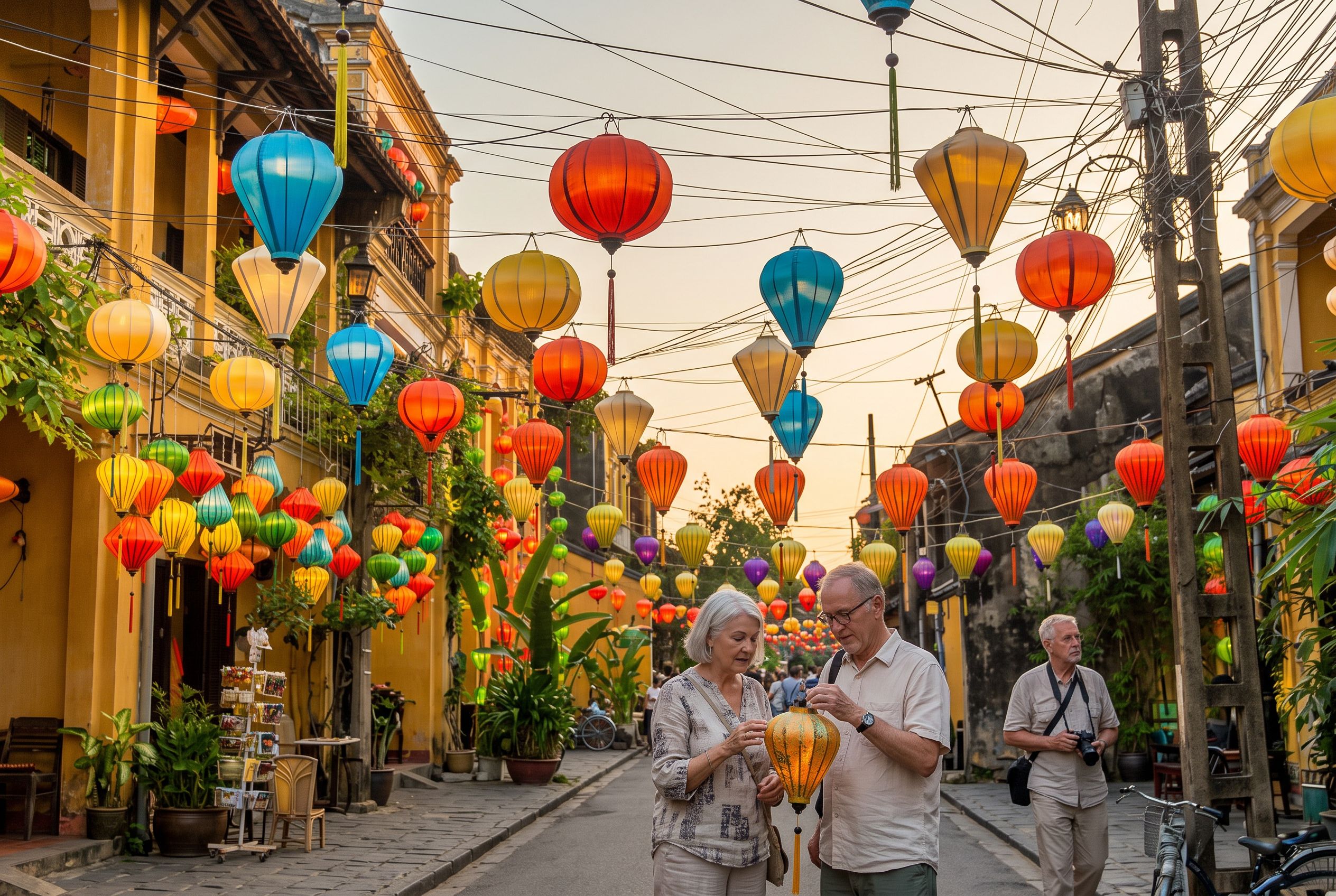
Hoi An's old town keeps a calendar older than any booking site. On the fourteenth day of every Vietnamese lunar month, the evening before the full moon, the electric lights of the Ancient Town are reduced or switched off, motorbikes are kept out of the central streets, and silk lanterns take over. The event is known as Old Town Night, and more widely as the Lantern Festival. It is not a one-off spectacle staged for visitors but a monthly civic ritual that residents observe, and it repeats thirteen times a year.
For travellers in their fifties and sixties, that repetition is the useful part. A single famous date can be missed through weather, jet lag or a delayed flight. A monthly rhythm can be planned around. What follows is how the year actually runs, which nights draw the biggest crowds, how the heat and rain behave, and where a visitor who would rather sit than stand can watch the lanterns in comfort.
What actually happens on a Hoi An lantern night?
The Lantern Festival is a monthly Old Town Night held on the 14th day of the Vietnamese lunar month. Electric lighting in the historic centre is reduced or switched off, motor vehicles are restricted, silk lanterns light the streets, and flower lanterns are floated on the Hoai River.
The published programme runs from roughly 6 p.m. until 10 p.m., with bai choi singing, folk games, street music and lantern-lit lanes. The lights-off window in the Ancient Town is reported as approximately 18:00 to 22:00. Lantern releasing concentrates between 7 p.m. and 9 p.m., when the riverfront is at its busiest.
The floating lantern custom is described locally as a flower-lantern festival. Visitors place candle lanterns on the Hoai River as a gesture associated with wishes, remembrance, peace and good fortune. The lunar full-moon period is also connected with visiting pagodas, burning incense, praying for family wellbeing and honouring deceased relatives.
Two practical rules are documented. Floating lanterns should be released from a boat or the river's edge, not from a bridge. Sky lanterns that rise into the air with a burning flame are prohibited because of fire risk around the Old Town's wooden buildings.
When are the lantern nights in 2026 and 2027?
Published 2026 dates for Hoi An's lantern nights are 2 January, 1 February, 2 March, 1 April, 30 April, 30 May, 28 June, 27 July, 26 August, 24 September, 23 October, 22 November and 22 December. The 2027 dates run 21 January, 19 February, 21 March, 20 April, 19 May, 18 June, 17 July, 15 August, 14 September, 13 October, 11 November and 11 December.
The dates follow the lunar calendar, which is why they drift against the Gregorian one. The 19 February 2027 night is identified as the first full-moon period of that year's calendar.
Two nights carry more weight than the rest. Nguyên Tiêu, the first full moon of the lunar year, is described as the largest lantern night of the year, with particularly important religious and cultural activity; in 2026 it falls on 2 March. Mid-Autumn is the other, and Hoi An's Mid-Autumn Festival is scheduled for 23 to 26 September 2026, with the main full-moon night on 25 September. The monthly lantern night of 24 September 2026 sits inside that programme.
Operators note that programmes and weather-dependent activities can change, and some sources advise verifying the date with a hotel or the local tourism authority shortly before arrival. A stay of several nights around a full moon gives more protection against a calendar or weather mistake than a single booked evening.
 AI-edited
Which lantern night should I choose?
Nguyên Tiêu on 2 March 2026 is the biggest and busiest night of the year. Mid-Autumn, from 23 to 26 September 2026, is the most animated for families. The October and November dates are the quietest, but they fall in the wettest part of the year.
The choice is really a trade between atmosphere, crowd and weather. Nguyên Tiêu delivers the fullest programme and the largest crowds. Mid-Autumn brings lion, unicorn and dragon dances, lantern processions, children's activities and folk performances, and one source describes it as a more substantial celebration than the routine lantern-release activity. The 24 September 2026 night therefore runs with more families and children's programming than an ordinary monthly evening.
At the other end, the November 2026 lantern night is described by one travel source as potentially quieter and atmospheric. That is a travel-source impression, not an official crowd statistic, and should not be treated as a guarantee. The cited material does not publish measured visitor numbers or crowd-density data for Hoi An, and exact crowd levels by month are not documented.
How do the seasons shape the festival year?
January and February evenings suit extended walking better than the hot season, though Tet brings its own travel surge. March and April are often the most comfortable months. May to August turns hot and humid. October and November are quieter and wetter, and December evenings are cooler.
Central Vietnam's monsoon rains can affect outdoor events, swell the river and temporarily interrupt boat activities. The cited material specifically flags October to December as weather-sensitive, and describes February to August as the safer, drier travel window. During the wetter months, boats and floating-lantern activities may be cancelled for safety or operational reasons.
Tet, Vietnamese Lunar New Year, falls on 17 February in 2026 according to the published date. It brings a separate surge of decoration, family observances and holiday travel. Smaller shops and restaurants may close, and transport can be difficult, so accommodation and dining are worth arranging well ahead.
Heat is not quantified in the event sources, and the material does not record age-specific problems with heat, noise, boat boarding or prolonged standing among visitors aged 50 and over. What is documented is that June and July are specifically described as hot and humid, and that walking on stone streets or waiting beside the river becomes more taxing in those months.
| Period | Weather and comfort | Crowd character |
|---|---|---|
| January to February | Comfortable evenings for walking | Tet travel surge; some smaller businesses close |
| March to April | Often the most comfortable window | 2 March Nguyên Tiêu is the busiest night of the year |
| May to August | Hot and humid, especially June and July | Regular monthly crowds |
| September | Warm; Mid-Autumn programme 23 to 26 September 2026 | More families and children than a routine night |
| October to November | Quieter and wetter; boats may be curtailed | Potentially lighter, though not guaranteed |
| December to January | Cooler evenings suit slower walking | International Lantern Festival, 3 to 6 December 2026 |
Where can I watch the lanterns in comfort?
The most comfortable options are a licensed boat from the official boarding point, a riverside restaurant or hotel terrace, or the Hoai River embankment secured before dusk. Bridge viewpoints are the least comfortable at peak release time, and seating and shade on the embankment are not guaranteed.
A licensed boat is described as the most comfortable option for people who prefer to sit while viewing the lanterns, subject to river conditions and the operator's posted fare.
Two defined riverside venues appear in the published Mid-Autumn programme. Hoi An Park at 2 Tran Hung Dao hosts the 7 p.m. lion, unicorn and dragon-dance event. At 106 Bach Dang, music and moonlight performances are programmed. Both offer a fixed location rather than continuous walking through crowded lanes.
The Hoai River embankment beside the Ancient Town is the most direct public viewpoint for floating lanterns, though seating and shade are not guaranteed. The An Hoi Bridge and nearby riverbank form a central launch and viewing point with stalls selling floating lanterns, and congestion is likely at peak release time. Bach Dang riverside is useful for watching the river and street activity, though the pavement may be busy and uneven.
What does a lantern night cost?
Walking through the Ancient Town on a monthly lantern night is described as free, with no separate festival ticket. Entry to old houses, assembly halls, museums and other designated heritage sites is charged separately. Floating lanterns and boat rides carry their own prices.
Published sources disagree on the heritage admission structure. One reports a broader Ancient Town sightseeing ticket of 120,000 VND for international visitors and 80,000 VND for Vietnamese visitors; another reports a newer arrangement of 20,000 VND per individual heritage site. The two readings have not been reconciled. The safest approach is to budget for heritage admission and confirm the current tariff at an official entrance or tourism office on arrival.
Floating candle lanterns are not necessarily included in entry arrangements. A Hoi An operator reports published prices of approximately 5,000 to 40,000 VND, depending on the lantern and seller; that range covers small floating lanterns, not necessarily a full workshop or a large decorative lantern. Street vendors sell small paper lanterns during the festival.
Boat prices vary by duration and operator. A 45-minute river boat is reported at approximately 120,000 to 200,000 VND. One travel publication reports a typical 20-minute ride at 150,000 VND for one to three people or 200,000 VND for four to five, and advises using the official boarding point and checking the posted price rather than negotiating with touts. No single authoritative fare schedule is published, so treat all of these as indicative and confirm before boarding.
Monthly lantern nights have food stalls and restaurants around the Ancient Town and riverfront. No official festival-wide menu or fixed price list is documented. For a closer look at where to eat well in town, our guide to Hoi An hotels worth booking for the food covers the dining side in its own right.
How crowded and how accessible is it?
The Hoai River frontage and lantern-release areas are busiest from about 7 p.m. to 9 p.m. The Ancient Town is busiest during the evening programme, particularly at lantern release and during performances. No comprehensive step-free accessibility map, wheelchair route, seating inventory or official festival accessibility policy is published for the Ancient Town.
What is documented is that motor vehicles are restricted in the historic centre during the event, with core streets including Tran Phu, Nguyen Thai Hoc, Bach Dang and Le Loi named in event information. Pedestrian-only arrangements may reduce vehicle risk while making longer walking distances unavoidable. That is a practical inference from the published street restrictions, not a documented municipal accessibility standard.
The historic streets can be crowded, narrow and uneven. Those details are not documented and should be confirmed directly. the available material does not state steps, ramps, lifts, accessible toilet provision, rest points, wheelchair suitability or senior admission prices for any named attraction.
For reduced mobility, the practical route is to request written confirmation from your accommodation and chosen restaurant about step-free access, toilet facilities, seating and the route to the riverside. Do not assume that a heritage house or a boat is accessible merely because it is open to festival visitors. Our companion piece on health, vaccinations and peace of mind in Hoi An deals with the medical side separately.
What should I wear and bring?
No formal dress code is prescribed for Hoi An's lantern nights. Light, breathable clothing suits the hot months, a light rain jacket or compact umbrella helps from October through November, and stable closed-toe footwear is sensible because walking surfaces may be uneven and crowded.
- Carry a small torch or use a phone light when leaving the brightly lantern-lit areas.
- Bring cash for food, lanterns and small purchases.
- Carry only a small bag; crowded riverfront areas are awkward for larger luggage.
- For temples and heritage interiors, modest shoulders and knees are the safest choice.
These are practical recommendations rather than published Hoi An festival rules. The event sources do not prescribe a dress code for the festival itself.
What else happens in the Hoi An year?
The first Hoi An International Lantern Festival is scheduled for 3 to 6 December 2026 in and around the Ancient Town, including Hoai River Square, the An Hoi Sculpture Garden, the Hoai River and nearby streets. Its installations are expected to remain in place through the first full-moon festival of 2027.
The announced programme includes an opening performance involving land and water, approximately 15 large-scale lantern installations, lantern-making experience areas, local culinary spaces, heritage and handicraft exhibitions, and artistic and cultural programmes. For visitors in December 2026 or January 2027, that display adds a lantern attraction beyond the ordinary monthly festival.
The seventh lunar month is associated with honouring parents and ancestors, and the August 2026 celebration is described as especially significant in Hoi An. The first full-moon celebration after Tet, Nguyên Tiêu, carries the heaviest religious and cultural activity of the year.
Elsewhere in the calendar, the Japanese Covered Bridge (Chùa Cầu) reopened to visitors in 2025 after a 19-month restoration. It sits at the centre of the lantern-lit Old Quarter and is one of the town's busiest photographic landmarks. Quảng Nam has proposed an overall restoration programme for the ancient town and associated relics, estimated at VND1.67 trillion for 2030 to 2035, which reflects continuing concern about deteriorating buildings and inappropriate alterations to historic houses. A Da Nang to Hoi An urban railway is proposed but not yet operating.
For a wider look at how to shape a stay around these dates, our five-day Hoi An itinerary for the over-50s sets the festival alongside the rest of the town. If you would rather base yourself outside the busiest lanes, a closer look at Four Seasons Resort The Nam Hai, Hoi An covers a coastal option in detail.
How should I plan the evening itself?
Book accommodation well before a major night, choose a room away from the road, market and riverfront entertainment if sleep matters, and plan to eat earlier rather than later.
Guest reviews of Hoi An properties, treated as first-hand reports rather than verified testimony from travellers aged 50 and over, point consistently at noise as the variable that decides whether a festival night ends well. Reviews of properties near the markets and entertainment areas describe exposure to crowds, traffic, horns and street activity. Guests at one Old Town property describe it as quiet despite being a short walk from the night market; others report road noise beginning around 5 a.m. and housekeeping activity from around 6:30 a.m.
Bathroom design is the second recurring theme. Reviews across several properties mention shower entries requiring a step, slippery floors on entering or leaving the shower, and deep tub and shower combinations that may be difficult for guests with mobility limitations. A listing that says "walk-in shower" does not guarantee a fully accessible bathroom. Ask specifically for a lift-accessible route, a no-step shower and a non-slip bathroom floor, and request confirmation in writing.
Breakfast timing matters after a late lantern evening. Reviews of one property describe the breakfast room as busy near closing, with seating needing to be rearranged, and another reports items not replenished before the 10 a.m. close. Going earlier is the simpler answer. For light sleepers, a rear-facing room, a higher floor or a hotel outside the busiest streets is the safer choice, though that is an inference from reported room-level differences rather than a claim about every festival night.
Finally, a note on expectations. Visitors arriving on a non-full-moon night may still see lantern sellers and boat rides, but should not expect the distinctive atmosphere created by the lights being switched off. Ordinary lantern releases are described in forum accounts as a constant tourist attraction, and one contributor notes that Hoi An can feel like a carefully managed destination even while enjoying it. The full-moon evening is the version worth planning around.


