
Hoi An's kitchen is small and specific. The town is known for a handful of dishes that are made here and rarely taste the same anywhere else: cao lầu, white rose dumplings, cơm gà, mì Quảng and the filled baguette that made the town famous. For food-minded visitors in their fifties and sixties, the pleasure is that almost all of it sits within a walkable heritage district, and the prices are gentle. The practical challenge is different: knowing which dishes to order, which addresses are worth the queue, and how to eat well when the pavements are uneven and the evenings are crowded.
This guide covers the central Vietnamese specialities, the market stalls and family kitchens where they are served, and what a cooking class adds. Restaurant dining at the top end of the market is covered separately in our high-end restaurant guide, and hotel dining has its own dedicated article.
Which dishes define Hoi An?
Five dishes carry Hoi An's reputation: cao lầu, white rose dumplings, cơm gà Hội An, mì Quảng and bánh mì. All five are widely available in and around the Ancient Town, most cost a few tens of thousands of dong, and the best versions tend to be found at small, busy, single-speciality kitchens rather than at all-purpose restaurants.
Cao lầu is the dish most closely tied to the town. It is a dry noodle dish rather than a soup: thick, chewy noodles with slices of pork, herbs, greens, crispy pork skin and only a small amount of broth or sauce. Tourism information cited in recent Hoi An food coverage describes it exactly that way, with char siu pork and a modest quantity of sauce. Its distinctive preparation is associated with Hoi An water and with noodles made locally. A recorded travel summary calls it "a unique noodle dish."
White rose dumplings (bánh bao bánh vạc) are delicate steamed rice-flour parcels, usually filled with seasoned shrimp or pork and topped with fried shallots. Fodor's describes them as shrimp-filled dumplings and identifies the White Rose Restaurant as the production source supplying restaurants around town. They suit lunch or an afternoon snack rather than a main meal.
Cơm gà Hội An is the town's chicken rice: shredded chicken, turmeric-coloured rice, herbs, onion and a light broth. Mì Quảng, a regional dish from Quảng Nam rather than a Hoi An exclusive, uses broad rice noodles with a small quantity of intensely flavoured broth and toppings such as pork, chicken, shrimp, herbs and peanuts. Bánh mì is the fourth pillar, and the Hoi An version is known for a thin, crisp baguette with generous fillings, pickled vegetables, herbs, pâté, pork, egg or chicken, and a house sauce.
 AI-edited
Where should you actually eat?
The most reliable strategy is to match the dish to the address. Cao lầu and market snacks belong at Hội An Central Market; bánh mì has three competing addresses; chicken rice has one classic name; and the dumplings are best eaten fresh in town. Prices vary by shop and date, so treat every figure as indicative.
Cao Lầu Bà Bé, inside Hoi An Central Market, is reported at roughly 15,000–30,000 VND per bowl, with cash payment and approximate market hours of 7:00–19:00. Cao Lầu Thanh, Cao Lầu Bá Lễ and Cao Lầu Không Gian Xanh are also repeatedly recommended by food guides and traveller listings; Wanderlog describes Cao Lầu Thanh as authentic, clean and highly rated, while Bá Lễ is noted for handmade noodles.
For bánh mì, the market divides. Bánh Mì Phượng at 2B Phan Châu Trinh is the best-known address, made internationally famous after Anthony Bourdain featured it; Will Fly for Food records his description of the sandwich as a "symphony of a sandwich." Madam Khánh – The Bánh Mì Queen at 115 Trần Cao Vân is the principal alternative, and a September 2025 food account on Substack described it as a leading bánh mì destination in Central Vietnam. The same account argued that Phượng's standards had suffered under heavy crowds after its fame increased.
Published prices vary by shop and date, but a Hoi An food guide gives approximately 20,000–35,000 VND per bánh mì sandwich. Guest reviews of Bánh Mì Phượng commonly cite 25,000 to 50,000 VND, with cocktails around 60,000 VND; these are review figures rather than a published rate card.
How do the market food stalls work?
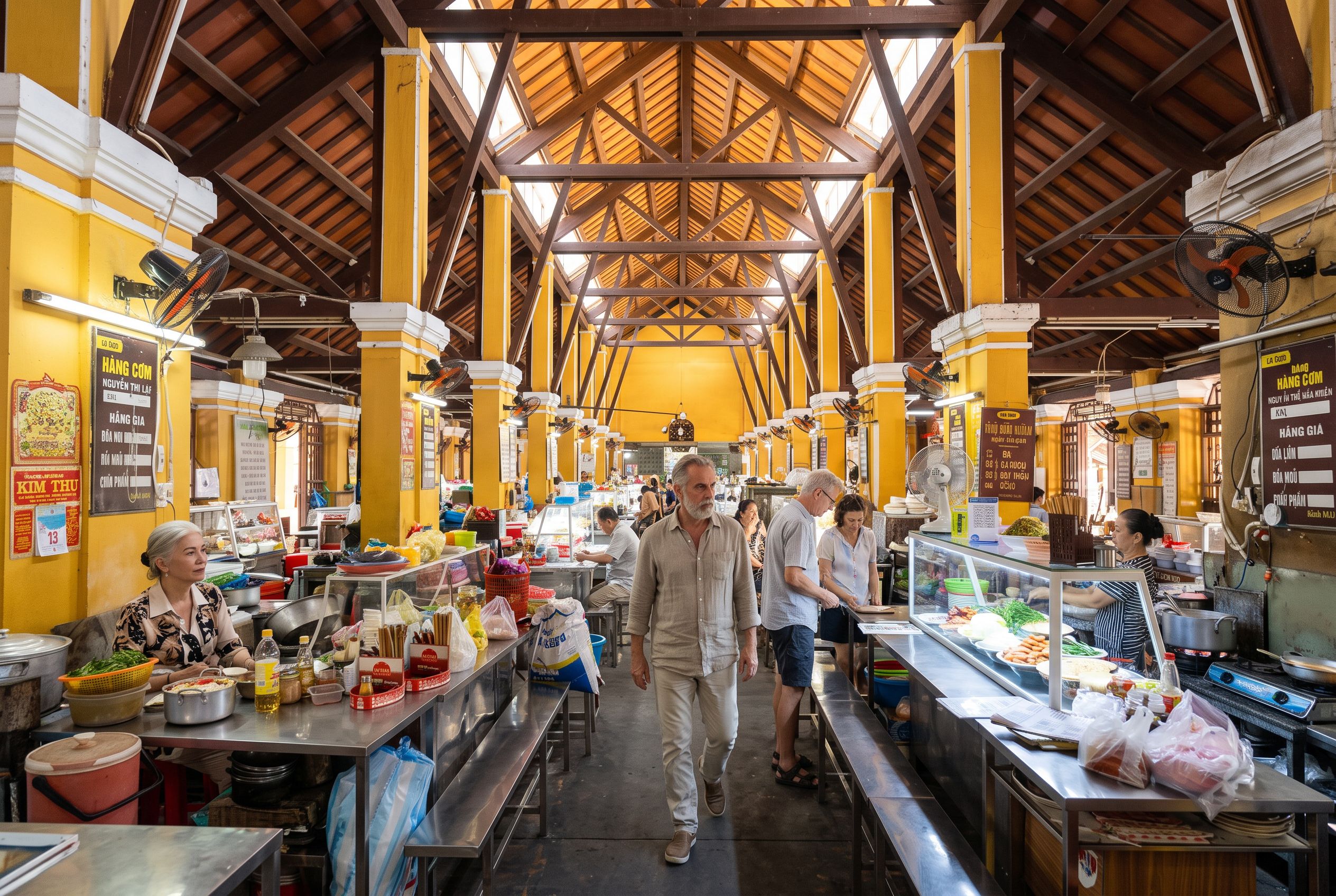
Hội An Central Market on Trần Phú is the single most concentrated place to eat local food. Tourism information cited in a recent Hoi An food guide identifies cao lầu, cơm gà, bánh đập and white-rose dumplings there. It is a working market, not a food hall, and the calmest documented period for walking and eating is early morning.
The Ancient Town is a functioning district with cafés, restaurants, shops and a market, and the market and riverside dining areas sit within the active heritage district. Beyond the market itself, the best browsing is around the riverside and the Old Town evening market after sunset, at food stalls and small family restaurants just outside the most heavily visited lanes, and around the Bánh mì Phượng area, where queues are constant but fast-moving.
Cam Nam is recommended for bánh đập and hến trộn, the grilled rice crackers broken over soft rice paper and served with clam salad. Fresh seafood is practical around the coast and at nearby beach districts, though it is not unique to Hoi An.
Local kitchens versus tourist spots: what is the difference?
The distinction is less about quality than about format. Family kitchens outside the busiest lanes tend to serve one or two dishes done well, at lower prices and with more chance of a seat. Tourist-facing addresses trade on reputation, run queues and, in the case of Bánh Mì Phượng, offer indoor seating across two floors where diners can skip the takeaway line.
Recorded travel material notes that parts of the Old Town can feel touristy, and a 2025 Reddit travel report found the night-market area across the river particularly overwhelming, with bright lighting and persistent vendors. The same report described the food there as somewhat repetitive unless visitors seek out street food and vegetables. That is a useful steer rather than a warning: the eating improves as you move away from the riverfront at peak hours.
For breakfast, Hoi An It recommends mì Quảng or cao lầu before 09:00, when the broth is fresh and the Old Town is relatively quiet. A Fodor's guide recommends wandering Hoi An's alleys for noodles, dumplings and fruit, while a Reddit food-tour report describes moving among many street stalls away from the tourist zone.
Two long-standing addresses deserve a note. Cơm Gà Bà Buội on Phan Chu Trinh is frequently identified as the classic chicken-rice address; a 2026 Hoi An guide reported unreliable opening and weak recent visitor ratings at number 22, so this should be treated as a current practical caution rather than a confirmed closure. Mango Rooms had moved from its frequently published former address at 111 Nguyen Thai Hoc to 37 Phan Boi Chau, according to a 2026 guide, so older food guides should be checked before setting out.
Is Bánh Mì Phượng worth the queue?
Guest feedback suggests the queue moves faster than it looks, and that sitting down inside is the practical workaround. As of October 2026, Bánh Mì Phượng holds a Google rating of 4.3 out of 5 from 16,788 reviews. Reviewers describe waits of roughly 5 to 20 minutes even when the line appears long.
Reviewers consistently describe the baguette as crispy outside and soft inside, with well-balanced fillings and a house sauce and pâté that many single out as the defining feature. Seating is available indoors across two floors, including an upstairs area that reviewers describe as breezier and less crowded than the street. Several note that diners can skip the takeaway queue by sitting down inside, where staff take orders at the table and food arrives quickly. Staff are repeatedly described as fast and efficient at managing the queue.
Reviewers note the shop is open from 6:30 am to 9 pm and that arriving before 8 am avoids the longest queues. Payment is taken at the time of ordering, with both cash and card accepted, and separate lines exist for ordering and collecting takeaway.
"Both were packed with flavour and lived up to the hype. After ordering, you'll receive a receipt with a number. Just stay nearby and listen for your number to be called for collection." (Google, July 2026)
One planning point sits outside the reviews. Bánh Mì Phượng reopened on 17 December 2023 after the shop at 2B Phan Chu Trinh was suspended for three months in September 2023 following a salmonella outbreak affecting hundreds of people. It has been reported as operating normally since, and the incident remains relevant for visitors deciding whether to queue at this address.
Alternatives are well documented. Phi Bánh Mi was described on Reddit as inexpensive, tasty and friendly, with one contributor specifically praising its vegetarian bánh mì, though it was also described as tiny and opening according to the owner's work schedule, so it should not be treated as a dependable fixed-hours stop without checking locally. Madam Khánh's own listed hours have been reported as 6:30–19:00, although map listings may show later hours; confirm locally before an evening visit.
What does a cooking class add?
A class solves the two hardest problems for a first-time visitor: identifying which stall to trust and understanding how a dish is meant to be assembled. The clearest practical preference in the available reports is to use a guided food tour rather than to worry about choosing stalls independently.
The cited sources do not document operator-run cooking classes for the exact Ancient Town heritage system, so class availability, duration and price should be confirmed directly with the school or your accommodation rather than assumed.
For those who prefer to eat rather than cook, the etiquette is straightforward. Lime, chilli paste and fresh chilli are commonly added at the table, so ask for chilli separately if you prefer a milder meal. Pho is not Hoi An's defining dish, but the usual manners apply: taste the broth before adding anything, add herbs, lime, chilli or bean sprouts gradually, use chopsticks for noodles and a spoon for broth, and ask staff if you are unsure whether a table condiment belongs in the soup.
When is the best time to eat your way around Hoi An?
February to April is the most consistently recommended window, with moderate temperatures, lower humidity and limited rain. Early morning is the documented calmest period for both walking and eating. October and November carry the greatest practical risk of flooding, which can close premises and reduce street-food activity.
The climate pattern is a tropical monsoon one. January is the coolest part of the year, with an average high around 24°C and a low around 18°C, and rain tapering but conditions still damp. February brings the start of the dry season. March is one of the driest and most comfortable months, generally warm and suitable for walking and food tours. June is the hottest month in the cited climate data, with an average high around 34°C and a low around 26°C. September sees rain increase sharply, and October is one of the wettest months.
VnExpress International reported that heavy rain associated with Storm Fengshen in October 2025 produced knee-deep flooding in Hoi An's old streets, closed shops and turned roads into waterways. During exceptionally wet weather, expect temporary restaurant closures, difficult walking conditions and reduced street-food activity. Our guide to coping with the heat and humidity in Hoi An covers how to structure a day around the temperature.
One further change is worth watching. VnExpress International reported plans to remove tables, food carts, bicycles selling grilled snacks and other vendor activity from sidewalks in the ancient town. If enforced, this could reduce informal eating and make some busy food streets feel less crowded, but the report does not establish a final implementation date.
What should older travellers plan for?
Cobblestones and uneven surfaces are reported in parts of the Minh An area, which can make wheelchair and walking-aid use difficult. Verify seating, toilet access and distance before setting out.
Motor vehicles are restricted in the Ancient Town during designated daytime hours, so visitors generally walk or cycle between the Japanese Covered Bridge, assembly halls, riverside and food streets. For market and street-food visits, request a vehicle drop-off on a main road, use a walking aid suited to uneven paving, and confirm seating and toilet access directly with the restaurant. A comprehensive official accessibility inventory for Hoi An's food venues is not documented. Our article on how accessible Hoi An is for older travellers goes into the detail.
On health, two pharmacies are documented within Hoi An. Dapharco BLU at 684 Hai Bà Trưng, Minh An Ward, lists hours of 7:30 a.m.–9:30 p.m., according to Quảng Nam tourism's health information. Long Châu Pharmacy has branches at 509 Cửa Đại, Phong Sơn Ward and 105 Nguyễn Thị Minh Khai, Cẩm Phô Ward, with listed hours of 7:00 a.m.–10:00 p.m. Pacific Hospital at 6 Phan Đình Phùng Street lists emergency service as available 24 hours in a published medical-facilities directory. Hoi An Hospital at 4 Trần Hưng Đạo Street has routine outpatient hours and can be reached on 0235 3914 660. Quảng Nam's tourism information advises seeking hospital or clinic care for high fever or serious illness and notes that travellers may prefer larger English-speaking medical services in nearby Da Nang for complex cases.
Emergency numbers for Vietnam are 113 for police, 114 for fire and 115 for medical emergencies. For urgent transport to medical care, Quảng Nam tourism information says a taxi may be faster than waiting for an ambulance and gives Mai Linh Taxi's dispatcher number as +84 (0)235 3929 929. Published visitor guidance recommends ordinary precautions in crowded markets and tourist areas, including awareness of pickpocketing, and avoiding isolated walking routes at night.
If you are combining eating with other errands in town, our practical guide to having clothes tailored in Hoi An covers the fitting schedules that most often collide with meal times, and the quietest hotels around Hoi An is useful if street noise is a concern for early nights.
What should you avoid, and what is not documented?
No reliable Hoi An-specific source documents a definitive list of foods visitors should avoid. The sensible precautions are general ones: choose high-turnover stalls, prefer food cooked in front of you and served hot, and be cautious with raw garnishes, untreated water and ice where hygiene is unclear.
During the rainy season, check local conditions before eating or travelling through low-lying Old Town areas, since flooding can affect streets and premises. Individual restaurants, stalls and markets may close for holidays, renovation or family reasons, but no reliable city-wide schedule of food-market closure days is documented.
Several details that older travellers often ask about are simply not published. The material does not document senior or over-65 fares for Hoi An food attractions, a city-wide senior discount or reduced tariff, a universal food-market pass, standard maintenance closures for the city's food venues, or a fixed annual closure season for Hoi An restaurants or markets. Conditions at individual food venues are not documented either. These details must be checked directly with the specific restaurant, market or cooking school. Exact walking times between the named eateries are not documented.
What is documented is the shape of a good day. Start early, eat the dish the address is known for, keep the market as your anchor, and leave the famous bánh mì queue for before eight in the morning. The town rewards that rhythm.


