
Lake Como’s great villa gardens are its quiet masterpieces—places where the art of horticulture meets the drama of the Italian lakes. For travellers aged 50 to 70, these estates offer a slower, more deliberate kind of beauty: shaded avenues, terraced blooms, and the soft lapping of water against ancient stone. But each garden has its own character, its own demands on the legs, and its own ticketing quirks. This guide cuts through the noise to tell you exactly what to expect underfoot, when to go, and how to make the most of your time among the camellias and cypresses.
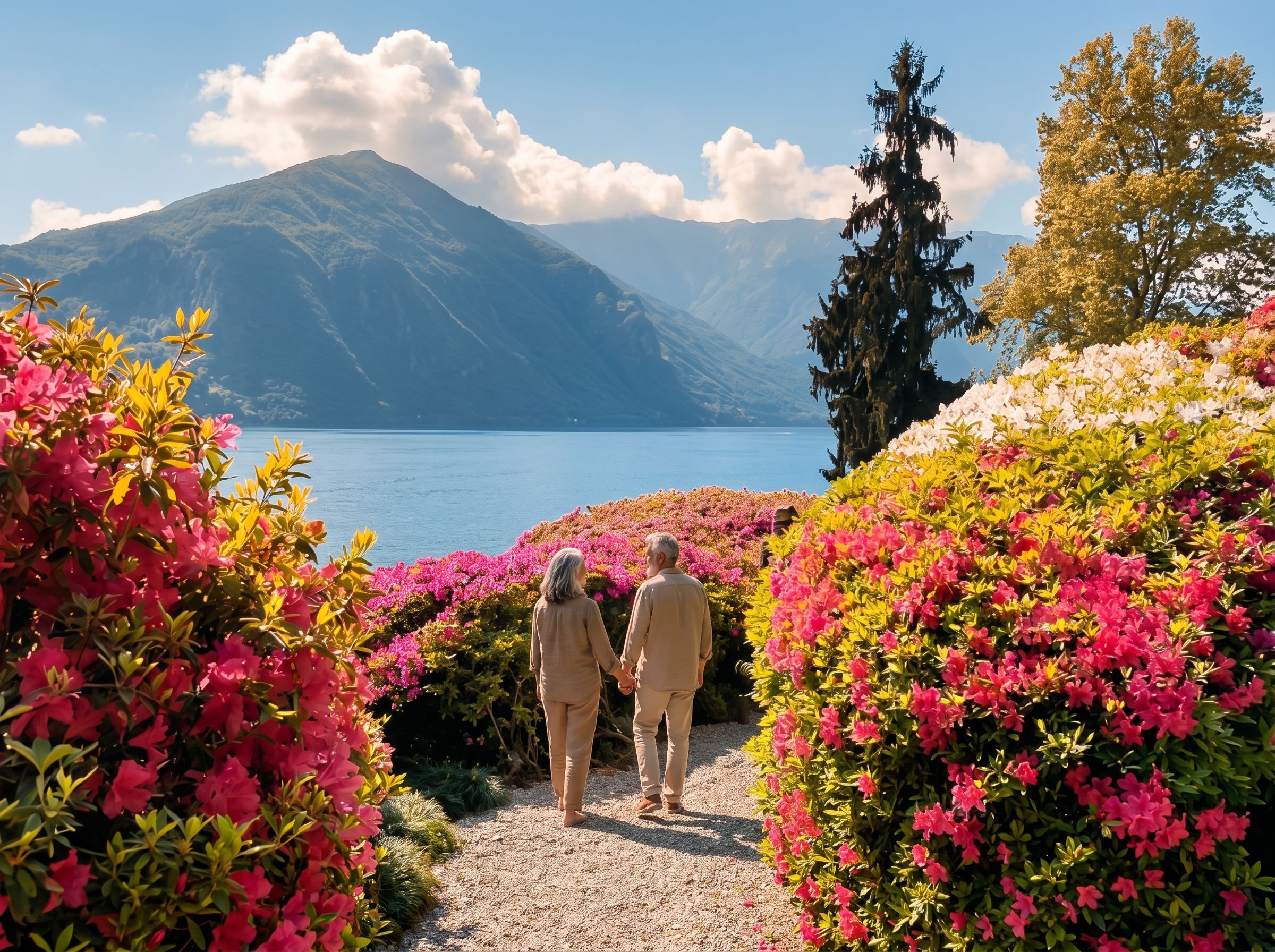 AI-edited
Which garden is easiest underfoot?
Villa Carlotta in Tremezzo is the gentlest of the four: the villa describes almost the whole garden as accessible to visitors with disabilities, helped by two lifts in the grounds and a gravel-stabilising surface in the avenues, but it also names several uphill paths. Villa Melzi in Bellagio runs a close second on compacted gravel.
Villa Carlotta’s botanical garden covers eight hectares, and its main avenues are broad and laid with a gravel-stabilising surface. The rhododendrons come earliest: the villa dates their full bloom to between mid-March and mid-April, and the azalea collection that made the garden famous worldwide follows through the spring. According to the official villa website, the museum interiors are self-guided, with maps available at the ticket desk. For those who prefer to sit and absorb, benches dot the lawns beneath century-old plane trees and sequoias. The landing is called Tremezzo – Villa Carlotta and the villa puts it 400 metres from the entrance, along the lakeside road. One caveat: Navigazione Laghi names this pier among those that are not easily accessible for wheelchair users and passengers with reduced mobility, so ask the crew for help with the gangway. Even so, Carlotta remains the clear choice for a morning that prioritises ease over exertion.
Villa Melzi’s gardens, open from late March to the end of October, are the kindest of the four to the knees — though not level: the Regione Lombardia describes the surface as compacted gravel, not as step-free. The path follows the Bellagio shoreline past a lily pond planted with Japanese maples and a blue-and-white Moorish kiosk that reaches out over the water. The ticket is the cheapest of the four at €10 as of 2026, needs no booking and is sold at the gate on the day of the visit; it covers the chapel and the museum in the former orangery. The trade-off? The gardens are smaller than Carlotta’s, and the villa itself is private and closed to visitors. But for a quiet hour with a view of the lake, it is hard to beat.
How do I get to Villa del Balbianello without a strenuous walk?
Take the taxi boat from the Lido di Lenno. Bellagio Boat Service charges €9.90 per person each way as of August 2026 and runs it to fixed departure times, so book it before you travel. The alternative is the walk the FAI itself describes: one kilometre uphill, partly gravel, about 25 minutes, and expressly unsuitable for anyone with walking difficulties.
Villa del Balbianello, perched on a wooded promontory near Lenno, is the most dramatic of the lake’s villa gardens—and the most challenging to reach. The FAI puts the walk from Lenno at one kilometre uphill, partly gravel, about 25 minutes, with a longer trekking route of 2.5 kilometres taking around 45 minutes — and states plainly that neither suits pushchairs or visitors with walking difficulties. For many travellers over 50, that is the difference between a pleasant outing and an exhausting one. The alternative is the taxi boat from the Lido di Lenno, operated by Bellagio Boat Service rather than by the FAI. As of August 2026 it costs €9.90 per person each way, runs to scheduled departure times and must be booked in advance; you are asked to be at the pier ten minutes before your slot. There is also a third route that few visitors know: with advance notice you may be driven by car along the historic park road to the ticket office at the entrance, after which your companion moves the car to the public car park.
One important note: Villa del Balbianello is closed on Mondays and Wednesdays. Double-check the FAI calendar before building your itinerary. For more on planning your base, see our guide to Where to Stay on Lake Como When Comfort Comes First.
What are the opening seasons and ticket prices?
| Villa | 2026 Season | Adult Ticket | Senior Discount | Booking Required? |
|---|---|---|---|---|
| Villa Carlotta | March 20 – November 8, plus winter dates | €17.50 | €15.00 (65+) | No, but recommended |
| Villa del Balbianello | March – January, closed Mon and Wed | €15 (park only) | None; free for disabled visitor + companion | Yes, mandatory online |
| Villa Melzi | Late March – end of October | €10 | None listed | No |
| Villa Monastero | Open all year, hours vary by month | €13 garden, €15 with Casa Museo | €10 / €11 (65+) | No |
Two of the four cut their price for over-65s. As of the 2026 season, Villa Carlotta charges €15.00 instead of €17.50 on presentation of an identity card; Villa Monastero charges €10.00 instead of €13.00 for the botanical garden, or €11.00 instead of €15.00 with the Casa Museo. Villa del Balbianello has no age-based reduction, but a visitor with a disability and one companion enters the park free and pays €5 each for the villa tour — and at Villa Monastero the same pair enters free with priority access, no queue. As of 2026, Balbianello's park-only ticket is €15, against €25 for the park plus the compulsory 50-minute guided tour of the interiors. Villa Monastero's botanical garden runs about two kilometres from Varenna to the hamlet of Fiumelatte, which makes it the longest of the four walks rather than the easiest.
How accessible are the villa gardens for those with mobility concerns?
Villa Carlotta and Villa Monastero document the most help: two lifts in Carlotta’s grounds and a lift to its museum, an electric shuttle and free entry for disabled visitors at Monastero. The FAI calls Balbianello partially accessible. None of the four is level, and Villa Melzi is gravel throughout.
Accessibility varies significantly across the four villas. Villa Carlotta writes that most areas of the park are accessible to people with impaired mobility, helped by two lifts in the garden and a gravel-stabilising system in the avenues, and that the museum is reached by lift — not that it sits on one level. Mobility scooters and electric wheelchairs are admitted, and accessible toilets are placed along the visitor route and at the cafeteria; several of the paths, the villa also says, run uphill. At Villa Melzi the surface is compacted gravel rather than a level promenade, and the grounds are compact enough to cover in an unhurried 45 minutes.
Villa del Balbianello presents more of a challenge, and the FAI is unusually precise about it. Every path inside the park has a gradient and is partly gravelled; a threshold has to be crossed to enter the villa; the Durini Loggia is reached by a staircase. Against that, the lift inside the villa has a cabin that takes a wheelchair comfortably and serves three of the six levels, the Segrè Loggia has no steps at all, there are accessible toilets both in the Segrè Loggia and beside the dock, benches stand throughout the park and folding chairs are kept inside the villa. The FAI asks wheelchair users to contact the site in advance. For a full breakdown of mobility-friendly logistics, see our Lake Como for Travellers Over 50: The Complete Guide.
Villa Monastero’s garden runs for about two kilometres along the Varenna shoreline, and the operator is candid about what that means. An avenue drops away at the garden entrance and has to be walked back uphill; there are steps in the second half; the ground around the house and the cafeteria is gravel; and some parts of the botanical garden are not accessible to disabled visitors at all. What the villa does provide is a small electric shuttle for visitors with reduced mobility, which covers the first stretch from the ticket office to the Casa Museo and the cafeteria and back and can carry a wheelchair; it can be requested on arrival at the ticket desk. The Casa Museo itself has lifts.
What should I see at each garden beyond the flowers?
Each villa offers a distinct character that rewards a focused visit. At Villa Carlotta, the museum houses sculptures by Antonio Canova, including the celebrated Palamedes, and a collection of neoclassical plaster casts. The gardens themselves are the main event: a rhododendron valley, a bamboo grove, and a sequence of terraced flowerbeds that change colour with the seasons. Allow 90 minutes to two hours.
Villa del Balbianello is famous for its cinematic pedigree—it appeared in Star Wars: Episode II and Casino Royale—but the real draw is the loggia, a covered terrace that frames the lake like a painting. The gardens are compact but layered, with box hedges, wisteria, and a lemon house. The guided interior tour (book ahead) shows you the rooms where explorer Guido Monzino lived and planned expeditions.
Villa Melzi is quieter and more intimate. The garden features a Moorish-style kiosk, a small chapel, and a collection of statues along the lakefront. It is also the least reviewed of the four — 5,811 Google ratings in August 2026, against 9,528 for Villa Monastero, 12,421 for Villa Carlotta and 12,688 for Villa del Balbianello — which is part of why it still reads as contemplative rather than crowded. Villa Monastero in Varenna combines a botanical garden with a museum of furnished rooms that retain their original 19th-century character—think carved wood beds, frescoed ceilings, and a grand piano in the salon.
“Of all the villas we visited this was our favourite — the gardens and the grounds were immaculate. Keep in mind if you’re visiting there is a lot of elevation to climb. They make it very easy by providing signs for a short or longer walk, and continue to provide signs to help you know how much time is left. Overall it was a breathtaking experience in a peaceful garden setting right alongside beautiful Lake Como.” — one Google reviewer on Villa Carlotta, May 2026
When is the best time to visit the gardens?
May and June are the ideal months for the azaleas, with average daily highs of 20°C and 25°C and the summer crowds still to come — though both are also the wettest months of the year. For the rhododendrons at Villa Carlotta you need mid-March to mid-April. September and early October bring autumn colour and thinner crowds.
Thirty years of reanalysis for Tremezzina in the Copernicus ERA5 archive (1995–2024) put the average daily high at 20°C in May and 25°C in June — and the rain at roughly 150mm in April, rising to about 180mm in May and June. Spring on this lake is green because it is wet, so pack for a shower. July and August average 26°C by day, with the thermometer passing 30°C on roughly one day in ten; the ferries are full, and the villa gardens feel less like sanctuaries and more like queues. If you must travel in summer, be at Villa Carlotta when it opens at 10am and leave by early afternoon.
Winter is not a closed season here. Villa del Balbianello opens from March to January, every day except Monday and Wednesday, with reduced hours from November (10am to 5pm, last entry to the park at 4pm). Villa Monastero keeps its botanical garden open all year, at 10am to 5pm in the winter months. Villa Carlotta adds scattered winter dates of its own in November, December and February. The gardens are less colourful, but the views of the snow-capped Alps across the lake are a worthy trade-off. For a broader look at seasonal logistics, read our Day Trips Worth Making from Lake Como guide.
How do I get between the villas by ferry?
| Route | Ferry Type | Travel Time | Frequency |
|---|---|---|---|
| Bellagio → Tremezzo (Villa Carlotta) | Slow passenger ferry | 15 minutes | Every 30–60 min |
| Bellagio → Lenno (Villa del Balbianello) | Slow ferry or hydrofoil | 20–30 minutes | Every 30–60 min |
| Varenna → Bellagio (Villa Melzi) | Slow ferry | 15 minutes | Every 20–30 min |
| Varenna → Tremezzo (Villa Carlotta) | Slow ferry | 25 minutes | Every 30–60 min |
Navigazione Laghi runs the public ferry network. As of July 2026, the slow passenger ferry is the only service that stops at Tremezzo for Villa Carlotta; the faster hydrofoil bypasses it. For Villa del Balbianello, take the ferry to Lenno, then transfer to the taxi boat. On the tariff sheet in force since April 2026, the one-day free-circulation pass covering Bellagio, Varenna, Tremezzo and Lenno costs €17.50 for adults and €14.00 for travellers over 65 from Monday to Friday, weekends and public holidays excluded—a worthwhile investment if you plan to visit two or three villas in one day. It is also valid on the fast service, provided you pay the €3.00 supplement.
One practical note: the ferry schedule changes seasonally and is posted at each dock. Pick up a paper timetable at the Bellagio or Varenna ticket office. Navigazione Laghi also marks recommended crossings with a symbol on the timetable boards and in the pocket timetables — those are the sailings best suited to carrying wheelchair passengers, and worth looking for before you queue.
What local traditions and food should I look for near the villas?
After a morning in the gardens, seek out a lakeside trattoria serving risotto with perch (risotto al pesce persico) or missoltini—salted, dried agone fish that is a signature of the Larian culinary tradition. The Sagra del Missoltino, run by the Pro Loco of Mezzegra in the Tremezzina, celebrates this ancient preserving method each August.
The villas sit within a region rich in food traditions that reward a slow, deliberate approach. Varenna’s big summer night is the Festa del Lago in the Giardini di Olivedo, run by the local Pro Loco; the 42nd edition falls on 3 and 4 July 2026 and closes with a re-enactment of the historic landing and a firework display over the water. Further down the lake, the Sagra di San Giovanni runs on 27 and 28 June 2026 around Isola Comacina and Ossuccio — in the municipality of Tremezzina, not in Como itself — with a solemn procession carried across to the island by boat. For a quieter experience, visit a trattoria in Bellagio or Menaggio and order polenta uncia—polenta with melted butter and mountain cheese, a dish that embodies the region’s alpine-lake duality.
For those interested in wellness and recovery after a day of walking, our guide to The Best Spa Hotels on Lake Como offers recommendations for properties with thermal pools and massage services near the villa circuit.
The villas and gardens of Lake Como are not about ticking boxes. They are about finding a bench in the shade, watching a bumblebee work its way through a hydrangea, and letting the afternoon unfold at its own pace. Choose the garden that matches your energy, book ahead where required, and leave room for the unexpected—a sudden view, a passing ferry, a conversation with a fellow traveller on the dock.


