
Lake Como has a reputation for glamour, but its real gift to the traveller aged 50 to 70 is something quieter: the chance to stroll at water level, breathe in the alpine air, and watch the light shift across the lake without breaking a sweat. The secret is knowing which paths stay flat, which terraces require no climbing, and where to find a bench when your legs ask for a rest. This guide maps out the best easy walks and no-climb viewpoints, with distances, surfaces, and the practical details that matter when your priority is strolling, not exertion.
 AI-edited
Which lakeside walk is flattest and most accessible?
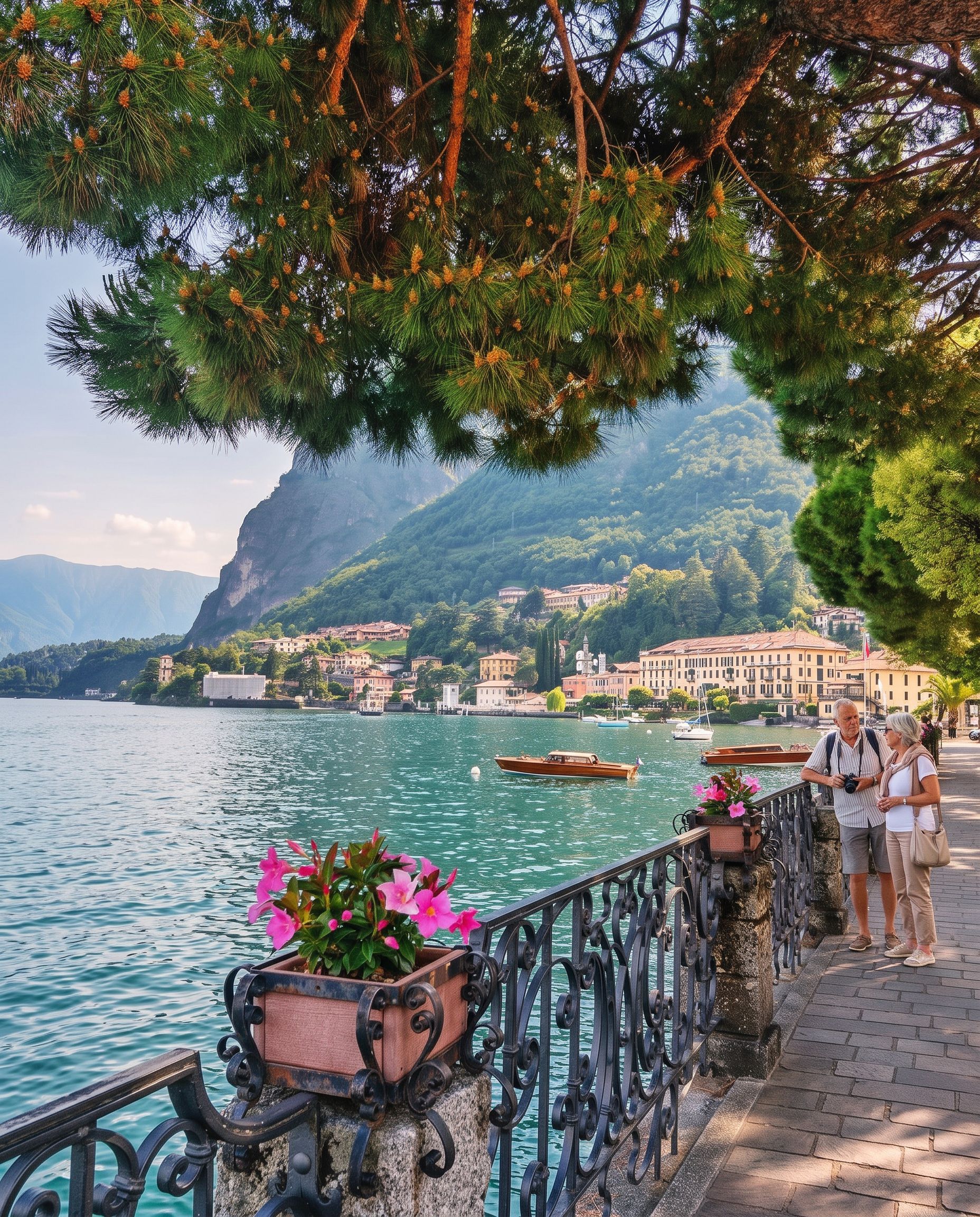
Menaggio's waterfront is the easiest place to start a level lakeside stroll, running from the ferry pier along the shore into the pedestrian centre. Menaggio is one of five Lake Como towns on the Regione Lombardia's accessible-tourism itinerary, alongside Como, Lecco, Bellagio and Varenna, and its access conditions were checked on site by accessible-tourism specialists.
Menaggio’s promenade runs from the ferry dock past the Grand Hotel Victoria Concept & Spa, which stands at Viale Benedetto Castelli 7, about 100 metres from the pedestrian centre. Bellagio and Varenna are stages of that same regional itinerary, so treat Menaggio as the gentlest of several checked options rather than the only one. Minigolf Menaggio sits directly on the lakeshore at Piazzale Vittorio Emanuele 8, with seating under the trees — a pleasant spot for a pause. As of July 2026, the promenade remains open and free.
For a longer flat walk, the Lino Gelpi Promenade in Como city runs along the water to Villa Olmo; the Regione Lombardia puts the walk from the cathedral along the lungolago to Villa Olmo at about two kilometres. The path is public, but Como's newly rebuilt lakefront section has steps, changes of level and small bridges and cannot be crossed throughout in a wheelchair, so the flat ground here is the historic core around the cathedral. The Como–Brunate funicular station lies about 800 metres from Piazza Cavour, at the opposite end of the waterfront from Villa Olmo, so the two are easy to put into one morning (more on the funicular below). If you prefer to see the lake mostly from the water, our guide Seeing Lake Como Mostly by Boat, With Little Walking covers ferry routes that require minimal walking at each stop.
Is the Greenway del Lago suitable for easy strolling?
The Greenway del Lago di Como runs 11.2 kilometres from Colonno to Griante and takes about three and a half hours in full. Its keeper describes alternating stretches of paved road, tracks and cobbled steps, and states plainly that the route cannot be walked with a wheelchair or a pram. Walk one village-to-village section instead, and come back by boat or bus.
The Greenway follows the ancient Strada Regina, a Roman-era trade route now repurposed as a scenic pedestrian path. The Lenno-to-Tremezzo section runs about 3.4 kilometres between the two ferry piers and passes Villa del Balbiano and Villa Carlotta. It is not level ground: the Greenway’s keeper writes that “along the route there are alternating stretches of paved road, tracks and cobbled steps”, and that “it is not advisable to cycle along the Greenway, there are uphill stretches, narrow cobbled streets, steps”. Take it slowly, in village-sized pieces, with a café stop at each end. The keeper names one place to sit down along the way: the Teresio Olivelli civic park in Tremezzo, with a large green space, benches and a lake view.
For the best experience, take the C110 bus from Menaggio to Lenno to start your walk, then stroll north to Tremezzo; the line was renumbered from C10 in 2025 and runs Como–Argegno–Menaggio–Colico along the western shore. The Greenway itself ends at Griante, and from there it is roughly 3.5 kilometres further along the lakeside road to Menaggio, so most walkers return by ferry or bus. Walking the Greenway itself costs nothing, and no ticket or permit is needed at any point along it. In summer, walk it early or late in the day: Como's average daily high in July is close to 29 °C, and the cobbled sections hold the heat.
Can I walk flat in Varenna without stairs?
Yes — on the Passeggiata degli Innamorati, the red-railinged walkway carried out over the water. Dove Viaggi describes it as a short pedestrian route from the ferry pier to the heart of the village, “completely level, walkable by anyone”. Do not count on the Riva Grande for the same: the lake’s harbour authority lists it as a gradinata, a stepped quay where fishing boats moor.
The walkway is carried out over the water on stilts, with Bellagio across the lake and the iconic red railing at your elbow, and it runs level from the pier into the village. Varenna itself is one of the five Lake Como towns whose access conditions the Regione Lombardia had checked on site by accessible-tourism specialists. The Riva Grande, by contrast, is not a promenade at all: it is the stepped quay below the village where fishing boats moor, listed as a gradinata by the lake’s harbour authority — so do not plan a level stroll along it.
Villa Monastero’s botanical garden stretches about two kilometres along the waterfront, and the operator is refreshingly plain about the ground: some areas of the garden are not accessible to disabled visitors, the entrance avenue drops away and has to be walked back up, there are steps in the second half, and the surface by the museum house and cafeteria is gravel. Against that, an electric shuttle runs inside the garden for visitors with reduced mobility, disabled visitors enter free and without queuing, and there are accessible toilets in three places. Garden entry in the 2026 season is €13.00, or €10.00 for over-65s; with the Casa Museo it is €15.00 and €11.00. The Castello di Vezio above Varenna is a steeper option than it looks on the map but a short one: its keeper reckons under 20 minutes for a good walker and 30 otherwise, or 40 by the sunnier Scabium path from Villa Monastero.
What is the easiest viewpoint with no climbing?
The Como–Brunate funicular is the easiest viewpoint on the lake. Seven minutes carry you from the valley station at 199 metres up to Brunate at 692 metres, with views over Como, the lake and, on clear days, Milan. ATM, which runs the line, states that the funicular is accessible to passengers travelling in a wheelchair. On the ATM tariff a return costs €7.20 and a single €3.60, and companions of disabled passengers travel free.
The funicular opened in 1894 and runs every 15 minutes from 06:00, tightening to every 12 minutes between 07:00 and 09:00 and returning to a quarter-hour service until midnight. The ride saves 493 metres of climbing. Do not plan the Faro Voltiano into the same afternoon: the lighthouse stands on Monte Tre Croci in the hamlet of San Maurizio at just under a thousand metres, roughly two kilometres on foot above the top station, its viewing platform is reached by a spiral staircase of 143 steps — and the FAI records it as closed in 2026 for major repairs. At the top, the funicular sells its tickets through Bar Serafino’s on Piazzale Bonacossa and the Trattoria Bracconieri on Piazza Pirotta, so a coffee with a view is easy to come by before the ride down.
For an alternative, the Argegno–Pigra cable car lifts you to the mountain village of Pigra at 900 metres. ATM gives the ride as six minutes, with departures every 15 minutes, and puts the valley station about 100 metres on foot from the boat pier; on the same ATM tariff a single is €4.10 and a return €8.20, and here too a companion travels free. If you would rather stay at lake level, the Punta Spartivento viewpoint sits at the tip of the Bellagio peninsula, roughly 500 metres on foot from the ferry pier, and costs nothing.
| Viewpoint | Access Method | Elevation | Cost (Return) | Walking Required |
|---|---|---|---|---|
| Brunate Terrace | Funicular from Como | 692 m | €7.20 | None beyond station |
| Pigra village | Cable car from Argegno | 900 m | €8.20 | None beyond station |
| Punta Spartivento | Walk from Bellagio ferry pier | Lake level | Free | About 500 m |
| Life Electric (Como) | Walk from Piazza Cavour, Como | Lake level | Free | About 1 km |
Which villa gardens are easiest to walk?
Villa Carlotta in Tremezzina is the villa garden that has done most for visitors who cannot manage rough ground: two lifts inside the garden, a gravel-stabilising system in the avenues, and a lift in the museum. The operator is equally plain about the limits — “almost the entire garden is accessible to the disabled, but there are several uphill paths”.
Villa Carlotta’s park covers eight hectares of azaleas, rhododendrons and camellias. Two lifts in the garden and a gravel-stabilising system in the avenues let visitors who struggle to walk see most of it, and the museum has its own lift; mobility scooters and electric wheelchairs are welcome. The formal Italian section, however, is laid out as terraces “connected by stairs”, and the wider park has several uphill paths. Entry in the 2026 season is €17.50, or €15.00 for over-65s. The villa opens daily from 20 March to 18 October, 10:00 to 19:00 with the last ticket at 18:00, and from 19 October to 8 November, 10:00 to 18:00.
Villa Monastero in Varenna has a two-kilometre linear garden along the waterfront, 190 metres from the ferry pier. Its entrance avenue slopes down and must be walked back up, the second half of the garden has steps, and the ground around the museum house is gravel; an electric shuttle serves visitors with reduced mobility inside the garden, and disabled visitors enter free and skip the queue. Garden entry in 2026 is €13.00, or €10.00 for over-65s. If you want to add Villa del Balbianello at Lenno, note that the FAI opens it from March to January every day except Monday and Wednesday, and that its lift reaches three of the villa’s six levels.
“Of all the Villas we visited this was our favorite — the gardens and the grounds were immaculate. Keep in mind if you’re visiting there is a lot of elevation to climb. They make it very easy by providing signs for a short or longer walk, and continue to provide signs to help you know how much time is left.” — a review left on Google in May 2026
How do I get between walks using the ferry?
The public ferry (Navigazione Laghi) is the best way to connect lakeside walks. On the summer 2026 car-ferry timetable, crossings between Bellagio, Varenna, Menaggio and Cadenabbia take 10 to 30 minutes and run from about 05:40 in the morning until close to midnight. The one-day free-circulation pass for this mid-lake stretch costs €17.50, or €14.00 for over-65s from Monday to Friday, holidays excluded.
Boarding is always assisted by Navigazione Laghi staff, over a gangway at least 80 cm wide with a non-slip surface “and with a variable slope according to the hydrometric level of the lake” — which is why no one can promise you a level step aboard. There is no 24-hour deadline: the operator asks passengers to ring the free number 800 551801 for advice on the most suitable boats, marks the recommended sailings on the timetable boards, and notes that boarding may still be limited at the captain’s discretion. Not every pier is easy either — the operator names the Villa Carlotta landing among the difficult ones. For the best views, choose the slower boats that allow deck access rather than hydrofoils, which only have indoor seating. Our guide Getting Around Lake Como by Ferry, No Car Needed provides detailed schedules and ticketing tips.
Menaggio makes a practical base for this, with Varenna — for the walkway over the water — and Bellagio, for Punta Spartivento, both a short crossing away. The lanes climbing away from the shore in Varenna and Bellagio are steep and stepped, and the waterfronts are the easier ground in both; even there, though, the Riva Grande at Varenna is a stepped quay rather than a promenade.
What practical tips should I know before I go?
Wear sturdy shoes with good grip, as cobblestones and uneven pavements are common even on flat walks. Bring layers for evening coolness and a sun hat for summer heat. Public fountains provide safe drinking water, so carry a reusable bottle. Check for step-free access before booking a historic property, and note that Menaggio has a hospital of its own on Via Casartelli.
If sleep quality matters to you, ask when you book for a room away from the stairs and the lift. It is worth writing down the local numbers before you set out: 112 is the single emergency number, 116117 reaches the out-of-hours medical service, and Menaggio has a hospital on Via Casartelli (+39 0344 33111) and a pharmacy at Via IV Novembre 30. For dining, an aperitivo at a local bar in the early evening is the gentlest possible end to a day of strolling.
For those who prefer organised experiences, our guide Small-Group and Guided Tours of Lake Como: A Practical Guide for the Organised Traveller covers tours that focus on easy walking and ferry-based itineraries. Villa Carlotta’s 2026 season runs daily from 20 March to 18 October and then on shorter hours to 8 November, so a late-October visit is quieter but ends earlier in the afternoon. The upper alleys of Bellagio and Varenna are stepped; the waterfronts are the easier ground in both towns.
| Month | Avg Temp (°C) | Rainfall (mm) | Crowd Level | Walking Notes |
|---|---|---|---|---|
| May | 12–23 | 160 | Moderate | Flowers at their best, but the wettest month |
| June | 16–27 | 135 | High | Warm, peak season begins |
| July | 18–29 | 85 | Very high | Peak heat, early walks recommended |
| September | 14–23 | 115 | Moderate | Mild, ideal for walking |
| October | 10–17 | 125 | Low | Cooler, rain jacket needed |
As of July 2026, the Greenway reports no closures or detours on its route and the ferries run to their regular summer timetable. In Como, bear in mind that the newly rebuilt lakefront section has steps, changes of level and small bridges, so the surer flat ground there is the historic core around the cathedral; and take the Greenway in single sections, with a coffee stop at each end. The lake rewards those who take it slowly — and that is exactly the pace these walks are designed for.


