
Hoi An suits grandparents travelling with grandchildren because the main event is a walk, not a climb. The Ancient Town is a compact historic quarter of old houses, assembly halls and temples, and the official heritage authority operates its central streets as a pedestrian and non-motorised zone from 9:00 to 21:30 in summer and 9:00 to 21:00 in winter. That single fact shapes the whole trip: you can move at a grandchild's pace, stop when the heat bites, and still be inside the picture everyone came to see.
The town rewards a slow, flexible visit rather than a checklist. Craft sessions, a river boat after dark, a beach morning and a basket-boat ride fill three or four days comfortably. This guide covers those, plus the rest points and pacing that make the difference when one generation is seven and the other is seventy.
Why does Hoi An work for three generations at once?
Hoi An works because the historic centre is flat, largely car-free during published hours, and small enough to cross on foot, while the beach and the coconut waterways sit a short drive away. Grandchildren get boats, lanterns and sand; grandparents get shade, short distances and a town that empties and refills at predictable times.
The official heritage authority lists two ticket options for the Ancient Town: an 80,000 VND ticket covering the general heritage area plus three selected sites, and a 120,000 VND ticket covering the general area, a principal monument and three additional cultural sites (hoianheritage.danang.gov.vn). Visitors need to buy a ticket only once, and it remains valid throughout a stay in Hoi An of up to three days.
Children under 16 are exempt from the Ancient Town ticket under the official exemption list. That is a meaningful saving for a family group, and it means the ticketed buildings are effectively free for school-age grandchildren.
How easy is the Old Town to walk with children?
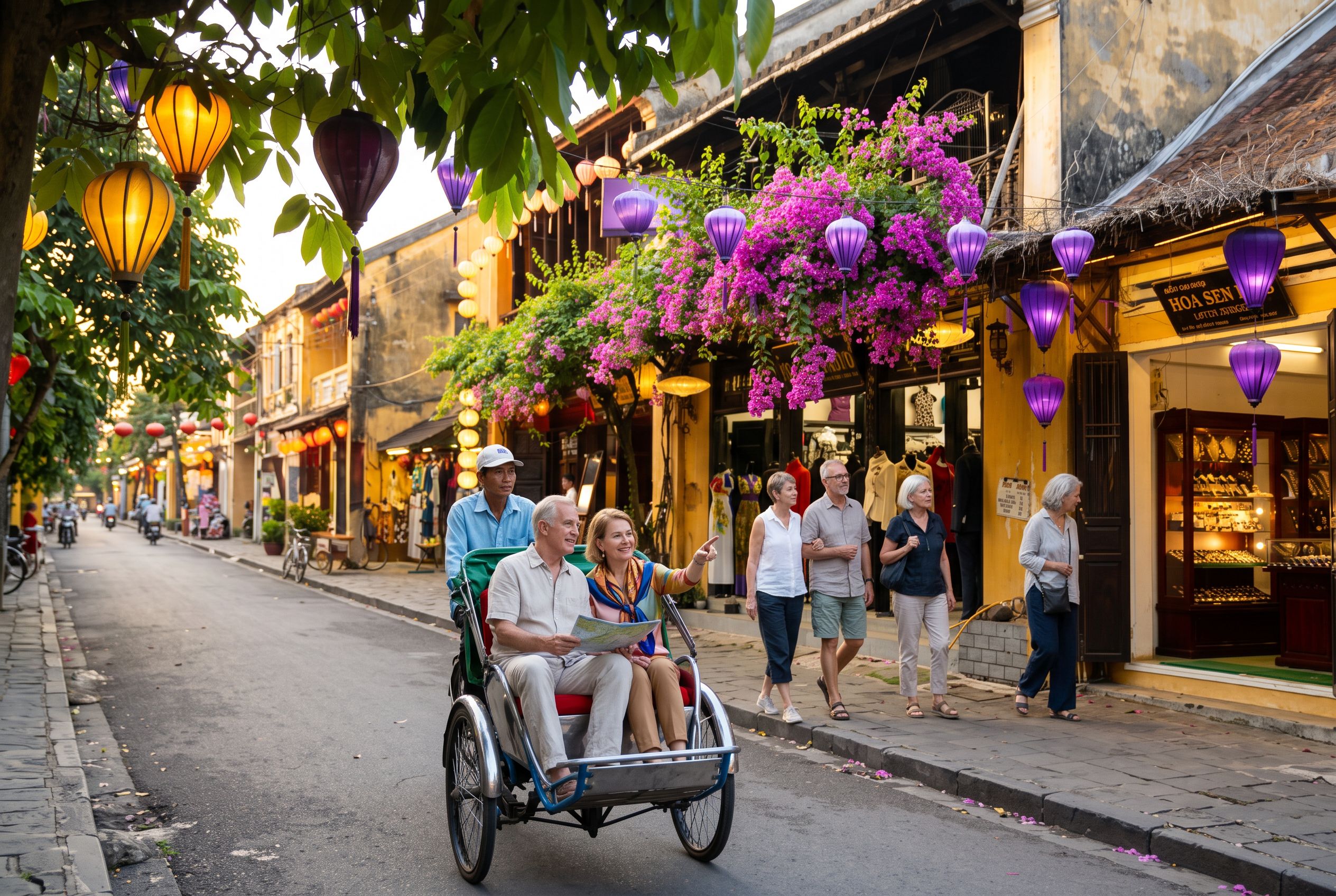
The Old Town is broadly flat and pedestrianised during published hours, which makes it the most manageable part of the trip for slower walkers and for children who will not walk far. The heritage authority does not publish step counts, gradients or a step-free route, so treat the streets as easy and the buildings as unknown.
The pedestrian and non-motorised zone runs from 9:00 to 21:30 in summer and 9:00 to 21:00 in winter, according to the official heritage notice. Phan Chu Trinh Street keeps a shorter evening schedule, from 17:30 to 21:30 in summer and 17:30 to 21:00 in winter. Outside those hours, traffic returns.
Published tourism guidance notes uneven paving and steps into historic buildings as the principal mobility obstacles. The official sources do not document the number of steps, ramps, lifts, handrails or accessible toilets at the Japanese Covered Bridge, Tan Ky Ancient House, the assembly halls or the museums. Ask at the ticket booth or at the door before committing a grandparent to a staircase.
 AI-edited
A practical rhythm: walk one stretch of the Old Town in the morning, sit for a drink, then return to the accommodation for the hottest hours. One Hoi An listing recommends early morning and late afternoon for softer light and fewer crowds, though that is a recommendation rather than an official crowd measurement. A traveller posting in October 2026 likewise recommended walking the Ancient Town in the morning, before the crowds arrive.
For families planning to spread their days across the region, our guide to two weeks across Central Vietnam sets out how Hoi An fits alongside Da Nang and Hue.
Can grandchildren make paper lanterns?
Lantern-making is a seated craft activity and one of the best options for mixed ages, because a grandparent and a grandchild work at the same table. The available official material does not identify a single workshop with a confirmed timetable, age rule or published price, so book through your accommodation and confirm the details before you go.
That is not a reason to skip it; it is a reason to ask questions first. Your hotel or homestay is usually the fastest route to a workshop that takes families.
What to confirm before booking:
- Whether the session is seated throughout, since a standing class is hard on knees and backs.
- The minimum age, if any, and whether a grandparent can work alongside a younger child.
- The price per person and what the finished lantern includes.
- How long the session runs, so it does not collide with a nap or a meal.
The official heritage notice does list cultural activities that come with the town rather than a separate booking, including the "Night Town" project with Bai Choi games, folk games, folk singing classes and street performances with traditional instruments. Art performances run at the Traditional Art Performance House at 66 Bach Dang Street at 10:15, 15:15 and 16:15 daily, and a Japanese tea ceremony is held at the Japanese Culture Gallery at 06 Nguyen Thi Minh Khai Street at 9:30 and 16:30 daily. These are short, seated and free of charge once you hold a ticket.
What happens on a river boat with floating candles?
A Hoai River boat ride with lantern or candle release is the classic Hoi An evening for families, and it is short enough for tired children.
A Hoi An heritage guide describes the boat ride as optional entertainment, separate from the Ancient Town heritage ticket, and advises confirming the price, duration, life jackets, passenger limit and return point before boarding. Do not assume the Ancient Town ticket includes the ride.
The operator material available does not document a standard boarding ramp, handrail, life-jacket specification, wheelchair accommodation or senior fare for Hoai River boats. A Tripadvisor-listed combined boat product states that it is not wheelchair accessible, though that applies to that particular product rather than every boat on the river. If a grandparent has difficulty with steps down to a boat, ask the operator directly what boarding involves.
Evening in the Old Town is busy. A Reddit discussion dated October 2026 describes Hoi An as relatively peaceful by day and much busier at night. Plan the boat early in the evening, then walk back while the streets still feel manageable.
Is a basket-boat ride suitable for young children and grandparents?
A basket boat runs about 45 to 60 minutes through the Bay Mau nipa-palm waterways at Cam Thanh, with published hours of 8:00 to 17:00 daily. A 2026 basket-boat guide advises declining the spinning manoeuvre for young children, older adults and anyone prone to nausea, and says trips are suspended in thunderstorms, strong winds or abnormal water levels.
The location matters: the basket boats operate in the Bay Mau nipa-palm waterways in Cam Thanh, Hoi An. A booking-platform listing gives the experience as approximately 45 to 60 minutes, Monday to Sunday, 8:00 to 17:00, and states that children 100 cm and taller require an adult ticket while children under 100 cm are free when accompanied by an adult.
A 2026 Hoi An basket-boat guide reports reference prices of 30,000 VND per person for forest admission, 150,000 VND per two-person boat for 45 minutes, and 180,000 VND per two-person boat for 60 minutes. Those come from a secondary guide describing "official reference prices", not from the Cam Thanh authority's own published page, so treat them as indicative and confirm at the jetty.
The same guide says spinning is optional and may provoke motion sickness. That is the single most useful sentence for a grandparent planning this outing: you can decline it, and the ride still happens.
Is An Bang Beach worth a morning with grandchildren?
An Bang Beach sits about 4 km northeast of the Ancient Town on a relatively flat route, and a tourism guide identifies March to August as the best period for swimming there. A separate guide warns that September to November can bring strong currents and rip tides, so the season changes what the beach is for.
Published tourism guidance describes An Bang as having restaurants and beach bars. The official and operator material also does not provide a current opening season, entrance fee, lifeguard timetable or published list of shaded rest points for An Bang.
Reporting in April 2025 said four years of erosion-control work had restored about 2.3 km of beach, with an underground breakwater and sand replenishment carried out between June 2020 and September 2024, and beachfront businesses and access paths reopening afterwards. The same report said a further coastal-protection project launched in March 2025 would address the remaining 5.2 km of coastline, with completion scheduled for 2026. Expect continuing works in some coastal areas.
For a fuller picture of the beach and its facilities, see our dedicated guide to An Bang Beach for the over-50s.
How do you pace a day around the heat?
Split the day in two. Walk the Old Town or take the boat in the morning, retreat indoors during the hottest hours, and return to the streets or the river in the late afternoon and evening. The official pedestrian zone runs to 21:30 in summer and 21:00 in winter, so the evening window is generous.
What is documented is the seasonal split in the pedestrian hours and the swimming season at An Bang.
A workable shape for a day with grandchildren:
- Early morning: a short Old Town walk before the crowds, then breakfast.
- Mid-morning: a seated activity, such as lantern-making or one of the performances listed in the official notice.
- Midday to mid-afternoon: back to the accommodation, air-conditioning and rest.
- Late afternoon: the basket boats at Cam Thanh, which close at 17:00, or the beach.
- Evening: the river boat and the lantern-lit streets.
A traveller in their mid-50s, posting in a Reddit discussion dated October 2026, preferred staying centrally in Hoi An rather than commuting from Da Nang, and recommended a minimum of two nights. For a multigenerational trip, three or four nights removes the pressure to do everything at once.
Where do you find rest points and shade?
The official Hoi An Heritage Centre does not publish a formal list of rest points or a seating network for the Ancient Town, so plan your own stops around cafes, the ticketed buildings and your accommodation. Riverside walks are repeatedly mentioned by visitors as a gentler alternative to the busiest lanes.
This is one of the genuine gaps. No official Hoi An source documents a town-wide step-free route, lifts in the heritage buildings, or a formal seating-and-rest-point network. Treat those provisions as not documented and build your own rhythm.
What visitors report is useful. A contributor in a September to October 2026 Reddit discussion about Hoi An accommodation for someone with mobility problems recommended hotels or resorts with drivers able to drop passengers directly in the Old Town, reducing the walking before sightseeing begins. The same discussion noted that a day can be enough for the historic centre, while a hotel driver can take older visitors close to the centre rather than leaving them to walk from a distant resort.
Ask your accommodation to write down the nearest clinic and the local emergency number before you need them.
Where should grandparents and grandchildren stay?
Properties close to the Old Town are praised for convenience, while those just beyond the centre are praised for calm. For a family group, the deciding factors are stairs, room configuration and how close a driver can get to the Old Town entrance.
The guest evidence points to a consistent pattern: warm service, good breakfasts and comfortable sleep in quieter properties, with stairs, uncertain step-free bathrooms and room-specific internal noise as the main risks for a multigenerational group.
- Family Hotel Hoi An Center had a guest placed on the fourth floor without an elevator; the guest praised the owners but identified the stairs as a drawback, per Tripadvisor.
- Hoianese Center Hotel explicitly states that upper floors are accessible by stairs only, per Booking.com.
- The Quin Riverside Villa explicitly lists bathrooms with walk-in showers, per Booking.com.
- Hoi An Historic Hotel was generally described as quiet and away from street noise, but a guest staying in room 118 reported noise from adjoining staff facilities that disturbed sleep, per a Tripadvisor review dated August 2015.
- D Central Hoi An Homestay was described as close to the night market but far enough away from its noise, per Booking.com reviews.
- Guests at Hoi An River Life Homestay repeatedly described the property as close to the Old Town yet peaceful, including "no noise at all" and "pretty quiet", per Tripadvisor reviews on a page updated August 2025.
Ask specifically about connecting rooms, ground-floor rooms and lift access. Tripadvisor's Hoi An family-hotel listings mention connecting rooms, and The Quin Riverside Villa's property responses describe two rooms with a connecting door. Hoi An Central Hotel reviews mention a room with two large beds for a family travelling with two children.
How do you get to Hoi An and around it?
The journey from Da Nang to Hoi An is roughly 30 minutes by taxi, according to a Reddit family-travel discussion dated April 2024 and updated January 2026. Getting a Grab ride back to Da Nang late at night can be difficult, so arrange a private car through your accommodation or pre-book.
Quang Nam launched a 100-km tourism route on 8 March 2025 linking Hoi An Ancient Town, My Son Sanctuary and Dong Giang Heaven Gate, and the provincial Department of Construction approved a new interprovincial bus route for the corridor. The report does not provide the bus timetable or confirm accessibility standards.
Rail is expanding in the area. Vietnam's tourism authorities and Vietnam Railways signed a cooperation memorandum in July 2024, and a luxury SJourney train brought tourists to Tra Kieu Station in Duy Xuyen District, Quang Nam, in January 2025 for onward visits to Hoi An-area attractions including Thanh Ha Pottery Village and Cam Thanh Coconut Village. Quang Nam's 2024 to 2026 plan seeks to expand rail tourism through Tra Kieu and Tam Ky stations. Longer-term proposals for urban railway links between Chu Lai International Airport and Hoi An are plans rather than an operating link.
For families who want to explore beyond the town, our guide to day trips worth making from Hoi An covers the options. Cycling is another way to see the villages; our piece on cycling the Hoi An countryside sets out what that involves.
What do tickets cost and who is exempt?
The official heritage authority lists an 80,000 VND ticket covering the general heritage area plus three selected sites, and a 120,000 VND ticket covering the general area, a principal monument and three additional cultural sites. Children under 16 are exempt, and the ticket is valid for a stay of up to three days.
Sources differ on the exact structure and validity. An earlier official English notice describes the international ticket as 120,000 VND covering five attractions from a list of 21, with the ticket valid for 24 hours for the attraction visits. Confirm the current option, price and validity at an official booth before paying.
On concessions, the official notice states a 50% discount for Vietnamese elderly people covered by the Elderly Law, along with war veterans, people with disabilities and several other Vietnamese categories. It does not establish a comparable discount for foreign visitors aged over 65. No official source here documents a universal family pass, caregiver pass or reduced-mobility pass.
| Ticket | What it covers | Validity |
|---|---|---|
| 80,000 VND | General heritage area plus three selected sites | Up to three days |
| 120,000 VND | General area, a principal monument and three additional cultural sites | Up to three days |
Groups purchasing eight or more tickets receive a free guide service for the tour of the Ancient Town and the monuments included in the ticket. For a multigenerational group, that is worth organising in advance. Keep the ticket stub, as the official notice asks visitors to retain it for access to the ancient town.
The official visitor guidance asks visitors to dress respectfully, and specifically discourages sleeveless tops, shorts and skirts above the knee inside sightseeing places. Mention this to grandchildren before you set out.
What else should grandparents know before booking?
Book on weekdays where you can, keep the itinerary short, and confirm accessibility details directly with each operator, because the official sources do not publish them. A Reddit family-travel discussion dated April 2024 and updated January 2026 recommends visiting Hoi An on weekdays because there are fewer tourists.
The Ancient Town is walkable and largely pedestrian-oriented at scheduled times, An Bang offers a beach outing, and Cam Thanh offers basket boats. Accessibility is uneven, and several boat products are not wheelchair accessible.
Three things to settle before you travel:
- Stairs. Ask each property and each attraction what the steps involve.
- Medical. The sources do not name the nearest pharmacy or clinic to the Old Town. Ask your accommodation for both, plus the local emergency number.
- Booking terms. The sources do not document cancellation policies, reserved entry times or mobility assistance for the Ancient Town ticket, the boat rides or the basket boats. Ask when you book.
Recent changes are worth knowing. A 2026 report stated that restoration of the Japanese Covered Bridge was completed and inaugurated in August 2024, following work with Japanese conservation specialists that began in 2022. Vietnam News reported that the 2026 Festival of Light and Heritage opened on 4 March 2026, with themed Silk, Ceramic and closing weeks scheduled through 30 April. Hoi An Memories Land welcomed more than 600,000 visitors in 2025.
if your family is weighing Hoi An against Vietnam's other destinations, the sources reviewed here do not provide a comparative ranking, and no source establishes Hoi An as Vietnam's single best destination.


