
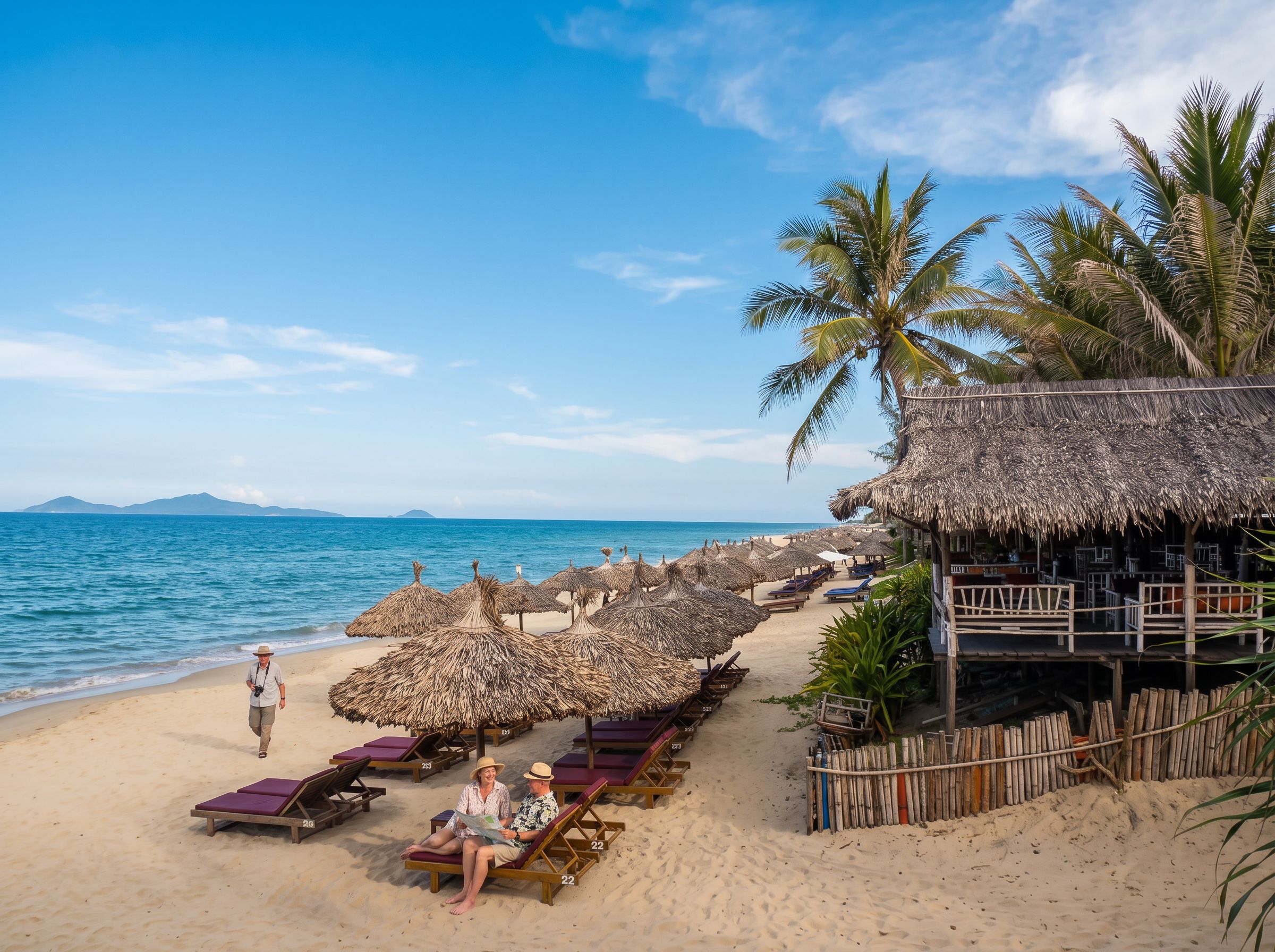
An Bang Beach sits a short ride from Hoi An's Old Town, and it does one thing exceptionally well for travellers who want the sea without a schedule. The sand is soft, the water is warm for much of the year, and the beachfront runs on cafés, loungers and seafood rather than jet skis and noise. The Vietnam National Authority of Tourism describes An Bang as quieter than neighbouring Cua Dai, with coconut shade and views towards the Cham Islands. For anyone in the 50 to 70 bracket who wants a gentle swim, a shaded chair and a decent lunch within a few steps of the water, this is the easiest beach day on this stretch of coast.
It is also a beach with real practical limits, and they are worth knowing before you go. The approach road is flat, but the final metres onto the sand involve soft ground and uneven lanes. Afternoon waves pick up. Midday heat is punishing. None of that rules An Bang out. It simply means the timing and the transport choice matter more here than at a resort beach with a managed shoreline.
Why do older travellers choose An Bang over Cua Dai?
An Bang offers the broadest choice of cafés, loungers and beach clubs of any beach near Hoi An, with free public access and a relaxed, bohemian atmosphere. Cua Dai is quieter and more spacious on weekdays, but coastal erosion and sea walls affect parts of it, so the beach experience varies along its length.
The two beaches sit close together on the same coast, roughly 4 to 5 km east of the Old Town, and both are free in their public areas. The difference is what surrounds the sand. An Bang's central beachfront concentrates restaurants, cafés, beach bars and small hotels, which makes it straightforward to combine a swim with lunch or an early dinner. Cua Dai spreads out more, and Vietnam Airlines reports significant coastal erosion there over the past decade, with sea walls protecting some sections.
For a half-day visit with a meal attached, An Bang is the simpler proposition. The main café strip can be busy, and walking a little farther north or south along the sand usually delivers quieter ground, though with fewer managed facilities. Cua Dai has its own dedicated guide elsewhere in this magazine.
How do you get to An Bang from the Old Town?
An Bang lies about 3 to 5 km from Hoi An Ancient Town. Cycling takes roughly 15 to 20 minutes according to Vietnam Airlines, and taxis, motorbike taxis and hotel shuttles all make the trip. For travellers 50 to 70, a taxi or arranged car is the easiest option in the heat.
The route generally follows Hai Bà Trưng Road from the Old Town toward the coast. The approach itself is flat, which makes cycling feasible for anyone comfortable on a bike, and several accommodations lend or rent bicycles. The catch comes at the end: the final access onto the sand involves soft sand and uneven lanes, so the last hundred metres on foot can be more tiring than the ride.
Distances reported across published guidance vary between roughly 3 km and 5 km depending on the starting point and the route taken. A taxi or Grab car removes the heat and the parking question entirely, and arranging the return trip in advance is sensible if you plan to stay into the evening, because drivers may be reluctant to take the longer run back to Da Nang.
 AI-edited
Parking near the beach is managed by attendants who may whistle, step in front of bicycles and wave visitors toward particular spaces. Designated parking areas can be used, and customers of some restaurants may park directly outside. If you are arriving by car, ask your driver where they intend to drop you, since the walk from the road to the water is not uniform along the beach.
For a broader look at how the town and the coast fit together, see our guide to day trips worth making from Hoi An.
What are the sunbed and beach-club options?
An Bang has no admission ticket and no standard beach pass. Loungers, umbrellas, showers, food and drinks are commercial services provided by beachfront businesses. Operators commonly set loungers beneath thatched umbrellas, and terms vary by establishment, so ask about the price or minimum spend before settling in.
The beach is publicly accessible and free, a point confirmed by published guidance on An Bang Beach. What you pay for is comfort: a lounger, shade, a shower afterwards, and the food and drink that come with them. A current beach guide reports loungers free with a drink costing about 40,000 VND, or approximately 50,000 to 100,000 VND without an order. Those prices are indicative and establishment-specific, and they vary by season and by operator.
No verified current named beach-club menu or fixed sunbed tariff is published for every operator on the beach. The practical approach is to walk the strip, ask two or three places what a lounger costs with and without a food order, and choose accordingly. Beachfront bars and restaurants provide the principal shaded seating, and the published descriptions specifically mention seafood and beach cafés.
What are the swimming and sea conditions like?
An Bang has calm water suitable for swimming for much of the year, with lifeguard zones and relatively shallow water that make it approachable for less confident swimmers. Conditions are seasonal: the sea is generally calmer from March to September, while October to February can bring stronger waves, wind and rain.
Tourism guidance identifies March to August as the strongest period for beach use, with generally sunnier weather and calmer conditions. September to January is described as wetter, with occasional storms and less dependable swimming. A separate local guide extends the broadly favourable window to March through September and warns that October to February can bring rain, wind and rougher seas.
Conditions also change within the day. One source reports stronger afternoon waves and a steeper shore drop-off in some sections, which makes afternoon swimming less suitable for non-swimmers. Morning is the best-supported choice for gentler water.
One source gives official swimming hours of 4:30 a.m. to 7:00 p.m. in summer and 5:00 a.m. to 6:00 p.m. in winter, stating that swimming outside those periods is unsupervised. No current official lifeguard roster or daily flag status is documented, so conditions should be checked locally before entering the sea. Swim in daylight, follow lifeguard flags, use a managed section where one is available, and stay out of the water where black flags are flying.
When should you go to avoid heat and crowds?
Early morning and late afternoon are the best-supported windows for cooler temperatures, calmer seas and fewer people. Sand and sun become particularly intense around midday, and the central An Bang service area grows livelier after about 3:30 p.m. as the heat drops.
Vietnam Airlines recommends early morning and late afternoon at both Hoi An beaches for exactly these reasons. Early morning is repeatedly described as quieter and cooler, which suits anyone who wants the water at its gentlest and the sand largely to themselves. Late afternoon is cooler than midday but busier near the main restaurant and beach-bar cluster.
The wider seasonal picture matters too. February to April is described as Hoi An's best balance of moderate temperatures, lower humidity and manageable crowds, while May to July brings warmer water but substantially more heat and humidity. March to May offers the most comfortable combination of drier weather and manageable heat, and March to August is the wider commonly recommended beach season.
Times to avoid, according to the published guidance, are midday heat, late-afternoon crowding around An Bang's central service area, and the wetter or storm-prone period from roughly September or October through January. If you are building a day around the beach, an early start with a late breakfast on the sand works better than an afternoon arrival.
For strategies on seeing the town itself without overdoing the walking, our guide to seeing Hoi An with little walking and out of the heat covers the practical options.
What is the seaside dining like?
An Bang's beachfront restaurants, cafés and beach bars serve drinks and food while providing access to loungers, with seafood and beach cafés specifically mentioned in published descriptions. The most convenient dining is concentrated near the principal access area, and beach cafés generally operate from morning into the evening.
Walking farther from that central cluster may give you a quieter setting, but it also means fewer managed facilities. That trade-off is worth weighing if you want a table with shade, a toilet nearby and someone to keep an eye on your bag while you swim.
Beach cafés and restaurants set their own opening hours. The available guidance generally describes them as operating from morning into the evening, with some reducing hours or closing during the wetter season. No official closing day or scheduled maintenance closure is documented for An Bang or Cua Dai, so it is worth checking with a specific establishment if you are making a special trip.
Litter is identified as the main problem mentioned in recent beach comments, with a recommendation to check current Google and Tripadvisor feedback before travelling. That is planning information rather than a verdict on any one business, and conditions change with the season and with recent weather.
How accessible is the beach for walkers and wheelchair users?
The approach road to An Bang is flat, but beach access itself is more difficult. Sources mention soft sand, uneven lanes, narrow entrances, possible steps and seasonal erosion. No reliable official source documents step-free beach access, beach wheelchairs, mobility assistance or a dedicated accessible bathing service at An Bang.
That silence matters. The sand itself should be treated as potentially difficult for walkers and wheelchair users, and the absence of published information is not evidence that access is easy. No source documents lifts, ramps, step-free routes from the road to the sand, accessible toilets, transfer assistance or reserved seating at either beach. Restaurants and resorts may make individual arrangements, but these are not documented as beach-wide provisions.
Toilets and showers are reported at the beach, and a rescue team is reported by Vietnam Airlines. The nearest pharmacy, clinic or hospital is not documented. If you have mobility concerns, the practical move is to contact a specific beachfront business directly and ask what they can arrange, rather than assuming a standard provision exists.
What else should you know before you go?
An Bang has no entry fee, no documented senior discount and no published beach pass. Life jackets can be rented nearby for around 50,000 VND, and the beach is reachable by bicycle, taxi, motorbike taxi or hotel shuttle. Emergency numbers for Vietnam are 113 for police, 114 for fire and rescue, and 115 for medical emergencies.
No official over-65 fare, senior discount or reduced tariff is documented for either An Bang or Cua Dai. The 50% discount on Hoi An Ancient Town tickets applies to Vietnamese elderly people as defined under Vietnam's Elderly Law; the source does not state that it extends to foreign visitors aged 65 or over. If you are planning time in the town as well as the beach, that distinction is worth knowing before you queue at the counter.
Because English-language emergency response may be limited, hotel staff, a beach restaurant or your accommodation host can be asked to call and explain the exact beach access point. The Quảng Nam Tourist Support Center is listed at 0235 3666 333 in a local emergency directory, and the Hoi An police emergency contact at 0235 3861 1204.
Coastal works are also under way along this stretch. A project launched in 2025 is intended to protect approximately 3.4 km of coast, including the shoreline running north toward the An Bang area, with completion planned for 2026. Construction activity may alter the width of the sand, views and access at particular sections, though available reporting does not establish that all of An Bang Beach is closed. If you are travelling during the works, it is worth asking locally which sections are currently affected.
How should you plan the day itself?
Plan around the heat and the tide of people rather than around a fixed itinerary. An early arrival, a lounger secured with a clear price agreed, a swim in a flagged zone before the afternoon waves build, and lunch on the sand covers the essentials. Arrange your return transport before you settle in.
An Bang works best as a half-day rather than a full one. The beach supports swimming, lounger and umbrella rental, restaurants and cafés, and local yoga and spa sessions, but the sun and the sand take more out of you than the distance suggests. A morning swim followed by a long lunch under shade is a realistic shape for the day.
If you want the town as well, guided options can take the logistics off your hands. Our guide to small-group and guided tours of Hoi An sets out what is available for travellers in this age bracket.
One final point on the beach itself. The Vietnam National Authority of Tourism describes An Bang as quieter than Cua Dai, with soft sand, gentle waves, coconut shade, seafood stalls and views towards the Cham Islands. That description holds for most of the year, but the sea and the sand are working coastlines, not resort installations. Check conditions on the day, ask before you pay, and the beach rewards the patience.


