
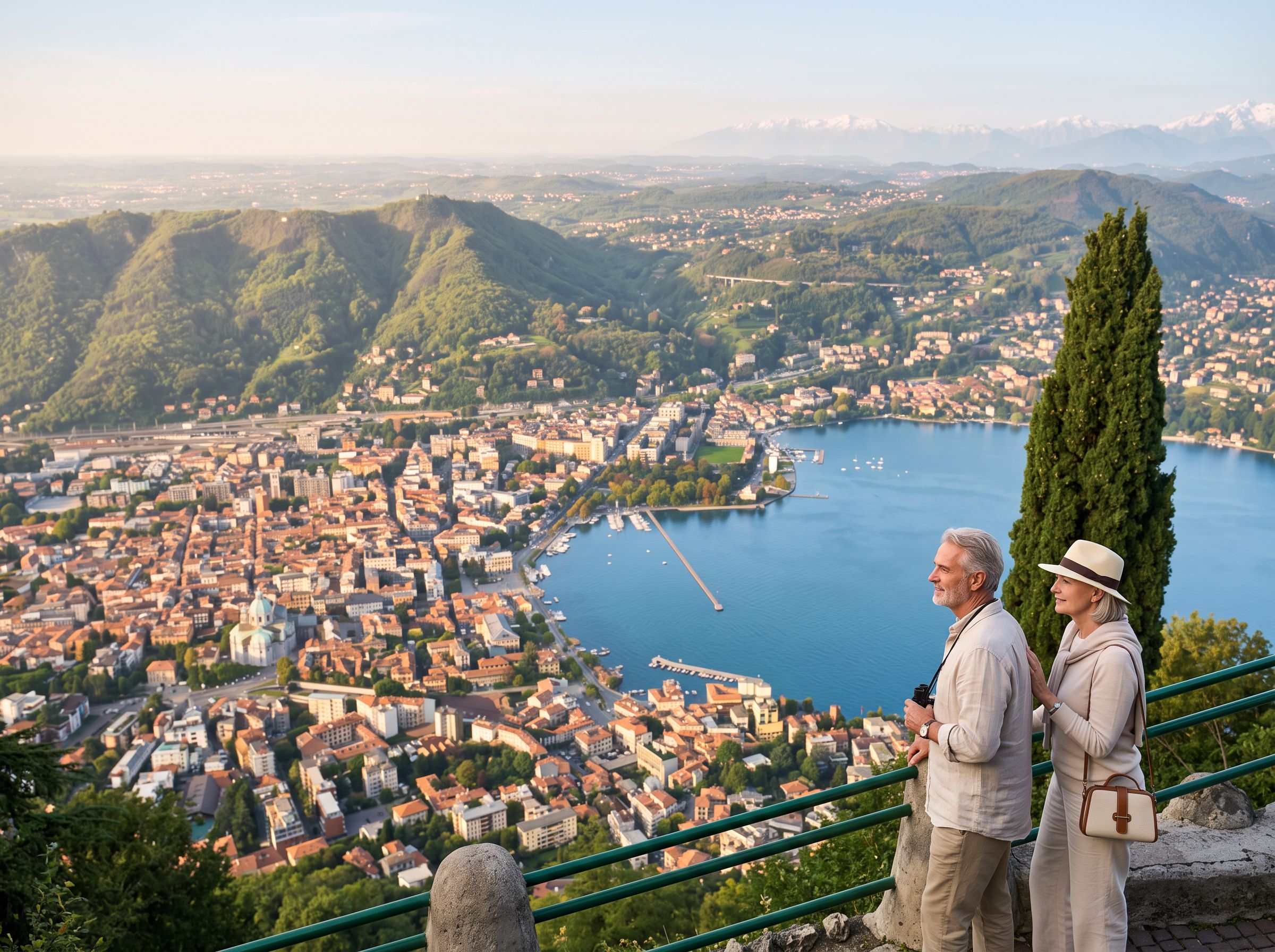
There is a particular magic to the Italian Lakes that reveals itself slowly, over days rather than hours. For the traveller aged 50 to 70, the appeal is not just in the postcard views—it is in the rhythm of ferry crossings, the ease of lakeside promenades, and the pleasure of settling into a different town every few nights without the stress of packing and unpacking daily. This 14-day itinerary links Lake Como, Lugano, Lake Maggiore, and Lake Garda using trains and ferries, with a pace designed for comfort and discovery. You will spend three to four nights at each base, minimising transit stress while maximising the distinct character of each lake.
 AI-edited
Why choose this multi-lake route for a two-week trip?
This route works because it respects your energy. By staying three to four nights per base and relying on trains and ferries rather than cars, you avoid the fatigue of daily hotel changes while still experiencing four distinct lake personalities. Most transfers run between forty minutes and an hour and a half; only the move from Stresa to Lake Garda takes three hours or more.
The Italian Lakes are not a single destination but a collection of moods. Lake Como is the aristocrat, with its steep wooded slopes and grand villas. Lake Lugano (technically in Switzerland but easily reached from Como) offers a quieter, more cosmopolitan feel. Lake Maggiore brings the drama of the Borromean Islands and a gentler, more open shoreline. Lake Garda, the largest, offers the most variety—from the rugged northern cliffs to the flat southern beaches. By linking them in a logical loop, you see the best of each without the rush of a day-tripper.
For travellers aged 50 to 70, the key is to avoid the common mistake of trying to see everything. This itinerary deliberately excludes single-town deep dives—our Lake Como and Lake Garda guides cover those—and instead gives you a high-level plan that you can adapt to your interests and mobility level.
How many nights should I spend at each lake?
Allocate three nights for Lake Como, two for Lugano, three for Lake Maggiore, and four for Lake Garda. This gives you a full day to explore each base, plus a day trip or two, without feeling rushed. The extra night on Garda reflects its size and variety.
Here is the breakdown at a glance:
| Base | Nights | Why this length |
|---|---|---|
| Lake Como (Menaggio or Varenna) | 3 | Sufficient for ferry hops to Bellagio, Varenna, and Tremezzo |
| Lugano (Switzerland) | 2 | Compact city; one day for the lake, one for the town |
| Lake Maggiore (Stresa) | 3 | Explore the Borromean Islands and the lakefront; the Mottarone cable car has been closed since 2021 |
| Lake Garda (Peschiera or Desenzano) | 4 | Largest lake; day trips to Sirmione, Limone, and Verona |
This pacing means you change hotels only three times in two weeks—a significant comfort advantage. Each transfer is by train or ferry. Two of them are long: Lugano to Stresa takes about two and a half hours with changes, and Stresa to Lake Garda three hours or more.
What is the best way to travel between the lakes?
Trains and ferries are your primary modes. Avoid driving on the narrow, winding lakeside roads, especially on Lake Como where traffic can turn a 30-minute drive into a two-hour crawl. The train network linking Milan to each lake is reliable, and ferries connect the towns within each lake efficiently.
Your main transfer points are Milan and Verona. Como San Giovanni lies 41 minutes from Milan Centrale; from Varenna-Esino the direct Trenord service takes 68 minutes. For Lugano you do not need Milan at all: direct trains leave Como San Giovanni and reach Lugano in 34 to 44 minutes. Milan Centrale to Stresa is 71 minutes on a direct regional train, from €8.60. The one long day is the move from Stresa to Lake Garda: allow three to three and a half hours to Desenzano or Peschiera, with one or two changes.
The Treviglio–Brescia high-speed line is not new: it opened on 11 December 2016 and already puts Brescia 36 minutes from Milan. The section still to come is Brescia Est–Verona, about 48 kilometres long; test trains began running on it in June 2026 and FS expects it in service in the first quarter of 2027. Separately, Deutsche Bahn, ÖBB and Trenitalia plan direct Frecciarossa trains from Munich to Milan via Innsbruck from the end of 2026, a journey of about six and a half hours, useful if you are arriving from Germany.
For ferry travel within each lake, buy a day pass or a multi-ride card. On the tariff in force since 1 April 2026, a single adult ticket from Varenna to Bellagio is €5.50, or €4.40 for over-65s Monday to Friday, weekends and public holidays excluded. The €4.60 often quoted is the car-ferry rate for a vehicle up to 3.5 metres, not a foot passenger. The one-day free-circulation ticket for the central lake costs €17.50 (€14.00 over 65, Monday to Friday) and pays for itself from the fourth crossing. Lake Garda has its own free-circulation ticket, good for a whole day without any stop limitation: on the same 2026 tariff, €39.50 for the whole lake including fast services, €27.00 for the upper or lower lake alone. Watch the season there — the Garda timetables run from 1 April to 4 October in 2026.
Lake Como (Days 1–4): Where to base yourself for comfort?
Base yourself in Menaggio or Varenna, not Bellagio. Both appear in Lombardy's official accessible-tourism itinerary for Lake Como, alongside Como, Lecco and Bellagio; Menaggio keeps its shops and restaurants within a few hundred metres of the water, while Varenna offers quieter charm if you are comfortable with some stairs. Both are excellent ferry hubs.
Menaggio keeps everything close to the water: the ferry dock sits about 340 metres from Piazza Garibaldi, with restaurants and shops in between. Varenna is arranged differently. The ferry landing is at Olivedo, and the old centre around Piazza San Giorgio lies roughly half a kilometre south along the waterfront; what climbs steeply are the lanes leading away from the lake and the link up to the Varenna-Esino station.
From either base, use the ferries to visit Bellagio (the "Pearl of Lake Como," though steep), Tremezzo (home to Villa Carlotta’s botanical gardens, where almost the whole garden is open to visitors with disabilities, though the villa itself warns of several uphill paths), and the Greenway of Lake Como—an 11.2-kilometre path from Colonno to Griante through seven lakeside villages, which its operator describes as alternating stretches of paved road, tracks and cobbled steps, impassable with a wheelchair and about three and a half hours end to end. For a deeper look at walking options, see our guide to Easy Lakeside Walks and the Best Views on Lake Como.
Guests consistently report that the ferry service on Lake Como is punctual and scenic, though summer crowds can mean waiting for the next boat. Navigazione Laghi has put the new hybrid vessel Olimpia into service on Lake Como: the fleet's 101st ship, inaugurated at Lecco on 11 May 2026 and part of an industrial plan for 2024–2029 that carries more than €117 million for fleet renewal, infrastructure and digitalisation. Lake Como itself holds a Google rating of 4.8 out of 5 from 14,481 reviews as of August 2026.
Lugano (Days 5–6): A Swiss interlude worth the detour?
Lugano is a compact, walkable city that offers a change of pace from the Italian lakes. Its lakeside promenade runs right along the water, the old town is car-free, and the funicular to Monte Brè provides panoramic views without strenuous hiking. Two nights is enough to absorb its character.
From Lake Como, take the train from Varenna or Como to Lugano (about one hour, with a change at Milan or direct from Como). Lugano's waterfront is lined with cafes and parks. The station sits above the centre, and the funicular between them runs from 05:00 to 00:15 every day of the year, covers the climb in a minute and a half and takes wheelchairs and pushchairs; from its lower station at Piazza Cioccaro the Parco Ciani is a short walk along the lake. The city is Italian-speaking: Italian is the language of Ticino, which is not one of Switzerland's officially multilingual cantons.
For active travellers, the funicular to Monte Brè reaches the top in just over ten minutes and opens a view over the lake and the Alps. Check the dates before you count on it: in 2026 it was closed from 7 January to 13 February and again on Christmas Day. Alternatively, take a ferry across Lake Lugano to the picturesque village of Gandria, where the boat sets you down at the waterfront and the crossing is as much of the pleasure as the walk. Lugano is also a good place to buy Swiss chocolate or watches, though prices are higher than in Italy.
One note: Lugano is not a lake for swimming in the same way as Como or Garda—the water is cooler and the beaches are fewer. But for a relaxed two-day pause between the busier Italian lakes, it works beautifully.
Lake Maggiore (Days 7–9): The Borromean Islands and gentle exploration
Base yourself in Stresa, a gracious town on the western shore with a flat lakefront promenade and excellent ferry connections to the Borromean Islands. Three nights allow you to visit Isola Bella and Isola dei Pescatori, take the cable car to Mottarone, and enjoy a relaxed pace.
Stresa is one of the most senior-friendly towns on Lake Maggiore. The main street, Corso Italia, is flat and lined with benches, and the ferry dock is a five-minute walk from the centre. The highlight of any visit is the Borromean Islands: Isola Bella with its ornate palace and terraced gardens, and Isola dei Pescatori, a fishing village with narrow lanes and simple restaurants. Both islands are reached by frequent ferries. Isola Bella needs a warning: its operator says the island's morphology and heritage-protection constraints can make the site hard going for visitors with impaired mobility, and that Palazzo Borromeo's lift reaches only the first-floor rooms. Terre Borromeo opens its Lake Maggiore sites from 12 March to 8 November 2026.
Do not plan around the cable car. The Stresa–Alpino–Mottarone line, which used to climb to 1,491 metres in about twenty minutes, has not carried passengers since the accident of 23 May 2021, and Stresa's own tourist office still heads its page LA FUNIVIA E' CHIUSA — the cable car is closed, with no reopening date published. The view is real enough for those who drive up: on a clear day it takes in seven lakes, Maggiore, Orta, Mergozzo, Varese, Comabbio, Monate and Biandronno.
Lake Maggiore is generally less crowded than Como or Garda, especially in May, June, or September. The climate is mild: on Lake Maggiore the daily highs average about 20°C in May, 24°C in June and 21°C in September, which suits long days outdoors.
Lake Garda (Days 10–14): The largest lake, the most variety
Base yourself in Peschiera del Garda or Desenzano del Garda, both of which have their own railway station a short walk from the boats. From here, you can explore Sirmione, the northern towns of Limone and Malcesine, and take a day trip to Verona. Four nights give you the flexibility to set your own pace.
Lake Garda is the largest of the Italian lakes, and its size means you need to plan your days carefully. The southern towns—Peschiera, Desenzano, and Sirmione—are the easiest to reach, with train links to Milan and Verona. Sirmione, while hugely popular and crowded in summer, becomes quiet and peaceful in the evening once the day-trippers leave. Many senior travellers recommend staying overnight in Sirmione for this reason.
The northern towns—Limone, Malcesine, and Riva del Garda—have no rail stations and rely on buses or cars. If you want to visit them, take a ferry from Peschiera or Desenzano, but read the timetable first: the Desenzano–Peschiera–Riva line calls at more than twenty ports on its way north, so this is a half-day out rather than a quick hop. Fast services carry a €6.00 supplement each way. The scenery is dramatic, with cliffs plunging into the lake, but the walking is steep in places.
For a gentle day out, visit the Vittoriale degli Italiani in Gardone Riviera, the former home of poet Gabriele d’Annunzio. The estate includes a villa, an amphitheatre, and terraced gardens with lake views. The foundation is careful here: the estate's historic character prevents the architectural barriers being removed, so the visit is only partly accessible. Visitors with impaired mobility can see the Museo D'Annunzio Segreto, the museum "L'automobile è femmina" and the Auditorium, reached by the lift inside the Libreria — but the Prioria, d'Annunzio's house itself, cannot be visited in a wheelchair.
Lake Garda holds a Google rating of 4.8 out of 5 from 21,507 reviews as of August 2026. The cycling paths around the lake are popular, and surface and signposting differ from stretch to stretch, so check the section you plan to ride before you set out. For a more active option, see our guide to Cycling Lake Como by E-Bike: A Guide for Active Travellers Over 50, which also applies to the flatter sections of Garda.
What weather should I expect, and what should I pack?
May, June, and September are the ideal months for this itinerary, with daytime highs of roughly 21–24°C in May and September and 25–27°C in June, and fewer crowds. July and August are hot — around 29°C on Garda, a little cooler on Como and Maggiore — and crowded. Pack layers, comfortable walking shoes, a rain jacket, and swimwear if you plan to swim.
According to TravelClimate.net, May and June are the wettest months on Lake Como, with about ten rainy days each; September has seven. The same table puts the water at 24°C in July and 20°C in September, so early autumn is still swimmable, while October drops to 15°C. On Lake Garda that source gives July as the hottest month, at up to 29°C in the shade.
For packing, focus on versatility. A lightweight waterproof jacket is essential for sudden lake showers. Comfortable walking shoes with good grip are non-negotiable, especially for the cobblestone streets of Bellagio and Varenna. If you plan to visit churches or villas, bring a scarf or shawl to cover your shoulders.
How can I manage costs on this trip?
The Italian Lakes are not a budget destination, but you can manage costs by staying in smaller towns, eating where locals eat, and using public transport rather than private transfers. Expect to pay €€€ for mid-range hotels and €€ for meals in tourist areas.
Here is a rough cost guide for a two-week trip for two people:
| Item | Budget (€) | Mid-range (€) | Luxury (€€€) |
|---|---|---|---|
| Hotel (double room) | 100–150 | 200–350 | 400+ |
| Meals (lunch + dinner) | 60–80 | 100–150 | 200+ |
| Ferry day pass (two adults) | 35–79 | 35–79 | 35–79 |
| Train (per journey) | 10–30 | 10–30 | 10–30 |
| Attractions (two entries) | 24–35 | 24–35 | 24–35 |
To save money, consider staying in Lecco (Lake Como) or Desenzano (Lake Garda) rather than the more expensive central towns. Eat at trattorias away from the lakefront, where a plate of pasta might cost €12 instead of €20. And always carry small bills for cafes and ferry tickets, as not all places accept cards.
Is this itinerary suitable for travellers with mobility concerns?
Yes, with careful planning. Choose Menaggio or Como town on Lake Como, Stresa on Lake Maggiore, and Peschiera or Desenzano on Lake Garda. On Lake Garda, Peschiera and Desenzano are two of the six piers certified Bandiera Lilla Approved. Bellagio and Varenna are steeper, but both are stages of Lombardy's official accessible-tourism itinerary.
On Como, Maggiore and Garda the crew always assists boarding, over a gangway at least 80 centimetres wide with a non-slip surface and a slope that shifts with the water level; the newest ships have lifts and accessible toilets, while studies for the older ones are still under way. Lake Lugano is run by a separate Swiss company. For 2026 to 2028 the Lombardy Region has set aside €5.3 million, inside an €8.8 million programme, for the lake basin authorities of Iseo, Garda, Como, Maggiore and Ceresio to modernise ports and landing stages. Always check with your hotel in advance about elevator availability—many older buildings in Italy do not have them.
For gentle walking, the lakeside promenades of Stresa and Peschiera are the easier options; the Greenway of Lake Como, described above, is not. The northern Garda towns ask more of you than the southern ones, and if you want the northern cliffs without the climb, take a ferry or a guided boat tour. Know where the nearest emergency department is at each base: Menaggio has a hospital on Via Virginia Casartelli, Peschiera the Ospedale Pederzoli on Via Monte Baldo with its own accident and emergency unit. Stresa has neither — the nearest is the Ospedale Castelli at Verbania-Pallanza, about 16 kilometres by road.
"It's a perfect place to relax. It runs along Lake Maggiore, there are benches with a great view, well-kept gardens, breathtaking panorama of the Isole Borromee, you can take a boat to visit those islands. There are luxury hotels, great restaurants, shops, ice cream shops." — a review of the Stresa lakefront left on Google in April 2026
What is there to do in the evenings?
Evenings on the Italian Lakes are about leisurely dinners, lakeside strolls, and early nights. There is no nightclub scene to speak of, and that is part of the appeal. Most restaurants serve dinner from 7:30 to 10:00 PM, and the best view is often from a terrace overlooking the water.
In Menaggio, the main square comes alive with families and couples enjoying gelato. In Stresa, the lakefront promenade is lit with soft lights, and you can hear the lapping of water against the shore. In Peschiera, the old town walls provide a quiet setting for an evening walk. If you want a more lively atmosphere, head to Bellagio or Sirmione, where the crowds linger until late.
For a special evening, book a table at a villa restaurant. On Lake Como, Villa d’Este in Cernobbio offers a formal dining experience (see our dossier: A Closer Look: Villa d’Este, Cernobbio — A Lake Como Dossier for the Discerning Traveller). On Lake Garda, the restaurants in Sirmione’s old town are particularly atmospheric after dark.
What should I skip on this itinerary?
Skip the northern villages of Lake Como (Colico, Domaso) unless you have extra days—they are less accessible and require more travel time. Skip the Dolomites unless you are extending your trip—they deserve their own dedicated guide. And skip the idea of seeing everything; this itinerary is about depth, not breadth.
The Italian Lakes reward those who linger. A two-week trip that tries to include every village, every villa, and every viewpoint will leave you exhausted rather than refreshed. Stick to the bases and day trips outlined here, and you will return home with memories of quiet mornings on ferry decks, the taste of fresh lake fish, and the satisfaction of having travelled well.
For those who want to extend their trip, consider adding three to four nights in Verona (easily reached from Lake Garda by train in 20 minutes) or the Dolomites (which have their own dedicated guide). But for a first visit, this 14-day loop is the perfect introduction to the Italian Lakes for the active senior traveller.


