
Ubud rewards travellers who treat it as a base rather than a destination. The town itself holds the palace, the water temple and the market, but the landscapes that define Bali's interior lie beyond it, reached by road and best reached with a driver. For travellers aged 50-70, the question is not whether these places are worth the journey. It is which ones suit your knees, your heat tolerance and your patience for stairs, and how to arrange the day so that the effort stays manageable.
This guide covers five excursions that can be made from Ubud with a private car: the Tirta Empul water temple, the Mount Batur caldera and its lake, the Tegenungan waterfall, Besakih temple and a coffee plantation stop. Each has a different physical demand. Some reward an early start and little walking. Others ask for a full day and a tolerance for steps.
How do you get around from Ubud without a car of your own?
Bali has very little public transport, so a private, air-conditioned car with a driver is the practical choice for every excursion in this guide. Published Ubud guidance quotes roughly IDR 600,000 to 800,000 for an eight to ten-hour car with driver, fuel included, with entrance fees separate. Another senior-focused source gives a broader range of IDR 600,000 to 1,000,000 per vehicle per day.
The Tirta Empul operator's own getting-there page puts the rough range at about 550,000 to 2,000,000 IDR depending on the vehicle, and notes that taxis and app cars are available in the area but can be scarce for the way back from the temple. That last point matters. Ride-hailing around Tampaksiring is described as unreliable, especially for a pickup after a visit, so a driver who waits is worth more than a cheaper one-way fare.
Before leaving Ubud, agree five things with the driver: the maximum walking time at each stop, whether he will remain nearby, that the vehicle is shaded or air-conditioned, where the toilet stops and lunch will be, and the latest return time. A July 2024 Reddit planning discussion recommends an eight-hour driver who waits while visitors explore, so the itinerary can be shortened if heat, traffic or stairs become excessive.
Is Tirta Empul worth the drive, and how much walking does it involve?
Tirta Empul is a tenth-century holy-spring temple at Tampaksiring, about 17 km from Ubud by road, or roughly 20 minutes with clear roads. The operator gives 30 to 40 minutes by road, longer from stays outside the centre. The main temple areas are generally manageable, but joining the purification bathing involves changing, queuing and standing in the pools.
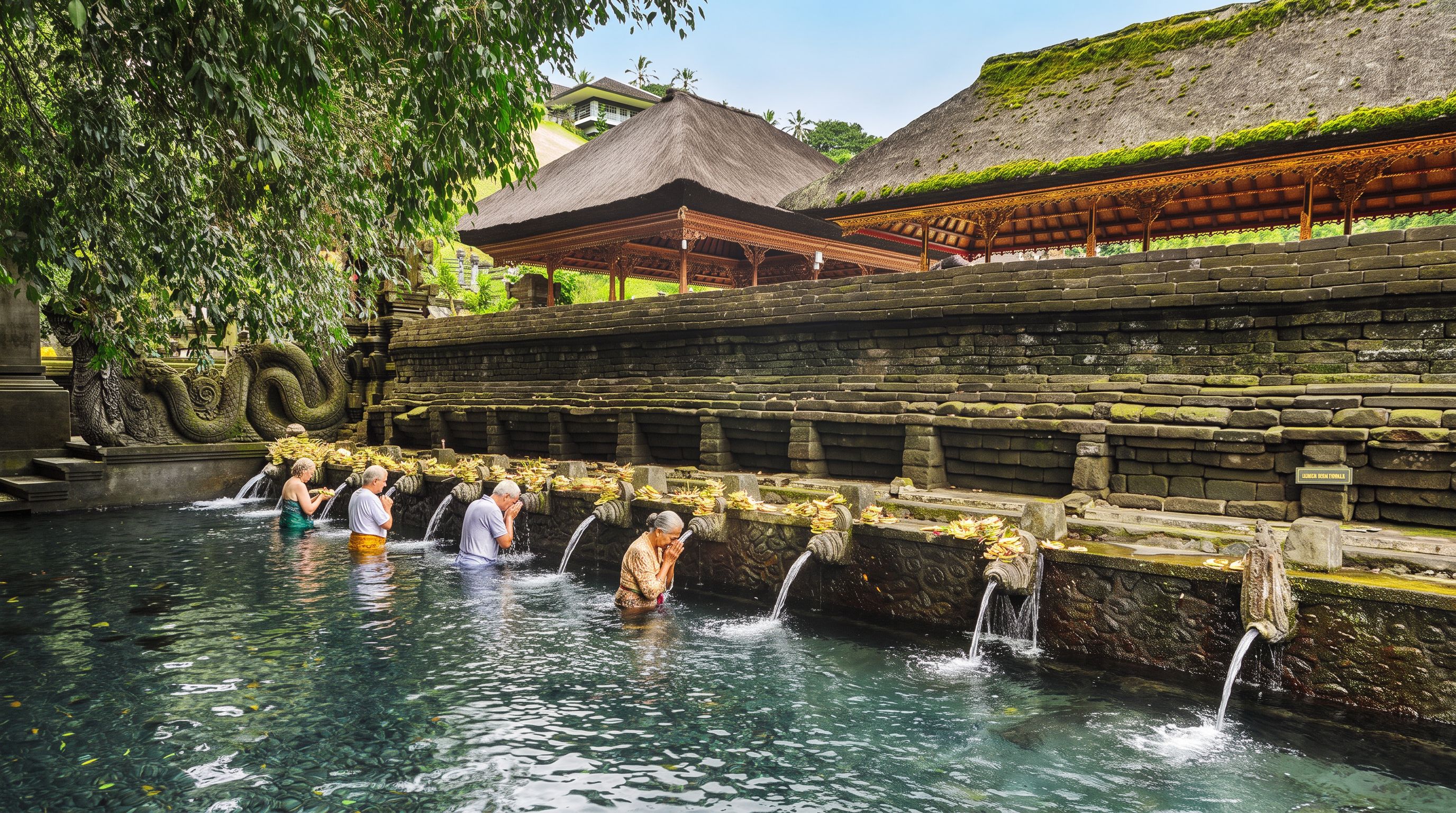
The temple sits in the Pakerisan watershed and forms part of the UNESCO Cultural Landscape of Bali Province. Its spring feeds the ritual bathing fountains used for melukat, the Balinese Hindu purification ceremony. Visitors who do not wish to bathe may watch from dry ground, and the grounds are arranged in three courtyards: the outer Jaba Pura, the middle Jaba Tengah with the ritual pools, and the inner Jeroan.
The operator describes a row of stone spouts, usually given as around 26 to 30 across two purification pools. Two spouts are skipped because they are reserved for funeral rites. A visitor sarong is lent at the entrance, free or for a small donation. For the pools, a green bathing sarong costs roughly 10,000 IDR and a locker roughly 15,000 IDR. Visitors are advised not to swallow the pool water and not to use soap or shampoo.
 AI-edited
Guest feedback gathered on Google, where the temple holds 4.6 out of 5 across 31,352 reviews as of November 2026, describes the grounds as well maintained and clean, with clear spring water and a koi pond. The same reviews recommend a guide to explain the fountain order, which spouts to avoid and the meaning of each step. The operator's private tour lasts over two hours and starts at 14 USD per person, 28 USD for two and 56 USD for a family of four.
"It made the entire experience so much more special because we actually understood what we were doing rather than just going through the motions. The holy water ritual itself was absolutely amazing and something I'm so grateful we got to experience." (Google, October 2026)
What should you know about timing, tickets and crowds at Tirta Empul?
The temple is usually open from about 8 am to 6 pm, and the operator's own page states that the main rush runs from around 10 am to 2 pm. Adult admission is 75,000 IDR for foreign visitors and 50,000 IDR for children, with children under five free. Arriving at opening is the single most effective way to avoid both heat and coach groups.
Sources differ on the tariff. The operator's ticket site lists 75,000 IDR for foreign adults and 50,000 IDR for children, while some older listings still show lower prices, so check the price at the gate. A verified senior concession is not documented. The temple is closed to visitors on Nyepi, Bali's Day of Silence, and temple ceremonies can restrict access on other days. The operator publishes no reliable calendar of ceremony-related closures; check at the entrance on the day.
Allow roughly 1½ to 2 hours, longer if bathing. The site is compact and can be walked in about an hour according to guest feedback, with a large parking lot near the market at the exit. That exit route passes through a long market of persistent souvenir vendors, which is worth knowing in advance. Queues for the purification pools have been reported at over two hours at busy times.
Can you see Mount Batur and the lake without climbing at 2 am?
Yes. A driver can take visitors to the Kintamani and Lake Batur viewpoints, keeping the excursion at a low-to-moderate physical level. This is a different experience from reaching the summit and should be booked explicitly as a viewpoint-and-lake day. Mount Batur is 48 km from Ubud by road, about 60 minutes with clear roads.
Mount Batur is an active 1,717-metre volcano whose caldera contains Lake Batur. The classic sunrise excursion involves a pickup from Ubud around 2 am, a drive of roughly 1½ hours and a climb of about two hours over loose volcanic gravel. One specialist account describes the climb as Grade 1-2, "easy to moderate" and beginner-friendly, but the same practical details, darkness, early departure and unstable terrain, make it unsuitable for many travellers with knee, balance or cardiac limitations. Guides are required in practice by the local guides' association and village communities.
The foreigner nature-park admission is reported as IDR 100,000, with Indonesian rates of IDR 10,000 on weekdays and IDR 15,000 on public holidays. The cited information reports no online ticket, time slot or quota, while noting that the Culali post has accepted card payments since 31 January 2025. No senior fare, lift, step-free trail, seating provision or dedicated reduced-mobility service is documented.
Rainy-season conditions from November to March can leave trails slippery, and Batur summits are frequently clouded during that period. The sunrise trek has its own dedicated guide on this site. For a gentler day, the caldera rim viewpoints and the lake shore deliver the scenery without the 2 am alarm.
Is the Tegenungan waterfall manageable for older knees?
The waterfall is close to the car park and reachable by a maintained concrete path with handrails, but the descent and climb back involve roughly 165 to 200 steep, uneven steps. Guest feedback describes these as difficult for seniors and those with knee or mobility issues. Cafes and restaurants at the top allow visitors to enjoy the view without descending.
That upper option is the practical answer for many travellers in their 50s and 60s. Several reviewers note the view from the top is good and that those who cannot manage the steps can wait there. A lift is available for those who spend at least IDR 150,000 at the restaurant, and a day club lift offers an easier way back up. The waterfall holds 4.4 out of 5 across 38,731 Google reviews as of November 2026.
The route can become slippery after rain, and swimming should not be assumed to be available in wet-season conditions. A published Ubud itinerary notes that waterfalls are frequently closed to swimmers during the rainy season, and water quality varies with weather. Arriving before 9 to 10 am is recommended in guest feedback to avoid crowds and heat.
The supplied results also carry no reliable official figures for current admission, opening hours or a published Ubud travel time. Ask the driver to confirm the current gate price and opening arrangements before setting out.
How demanding a day is Besakih temple?
Besakih is considerably farther from Ubud than Tirta Empul or Tegenungan, so it is best planned as a dedicated full-day outing with a private driver rather than combined with several other attractions. The temple sits in Karangasem Regency, east of Ubud, and the complex is large, elevated and spread across several courtyards.
The measured road distance from Ubud is 49 km, about 50 minutes with clear roads. Recorded itinerary guidance places Besakih at approximately one to 1½ hours east of Ubud each way before traffic and sightseeing stops. A driver and a slower itinerary are advisable given the scale of the site and the slopes of Mount Agung on which it is built.
Buy admission at the official counter, where official guides are available if wanted. The supplied results do not provide an official effort rating, step count or mobility statement for the exact complex. They also do not document an over-65 fare, reduced tariff, lift, guaranteed step-free route, wheelchair service, seating inventory or routine maintenance closure. Nor do they document reliable official figures for current travel time, opening hours, admission or senior concessions. Confirm the practical details with the driver and at the gate.
What happens on a coffee plantation stop?
Coffee plantations are commonly included as stops on northern Bali driver itineraries, but the material does not establish one specific plantation's official route or fare. The easiest arrangement is to ask the driver for the exact plantation name, confirm whether there is an admission charge or compulsory tasting, and agree on the waiting time before leaving Ubud.
Tasting areas are generally easier than walking through sloping coffee gardens. Many plantation experiences include uneven garden paths, so "coffee tasting" and "coffee farm walk" should be treated as two different activities and booked accordingly. A traveller who wants to sit with a cup and a view should say so; a traveller who wants to walk the rows should expect slopes.
The results do not identify a single exact coffee plantation near Ubud with sufficiently reliable official information on opening hours, admission, transport frequency or current prices. No exact plantation was named, so no reliable claim can be made about a particular plantation's entrance fee, senior discount, closing days, maintenance closures, lifts, seating or step-free access. Ask, confirm, then go.
How many sites should you attempt in one day?
One demanding site per day is the sensible rule. Start early, carry water and sun protection, and keep the itinerary short enough to cut if heat, traffic or stairs become excessive. Reddit participants have repeatedly described ambitious Ubud itineraries as overpacked, particularly where stairs, traffic and long road transfers are involved.
A Reddit discussion estimated that the Tegallalang rice terrace and Pura Tirta Empul could each take only 30 to 45 minutes on site, but adding Sidemen rice trekking, a waterfall, lunch and driving would produce a nine to ten-hour day. In a discussion explicitly covering travellers in their 20s to 60s, a participant warned that someone with a bad knee might need to sit out parts of the programme, and that the proposed Ubud-area days could involve more than 500 stairs.
For a low-strain plan, the documented combination is a driver-based itinerary pairing Ubud Palace and Pura Taman Saraswati with an early visit to Tirta Empul, treating Goa Gajah, the Campuhan Ridge Walk and Tegallalang as optional according to balance, stamina and tolerance for steps. The rice terraces have their own dedicated guide, which covers the gentler viewing points and the fuller walks in detail. If heat is your main concern, there is also a separate guide to seeing Ubud with little walking and out of the heat.
What about heat, rain and medical help on the road?
November to March is the rainy season, which can produce slippery paths, cloudier Mount Batur summits and temporary swimming restrictions at waterfalls. Morning visits reduce heat at every site in this guide. No pharmacy or medical post is documented inside Tirta Empul, Tegenungan, Besakih or any of the coffee plantations.
Ubud Royal Medical is reported as a 24-hour clinic with English-speaking doctors and an on-site pharmacy, and Apotek Ari Medika in Ubud is reported as open 07:00 to 22:00. BIMC Hospital Ubud is reported to operate a 24-hour emergency department at Jl. Raya Sanggingan No. 21, telephone +62 361 209 1030. Reported Bali emergency numbers are 112 for general emergencies, 110 for police, 119 or 118 for ambulance, 113 for fire, 115 for search and rescue, and 129 for natural-disaster assistance.
International visitors must pay the Bali Tourist Levy of IDR 150,000 through the official Love Bali portal, separate from attraction admission charges. The operator's page confirms that Bali requires foreign visitors to pay a tourist levy electronically. Carry the confirmation with you.
Nyepi closes normal sightseeing, transport and other activity across Ubud for 24 hours, and Tirta Empul is closed to visitors on that day.
How should you sequence these day trips across a stay?
Sequence by effort, not by geography. Put Tirta Empul early in the stay while energy is high, keep the Batur viewpoints for a clear morning, and hold Besakih for a day when nothing else is planned. Leave a rest day between the two longest outings.
A workable pattern for a week in Ubud runs as follows. Day one, settle in and walk the central sights. Day two, Tirta Empul at opening with a coffee stop on the return. Day three, rest or a short local walk. Day four, the Batur caldera viewpoints and lake. Day five, Tegenungan's upper terrace if knees allow, or a market morning instead. Day six, Besakih as a full day. Day seven, whatever the week has made you curious about.
That structure keeps every road transfer under about an hour with clear roads and leaves room for the traffic that the measured times exclude. It also means a single bad night's sleep does not derail the whole week. For guided options that remove the driving decisions entirely, there is a separate guide to small-group and guided tours of Ubud and Bali.
What should you confirm before each departure?
Confirm four things before every day trip: the current gate price, the opening hours on that specific date, whether a ceremony or Nyepi affects access, and how far you will be walking. Sources disagree on several tariffs, and the operators do not publish a complete closure calendar.
On price, Tirta Empul is the clearest example. The operator's own ticket page gives 75,000 IDR for foreign adults and 50,000 IDR for children, while some older listings still show lower prices, so check the price at the gate. On hours, the operator states the temple is usually open from about 8 am to 6 pm, but other published FAQs give different closing times.
On walking, the documented figures are specific where they exist: roughly 165 to 200 steep steps at Tegenungan, a compact hour at Tirta Empul, an elevated multi-courtyard complex at Besakih. The honest position is that the detail is not documented. Ask the driver, ask at the gate, and build in the option to turn back. That is not caution for its own sake; it is how a good day out stays a good day out.
For travellers who prefer a settled base between excursions, the hillside properties above the Tjampuhan valley are covered in a separate closer look at COMO Uma Ubud.


