
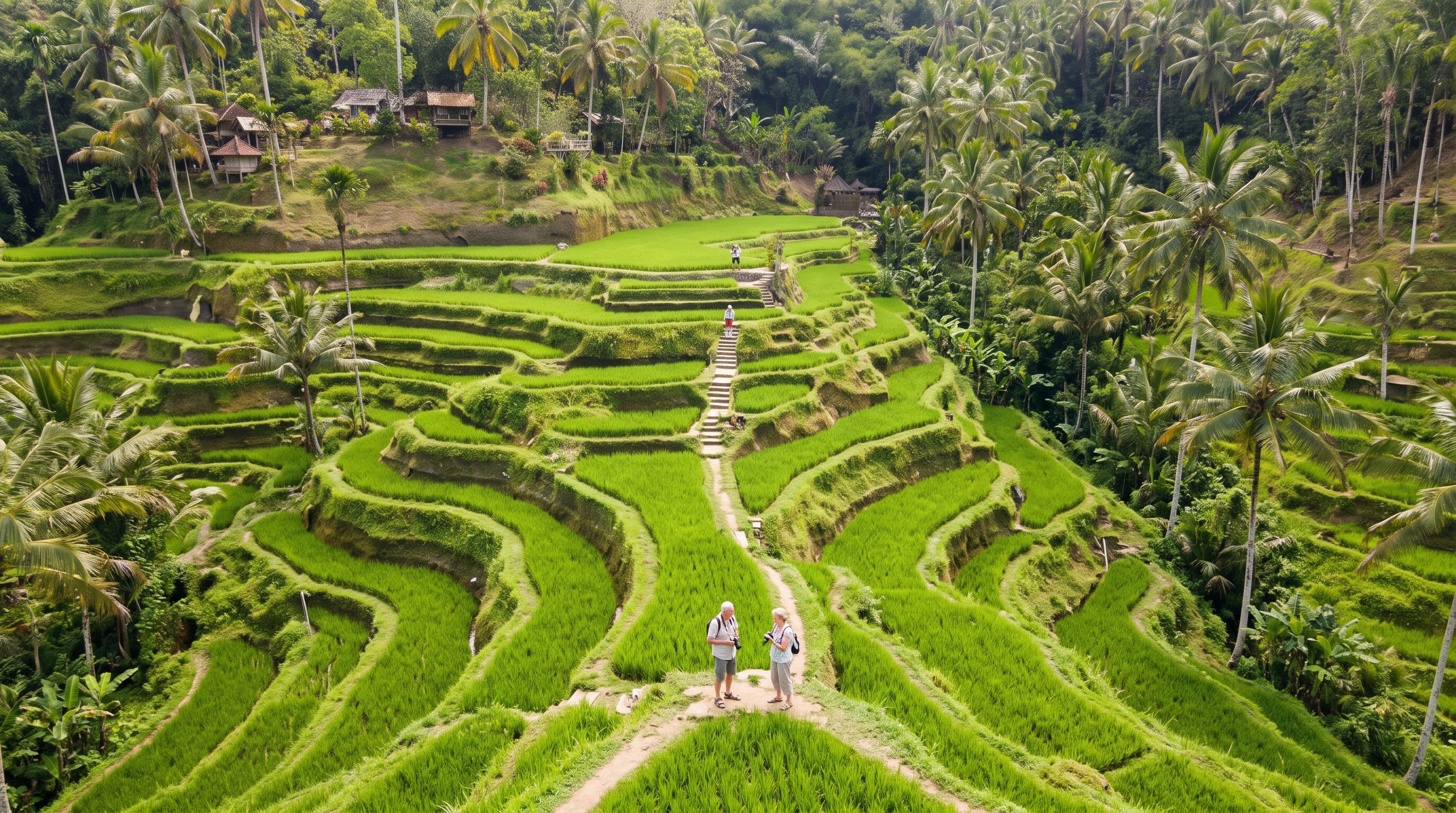
The rice terraces near Ubud divide neatly into two experiences, and the choice between them matters more for travellers in their fifties and sixties than for anyone else. Tegallalang, about 9 km north of Ubud, offers the quickest payoff: a 600-metre roadside ridge along Jalan Raya Tegallalang where cafés and viewpoints look straight across the Ceking valley, according to the terrace's own visitor information. Jatiluwih, an hour west in Tabanan Regency, spreads across a UNESCO-listed cultural landscape where colour-coded trails run from roughly 1 km to 7 km. One rewards a short stop; the other rewards a full day.
Both are working farms, not theme parks. Tegallalang's information page describes three main levels of stepped paddies dropping down the west side of the valley, with steep, uneven stone steps and narrow dirt tracks that have no handrails. Jatiluwih's official site asks every visitor to stay on designated paths and forbids vehicles on the trekking routes. Understanding that distinction, between looking and walking, is the whole planning exercise.
Which terrace suits which kind of traveller?
Tegallalang suits anyone who wants the classic view with minimal effort: the ridge, the cafés and the Abian Desa viewpoint are reachable without descending. Jatiluwih suits travellers who want a proper walk through farmland, with routes from about 1 km to 7 km and far thinner crowds. Neither offers a documented step-free circuit.
The two places have different characters. Tegallalang is busy and commercial in patches, with infinity-pool cafés such as Tis Cafe and Cretya Ubud lining the upper ridge, according to the terrace's own about page. Jatiluwih is quieter and agricultural: guest feedback gathered on Google describes it as notably less crowded and less commercial than other Bali rice terraces, with no swings or zip lines, and many visitors reporting long stretches walked almost alone.
Distance decides a lot. Tegallalang is a short hop from Ubud, easily combined with a morning in town (our guide to getting around Ubud by private driver, Grab or shuttle covers the logistics). Jatiluwih is roughly an hour's drive each way, and a September 2025 traveller account on Reddit describes leaving Ubud at 9 a.m. and reaching the Jatiluwih temple area around 10.45 a.m., which turns the trip into a full-day outing rather than a quick stop.
How do you see Tegallalang without the steep descent?
Stay on the ridge. The primary viewpoint stretches 600 metres along Jalan Raya Tegallalang, looking directly across the gorge, and the terrace's own information states that wheelchair users cannot reach the valley floor but can view the complex from the flat roadside sidewalk or the Abian Desa viewpoint. Cafés along the upper ridge offer seating with the same outlook.
This is the gentle version, and it is genuinely satisfying. The northern end of the terraces near Abian Desa features wider, flatter paths that see far less foot traffic, according to the terrace's about page. Roadside parking costs 5,000 IDR for scooters and 10,000 IDR for cars.
Shade is the thing to plan for. Tripadvisor reports little or no shade on some walking paths at Tegallalang, so a café table is not just comfort but shelter from the midday sun.
 AI-edited
What does the full Tegallalang walk actually involve?
The loop is short in distance but demanding in effort. The terrace's information page states that trekking the loop involves a 1,000-foot elevation gain and loss, with steep, uneven stone steps and narrow dirt tracks without safety handrails. Visits average 1 to 1.5 hours. Guests with knee trouble may prefer the café.
The descent drops toward the valley floor and then climbs the opposite side between the paddies. Guest feedback collected on Google is consistent on this point: the full trek circuit is demanding and involves considerable climbing, and visitors with limited mobility or bad knees may prefer to enjoy the view from a café rather than walk the full route. The same feedback notes that some sections have no safety rails at viewing points above sizeable drops, and that the route system may not allow returning the same way, sometimes requiring a long detour.
One guest, writing on Google in September 2026, put the circuit's appeal plainly:
"Amazing views and hiking path, we took a round tour, u don't have to return on the same way." (Google, September 2026)
Footwear matters. Multiple reviews recommend shoes with grip, because the clay trails turn slick after heavy downpours. The terrace's own page warns that heavy rain from November to February often makes the lower valley paths completely impassable, and advises checking local conditions before the 9 km drive from Ubud.
Which Jatiluwih route matches your energy?
Jatiluwih's official site lists colour-coded routes: Red takes around 60 minutes, Green runs 6 km, and Blue covers 7 km as the longest trekking course. A shorter red loop of about 1.5 km and 30 to 45 minutes is included in the admission ticket, according to recorded route information. Check the route board at the start, because published colours and lengths have changed between descriptions.
The official Jatiluwih attraction page gives three routes in its own wording: Red as the briefest course at around 60 minutes, Green at 6 km along the rice fields, and Blue at 7 km, described as the longest trekking course and suited to expert trekkers. Recorded route information from other guides describes a wider set of colour-coded loops, from roughly 1.5 km to 5.5 km, with the longest taking about 3 to 4 hours. The two descriptions do not match, so treat the board at the entrance as the authority on the day.
Guest feedback on Google describes the shorter trails dropping through the middle of the terraces, a few hundred metres down to the river or valley, then back up for a total of 1.5 km, while other trails run around the perimeter of the fields at about 5 km. The longer routes descend into the valley and demand more time, stamina and attention on uneven agricultural paths. They suit active walkers in dry weather.
Can you enjoy Jatiluwih without a long walk?
Yes. Roadside viewpoints and dining pavilions at Jatiluwih are reported as accessible, while the trekking routes use earthen irrigation paths and earthen steps.
The official site requires every visitor entering the rice-terrace area to hold an entrance ticket and to follow the designated path. Motorbikes and other vehicles are prohibited on trekking routes. Sacred areas and temples at Jatiluwih may require entry with a guide, according to a travel guide about the site.
Facilities along the way are documented in guest feedback: small warungs, cafés and stalls sell drinks, snacks and local produce such as vanilla beans and red rice. A commercial guide reports shaded resting pavilions, toilets and possible golf-cart or gentle-route assistance at the Jatiluwih information kiosk, but this is not an official statement and availability should be treated as unconfirmed. The official site does not document step-free routes, lifts, wheelchairs, senior fares or a formal assistance service.
What does entry cost, and when should you arrive?
Tegallalang's main walking paths cost 25,000 IDR in cash, per the terrace's own hours and fees page, which lists daily opening from 07:00 to 18:00 and advises arriving before 09:00 to avoid heat and tour buses. Jatiluwih's official site lists foreign-adult admission at 75,000 IDR. Neither publishes a senior concession.
Sources disagree on several figures, and it is worth knowing that before you arrive. Reported Tegallalang charges range from 15,000 to 20,000 IDR at access booths, 25,000 IDR for the main walking paths, and 10,000 to 50,000 IDR depending on the entrance or activity. One guide reports 25,000 IDR for foreign adults and 15,000 IDR for foreign children, while the terrace's own page states the main-path fee as 25,000 IDR cash. Crossing private land or small bamboo bridges requires donations of 10,000 to 20,000 IDR, and credit cards are not accepted anywhere on site, including the donation points.
Jatiluwih's entrance prices are listed on its official site at 75,000 IDR for foreign adults, 50,000 IDR for foreign children, 25,000 IDR for domestic adults and 15,000 IDR for domestic children. Another source reports 40,000 IDR for foreign adults, so verify the tariff at the official entrance. Guest feedback notes the fee is collected in cash, with card payment available but unreliable, and that drone use carries an additional 300,000 IDR fee.
| Detail | Tegallalang | Jatiluwih |
|---|---|---|
| Foreign adult entry | 25,000 IDR (main paths, cash) | 75,000 IDR |
| Foreign child entry | 15,000 IDR (one guide's figure) | 50,000 IDR |
| Domestic adult entry | Not stated on the official page | 25,000 IDR |
| Published hours | 07:00 to 18:00 daily | Sources differ: 06:00 to 19:00, 07:00 to 18:00, or 08:00 to 18:00 for outside visitors |
| Advance booking | Not required | Not required for entry; guided trekking and cycling should be booked at least two days ahead |
| Senior concession | None documented | None documented |
Hours at Jatiluwih are not consistent across sources. The official site's published schedule differs from other guides, one of which reports last access at 17:00. Confirm on arrival. Neither terrace documents a regular weekly closing day or a scheduled maintenance closure.
When are the terraces at their best?
Early morning. Tegallalang's own page recommends arriving before 09:00 to avoid heavy midday heat and large tour buses, and Jatiluwih's official site recommends arriving between 08:00 and 10:00. Guest feedback gathered on Google similarly points to arriving before roughly 08:00 to 10:00 for fewer crowds, cooler weather and softer light.
At Tegallalang, the calmest documented window is 07:00 to 09:00, before larger tour buses arrive after 10:00. A visitor-information page specifically advises avoiding approximately 10:00 to 14:00 during the busy July and August period. Reviews collected on Tripadvisor consistently recommend comfortable footwear and an early arrival.
At Jatiluwih, mornings and late afternoons are reported as offering the best photographic light, though no source specifically identifies a low-crowd period. The official site advises bringing raincoats or umbrellas. Heavy rain can make the earthen paths slippery, particularly during the wet season, reported as November to March by one source. The terraces' appearance varies by season; after harvest the fields may be dry, yellow or water-filled rather than green, and a Bali travel-tips discussion from August 2025 noted that September can show a mix of green, golden and freshly cut fields.
How do you get there, and what should you carry?
Tegallalang is about 9 km north of Ubud by car. Jatiluwih is roughly an hour's drive west in Tabanan Regency, and direct scheduled public bus service is described as limited, so most visitors arrive by private car, taxi or organised tour. Carry cash, grip-soled shoes, water and a rain layer.
For travellers who prefer not to self-drive, our guide to small-group and guided tours of Ubud and Bali sets out what organised options involve. At Jatiluwih, guided trekking and cycling should be booked at least two days ahead according to one source, with cycling sold by the tourism village from 470,000 IDR and guided trekking from 450,000 IDR. A self-guided shorter visit, buying the entrance ticket and walking at your own pace, is also documented.
Medical provision is not documented at either site. No source identifies a pharmacy, clinic, first-aid station or nearest hospital specifically for Tegallalang or Jatiluwih. A Ubud travel guide lists 110 for police, 119 for ambulance and 113 for fire, but the source does not identify these as numbers specific to either terrace. Carry any medication you need and tell your driver where the nearest clinic is before you set out.
One more caution from guest feedback: some sections at Tegallalang have no safety rails at viewing points above sizeable drops, and the route system may not allow returning the same way. If you are walking alone or with a companion who tires easily, agree a turnaround point before you descend.
What else is nearby, and how fragile is this landscape?
Tegallalang sits close to other Ubud-area sights, while Jatiluwih stands alone in Tabanan. The UNESCO World Heritage Committee expressed concern in 2025 about the impacts of tourism and associated development, particularly in the Jatiluwih area, and described the landscape as extremely fragile, according to a recent account summarising that decision.
The same account reported that the traditional subak irrigation institutions appeared to be at a tipping point, with urgent action needed on permits, land sales and development control. Tegallalang is not itself identified as one of the UNESCO-listed component sites, which distinguishes the famous Tegallalang viewpoint near Ubud from the five component areas included in Bali's inscription. Jatiluwih's irrigation works through the subak system, a traditional cooperative arrangement managing rice-water distribution, and visitors are instructed not to pick rice, fruit or other plants and to remain on designated paths.
Near Tegallalang, the Toya Ubud eco-park and resort in Kenderan Village had a soft launch in November 2024 and was fully open by February 2025, according to the Bali regional tourism publication GoBali, which notes that visitors combining viewpoints, short walks and a waterfall visit may encounter a more developed visitor environment than in older descriptions of the area. For a gentler day in town, see our guide to seeing Ubud with little walking and out of the heat. Volcano hikes are a separate subject with their own dedicated guide.
How should a traveller in their 50s or 60s plan the day?
Match the terrace to your knees, not to the photographs. If steps are a concern, take Tegallalang from the ridge and Jatiluwih from the viewpoints and the short red loop. If you walk regularly, the Tegallalang circuit and Jatiluwih's longer colour-coded routes are within reach in dry weather. Start early, carry cash, and leave the afternoon free.
For the leisurely plan, Tegallalang works as a two-hour morning: arrive by 08:00, park on the ridge, take coffee at a café with a valley view, walk the flat roadside sidewalk toward Abian Desa, and be back in Ubud before the heat. Jatiluwih, if you go, rewards the viewpoint and the 1.5 km red loop, with a warung lunch on site.
For the active plan, Tegallalang's loop takes 1 to 1.5 hours with a 1,000-foot elevation gain and loss, so poles and grippy shoes help. Jatiluwih's longer routes take three to four hours on uneven agricultural paths, best in dry weather and with a rain layer in the bag.
Two final practical notes. Rates and hours are indicative and vary by season and by the entrance used; sources disagree on several figures, so confirm at the ticket booth. And the terraces are farms first: stay on the paths, respect the subak system that waters them, and the landscape will still be worth the drive when you next return.


