
Ubud rewards a slower rhythm than most Balinese destinations. The town is small at its centre, the surrounding villages are not, and the heat builds through the middle of the day with a persistence that makes a midday rest a practical necessity rather than a luxury. For travellers aged 50 to 70, the most comfortable shape for five days is one base, no repacking, a single substantial outing each morning, and an afternoon that belongs to you. Bali.com notes that Ubud's climate is significantly cooler and wetter than the coast, and that walking the town is best done in the cooler, drier mornings and late afternoons.
This plan uses central Ubud as the fixed base for all five nights. It covers the palace and the water temple, the monkey forest, a spa afternoon, a dance performance, and two optional outings for those who want them: the Campuhan Ridge Walk and the Tegallalang rice terraces. A private car with driver handles anything outside the centre.
Why does one base work better than moving around?
Central Ubud is compact enough to walk in parts, and a single base removes the daily packing, transfer and reorientation that wears travellers down. Bali.com describes the centre of Ubud as "not too big at all," while the wider area people call Ubud is large and somewhat undefined. Staying central keeps the palace, market and water temple within a short walk.
The distinction matters. Bali.com notes that some hotels are up to 30 minutes from the centre, set in nature and river valleys, and that many of these run free shuttles to the palace or market a few times a day. A shuttle is workable, but it ties your day to someone else's timetable. For a five-day programme built on early starts, a central base is simpler.
Ride-hailing apps are restricted in Ubud. Bali.com states that they do not operate here, or are only allowed to drop guests arriving from outside Ubud. That makes a hotel-arranged car or a pre-booked driver the reliable option for outlying sights, and it is worth confirming with your accommodation before you arrive.
Day 1: What should you see in central Ubud on arrival day?
Keep the first day level and close. Ubud Palace (Puri Saren Agung), the traditional market next door and Pura Taman Saraswati sit within a few minutes of each other in the flat heart of town. Bali.com describes the palace as the former royal residence in the centre of town, open to visitors, with a large traditional market just next door.
Daytime access to the palace's outer courtyards is reported as free, with hours listed as 08:00 to 18:00. The palace remains associated with traditional Balinese arts, and evening dance performances are held there; published listings commonly report performances at about 19:30, with tickets around IDR 100,000 to 150,000. Confirm the schedule locally on the day.
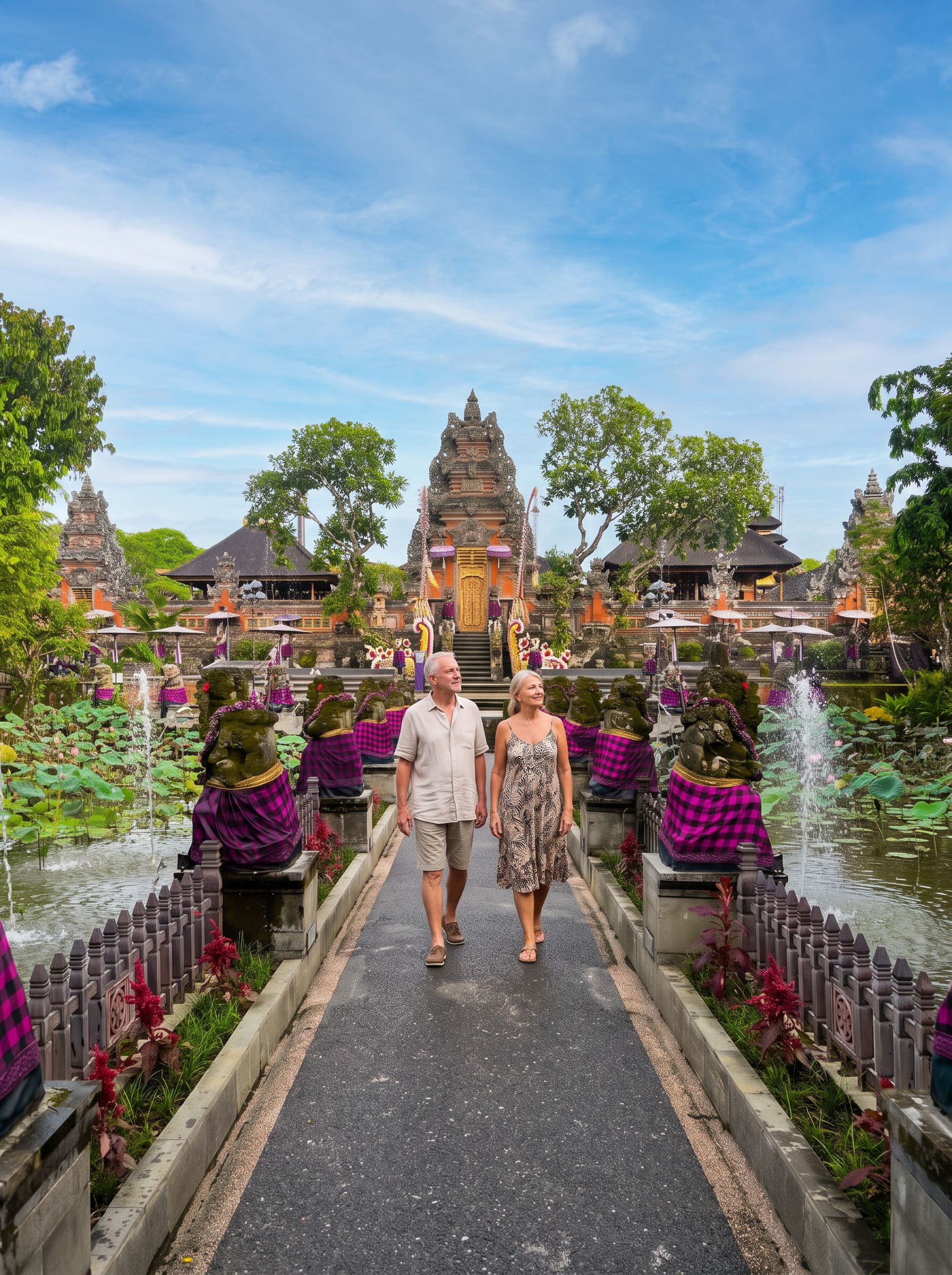
Pura Taman Saraswati, the water temple known for its lotus pond, can be viewed from the outer grounds without an admission charge according to one source, with reported hours of 08:00 to 19:00, extending to 21:30 on Fridays. Guest feedback gathered on Google describes the temple as compact, easily seen in roughly 10 to 45 minutes, and notes that the entrance fee includes loan of the required traditional attire. Visitors cannot enter the inner temple and are limited to the front courtyard and ponds.
 AI-edited
"There are also beanbags right next to the pond under the shade of some trees. I think that might have been my favourite place to sit and have a drink - the view was stunning and it was lovely lounging in the shade for a bit." (Google, March 2026)
For the evening, a dance performance is the natural close to day one. Bali.com notes that dances and performances are regularly held in several venues across Ubud. Our guide to the art, dance and crafts of Ubud sets out what to expect from the different forms.
Day 2: How do you handle the Sacred Monkey Forest comfortably?
Arrive at opening. The Sacred Monkey Forest Sanctuary opens at 09:00 and the calmest reported window is 09:00 to 10:00, before heat and crowds build. Adult admission is IDR 130,000 and child admission IDR 100,000, with last entry at 17:00. Reviews gathered on Google recommend arriving around opening for cooler temperatures and fewer people.
The sanctuary covers approximately 12.5 hectares and is home to about 1,000 long-tailed macaques. It is both a forest and a temple complex, with moss-covered statues and shrines among massive trees. As of November 2026, its Google rating stands at 4.5 out of 5 from 60,118 reviews.
Two practical points. First, the paths. Reviews describe some routes with steep stairs and narrow ramps, and note the terrain is not suited to wheelchairs. Second, the monkeys. Bali.com advises caution, noting they can be quite aggressive. Reviews consistently advise securing sunglasses, hats, water bottles, bags and jewellery in a zipped bag, and not carrying food.
Spend the afternoon at your hotel. This is the pattern that makes the whole five days work: one outing, then shade, air-conditioning and rest through the hottest part of the day.
Day 3: Is the Campuhan Ridge Walk worth it, and who should skip it?
It is worth it if you are steady on your feet and start early. The Campuhan Ridge Walk is a free hillside trail along a narrow ridge between two river valleys, with limited shade and a flight of steps near the start. Early morning, around 05:30 to 07:00, is recommended in one itinerary source.
Sources describe different route lengths rather than a single standard distance: one gives a roughly 1.5-hour return walk, another a longer route of approximately 4 to 5 km one way to Bangkiang Sidem. Much of the path is paved, but some sections are uneven, and there is an initial ramp and a flight of steps followed by gentle undulations. The trail is not documented as fully accessible. No lift, handrail provision, accessible toilet or formal mobility assistance is documented.
If that sounds like too much, the day still works. Bali.com notes that Ubud has many museums showcasing the lives and works of local artists and expatriates, some dating back 50 years or more. A museum morning followed by a long lunch is a perfectly good substitute.
Either way, keep the afternoon free and book a spa session. Bali.com describes Ubud as having fantastic spas and being a great place to pamper yourself with a traditional massage or herbal treatment. The town's name derives from the word ubad, meaning "medicine," reflecting its historical role as a centre for medicinal plants and healing. Spa booking systems, cancellation terms and any reduced rates for older guests are not documented; ask your hotel to book and confirm the terms in writing.
Day 4: Should you add the Tegallalang rice terraces?
Only if everyone in the party is comfortable with hills, steps and uneven ground. Tegallalang lies north of Ubud, charges approximately IDR 50,000, and a suggested visiting window is 07:30 to 09:00. Paths may be unpaved, uneven, muddy or slippery, with steep sections and drops beside the terraces.
This is the day to use a driver. The terraces are outside central Ubud and are not reliably step-free, so a private vehicle to the entrance and a short, pre-agreed route is more practical than attempting to walk from town. Exact step counts, lift provision and a standard walking distance are not documented. No pharmacy, clinic or medical post at the terrace is documented either.
If the group is mixed, split the morning. The terraces suit those who want the walk; a driver can take others to a café with a view and collect everyone afterwards. A gentler northern alternative reported in traveller discussions is a drive to a Kintamani café for volcano views, lunch and a hot spring such as Toya Devasya, described as among the more tourist-friendly options, though entry ladders there still require care.
On the volcano sunrise: Mount Batur trekking is best avoided for this audience unless everyone is fit and specifically wants a strenuous hike. Traveller discussions note the early transfer alone can take a couple of hours before the climb begins. If you do want a volcano sunrise, treat it as the only activity of that day and rest beforehand.
Day 5: What does a visit to Tirta Empul involve?
Tirta Empul is a Hindu water temple associated with purification rituals, open daily from 07:00 to 18:00 with payment on arrival. Adult admission is IDR 75,000, children aged 5 to 12 pay IDR 50,000, and under-fives enter free, following a fee update on 1 January 2025. One source describes the site as mostly flat, though full step-free access is not established.
Go early and go with a driver. Exact steps, lift provision, accessible toilets and route distances are not documented, so ask your driver or the temple directly if you have mobility concerns. No pharmacy or medical facility within the complex is documented. Temple-specific dress requirements are not detailed; confirm clothing rules with the temple or your accommodation before departure, and follow temple instructions on site.
No over-65 or senior fare is documented at any of Ubud's principal attractions, and no verified multi-attraction pass covering the main sites is documented either. International visitors separately pay the Bali Tourist Levy of IDR 150,000 through the official Love Bali portal, which is not an attraction admission fee.
Return to Ubud for a final afternoon rest and a last dinner in town. Ubud's nightlife ends much earlier than in Kuta or Seminyak, per Bali.com, which suits an early start home.
How do you manage heat and health across the five days?
One substantial outing in the early morning, then shade, air-conditioning or a rest period during the hottest part of the day. That is the guidance, and it is the single most useful rule for this itinerary. Daytime highs sit near 29 to 31°C year-round, with the wetter season roughly November to March.
Two medical facilities are documented for the Ubud area. UbudCare Clinic 24 Hours on Jalan Raya Teges No. 8 in Peliatan records 24-hour emergency care, doctors, laboratory services, an on-site pharmacy for patients receiving treatment, and ambulance service, on 0811 3977 911. BIMC Ubud Medical Centre on Jalan Raya Sanggingan No. 21 in Kedewatan records 24-hour emergency and general-practitioner services and pharmacy services for prescribed medication. RSUD Gianyar is reported as the closest 24-hour hospital to Ubud, approximately 13 km east.
Recorded Bali emergency numbers include 112 for general emergencies, 110 for police and 118 or 119 for ambulance services, per Bali.com's emergency numbers page. Mosquito protection is advised in Ubud's vegetated environment, and dengue is identified as a local health concern. Our guide to health, vaccinations and peace of mind in Ubud covers the detail.
On footwear: traveller reports consistently mention humidity, mud and slippery stone, and recommend shoes with reliable grip. A small flashlight is suggested for dimly lit alleys.
How do you get around without wearing yourself out?
Walk short, familiar stretches in the centre and use a private car with driver for everything else. Central Ubud is the most manageable area on foot, especially around the palace and market, but it should not be treated as reliably step-free. Reported problems include narrow or broken pavements, missing slabs, open drains, high kerbs and scooters blocking the walking surface.
One traveller report describes curbs as high as 40 cm. Another notes that the main stretch around Monkey Forest Road is passable but that sidewalks become uneven and slopes increase toward the forest. A private car with driver is identified as the most flexible option for temples, museums, rice terraces and medical appointments.
Arriving from the airport: I Gusti Ngurah Rai International Airport (DPS) is 42 km from Ubud by road, about 35 minutes with clear roads and no stops. The realistic planning figure is longer during congestion. The airport's official taxi counter is in the arrivals hall, and recorded advice is to obtain the fixed-zone fare and receipt there before proceeding to the vehicle. Our guide to getting to Ubud, flights and Denpasar transfers has the full picture.
Note that a high-street bridge collapsed on 19 December 2025, sending central Ubud into gridlock according to Bali Discovery. Allow extra transfer time and confirm current road access locally if your dates fall near any disruption.
When should you go, and what should you check before booking?
The drier season runs roughly April to October, with May, June and September identified as the preferable shoulder months. July and August are the busier peak period. August is the driest month in the climate series, with 90 mm of rain, while January is the wettest at 325 mm.
| Month | High / Low | Rainfall | Note |
|---|---|---|---|
| May | 30.2°C / 20.7°C | 124 mm | Good shoulder-season option |
| June | 29.5°C / 19.9°C | 129 mm | Cooler nights, manageable rain |
| August | 29.0°C / 19.8°C | 90 mm | Driest month; busy season |
| September | 29.7°C / 20.3°C | 123 mm | Dry-season shoulder month |
| January | 29.7°C / 21.7°C | 325 mm | Wettest month; allow indoor alternatives |
Nyepi, Bali's annual Day of Silence, normally falls in March and brings island-wide restrictions on movement and normal tourism operations, including in Ubud, for approximately 24 hours. Do not schedule an essential outdoor activity on that day. Temple access and roads can also be restricted around religious ceremonies. Our guide to when to visit Ubud for dry days and fewer crowds goes further.
No reliable, Ubud-wide calendar of maintenance or revision closures was identified. Individual temples, museums, spas and attractions may close temporarily for ceremonies, maintenance or private events, so confirm immediately before visiting.
What should you confirm before you travel?
Confirm four things: your driver arrangements, your spa booking terms, the dance performance schedule for your dates, and whether your hotel runs a shuttle. None of these is documented as a single official booking system across Ubud's sights, so each needs a direct enquiry.
- Driver: agree the morning route and the waiting arrangement in advance, and keep the driver's contact details to hand.
- Spa: ask for cancellation terms in writing; these are not documented in the sources consulted.
- Dance performance: schedules should be checked locally, and booking and cancellation terms for performances are not documented.
- Hotel shuttle: many hotels outside the centre run free shuttles to the palace or market a few times a day, per Bali.com.
- Room choice: if noise matters, ask for a room away from bars and roads when booking.
Accommodation is covered in its own guide, including Ubud hotels worth booking for the food. Rates across Ubud are indicative and vary by season and booking channel.
Five days at this pace leaves room for the things that make Ubud what it is: a temple courtyard in the cool of the morning, a long lunch, a dance performance after dark, and an afternoon that asks nothing of you at all.


