
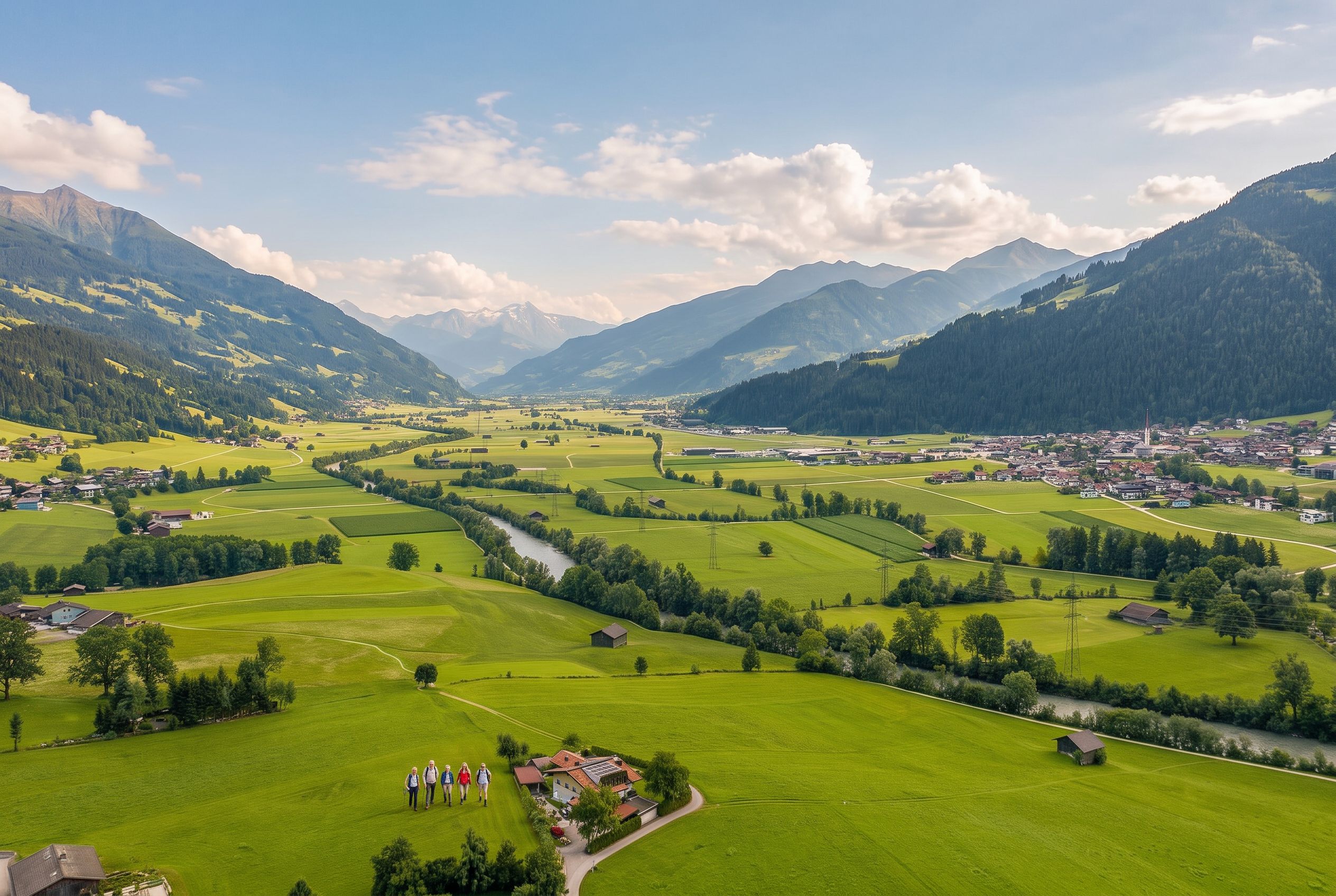
Located in the heart of Tyrol, Austria, the Zillertal is a long, glacier-fed valley that stretches more than 47 kilometres from the Inn River valley south to the year-round ice of the Hintertux Glacier at 3,250 metres. For travellers aged 50 to 70, it offers something increasingly rare in the Alps: a genuine working valley where dairy farms, family-run hotels, and modern cable cars coexist without pretence. This guide is designed to help you understand how the valley is laid out, where to base yourself, and how to match the pace of your visit to your own comfort and energy levels—whether you are a keen skier, a gentle hiker, or someone who simply wants to sit on a sunny terrace with a view of three-thousand-metre peaks.
 AI-edited
How is the Zillertal laid out?
The Zillertal runs from Jenbach in the north to the Hintertux Glacier in the south; the Tirol tourist board puts the valley at more than 47 kilometres, of which the Zillertalbahn covers the 32 kilometres from Jenbach to Mayrhofen. The main towns are Zell am Ziller (mid-valley), Mayrhofen (the largest resort, 8 km south of Zell), and then the smaller villages of Schwendau, Hippach, Ramsau, and Ginzling leading up to the glacier. Understanding this north-south spine is essential for choosing your base.
The valley is served by the Zillertalbahn, a narrow-gauge railway that runs from Jenbach (where it connects to mainline trains from Innsbruck and Salzburg) all the way to Mayrhofen. From Mayrhofen, buses continue south to the glacier. The valley floor is relatively flat, with the Ziller River running alongside the railway line. Most of the major cable-car systems branch off from the main valley: the Spieljochbahn near Fügen, the Zillertal Arena lifts at Zell am Ziller, and the Penkenbahn and Ahornbahn at Mayrhofen. Further south, the lifts at Ramsau and the Hintertux Glacier complete the network.
This linear layout means that moving between towns is straightforward by train or bus, but it also means that if you choose a base in Mayrhofen, you will need to factor in 15–20 minutes of travel to reach the Zillertal Arena slopes or the Spieljoch area. For travellers over 50 who prefer to stay put once they arrive, choosing a base that aligns with your primary activity is the single most important planning decision.
Choosing a base: Mayrhofen or Zell am Ziller?
Mayrhofen is the valley's largest resort, with the widest range of restaurants, shops, and après-ski options, plus direct access to the Penkenbahn and Ahornbahn cable cars. Zell am Ziller is smaller, quieter, and more affordable, with a more authentic Tyrolean character. Your choice depends on whether you prioritise convenience and variety or peace and value.
Mayrhofen is the undisputed hub of the Zillertal. It has a lively main street, a train station, a bus station, and two major cable-car systems. The Penkenbahn offers a barrier-free ride to the Penken plateau, which connects to the wider Ski- & Gletscherwelt Zillertal 3000. The Ahornbahn, Austria's largest aerial tramway, rises from 680 to 1,980 metres onto the Ahorn plateau, a gentler, sunnier area popular with families and leisurely walkers. As of August 2026, the Neuhaus Zillertal Resort in Mayrhofen holds a Google rating of 4.3/5 from 1,430 reviews and 4/5 on Tripadvisor from 704 reviews.
Zell am Ziller, by contrast, feels like a real town rather than a purpose-built resort. Its main square hosts the annual Gauder Fest on the first weekend in May — Austria's largest spring and traditional-costume festival, with roots reaching back to a market first recorded in Zell in 1428, and on the UNESCO list of intangible cultural heritage since 2014. Accommodation tends to be in family-run pensions rather than large hotels, and prices are noticeably lower. The Zillertal Arena cable car departs from the edge of town, giving access to a large, interconnected ski area that crosses into the neighbouring Gerlos valley. Zell trades the bigger resort's choice of restaurants and evening entertainment for lower prices and a quieter village centre.
The cable-car network: what you need to know
The Zillertal's cable-car network is among the most modern and accessible in the Austrian Alps. Most major lifts feature heated, barrier-free gondolas with ground-level entry, making them suitable for travellers with limited mobility. The key systems are the Penkenbahn and Ahornbahn in Mayrhofen, the Zillertal Arena lifts at Zell, and the Hintertux Glacier gondola.
The Penkenbahn is a 3S tricable gondola that leaves from the centre of Mayrhofen and reaches 1,790 metres in about eight minutes. The Mayrhofner Bergbahnen describe it as the lift with the highest documented level of accessibility in their network, with slowed-down cabins at boarding and turnstiles designed for wheelchair users. From there, a network of chairlifts and gondolas connects to the wider Zillertal 3000 area, which includes the neighbouring Tuxer Glacier. The Ahornbahn, on the other side of Mayrhofen, rises to 1,980 metres, where you will find a large sun terrace, a children's playground, and easy walking trails.
At Zell am Ziller, the Zillertal Arena system uses a combination of gondolas and chairlifts to access a large, family-friendly ski area. The main gondola from Zell, the Rosenalmbahn, rises from 580 metres to the Rosenalm at 1,744 metres, from which you can ski or ride across to Gerlos and Königsleiten. Note that the Zillertal Arena is not directly connected by piste to the Mayrhofen area; a bus or train journey is required to switch between them.
The Hintertux Glacier gondola runs from the valley floor at 1,500 metres to the glacier at 3,250 metres, with intermediate stations at Sommerbergalm (2,100 m) and Tuxer Fernerhaus (2,660 m). The panorama terrace at the top is reached barrier-free — Austria's highest passenger lift takes wheelchair users and pushchairs up to it — but the accessible restaurants and toilets are lower down, at Sommerbergalm and Tuxer Fernerhaus. The Nature's Ice Palace below it is not step-free: the approach crosses about 200 metres of snow and there are short iron ladders inside.
Summer versus winter: which season is best?
Both seasons offer distinct advantages for travellers over 50. Summer (June to September) provides warm weather, long daylight hours, and gentle hiking on valley-floor paths, while winter (December to March) offers reliable snow, accessible skiing, and the unique experience of the Hintertux Glacier. The choice depends on your preferred activities and tolerance for crowds.
Summer in the Zillertal is ideal for those who enjoy walking, cycling, and mountain views without the physical demands of skiing. The valley-floor path along the Ziller, the Zillerpromenade, runs 8 kilometres from Zell am Ziller to Mayrhofen. The higher-altitude plateaus—Ahorn, Penken, and Spieljoch—offer gentle walking trails with minimal elevation gain, accessible via the cable cars. The Schlegeis Reservoir is reached by the 13-kilometre Schlegeis Alpenstraße toll road. The much-photographed suspension bridge belongs to the Olpererhütte at 2,387 metres: the shortest approach from the reservoir car park is 2.8 kilometres with 590 metres of ascent and takes about an hour and a half uphill, so it is a mountain walk rather than a stroll. VERBUND, which runs the dam, states that a visit to the dam wall is not possible barrier-free.
Winter brings reliable snow from December through March, with the Hintertux Glacier offering year-round skiing. The ski areas are well-groomed and suited to intermediate skiers, with plenty of wide, gentle runs. For non-skiers, winter walking paths have been developed in the Fügen-Kaltenbach region, and the Therme Zillertal in Fügen is a popular refuge on cold days. The main drawback of winter is the early darkness (sunset around 4:30 PM) and the need for careful planning around bus and train schedules.
According to climate data from Klimatabelle Zillertal, July is the warmest month, with daytime highs reaching 21°C and nights around 12°C, but it also has the most precipitation days (15 a month). June and September offer slightly cooler conditions and, in September, fewer wet days. In winter, January is the coldest month, with highs around 0°C and lows around −7°C in the valley.
How accessible is the Zillertal for travellers with mobility concerns?
The Zillertal is one of Austria's leading regions for barrier-free tourism. Most cable cars have ground-level entry, many hiking trails are asphalted or well-fortified, and all Zillertalbahn trains are equipped for wheelchairs, with the low-floor services listed per connection in the timetable. However, some older village sidewalks and mountain paths remain uneven, so requesting level-access accommodation is recommended.
The region's official tourism body promotes "barrierefreier Urlaub" (barrier-free holidays) with a dedicated section on its website listing accessible hotels, restaurants, and attractions. The Therme Zillertal in Fügen (formerly the Erlebnistherme Zillertal, same site at Badweg 1) documents barrier-free entrances and comfortable pool entries; it publishes nothing about a pool hoist, adapted changing rooms or roll-in showers. The FeuerWerk wood experience centre in Fügen is listed in the regional accessibility leaflet as only partly accessible, and for the museum in Zell am Ziller — the Regionalmuseum Zillertal on Talstraße — no lift is documented.
For mountain access, all four Mayrhofner Bergbahnen feeder lifts — Ahornbahn, Penkenbahn, Horbergbahn and Möslbahn — have barrier-free boarding, and the operator singles out the Penkenbahn as the one with the highest documented level of accessibility. Two paths up there are listed as wheelchair-usable: from the Penkenbahn top station to the Gschösswand, and around the reservoirs at the Kombibahn Penken top station. Above Zell, the Fichtenweg circles from the Rosenalmbahn top station past the Fichtensee at 1,700 metres on a made-up forest track, though the operator notes it has steeper stretches and advises going with a companion. Barrier-free toilets are documented at the valley stations of the Ahornbahn and Horbergbahn in Mayrhofen and at the Rosenalmbahn valley, mid and top stations in Zell. At the Hintertux Glacier, Austria's highest passenger lift carries wheelchair users up to the panorama terrace at 3,250 metres. The valley-floor Zillerpromenade carries no wheelchair rating; what the operator documents is that it suits families with pushchairs.
One caveat: none of the valley's published lift-pass tariffs has a senior rate — there are adult, youth and child prices only. What does exist is a disability reduction: on the Snow Card Tirol, holders of an original disability pass from 60 per cent pay the youth rate (EUR 982 instead of EUR 1,227 for the 2026/27 season), and both the Mayrhofner Bergbahnen and the Zillertal Arena grant their reductions at the ticket desks only.
What is the realistic pace for a visit?
A week is the ideal length for a first visit, allowing you to settle into a comfortable rhythm without feeling rushed. Plan for one major activity per day—a morning on the mountain, a leisurely lunch, and an afternoon at a spa or exploring a village. Avoid the temptation to pack in multiple cable-car systems in a single day.
The Zillertal rewards a slower pace. The valley is long, and moving between towns takes time. A typical day might involve a morning cable-car ride to a mountain plateau, a gentle walk of 1–2 hours, lunch at a mountain hut, and a return to the valley by mid-afternoon for a rest or a visit to a thermal spa. The Therme Zillertal is an excellent afternoon option, with warm pools, saunas, and a relaxation area that requires no physical exertion.
For those who prefer to stay on the valley floor, the Zillerpromenade offers a scenic walk that can be done in sections. The path is 8 kilometres from the Zillerbrücke in Zell am Ziller to Mayrhofen — roughly two to three hours at a leisurely pace — and a bridge at 1.5 kilometres lets you cross and return along the other bank. The operator's own tip is to break the walk with a slice of cake in one of Zell's pastry shops.
Public transport tips for seniors
The Zillertalbahn train and regional buses are reliable and accessible, but evening services are limited. The last bus of the day leaves Hintertux Gletscherbahn at 20:30 and reaches Mayrhofen at 21:08, and missing it can leave you stranded. Use the ÖBB Scotty app to check real-time schedules, and always have a backup plan.
The Zillertalbahn runs every half hour between Jenbach and Mayrhofen during the day, and the trip takes about 50 minutes; early morning and evening gaps are longer. Every Zillertalbahn train is equipped for wheelchairs, but whether a given service runs with a low-floor carriage is shown per connection in the timetable enquiry, and a wheelchair space has to be booked by telephone in advance. There is room for luggage, and bicycles other than the railway's own rental bikes need a EUR 5 ticket. From Mayrhofen, bus route 4104 continues south to Hintertux; the ride takes about 40 minutes. The Verkehrsverbund Tirol cannot give low-floor information online and asks passengers to contact the operating bus company beforehand, so check the vehicle when a step-free boarding matters.
For winter visitors, the digital guest card doubles as a free ticket on the Zillertalbahn between Jenbach and Mayrhofen from early December to mid-April, tied to the validity of the Zillertaler Superskipass, and the village ski buses are free in winter as well. In summer the same guest card covers the Sommershuttle S1 and S2 and the Gäste- und Dörferbus; the wider Zillertal Activcard, valid from May to October for 3, 6, 9 or 12 days, is a paid card that adds the cable cars and admissions.
Checking the last departure matters most on the side-valley routes — the buses to the Schlegeis Reservoir and up to the Hintertux Glacier finish earliest. The ÖBB Scotty app provides real-time information and is available in English.
Where to find medical care?
Medical facilities are well-distributed across the valley. Public pharmacies are in Zell am Ziller, Mayrhofen, Ramsau, Fügen, Kaltenbach, Stumm and Aschau; Gerlos and Tux have only doctors' dispensaries. The nearest hospital is the Bezirkskrankenhaus Schwaz, about 35 kilometres and 35 minutes by road from Zell am Ziller. Austria's round-the-clock health advice line is 1450, staffed by qualified nurses and free of charge from anywhere in the country.
For minor ailments, the Gerlosstein Apotheke in Zell am Ziller (Dorfplatz 3a, +43 5282 2641) and the Steinbock Apotheke in Mayrhofen (Hauptstr. 444, +43 5285 62313) are the main pharmacies. Both can advise on over-the-counter medications and coordinate with local doctors if needed. The medalp Sportclinic Zillertal at Stillupklamm 830 in Mayrhofen specialises in injuries from leisure and sports accidents; it publishes no statement about step-free access, so call ahead if that matters.
For more serious medical needs, the Bezirkskrankenhaus Schwaz (district hospital) is the nearest full-service hospital. There is no direct train, so by public transport it means the Zillertalbahn to Jenbach and a change there. The hospital has an emergency department and is equipped to handle a wide range of conditions. The regional tourist board, Zillertal Tourismus, publishes its directories at zillertal.at.
What about costs and budgeting?
The Zillertal is moderately priced by Austrian standards. A week-long stay in a family-run pension in Zell am Ziller might cost €700–€1,000 per person including half-board, while a resort hotel in Mayrhofen can range from €1,200–€2,000. A day pass in the Zillertal Arena costs €82 for adults from 08:00 in the 2026/27 season, with cheaper afternoon starts and multi-day rates.
Accommodation is the largest expense. Zell am Ziller offers better value, with many pensions charging €80–€120 per night for a double room with half-board. Mayrhofen hotels are generally 20–30% more expensive, but they offer more amenities such as spa facilities, indoor pools, and evening entertainment. The Neuhaus Zillertal Resort, for example, has a large garden, a natural swimming pond and a 5,800-square-metre bathhouse that opened on 16 December 2024.
Dining is reasonable. A main course in a mountain hut costs €12–€18, while a three-course dinner in a valley restaurant runs €25–€40. Groceries from the local Spar or MPreis supermarkets are affordable, and many pensions offer packed lunches for hikers.
Lift passes are a significant cost. From two days upwards there is only one product, the Zillertaler Superskipass, and it is valid across the whole valley: six days cost €399 for adults in the 2026/27 season, five days €372.50, seven days €458.50. As noted, none of the operators has a senior rate, but the digital guest card carries you free on the Zillertalbahn between Jenbach and Mayrhofen from early December to mid-April, which offsets some of the cost.
| Expense category | Budget (€) | Mid-range (€) | Premium (€) |
|---|---|---|---|
| Accommodation (7 nights, half-board) | 700–900 | 1,000–1,400 | 1,500–2,000 |
| Lift pass (6 days, Superskipass) | 399 | 399 | 399 |
| Meals & drinks (outside half-board) | 150–250 | 250–400 | 400–600 |
| Local transport (bus/train) | 50–80 | 50–80 | 50–80 |
| Spa/wellness entry | 50–80 | 80–120 | 120–200 |
| Total estimate | €1,349–1,709 | €1,779–2,399 | €2,469–3,279 |
What are the best gentle activities for non-skiers?
For non-skiers, the Zillertal offers a wealth of gentle activities: the Zillerpromenade for walking and cycling, the Therme Zillertal for relaxation, the barrier-free panorama terrace on the Hintertux Glacier for the view, and the FeuerWerk wood experience centre for cultural interest. Effort varies, so check each one before you go rather than assuming it is step-free.
The Zillerpromenade is the valley's most straightforward gentle activity. It runs alongside the Ziller between Zell am Ziller and Mayrhofen — 8 kilometres in that direction, 4 kilometres to Aschau and 8 to Kaltenbach the other way — and the operator rates it a comfortable, easy walk that also suits families with pushchairs. E-bikes can be rented in both towns.
The Therme Zillertal in Fügen is a modern thermal spa with indoor and outdoor pools, saunas, steam rooms, and a relaxation area. On accessibility the operator documents barrier-free entrances and comfortable pool entries, and nothing about a hoist into the water or adapted changing rooms. A three-hour adult ticket costs €19 and a day ticket €34.20, with a 10 per cent surcharge at weekends and on public holidays; the baths open daily from 10:00 to 22:00, the sauna area from 13:00, and close only for the annual overhaul (7 to 20 June 2027).
The Nature's Ice Palace on the Hintertux Glacier is a natural ice cave beneath the glacier, and it does ask something of you: the operator describes about 200 metres over snow between the top station and the entrance, roughly 100 of them downhill and back uphill afterwards, recommends firm ankle-high shoes with a good grip, and points out the short, cold iron ladders inside. The reward is walking through ancient ice at 3,250 metres. If that is more than you want, the panorama terrace at the same top station is step-free.
For a cultural activity, the FeuerWerk in Fügen presents the story of wood across eleven stations, with a rooftop garden 16 metres up and the SichtBAR restaurant; the regional accessibility leaflet lists it as only partly accessible. The Erlebnissennerei Zillertal at Hollenzen 116 in Mayrhofen shows milk becoming cheese across eleven stations on 6,000 square metres, is open daily 09:00 to 17:00 with last admission at 16:15, and is one of the excursions the leaflet does list as barrier-free.
What do other travellers over 50 say?
Guest reviews consistently highlight the friendly staff, good food, and clean, comfortable rooms across the valley. Recurring concerns include the lack of senior discounts, the need for good hiking boots even on "easy" trails, and the early departure of evening transport. Planning ahead is the key to a stress-free visit.
Recent guests at the Neuhaus Zillertal Resort in Mayrhofen praise the "exceptionally friendly and attentive staff" and the "huge selection" at the breakfast buffet. The hotel's central location is also frequently mentioned: the Penkenbahn base station is under a kilometre away, the Ahornbahn about 1.6 kilometres. Some guests note that the spa area is "small" with a "lukewarm jacuzzi" and that rooms in the older wing feel "more basic." There is no conventional air conditioning, but the hotel says the chilled water from its groundwater plant tempers the public areas and the newer guest rooms.
The point worth taking seriously is that a route graded "easy" here can still contain short steep or uneven stretches, which matters a great deal if your knees or balance are not what they were. Walking boots with a proper sole and ankle support are worth the space in the case.
The Zillertal is a working valley rather than a purpose-built resort, and its highest reaches feel correspondingly unpolished. That is much of the appeal — provided you build the day around the timetable rather than against it.
"Great skiing and views across the alps. Can get windy at times. Was very quiet when we were there, which was great." — from a Google review of the Hintertux Glacier, January 2025
How to get there?
The Zillertal is easily reached by train. Take the ÖBB (Austrian Federal Railways) to Jenbach station, which is on the main line between Innsbruck and Salzburg. From Jenbach, transfer to the Zillertalbahn narrow-gauge railway for the 50-minute journey to Mayrhofen. By car, take the A12 Inntal Autobahn to the Jenbach exit, then follow the B169 south.
By train, the journey from Innsbruck to Jenbach takes 18 to 25 minutes, with several services an hour. From Salzburg, the journey takes about 2 hours. The Zillertalbahn from Jenbach to Mayrhofen runs every half hour during the day, and all its trains are equipped for wheelchairs; the timetable enquiry shows which services use a low-floor carriage, and a wheelchair space is booked by telephone. The nostalgic steam train, which runs on selected summer dates, is barrier-free too: a carriage with a lifting platform and a compartment for passengers with reduced mobility travels with it, and the crew helps with boarding.
By car, Innsbruck to Jenbach is about 35 kilometres and half an hour; Mayrhofen is about 68 kilometres and an hour. The B169 road follows the valley south, and parking is available at most hotels and cable-car base stations. Note that the Schlegeis Alpenstraße, which leads to the Schlegeis Reservoir, is a toll road: €19 per car, or €17 with the Zillertal guest card. In 2026 it runs from mid-May to 26 October, and the operator warns that start, end and daily hours can change at short notice with the weather and avalanche situation.
For air travellers, Innsbruck Airport (INN) is the closest, with direct flights from several European cities. Munich Airport (MUC) is about 2.5 hours away by train or car, and Salzburg Airport (SZG) is about 2 hours away. All three airports have good public transport connections to Jenbach.
What should I pack?
Pack layers, sturdy walking shoes or boots, a rain jacket, sunscreen, and a hat. In summer, valley temperatures run from about 12°C at night to 21°C by day, and it is colder the higher you go, so a fleece or light jacket is essential for the mountains. In winter, valley lows sit around −7°C in January and drop further on the glacier, so thermal underwear, a warm coat, gloves, and a hat are necessary.
For summer hiking, a small rucksack with water, snacks, and a first-aid kit is recommended. Many travellers over 50 also carry a walking stick for stability on uneven sections. What matters more than the brand is a boot that is broken in before the trip and has a sole with real grip on wet rock.
For winter, ski clothing is essential if you plan to ski or snowboard. For non-skiers, warm, waterproof boots with good grip are important for walking on icy paths. The winter walking paths in the Fügen-Kaltenbach region are generally well-maintained, but ice can form in shaded areas.
Regardless of season, a reusable water bottle is useful, as tap water in the Zillertal is safe to drink and of excellent quality. A small umbrella or rain poncho is also advisable, as afternoon thunderstorms are common in summer.


