
Chiang Mai rewards the traveller who chooses carefully. The Old City is flat and compact, which suits slower walkers, but its lanes carry traffic, temple loudspeakers and, on Sunday evenings, a walking market that closes the main road near Tha Phae Gate. For travellers aged 50 to 70 who wake at the smallest sound, the difference between a restful week and a broken one is rarely the hotel's star rating. It is the room's position, the street outside and the hour at which the neighbourhood goes quiet.
Where a detail is not documented, this guide says so rather than guessing. Rates are indicative and vary by season and booking channel.
Which areas of Chiang Mai are quietest for light sleepers?
Nimmanhaemin reads as more mixed in the available hotel feedback. The busiest nightlife corridors, particularly around Chang Klan and the Night Bazaar, are the areas most likely to disturb sleep.
Chiang Mai's urban core is compact, which is good news for anyone who prefers to walk less and ride more. The Old City sits inside a moat and is described as flat, though its sidewalks can be uneven and obstructed. That combination, level ground but imperfect paving, is worth knowing before booking. Our guide to how accessible Chiang Mai is for older travellers covers the city-level picture in more detail.
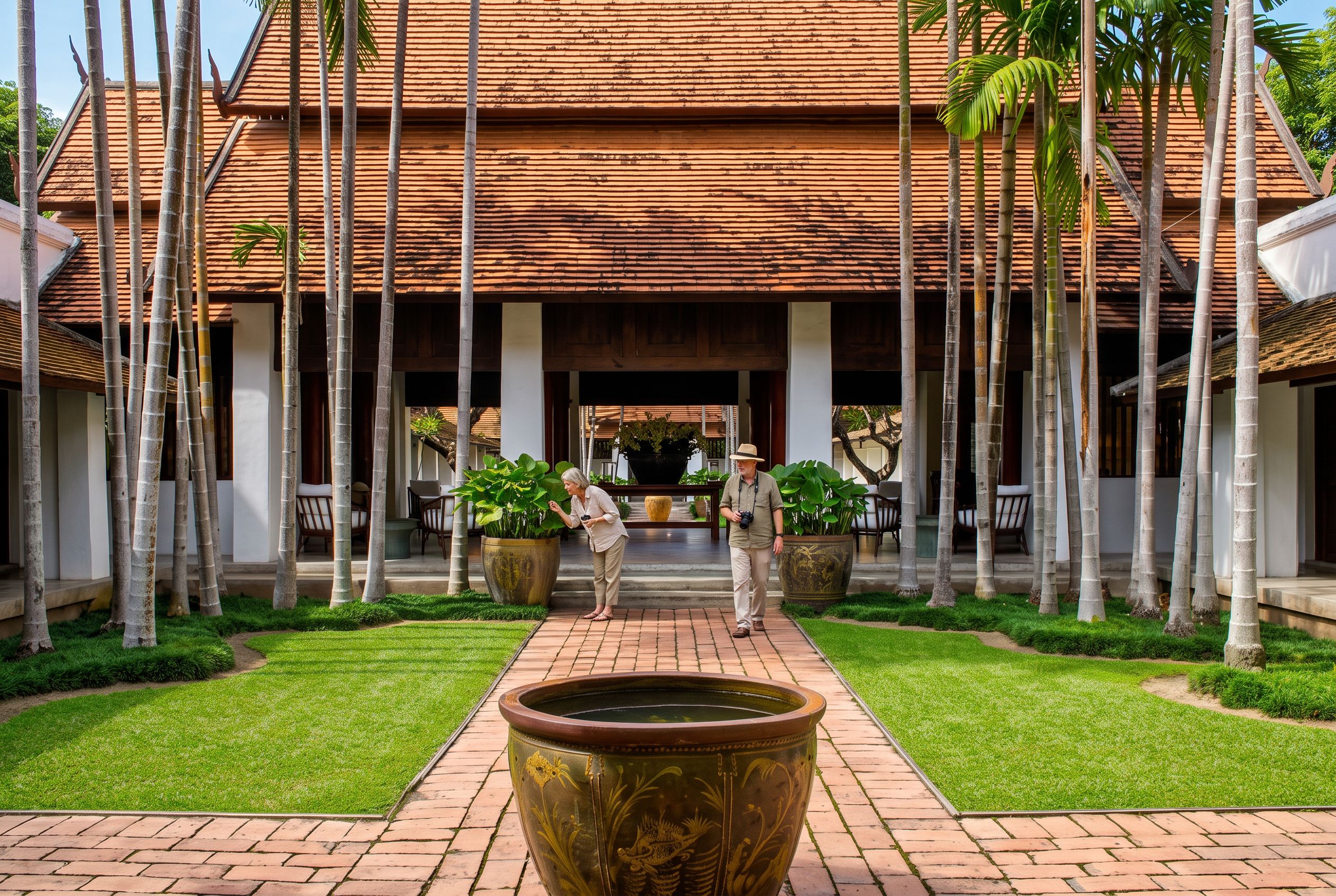
Within the Old City, the pattern that emerges from guest feedback is consistent: properties on quiet lanes, set back from main roads, or arranged around a courtyard tend to deliver better nights than those on the main thoroughfares. A budget guesthouse on a quiet Old City soi was reported by one traveller as quieter than a higher-end property in Nimman, which suggests construction quality and the mix of guests matter more than price. If you are still deciding between districts, choosing your base in Chiang Mai sets out the trade-offs.
 AI-edited
Which Chiang Mai hotels do guests describe as quiet?
U Chiang Mai, G Nimman Chiang Mai, Lis Hotel Chiangmai, My Chiangmai Boutique Lodge, The Rim Chiang Mai and De Lanna Boutique Hotel all carry quiet-stay evidence. Estia Chiang Mai Boutique Hotel documents lift and step-free access but states that noise-free guestrooms cannot be guaranteed.
U Chiang Mai is repeatedly described as tranquil, with noise undetectable to some reviewers, and it sits centrally in the Old City. The caveat is significant for anyone with mobility limits: the property has no elevator and multiple reviews mention stairs, uneven steps and some half steps. Staff carry bags, but the source warns mobility-limited guests to consider the stairs. Walk-in or roll-in shower details are not documented.
G Nimman Chiang Mai and Lis Hotel Chiangmai have the strongest documented combination of quiet rooms and accessibility. Both report room insulation that minimises outside noise, step-free routes, grab bars and walk-in showers. G Nimman has three elevators; Lis has spacious lifts. Both record a walkability score of 72 out of 100, and the nearest hospital is eight minutes from G Nimman and seven from Lis.
My Chiangmai Boutique Lodge sits on a calm lane with no busy traffic noise, roughly a 12-minute walk from Tha Phae Gate. There is no lift, and the source advises requesting a ground-floor room if stairs are difficult. Some reporting notes road noise in certain rooms and mosquitoes around the pool and open lobby.
The Rim Chiang Mai is described by guests as quiet and peaceful despite a main-road setting, with a pool-facing room recommended. De Lanna Boutique Hotel uses a courtyard layout that buffers city noise and is generally not noisy at night, though street-side rooms can hear traffic. It has stairs only, with lower-floor rooms suggested.
What should travellers with mobility needs check before booking?
Lift access, step-free routes and walk-in showers are documented for G Nimman Chiang Mai, Lis Hotel Chiangmai, Estia Chiang Mai Boutique Hotel, The Opium Chiang Mai and Tapae Place Hotel Chiangmai. For U Chiang Mai, My Chiangmai Boutique Lodge and De Lanna Boutique Hotel, stairs are documented and lifts are not.
Accessibility documentation in Chiang Mai is patchy, and the city itself is described as moderately accessible rather than fully step-free. Poorly maintained sidewalks are a known issue, though Grab and private taxis, songthaews and hotel shuttles can make getting around workable.
It is worth relying on:
- G Nimman Chiang Mai: step-free routes throughout, three elevators, grab bars, walk-in showers.
- Lis Hotel Chiangmai: step-free routes throughout, spacious lifts, grab bars, roll-in showers.
- Estia Chiang Mai Boutique Hotel: lift, wheelchair-accessible path to the lift, wheelchair-accessible registration desk, step-free path to entrance. Walk-in shower details are not documented.
- The Opium Chiang Mai: lift, wheelchair-accessible path to lift, accessible restaurant, concierge desk, lounge, gym and parking. Rainfall showerheads and bathtub-or-shower bathrooms are documented.
- Tapae Place Hotel Chiangmai: lift, handrails in stairwells, wheelchairs on site, well-lit path to entrance, step-free entrance and a pool access ramp. Walk-in shower details are not documented.
That is planning information, not a verdict: ask the property directly about your specific room. Where a hotel does not publish step counts or shower types, confirm when booking.
What noises actually disturb guests in Chiang Mai?
The most common complaint is not internal hotel noise but sound entering from outside or adjacent spaces. Poor soundproofing appears repeatedly when guests describe disturbed sleep. Temple loudspeakers, school music, nearby bars and road traffic are the recurring sources.
Dusit Princess Chiang Mai is the clearest example, with a Tripadvisor review stating that soundproofing is poor and that connecting-room noise affected comfort. One stay there was disturbed by children's voices and footsteps around 5 a.m.
At Chala Number 6, a Tripadvisor review reports that rooms next to a school heard constant music, singing and screaming from morning until about 5 p.m. Booking.com snippets for a Chiang Mai property report loud live music from a nearby bar audible in rooms.
Travellers also warn against stays close to Zoe in Yellow, where music can run until around 1 a.m., and against Nimman properties near aircraft paths or nightclub noise. The practical lesson is that a quiet street does not guarantee a quiet room. Hallway noise, neighbouring rooms and other guests can dominate if soundproofing is weak. Earplugs are worth packing even for properties that look peaceful on the map.
"Noise travels from this area until early hours," a Tripadvisor review of one central Chiang Mai hotel reported, while another review of the same property described it as quiet because it is set back from the main noise.
That contradiction is not unusual. It reflects room placement more than the hotel itself.
How much does room placement change the experience?
Enormously. The same property can produce a silent night or a broken one depending on which side of the building you are on. Pool-facing, courtyard-facing and end-of-hallway rooms are the ones guests most often recommend.
The Rim Chiang Mai is a good illustration. Guests describe it as quiet and peaceful despite its main-road position, and some specifically recommend a pool-facing room and a room away from the main street. De Lanna's courtyard layout buffers city noise, with some rooms in a quiet inner area, but street-side rooms can hear traffic.
My Chiangmai Boutique Lodge shows the same pattern: the lane is calm with no busy traffic noise, yet some reporting notes road noise in certain rooms. At Chiang Mai Hotel, one Tripadvisor review says the hotel is quiet because it is set back from the main noise, while another says noise travels from the area until early hours.
Two further points from guest feedback are worth carrying into any booking. Older buildings with thick concrete walls tend to be quieter, and the best chance of a quiet room rises with price. Neither is a guarantee, but both are reasonable filters when comparing options.
When is the quietest time to visit Chiang Mai?
September is often one of the quietest and cheapest months, because crowds and prices are near yearly lows. The cool, dry season from November to February is the most comfortable for outdoor travel but also the busiest. March to May is hot; June to October is wet.
Chiang Mai's climate divides into three broad periods. According to Thailand weather by month, the city's wettest month is August at 223 mm, its driest is February at 10 mm, its hottest is April with a 37°C average high, and its coolest nights fall in January at 16°C. Annual rainfall is about 1,139 mm.
December and January are the coolest months, with Chiang Mai nights at 16 to 17°C. Rainy season runs mid-May to October, and rain falls mostly as one to two hour afternoon downpours rather than all-day washouts. If heat and humidity are a concern, our guide to coping with Chiang Mai's heat and humidity covers the practical side.
For light sleepers, the season matters in a second way. A large, older hotel can feel eerily quiet in low season because there may be very few guests, which cuts both ways: fewer neighbours, but also less staff presence. May can be low season, improving availability and reducing crowding in some areas.
How do you get around quietly and safely?
Grab and reputable taxis are the practical choice, especially after dark. Songthaews are the most common form of public transport but carry no seat belts or other safety equipment. The RTC Chiang Mai City Bus runs air-conditioned services on nine routes.
Chiang Mai is described in current travel guidance as one of Thailand's safest cities for visitors, with the main concerns being traffic crashes, seasonal smoke and petty scams rather than violent crime. For visitors staying quietly and walking less at night, transport safety is the more relevant risk.
According to Visit Chiang Mai's transport guide, a songthaew is a converted pick-up truck with two rows of back benches, seating between eight and ten adults. It has no seat belts and no other safety equipment on board. Licensed airport taxis operate at Exit 9 of the arrivals hall at Chiang Mai International Airport, and many hotels offer airport transfers.
For medical planning, city-centre sources consistently point to Chiang Mai Ram Hospital as the major private hospital in town, with Bangkok Hospital Chiang Mai and Maharaj Nakorn also named as emergency-capable. Pharmacy access is described as plentiful city-wide, with Boots and Watsons branches easy to find on major roads and at Central Festival. For an exact quiet hotel, the nearest hospital and pharmacy are not documented.
What else should light sleepers plan for?
Book a room away from the elevator and away from connecting doors. Ask specifically about the room's orientation. Confirm lift access and shower type in writing if either matters. And check whether your dates coincide with the Sunday Walking Street market, which closes the main road near Tha Phae Gate.
Several practical points recur across guest feedback. Connecting rooms are a common source of disturbance, so request a room without one. Rooms facing roads, schools, bars or pool-adjacent activity are the ones most often reported as noisy. Low-rise boutique hotels away from nightlife are generally safer bets than central party-adjacent properties.
Booking terms are not documented for most of the properties named here. Ask the property directly.
My Chiangmai Boutique Lodge is described as helping arrange tours and airport cars. For the other properties, operator-run activities such as guided tours, classes, rentals, shuttles or seasonal events are not documented. Senior or over-65 fares and reduced tariffs are not documented for any of these hotels.
Which hotels make the shortlist?
G Nimman Chiang Mai, Lis Hotel Chiangmai, The Rim Chiang Mai and Estia Chiang Mai Boutique Hotel carry the clearest mix of calmness, location and accessibility data. U Chiang Mai is very quiet and central but has no elevator and multiple stairs.
For travellers aged 50 to 70 who sleep lightly, the decision usually comes down to two questions: how quiet is the room, and how easily can I move around once I am there. The four properties above answer both with documentation rather than assumption.
If stairs are not a concern and quiet is the priority, U Chiang Mai's tranquillity is well attested. If a lift matters, G Nimman and Lis are the ones with the clearest evidence. If you want a central Old City base with a pool and can manage without documented lift access, The Rim Chiang Mai fits. And if you want a smaller, central property with lift access and a five-minute walk to the Sunday Walking Street Market, Estia is documented for the access, though it states that noise-free guestrooms cannot be guaranteed.
Whichever you choose, ask about the room's position before you confirm. In Chiang Mai, the room matters more than the hotel.


