
Chiang Mai rewards the traveller who plans around energy rather than against it. The old Lanna capital is flat where it counts, compact enough that two temples can fill a morning, and calmer than Bangkok by a wide margin. It is also a city of uneven pavements, high kerbs and temple thresholds, which means the honest answer to the accessibility question depends less on the city than on how each day is assembled. This guide reads the ground itself: what is level, what is stepped, where the air-conditioned rest stops are, and how Doi Suthep's staircase compares with the lift beside it.
Is Chiang Mai accessible for travellers who tire easily?
Chiang Mai is only partly accessible. The Old City is flat and compact, but pavements are a patchwork of uneven slabs, tree roots and high kerbs, with dropped kerbs rare. Modern malls, private cars and flatter attractions make the city workable with planning, but it is not a step-free destination overall.
That reading comes through consistently. One senior travel guide describes Chiang Mai as "moderately accessible", noting a flat Old City alongside uneven sidewalks and stairs at some attractions, and observing that major temples are often only partially step-free. A separate travel guide puts it more bluntly, saying the city is not really wheelchair-friendly, citing inconsistent or absent sidewalks and many buildings without ramps or elevators.
Traveller reports gathered from forums in 2025 and 2026 echo the same pattern. A September 2026 wheelchair thread concluded the city "won't be perfect" and that sidewalks were in poor condition everywhere. A 2025 thread noted that many sidewalks lack wheelchair cutouts, and that near the moat almost all sidewalks are inaccessible in that regard. A February 2025 report from a traveller staying in Nimman described walkability as quite poor, with broken or hazardous sidewalks that forced walking in the street.
One recurring surprise is how much easier malls and modern venues are than streets, temples or old-city walking routes. Another is that a wheelchair symbol on a map app proves very little: a January 2026 discussion warns that even where Google Maps shows one, the place may still fail on details such as restrooms or internal steps.
What are the Old City pavements and kerbs actually like?
The Old City is flat and compact for slow temple-hopping, but its sidewalks are uneven and often obstructed. Sturdy shoes and steady walking are recommended, and a folding chair can help where shoe removal at temple entrances is difficult.
The flatness is genuine and it matters. Chiang Mai's Old City temple core is compact enough for temple-hopping on foot, with Wat Phra Singh and Wat Chedi Luang both standing inside the walls. For a traveller who tires easily, that geography is a gift: short distances between stops, and the option to sit in a shaded compound between them.
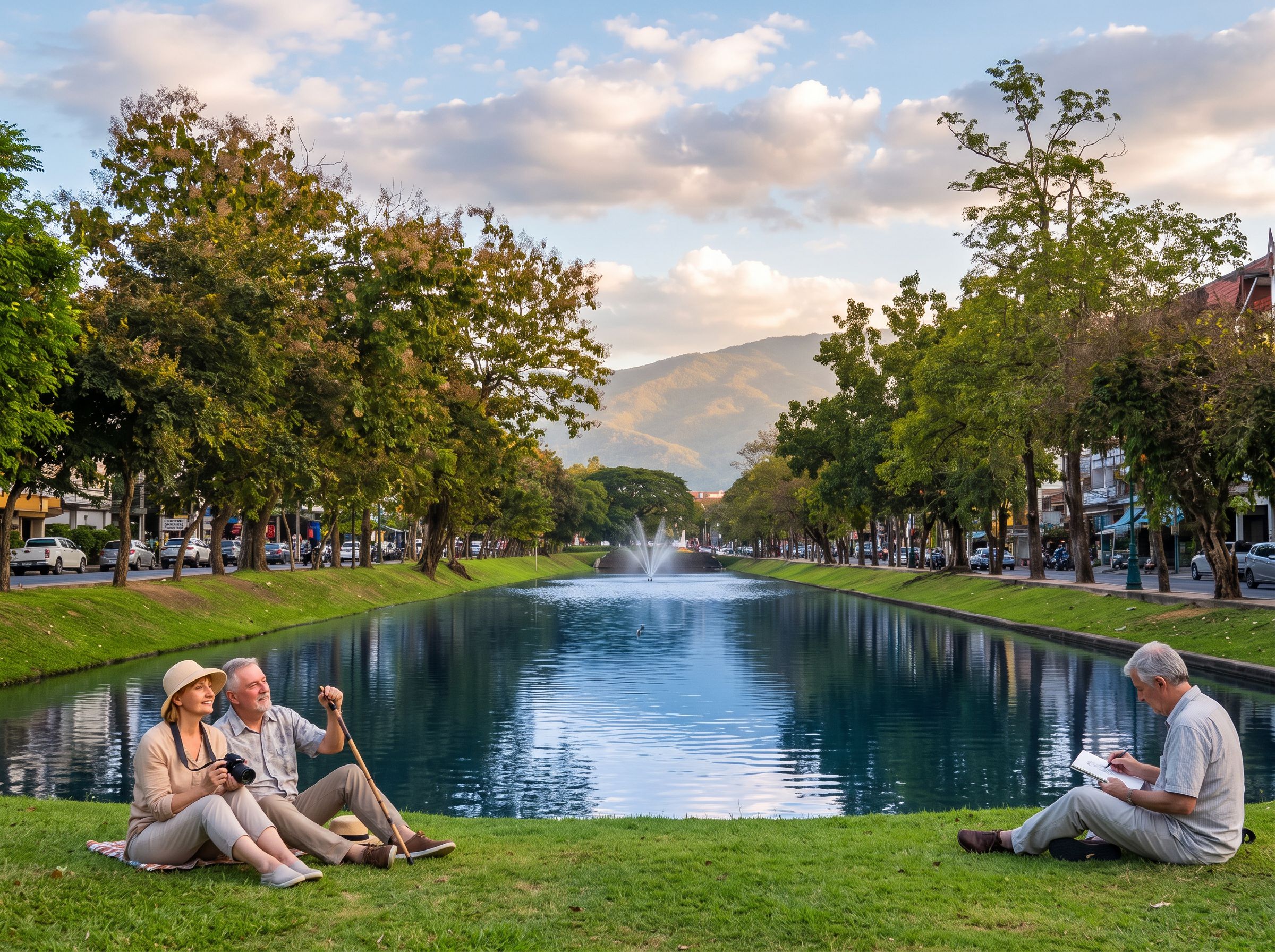
The surface underfoot is the complication. Pavements in older areas are described as a patchwork of uneven slabs, tree roots and high kerbs, with dropped kerbs rare. One source describes the Old City temple area as a calm, steady-paced place for slow temple-hopping, but it does not give a precise time window, so the calmest hour of the day is not documented.
 AI-edited
Two practical habits come out of the traveller threads. A February 2026 discussion recommends starting early and using a driver or guided transport for temple visits, because some places are manageable only if you reduce the walking between stops. Another thread suggests carrying a portable folding chair if shoe removal at temples is difficult, so you can sit while changing footwear.
Which temples and sights are step-light?
Wat Phra Singh has a broad, largely flat and paved compound, though some buildings still have steps at the threshold. Wat Chedi Luang sits on the flat Old City circuit and is mostly step-free at ground level. Royal Park Rajapruek, Art in Paradise and Wat Umong are also described as manageable.
Wat Phra Singh is the strongest candidate for a first temple visit. Its compound is broad, largely flat and paved, with room to move between halls, though some buildings still have steps at the threshold. Mobility at this site is documented as largely flat and paved with a few threshold steps; health provision, safety details, booking and assistance services are not documented.
Wat Chedi Luang appears as part of the flat Old City temple circuit and as mostly step-free at ground level. Beyond that, specific mobility details are not documented, so it is worth asking at your accommodation what the current situation is before you commit a whole morning to it.
Beyond the Old City, several sites come up repeatedly in traveller reports:
- Royal Park Rajapruek is described as having wide paved paths, accessible trams and golf carts available for visitors with limited mobility. Exact ticketing and booking rules are not documented.
- Art in Paradise Chiang Mai is described as fully air-conditioned, step-free and accessible. Booking and cancellation terms are not documented.
- Wat Umong was described in a February 2026 family-oriented thread as fully accessible, even for those in wheelchairs.
- Chiang Mai Zoo & Aquarium has hilly terrain but offers tram rides and accessible viewing areas for much of the exhibits.
- Queen Sirikit Botanical Gardens was suggested as having wheelchair access and suiting a nice half day stroll.
- Jing Jai Market was described as wheelchair accessible in two separate threads, including one that called the weekend market enormous and fully accessible, and another that recommended it for wider aisles than many markets.
Two further notes belong here. Chiang Mai National Museum has a ground floor that is wheelchair accessible by a side ramp, while the second floor is reached only by stairs, so visitors who cannot use stairs will miss part of the collection. The museum is open Wednesday to Sunday, 09:00 to 16:00, and closed Mondays, Tuesdays, national public holidays and during the four Songkran days in mid-April, according to published visitor information for the museum. The Treasury Museum on Rachadamnoen Road is free to enter and stands out for accessibility features including Braille panels designed for visually impaired visitors, with Tuesday hours of 13:00 to 16:30 and Saturday hours of 13:00 to 18:00, per the museum's published listing. It is closed on Mondays.
Doi Suthep: the 306 steps versus the lift
Doi Suthep is defined by its 306-step naga staircase, but a covered funicular-style lift runs beside it for about 20 baht on top of the foreigner entry fee. The upper terrace is mostly level after arrival. Reports also describe a tram service that bypasses most of the stairs.
This is the single most useful piece of accessibility information in Chiang Mai, because the site is one of the city's signature religious destinations and its staircase is a defining feature of the visit. Foreign visitors pay an entry fee, and the lift beside the staircase carries an additional charge of around 20 baht. Once you are up, the terrace is mostly level.
Traveller reports gathered in 2026 add detail. A January 2026 thread says the site has a tram service that bypasses most stairs, while another post says cable cars are available to help seniors and people with disabilities reach the temple area. The sources do not agree on the exact mechanism or reach of every assisted route, so confirm the current arrangement on arrival rather than relying on a single description.
Health provisions, safety details, the booking process, cancellation terms and staffed assistance services at Doi Suthep are not documented. The site does not publish step counts or lift dimensions. Ask on arrival, or ask your hotel to check before you set out.
Getting around when walking is difficult
Grab and private taxis are the most reliable option for door-to-door movement, and private drivers are often recommended for easier access. Traditional songthaews and tuk-tuks involve a high step up with little to hold on to, which is a barrier for some travellers with limited mobility.
What they do support is the practical conclusion that Grab and private taxis are usually the most convenient choice for accessibility. A January 2026 thread says Bolt is the easiest way to travel between places if walking is difficult, because it reduces the amount of walking required.
From the airport, the picture is clearer. The official airport transport pages list the RTC Chiang Mai City Bus as serving routes between Chiang Mai International Airport and key city points including the Old City, Night Bazaar, Nimmanhaemin, Chang Phuak Gate, Tha Pae Gate, Suan Dok and Central Airport, with a flat fare of 30 baht per trip for the city bus and 40 to 60 baht on the airport shuttle buses. Airport shuttle buses run on routes A1, A2 and A3, and airport vans are available from the international terminal gate 12, according to Chiang Mai International Airport's own transport information.
One recent travel guide cautions that airport bus services and public buses change over time, so the most predictable option after a long flight is often the official taxi counter or a pre-booked transfer. Airport transfer guides consistently describe the airport as very close to the old city, with typical taxi transfers taking about 10 to 20 minutes.
Where you sleep shapes how much you walk. Our neighbourhood guide to choosing your base in Chiang Mai covers that ground in detail; hotel-by-hotel access is outside this article's scope.
Where are the air-conditioned rest stops?
Modern malls are the most reliable air-conditioned refuges, and traveller reports single out Maya and Airport Plaza as wheelchair friendly. Art in Paradise is fully air-conditioned and step-free. Accessible restrooms can still be a problem even where a venue looks wheelchair-friendly on a map.
The mall point is worth taking seriously rather than treating as a compromise. A January 2026 discussion on limited mobility notes that the few reliably accessible places in Chiang Mai are usually large shopping malls once inside. That makes them useful anchors in a day: a cool, level place to sit, eat and reset between temple stops.
Art in Paradise Chiang Mai serves a similar function. It is described as fully air-conditioned, step-free and accessible, which makes it a sensible midday option when the heat is at its worst. Booking and cancellation terms are not documented.
Heat planning belongs alongside mobility planning here. If you are building a day around cool indoor pauses, our guide to coping with heat and humidity in Chiang Mai sets out the timing that works.
When should older travellers visit Chiang Mai?
November to February brings the most reliable weather, with December and January the coolest and driest. March to May is the period to think twice about because of smoke and heat. The rainy season runs June to October.
Temperature across the year ranges from about 15 to 36 degrees Celsius (59 to 97 Fahrenheit). For a traveller whose mobility is affected by heat or joint stiffness, that range is the single most useful planning figure in this article.
| Period | Conditions |
|---|---|
| November to February | Cool, dry, most reliable weather; December and January coolest and driest |
| March to May | Smoke and heat; the period sources suggest thinking twice about |
| June to October | Rainy season; shorter showers, lower prices, less predictable walking conditions |
For specific temples, museums and parks, access rules can vary, but no exact citywide closure schedule was documented.
Health, pharmacies and emergency numbers
Thailand's medical emergency and ambulance number is 1669 and the general police emergency number is 191. The Tourist Police line, 1155, is commonly cited for English-language assistance. Private hospitals in the city include Chiang Mai Ram Hospital and Bangkok Hospital Chiang Mai.
The broader documented hospital list for the Chiang Mai area includes Maharaj Nakorn Chiang Mai Hospital, Chiangmai Ram Hospital, Rajavej Hospital and Bangkok Hospital Chiang Mai.
Two honest gaps. No source naming the nearest pharmacy to Chiang Mai municipality was found, and the nearest pharmacy or clinic for each specific attraction is generally not documented; only citywide or hospital-level medical access is noted. The Chiang Mai municipality directory lists a hospital with a local phone number under Chiang Mai City Municipality but does not name it.
They do provide emergency contacts and indicate standard tourist-police and ambulance coverage. If you want a gentle, low-impact way to recover after a long travel day, our guide to Thai massage in Chiang Mai for the over-50s covers what to expect.
What is not documented, and what to ask instead
Exact step counts, lift dimensions, slope gradients, accessible restroom counts and door widths for the named places are not documented. Neither are online booking platforms, reservation procedures, cancellation policies or staffed assistance services for those places.
That list is worth reading as a checklist rather than a warning. Where a detail matters to you, the operator is the party that would publish it, and where they do not, ask directly before you travel.
- Ask your accommodation to confirm current access at a specific temple before you set out.
- Ask about restrooms at the venue itself, not from a map app. A January 2026 discussion warns that accessible restrooms can still be a problem even where a place looks wheelchair-friendly on a map.
- Ask whether a golf buggy or similar ad hoc assistance is available. A September 2026 wheelchair thread notes that some attractions may require a golf buggy or other ad hoc help rather than true step-free design.
- Confirm Doi Suthep's lift and any tram arrangement on the day.
Exact fees for each temple are not documented. No senior or over-65 fare, reduced tariff or age-based concession was documented for the specific Chiang Mai places named here, and none was documented for the city as a whole.
Looking ahead, several transport projects are in the pipeline. A planned Chiang Mai mass transit rail expansion, including a Red Line extension toward Royal Park Rajapruek and Chiang Mai Night Safari, was reported in December 2025 with a feasibility study and design under way. The reports available do not yet document completed wheelchair-accessible operation. Visitors should expect some route changes, congestion and possible sidewalk disruption in parts of the city centre and along north and south access corridors. If delivered as designed, the planned stations and Park & Ride sites would be useful for step-free access.
Chiang Mai works for travellers aged 50 to 70 who tire easily or use a stick, walker or wheelchair, provided the trip is built around short hops, cool pauses and confirmed access at each stop. It does not work on the assumption that the city is step-free, because it is not.


