
Venice is a city you cross on foot, and almost every crossing involves a bridge. The historic centre is stitched together by more than four hundred of them, and as Venice luggage guidance states plainly, bridges all have steps. That single fact reshapes the packing list. Flat, grippy shoes matter more here than in almost any other European city, a wheeled case becomes a liability the moment you leave the station, and between October and March the lagoon can push water over the pavement in the lowest parts of town. None of this is difficult to plan for. It simply has to be planned before you leave home, because the wrong shoes and the wrong suitcase turn a beautiful city into an obstacle course.
This guide covers footwear, luggage, layers, walking support and high-water kit, with the practical detail that travellers aged 50-70 tend to want: what the city's own guidance says, what it does not say, and what to confirm before booking. For the wider picture of seasons and events, see our companion guide to Venice through the year.
Why are shoes the most important thing you pack for Venice?
Because the walking surface is wet stone, bridge steps and temporary raised walkways, often in the same afternoon. Venice travel guidance consistently recommends comfortable walking shoes with non-slip soles for wet cobbles and bridge steps. Fashion shoes with smooth leather soles are the single most common packing mistake. Bring two pairs of walkers so one can dry while you wear the other.
The terrain is not dramatic. Venice is a flat city, but flat is not the same as even. Bridge steps are worn and often damp, some bridges have half-steps rather than full ones, and the stone paving along the canals holds moisture long after rain has stopped. Official Venice visitor information points to waterproof overshoes or rubber boots as the practical kit for acqua alta, which tells you what the city itself expects your feet to encounter.
Forum contributors on the Rick Steves Travel Forum and Fodor's Community return to the same point across two decades of threads: Venice means long days on uneven surfaces and over bridges, so shoes need to be comfortable rather than elegant. Several recommend a waterproof walking shoe or a Gore-Tex walker as the best compromise, and one recurring tip is to wear shoes that can get wet and dry quickly. A pair of leather boots is a frequent question on r/Venezia; the answer that recurs is that leather holds water and dries slowly, which matters if you are out for a full day.
Should you bring a wheeled suitcase to Venice?
No, or only if you can carry it. Venice luggage guidance states that bridges all have steps, and Venice-specific guides say rolling suitcases are impractical because they must be lifted over every bridge. A soft, carryable bag or a backpack is the practical choice. A light case you can lift and carry, rather than wheel, is the safer option wherever bridges interrupt a straight rolling route.
This is not a matter of preference. The city's bridge and access guidance notes that bridges are a recurring obstacle for luggage, and it also records that some bridges have half-steps, which is worse for a wheeled case than a full step because the wheels catch. Between the train station at Santa Lucia and a hotel two bridges away, a wheeled case may need to be lifted four or five times.
The same logic applies inside your accommodation. Guest reviews across several Venice hotels repeatedly mention narrow lifts, steep stairs, step-heavy entrances and compact bathrooms, and a few report no elevator at all or a single small lift with waits. That is planning information, not a verdict on any one property: if you are booking a historic building, ask about lift size, which floor the room sits on, and the shower type before you confirm. A soft bag you can carry up two flights is worth more than a hard case that has to be dragged.
 AI-edited
Does a walking pole help in Venice?
A compact walking pole can help with stability on uneven, damp surfaces, and it folds small enough to stow when you are on a vaporetto or in a museum. Venice's official accessibility material does not specifically document walking poles for visitors, so this is a practical travel recommendation rather than an official rule. Check with your accommodation about storage and with individual sites about carrying it indoors.
The case for a pole rests on the surface rather than the distance. Bridge steps, worn stone and the temporary elevated platforms used during high water all reward a third point of contact, and a pole is lighter than the alternative of gripping a handrail that may be wet. A folding model that collapses into a day bag is easier to manage than a fixed one, particularly on crowded waterbuses.
Venice's accessible materials document bridge aids, platform lifts and facilitated bridges, but they say nothing about walking poles in museums, churches or on transport. Treat it as you would in any Italian city: carry it folded where you can, and ask at the ticket desk if you are unsure.
How do you handle acqua alta without buying boot covers?
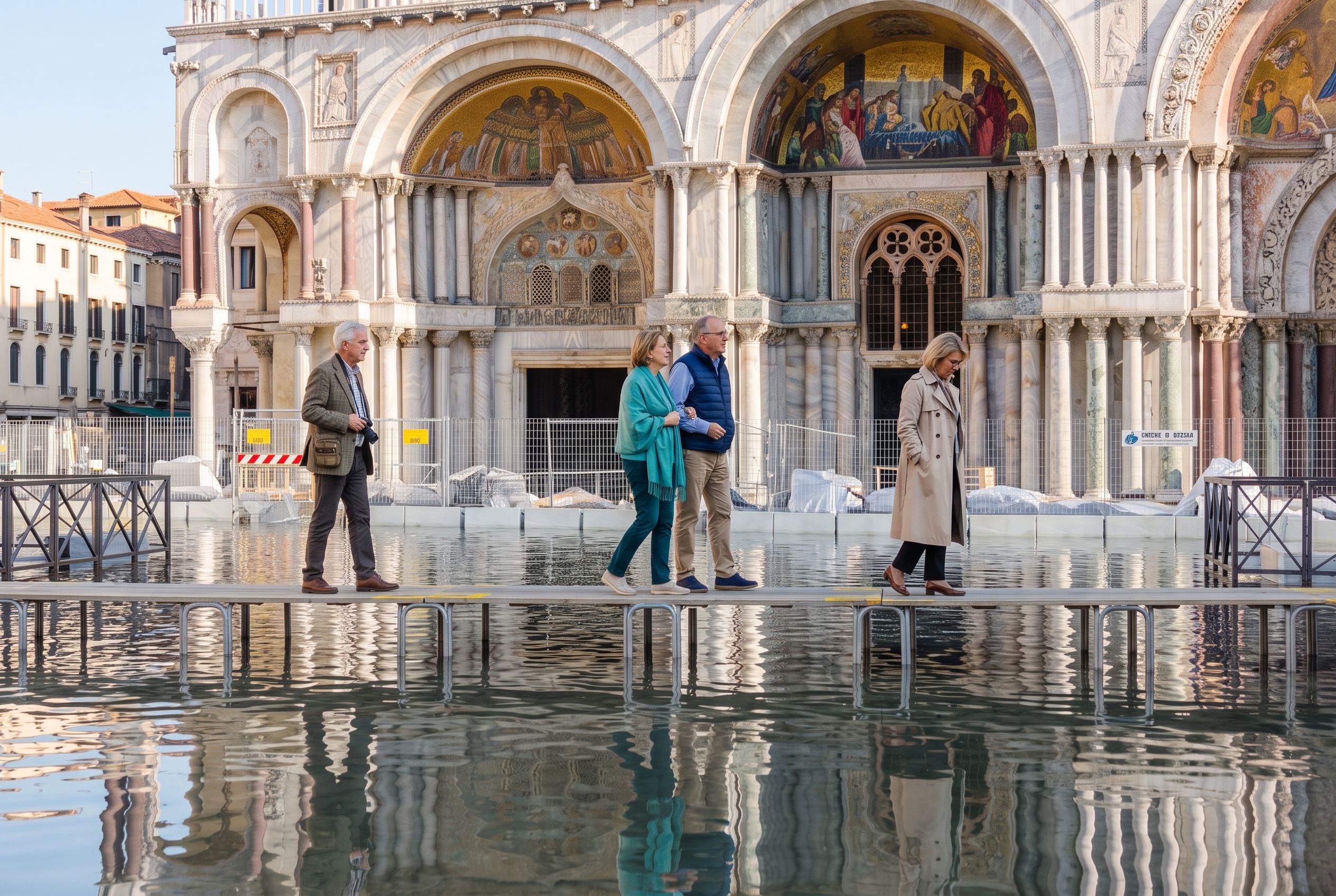
Use the raised walkways first. The City of Venice states that even during high water you can still move around on designated pedestrian routes, partly made up of temporary elevated platforms, usable up to a tide height of 120 centimetres. Boots and overshoes are the fallback for the gaps, not the primary plan. Buy them early if you want them, because official visitor information says prices rise when flooding is forecast.
The city's own high-water page explains the geography clearly: because the walkable ground of Venice does not unfold on a homogeneous plane, the same tide event affects different points in different ways. In Piazza San Marco, one of the lowest areas, high water becomes perceptible when the tide is greater than 82 centimetres. The area around the Rialto Bridge begins to flood at 105 centimetres, while in the square in front of the railway station, 135 centimetres are needed before water touches the walking level. Events above 140 centimetres are conventionally considered exceptional because they are of low frequency (Comune di Venezia, Venice and high water).
That means a 90-centimetre tide is a San Marco problem and not a Cannaregio one. It also means the answer to "do I need boots" depends on where you are sleeping and what you plan to see, not on the city as a whole.
| Location | Tide height at which water becomes perceptible |
|---|---|
| Piazza San Marco | Above 82 cm |
| Area around the Rialto Bridge | Up to 105 cm |
| Square in front of the railway station | 135 cm |
| Considered exceptional (low frequency) | Above 140 cm |
Public water transport keeps running during high tides according to schedule, except in very exceptional tides, though some routes may be modified once the tide reaches 95 centimetres. The MOSE barriers are raised when forecasts exceed about 110 centimetres. Raised walkways are deployed when the tide reaches around 100 centimetres, and one Venice water-level guide states they are suspended from 1 May to 15 September. The city's official visitor information says about 4 km of raised walkways are laid along the lowest parts of the main routes during acqua alta, covering most visitor needs.
Two practical consequences follow. First, timing matters as much as footwear: the official tide-information pages note that the Basilica and museums around Piazza San Marco may delay opening until the square drains. Second, the city advises keeping to the walkways and avoiding water where you cannot see the bottom. That is the rule that makes boots optional rather than essential.
What should you wear for the lagoon damp?
Layers and a light waterproof shell with a hood. Venice packing guidance advises weather-appropriate layers because conditions vary and humidity is high, plus a lightweight waterproof jacket for sudden rain and acqua alta conditions. The city can feel colder and damper than the temperature alone suggests, so a compact umbrella and a waterproof sleeve for phone and documents earn their space.
The lagoon effect is real but modest in packing terms. High water and lagoon conditions can make Venice feel colder and damper than the thermometer implies, and official high-water guidance focuses on route changes and raised platforms rather than clothing, so the layering advice is practical rather than formally documented. Treat it as you would any coastal city in northern Italy: a base layer, a mid layer, and a shell you can carry folded.
For winter visits, the same logic holds with heavier weights. Autumn carries the highest risk of acqua alta, and one packing source suggests late May to June, or July, if avoiding floods is the priority. That is packing advice rather than an official visitor-flow recommendation, and our guide to when to visit Venice for warm days and small crowds covers the seasonal picture in more depth.
How do you get around with limited walking?
The city publishes an accessible Venice map showing areas completely accessible by vaporetto, areas reachable by motoscafo or a facilitated bridge, and areas not accessible by public transport. The same map notes bridges with platform lifts and other facilities. This is the single most useful planning document for anyone managing a limited walking range, and it is free to consult before you book accommodation.
The official city pass FAQ states that both waterborne and land AVM/ACTV services are accessible to wheelchair users, and that waterbuses, buses, trams and the People Mover all have dedicated or equipped areas. Wheelchair users pay a discounted fare of €1.50, including one companion, valid for 75 minutes from first validation. Around 80% of public bus services on the Venetian mainland have removable or folding platforms, with accessible boarding at designated BUS FACILE stops.
A general senior or over-65 reduced fare for Venice transport is not documented in the gathered official material. One third-party Venice transport page claims over-65 pricing on the Venezia Unica City Pass, but this is not official city material and should be treated cautiously. If a senior discount is decisive for your budget, ask at the ticket office rather than assuming one exists.
Work on the Rio di Cannaregio began on 7 May 2024, with a temporary San Giobbe waterbus stop opened and service changes introduced: Line 3 was suspended, Lines 4.1 and 4.2 were diverted, and Line 22 got a new terminus at San Giobbe. Route changes of this kind are worth checking close to your travel date, since they affect movement around the city centre and lagoon links.
What if you need a pharmacy or a doctor?
The emergency number 118 is active 24 hours a day and free from landlines and mobiles. First-aid points operate at Piazza San Marco and Piazzale Roma, both open 08:00 to 20:00. Pharmacies are widespread, with standard hours of Monday to Friday 08:30 to 12:30 and 16:00 to 20:00, Saturday 09:00 to 12:00, plus a rotating night service.
For serious emergencies, Ospedale SS. Giovanni e Paolo is named as the main hospital in Venice's historic centre, at Campo SS. Giovanni, Castello 6777, reachable on foot or by waterbus at the stop named "Ospedale". The city's health page also lists district out-of-hours doctor numbers covering the historic centre, Lido, Pellestrina, Burano, Murano and Mestre, among other areas.
Some sources note that there are many pharmacies in Venice and that a few 24-hour pharmacies may exist, but exact counts differ across sources and a current exact total is not consistently documented. Ask at your hotel on arrival, and note that the rotating night service means the late-night pharmacy changes. Our guide to health, pharmacies and peace of mind in Venice goes further into this.
What is the actual Venice packing list?
A lightweight waterproof jacket with a hood, sturdy non-slip waterproof shoes, a second pair of walkers, carryable luggage, layers, a compact umbrella, and a waterproof phone sleeve or dry bag for documents and devices. If you are visiting in high-water season, add compact galoshes or knee-high overshoes, or plan to buy them on arrival.
- Footwear: two pairs of flat, grippy walking shoes, ideally waterproof or quick-drying.
- Luggage: a soft bag or backpack you can lift and carry over bridge steps.
- Outer layer: a lightweight waterproof jacket with a hood.
- Layers: base and mid layers for the lagoon damp, plus a compact umbrella.
- Water protection: a waterproof sleeve or dry bag for phone, passport and tickets.
- High-water kit: compact galoshes or knee-high overshoes if travelling between October and March.
- Stability: a compact folding walking pole if you want a third point of contact on wet stone.
- Sleep: earplugs and an eye mask, since even quiet hotels can carry wind, bar or canal noise and blackout varies by room.
The consistent recommendation across travel guidance is non-slip soles for wet cobbles and bridge steps, and the city's own advice points to rubber boots or overshoes for acqua alta conditions. Beyond that, the choice is yours to make on fit and comfort.
Should you buy overshoes in Venice or bring them?
Buy them in Venice if you need them. Official visitor information says knee-high boots and foldable overshoes are sold near Santa Lucia station and Piazzale Roma, and that prices rise when high water is forecast. Several travellers say not to waste suitcase space on rubber boots for exactly this reason. If you plan to rely on overshoes, buy early rather than on the morning of a forecast tide.
The city's tourism guidance describes waterproof overshoes as the standard answer if you want to walk outside the raised walkways during high water, and notes they are sold in the city. Knee-high rubber boots serve the same purpose. The trade-off is simple: buying locally costs more when a tide is forecast but saves luggage weight and space, and the walkways usually make them unnecessary.
One report notes that boats may be curtailed where they cannot pass under certain bridges, particularly on the Rio di Cannaregio, and several travellers observe that the city keeps functioning normally: the water rises, later recedes, and most of Venice is unaffected because flooding is usually limited to the lowest parts. A Rick Steves Travel Forum post describing an acqua alta in November 2021 recorded it as "nothing more than a couple of puddles in Piazza San Marco," with walkways stacked nearby and used only if needed. Another forum post noted that in October the square could be dry one afternoon and wet the next morning, with only a few inches deep in places around St Mark's Square while boardwalks handled access.
Official Venice visitor guidance identifies St Mark's area as the key place where acqua alta matters most for visitors, and the lowest areas flood first. If your itinerary centres on the Basilica and the Doge's Palace, plan those for a dry window and keep the rest of the city as your wet-weather alternative.
Common questions about packing for Venice
The questions that come up most often concern how much walking is involved, whether boots are genuinely necessary, and how far in advance to check the tide. The short answers: expect several hours on foot each day, boots are optional if you use the walkways, and the tide forecast is published 72 hours ahead.
Multiple forum contributors stress that Venice means a lot of walking on uneven surfaces and over bridges, and reviews consistently confirm that bridge crossings, steps and uneven access matter. The city's own high-water guidance implies that raised walkways cover only the lowest routes, so sturdy walking shoes matter even when it is dry.
On timing, the Venice municipality operates the official tide-forecast and warning system, and its visitor-facing pages explain that alerts cover the next 72 hours using gauge networks and forecasting models. Flood information is provided in real time via web and smartphone. The City of Venice has also made six short informative videos explaining high water and its impact, in a clear and accessible way.
What should you confirm before you book?
Ask about lift size, room floor, shower type and whether the entrance involves steps. Guest reviews of Venice hotels repeatedly mention narrow lifts, steep stairs and compact bathrooms, and a few report no elevator or a single small lift with waits. None of that is unusual in a historic building, but it is worth knowing before you arrive with a bag you have to carry.
Reviews also note that some Venice properties have lift access, water-taxi or canal entrances and easier arrival logistics, which matters in a city of bridges and steps. When reviews are negative, the usual complaint is not constant city noise but occasional amplification of nearby bars, gondolas, vaporetto traffic or terrace restaurants into the room. Some guests report thin soundproofing, wind through shutters, mosquitoes, or rooms too hot to sleep well when air conditioning underperforms. Ask for a room away from the bar or the canal side if you are a light sleeper.
Service complaints in the reviews cluster around inconsistency rather than hostility, and around breakfast being busy, limited or poorly organised. If breakfast matters to you, ask whether it is served in the same building. For the full picture of what a top-tier Venice stay involves, our closer look at the Gritti Palace covers one property in detail.
One final planning note: the city now operates an access-fee system for day visitors on published peak days. The gathered official sources do not provide a complete rule summary for every visitor category, so check the current rules for your dates rather than relying on last year's information.


