
Venice rewards the traveller who chooses the month before booking the flight. The city's weather and its crowds move on separate calendars, and only a few windows in the year put warm, walkable days alongside streets you can actually walk. For travellers aged 50 to 70, the trade-offs matter more than they do for a backpacker: heat, damp, uneven paving and high water all land harder on older knees and lungs. The good news is that the two best windows, late April to May and September into early October, are also the two most comfortable for walking, and the city's own tourism material and the monthly guides agree on where they fall.
What are the best months to visit Venice?
May and September are the two months most often named as the best balance of warm weather and manageable crowds. April and October follow closely, with October carrying a rising flood risk later in the month. July and August are the hottest and busiest, and the least comfortable for anyone who wants space to walk.
The monthly breakdown published by Visit By Month lists the best months as September, May, October and April, with May and September both rated "Ideal" and April and October rated "Great" (Visit By Month's month-by-month Venice guide). That ranking matches what the wider guide literature says: April through early June and September through early October keep coming up as the sweet spot.
For anyone in the 50 to 70 bracket, the practical reading is simple. Late April and May give you mild air, long daylight and streets that are busy but not crushed. September and early October give you the same, with the sea still warm and the summer crowds thinning week by week. Both windows let you walk the city in the morning, rest through the middle of the day and go out again in the evening without fighting heat or queues.
What is Venice like month by month?
January is the quietest month but cold and misty. February is cool yet crowded because of Carnival. March is a changeable transition. April and May warm up pleasantly. June turns hotter and busier. July and August are hot, humid and packed. September and October are warm and calmer. November and December are quiet, wet and inside the flood season.
The monthly figures from Visit By Month give a clear picture of the temperature curve. The yearly range for Venice runs from 1°C to 29°C. January averages 7°C by day and 1°C at night. May averages 22°C by day and 13°C at night. July averages 29°C by day and 19°C at night, and August 28°C by day and 19°C at night. October averages 18°C by day and 11°C at night, and November 12°C by day and 6°C at night.
| Month | Day high | Night low | Crowd level |
|---|---|---|---|
| January | 7°C | 1°C | Low |
| February | 9°C | 2°C | High (Carnival) |
| March | 13°C | 5°C | Moderate |
| April | 17°C | 9°C | Moderate |
| May | 22°C | 13°C | High |
| June | 26°C | 17°C | High |
| July | 29°C | 19°C | High |
| August | 28°C | 19°C | High |
| September | 24°C | 16°C | Moderate |
| October | 18°C | 11°C | Moderate |
| November | 12°C | 6°C | Low |
| December | 8°C | 2°C | Moderate |
Read the table with the crowd column in mind rather than the temperature alone. February is cool but rated "High" for crowds because Carnival fills the squares, and the weather does not put anyone off. May is rated "High" too, but the crowds are spread across a mild month with long evenings. July and August combine the highest temperatures with the heaviest visitor pressure, and the German-language guide Treffpunkt Venedig notes genuine heatwaves reaching 35°C to 37°C in those two months, which is a real strain for older visitors.
 AI-edited
When is Venice at its most crowded?
Carnival in February and the summer months of July and August are the two peak crowd periods. Outside those, the city concentrates its visitors into a narrow band of hours: St Mark's Square, the Rialto and the routes between the station and San Marco are busiest from roughly 10am to 4pm, then empty out sharply in the evening.
Carnival is the single biggest exception to Venice's quiet winter. February becomes much busier during the festival, especially around St Mark's Square, even though the weather is still cool, as noted by the Venice Explorer weather guide (Venice Explorer's weather-by-month guide). Hotel rates and restaurant demand rise with it.
Summer is the other peak, and it is the one that matters most for comfort. July and August are repeatedly described as the busiest and hottest months, and therefore the least comfortable for travellers seeking small crowds. The heat and humidity make long walks and vaporetto transfers tiring, and the crush on the main routes between the station and San Marco can be relentless through the middle of the day.
The good news is that Venice's crowds are concentrated, not citywide. Forum reports collected by Rick Steves describe St Mark's Square as a completely different place at 7am or 11pm, and note that walking just a few minutes away from the basilica brings relief. A ten-minute walk from the main tourist axis can lead to an almost idyllic Venice. Murano, Giudecca, Castello, Dorsoduro, Cannaregio, Sant'Elena and Torcello are all recommended for a quieter experience when the central sights are overwhelmed.
How bad is the summer heat, and does Venice smell?
July and August bring high humidity alongside the heat, and the combination makes long walks and water-bus transfers genuinely tiring. Late-summer heat and stagnant canal conditions can make parts of the city feel less pleasant, particularly in the busiest areas. If you want warm days without that, aim for May, June or September instead.
The search question "what time of year does Venice smell bad" has a real answer in the evidence: several guides describe late-summer heat and stagnant canal conditions as the period when canal-side walking feels less pleasant. It is not a year-round feature, and it is not a reason to avoid the city. It is a reason to avoid July and August if you have the choice.
For travellers aged 50 to 70, the summer trade-off is straightforward. June is already hot and busy as peak season starts, with a daytime average of 26°C. July and August push to 28°C to 29°C by day, with 19°C nights that offer little relief, and the heatwave risk noted by Treffpunkt Venedig sits on top of that. May and September give you 22°C and 24°C respectively, which is warm enough for light clothing and comfortable enough for a full day on your feet.
If summer is the only window that works, plan around the heat rather than through it. Walk early, use the vaporetto for longer hops, and keep the middle of the day for a long lunch or a rest. The city's quieter outer districts, including Giudecca and Sant'Elena, are easier to enjoy in the heat than the central axis.
When does acqua alta happen, and how does it affect an older visitor?
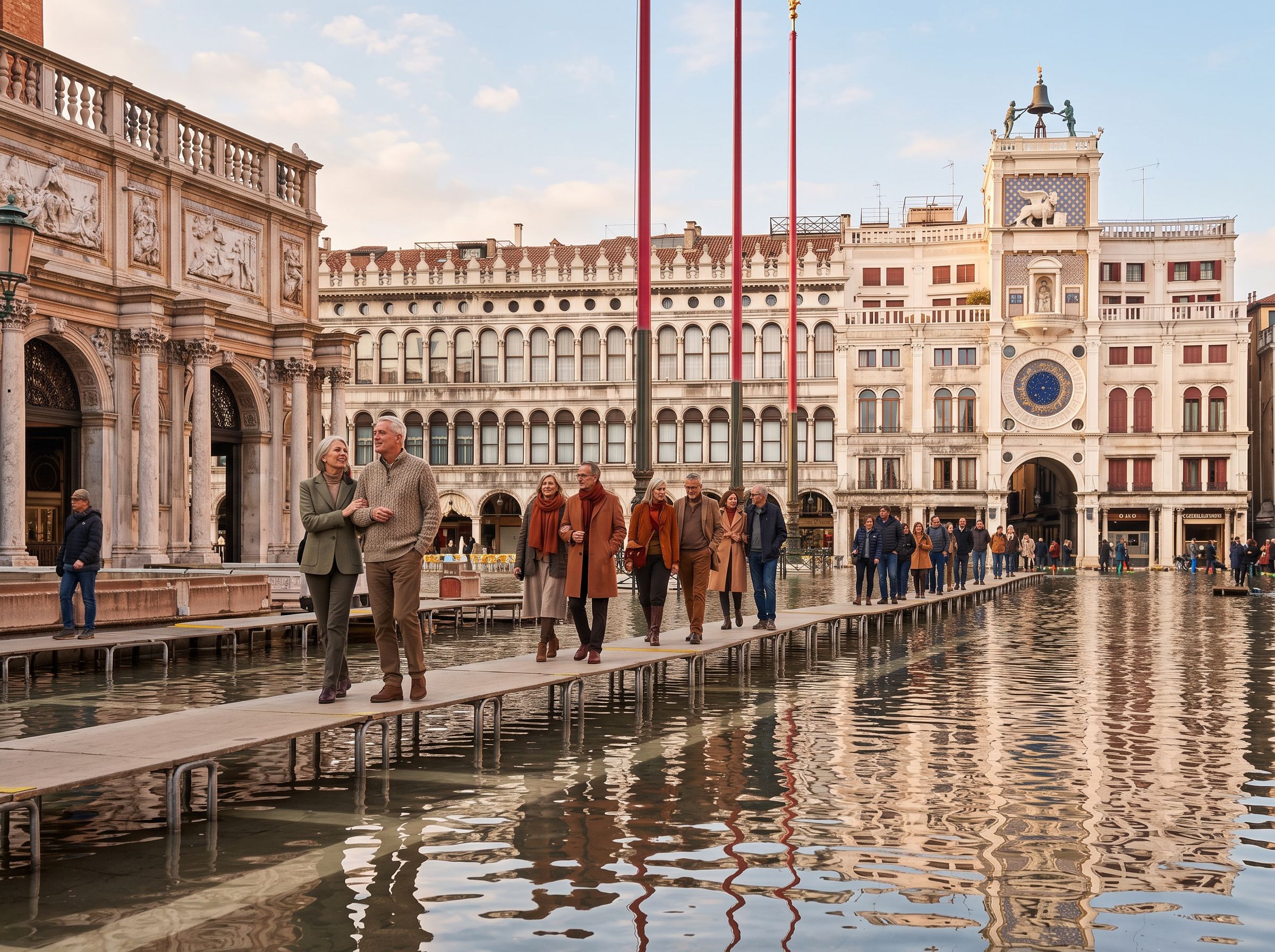
Acqua alta runs from October to March, with the highest frequency in November, then December, then October. Those three months account for roughly 75% of events. Flooding is usually temporary and raised walkways are deployed, but the walkways are not always wheelchair-accessible, and low-lying areas such as Piazza San Marco flood first.
The municipal tourism material is specific about the thresholds. At Punta della Salute, 80cm is the level at which the lowest parts of Piazza San Marco begin to flood, and 110cm or more is the threshold for acqua alta proper. The same material states that about 75% of acqua alta events fall in October, November and December, and that the season runs into March.
For an older visitor, the practical consequences are about movement rather than danger. Flooding can temporarily restrict movement in low-lying areas and force the use of raised walkways, which can be awkward for visitors with reduced mobility, according to a Venice accessibility guide (Venice Guide and Boat's limited-mobility guide). Raised flood walkways, when deployed, are not always wheelchair-accessible. That is planning information, not a reason to cancel: it tells you to check the tide forecast 24 to 48 hours before you travel if you are visiting between October and March, and to pack waterproof footwear.
If avoiding acqua alta is the priority, May to September is the safer period, because high tides are rare then. Summer is the safer season for flooding, with multiple sources describing acqua alta as rare in summer.
Which shoulder windows give warm days and small crowds?
Late April to early June and September to early October are the two windows that combine mild weather with manageable crowds. October is often singled out as an especially good balance, though flood risk rises later in the month. Mid-September is praised for sunny days and evenings that turn very quiet once the day-trippers leave.
The Rick Steves forum material is unusually consistent on this. October is described as wonderful, with warm days, cool nights and usually minor, manageable flooding. October through mid-November is called probably the sweet spot for weather, smell and crowd levels. Mid-September is singled out for sunny weather and crowds that were "not horrible" during the day and very quiet in the evenings.
Early May has its own advantage: cruise passengers come and go, and Venice becomes peaceful after they leave. Late March, April, early May, mid-September and October are all named as the best compromise for warm-ish days and smaller crowds. The city's own tourism material notes that October averages about 17.8°C by day and 12.0°C at night, with roughly 118mm of rain across about ten wet days, and that the tide begins to matter again in October.
For a traveller in the 50 to 70 bracket who wants to walk rather than queue, the two shoulder windows are the answer. Spring and early autumn give milder weather and fewer crowds, while winter brings cheaper stays but a higher chance of flooding and weather disruption. If you are weighing up which of the two suits you better, our guide to how accessible Venice is for older travellers covers the terrain, bridges and step-free routes in detail.
Which months are quietest, and what do you trade for them?
January is the quietest month overall, excluding New Year and the start of Carnival. November and February outside Carnival are also described as very quiet. The trade is cold, damp weather and, in November, the highest statistical risk of acqua alta in the year.
January and early February outside Carnival are the quietest period, but cold and damp, so they suit visitors prioritising emptier streets over warmth. November is repeatedly described as quiet, underrated and atmospheric, though it is also the highest-risk month for acqua alta. December keeps winter crowds low outside the holidays, but flood risk stays elevated, as the city's official tourism pages note (the City of Venice's acqua alta planning page).
Prices follow the same pattern. Visit By Month rates January and November as low season with the cheapest deals of the year, February and December as moderate, and June, July and August as the most expensive. For anyone whose priority is a quiet city and a lower bill, January is the answer. For anyone whose priority is warm days and small crowds together, January is the wrong month.
One practical note for light sleepers: room location matters as much as the season. Reviews of Venice stays repeatedly mention blackout curtains and quiet rooms, but also report that some rooms are not quiet at night, with noise from courtyards, nearby paths or breakfast areas. Our round-up of the quietest hotels in Venice for light sleepers looks at what guests actually report.
What should an older traveller pack and plan for?
Waterproof footwear is the single most useful item if you are travelling between October and March. Comfortable shoes for uneven paving and bridges matter in every season. Check the tide forecast 24 to 48 hours before departure in the flood season, and choose accommodation with a route that stays dry.
Venice is highly walkable in the historic centre, but the terrain is uneven, with bridges, narrow lanes and wet paving. Winter and late autumn are harder for older travellers because of dampness, fog and acqua alta, while April to May and September to early October are described as more comfortable for walking. Where sources mention practical movement, they stress waterproof footwear during high-water periods and note that flooding affects the lowest areas first.
Health provisions, pharmacy locations and medical help points for specific Venice attractions are not documented in the material gathered here. If that matters to your planning, our guide to health, pharmacies and peace of mind in Venice covers what is known. Senior fares, over-65 reductions and age-based city passes for Venice are also not documented, so no figure can be quoted here.
How many days do you need, and when should you book?
Three to four nights is the usual recommendation for Venice itself, and staying in the city rather than on the mainland lets you enjoy the quiet early mornings and late evenings that older travellers tend to value most. Book shoulder-season dates well ahead, as May and September fill first.
the city is quietest in the early morning and late evening, and staying in Venice proper rather than the mainland is what lets you experience those hours. Guests who stayed in quieter districts repeatedly described their stays as "very quiet" or "quiet yet central", and one Tripadvisor review noted "no trouble sleeping" after being moved away from noise.
Rates are indicative and vary by season and booking channel. The clearest guidance is that January and November are the cheapest months, June to August the most expensive, and the shoulder windows of May and September the ones that fill fastest because they offer the best weather-crowd balance.
If your dates are flexible, book the shoulder. If they are not, plan around the season you have: early starts and late evenings in summer, waterproof footwear and tide checks in autumn and winter, and a room away from the busiest routes in every month. The city rewards the traveller who works with its calendar rather than against it.


