
Tuscany's thermal heritage runs deeper than its wine cellars. For over three millennia, travellers have come to these hills to soak in mineral-rich waters, and the region's spa towns remain among Europe's most refined wellness destinations. For those of us who prefer our relaxation measured in unhurried mornings rather than packed itineraries, Tuscany's terme offer something increasingly rare: a legitimate excuse to do very little, very well.
This guide focuses on the four thermal towns that matter most for travellers aged 50–70 seeking genuine rest: Montecatini Terme, Saturnia, Bagno Vignoni, and Rapolano Terme. We've assessed each for comfort, accessibility, quiet, and treatment range, with honest notes on where the walking gets tricky and where the dining justifies booking half-board. For a broader overview of the region, our complete guide to Tuscany for travellers over 50 covers sightseeing, transport, and seasonal planning.
 AI-edited
Which Tuscan thermal town suits your needs best?
Montecatini Terme suits travellers who want urban convenience and rail access; Saturnia offers the most dramatic natural setting; Bagno Vignoni provides quiet village charm; Rapolano Terme delivers modern spa facilities without the crowds.
Each town has a distinct personality, and choosing the right one matters more than picking the "best" spa. Montecatini is a proper town with grand Liberty-style bathhouses, tree-lined avenues, and a working railway station — ideal if you prefer to leave the car behind. Saturnia, in the far south, is a scattering of stone houses around a famous waterfall of warm water. Bagno Vignoni is a tiny medieval village built around a central thermal pool, more atmospheric than amenity-rich. Rapolano, in the Crete Senesi, offers two modern spa complexes that attract a largely Italian clientele.
For first-time visitors, the decision usually comes down to how much infrastructure you want around you. Montecatini and Saturnia have the most hotel options; Bagno Vignoni and Rapolano are quieter but require more planning. Montecatini is not the only one of the four on the railway: Rapolano Terme also has its own station, on the Siena–Chiusi line, served by regional trains from Siena. What Montecatini has that Rapolano does not is a station inside the spa quarter — about seven minutes on foot from the Terme Tettuccio — while the Rapolano station is listed by the infrastructure operator as having no assistance service for passengers with reduced mobility.
Montecatini Terme: the classic spa town with rail access
Montecatini Terme is Tuscany's most established spa town, with grand historic bathhouses, a working railway station, and a mature clientele that skews older — making it the most practical choice for travellers who want wellness without logistical friction.
Montecatini's spa quarter dates from the 18th century, when Grand Duke Pietro Leopoldo of Habsburg-Lorraine had the springs captured and the first bathhouses built: the Bagno Regio in 1773, the Terme Leopoldine in 1775 and the rebuilt Tettuccio in 1779. In 2021 the town joined the UNESCO World Heritage list as one of the Great Spa Towns of Europe. Today, the town's centre is a grid of wide boulevards lined with elegant Liberty-style buildings, most of them bathhouses or hotels built during the town's golden age in the early 1900s. The Terme Tettuccio and Terme Excelsior remain the architectural highlights, their marble halls and frescoed ceilings evoking a more gracious era of spa-going — though the Excelsior is currently shut to visitors and can only be admired from the outside, along Viale Giuseppe Verdi.
For travellers over 50, Montecatini's greatest asset is its practicality. The train station connects directly to Florence and Lucca, and the town is flat enough for comfortable walking. The bathhouses themselves are well-maintained, with step-in pools and changing facilities that have been modernised for contemporary expectations. The town's clientele skews older, which shows in unhurried service, early dinner hours and a general absence of party atmosphere.
The water here is mineral-rich and slightly saline, used primarily for hydrotherapy and drinking cures. The Terme Tettuccio offers a full range of treatments, from mud therapy to inhalation rooms, and the town's hotels — many of them historic — offer half-board packages that include thermal access. The two bathhouses actually in service today are the Tettuccio and the Redi. The Tettuccio's business is the drinking cure rather than bathing — it opens daily from 8am to noon and again from 4pm to 7pm — and access to the Redi for consultations and treatments is by prior appointment only. As of August 2026, the town continues to invest in its thermal infrastructure, with several bathhouses undergoing careful restoration.
For dining, the half-board option at the better hotels is worth considering. The town's restaurants cater to a clientele that values proper Tuscan cooking over culinary experimentation, and the hotel dining rooms offer solid, traditional menus — though not at the Grand Hotel & La Pace, the town's five-star landmark, which has been closed since its sale and only filed its renovation permits in February 2026. If you prefer flexibility, the town centre has several excellent trattorias within a five-minute walk of the main hotels.
| Feature | Details |
|---|---|
| Rail access | Direct trains to Florence (48–56 min) and Lucca (about 25 min) |
| Main bathhouses | Terme Tettuccio and Terme Redi in service; Terme Excelsior closed to visitors |
| Price band | €€–€€€ (half-board packages from €150–250 per person) |
| Best for | Non-drivers, first-time spa visitors, heritage architecture |
Saturnia: the most dramatic thermal experience
Saturnia offers Tuscany's most famous thermal waters — a constant 37.5°C cascade that has flowed for millennia — but the free natural pools require careful footing, while the paid resort provides the most accessible and comfortable experience.
Saturnia sits in the Maremma, Tuscany's wild southwestern corner, where the landscape shifts from cypress-lined hills to volcanic plateaus. The town itself is small, but its thermal credentials are ancient: the waters have been used for therapeutic purposes for over 3,000 years, and the Romans built baths here that remained in use for centuries. The modern Terme di Saturnia resort, with its 124 rooms and suites, anchors the wellness offering, while the free Cascate del Mulino waterfall draws day-trippers from across the region.
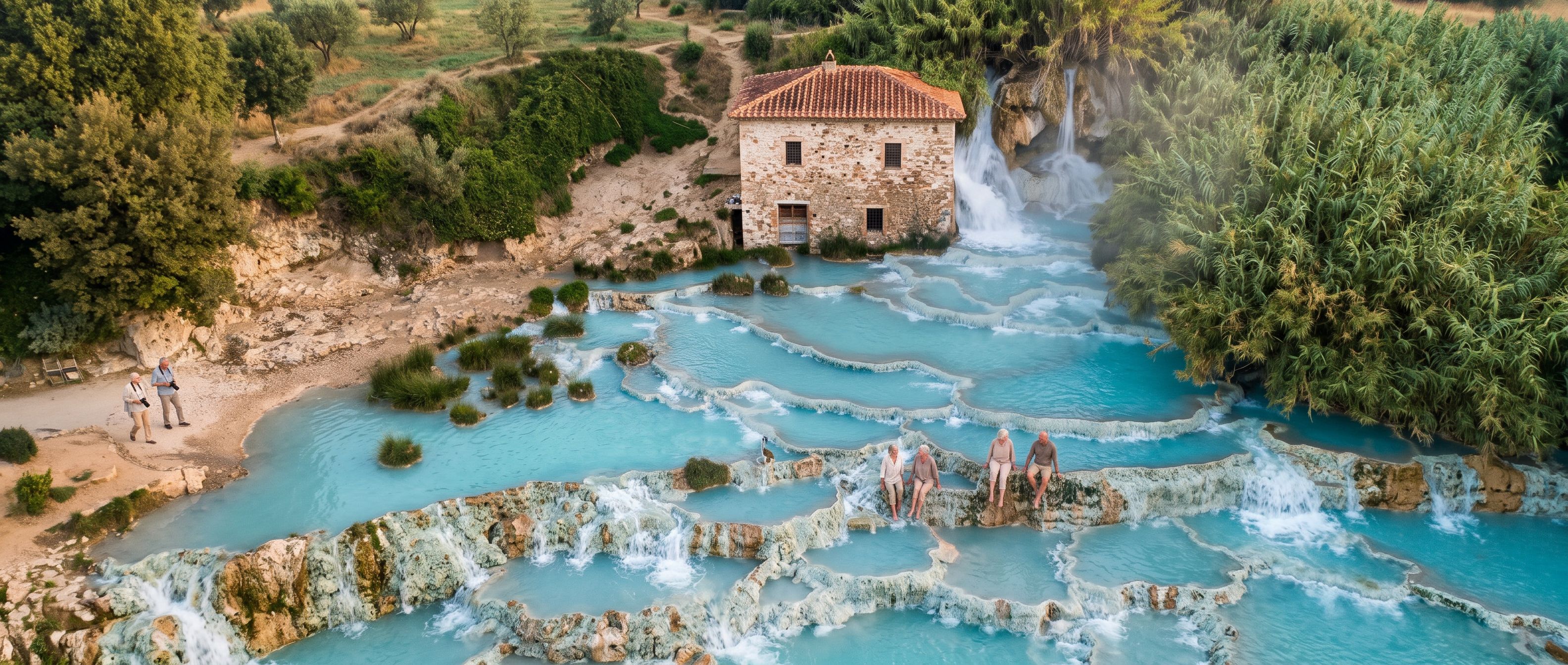
The free cascades are the stuff of travel photography: warm, milky-blue water tumbling over travertine terraces into a series of natural pools, steam rising into the morning air. The experience is genuinely remarkable, but it demands respect for the terrain. The ground around the pools is gravel and sand, the rocks are slippery, and there are no changing rooms or handrails. The site is free, unstaffed and open around the clock — Terme di Saturnia's own FAQ describes the Cascate del Mulino as a free natural site accessible 24/7 — so there is nobody on hand if you slip. A temporary parking area beside the falls reopened to visitors in March 2026, and the walk from it to the pools is short and largely flat. If you have any balance concerns, the paid resort is the safer choice.
The Terme di Saturnia resort itself is a different proposition entirely. The thermal park includes multiple pools, whirlpools, a Kneipp course, sauna, and Turkish bath, all set in a well-kept garden with sunbeds and umbrellas. The resort states that visitors with disabilities can access the thermal park, with reduced rates tied to recognised disability percentages, and the resort states in its own FAQ that it is accessible to guests with disabilities, with accessible rooms as well as accessible thermal pools; its ground-floor junior suites with garden access are described as suited to guests with specific accessibility requirements. As of August 2026 the resort holds a Google rating of 4.4 out of 5 from around 2,500 reviews, while the thermal park, listed separately, sits at 4.0 — enthusiasm for the water itself, alongside recurring complaints about maintenance and extra charges.
For dining, the resort's bistro offers quality meals at fair prices, and guests consistently praise the breakfast buffet. The half-board option is worth considering if you plan to spend full days at the pools, though the nearby town of Manciano has several excellent trattorias for a change of scene. Expect to pay €€€ for the full resort experience. Day access to the thermal park is €26 Monday to Friday and €31 at weekends and on public holidays, and the ticket covers five outdoor thermal pools, the whirlpools, the vascular path, changing rooms, lockers and parking.
For those who want the Saturnia water without the resort markup, the free cascades remain open year-round. The calmest times are weekday mornings in spring and autumn, when the light is soft and the crowds thin. Winter visits are possible — the water stays warm even when the air is cool — but the lack of changing facilities makes the experience more rustic than restorative.
Bagno Vignoni: a medieval village built around warm water
Bagno Vignoni is the quietest and most atmospheric of Tuscany's thermal towns — a tiny medieval settlement where the main square is a large thermal pool — but it offers limited amenities and requires a car to reach.
Bagno Vignoni is less a spa town than a village that happens to sit on a thermal spring. The centrepiece is the Piazza delle Sorgenti, a raised stone pool fed by the hot springs that has been the village's focal point since Roman times. The setting is genuinely striking: the pool sits in the middle of the village, steam rising from its surface, with the Val d'Orcia's rolling hills as a backdrop. But this is a viewing pool, not a bathing one — immersion is not permitted. Nor is the free bathing in the Parco dei Mulini below the village, which a municipal ordinance prohibits. In Bagno Vignoni you bathe in the hotels' thermal pools, and you pay to do it.
For travellers seeking rest, Bagno Vignoni's appeal lies in its stillness. The village is barely a village: a single piazza that is itself the thermal pool, a handful of restaurants, and a pace that makes Montecatini feel like Manhattan. The old Hotel Posta Marcucci, a historic property with its own thermal pools, now trades as Hotel La Posta; its pools are open to non-residents by prior booking from 1 April to 31 October, at €39 for a full day from 9.30am to 6pm. The more luxurious ADLER Spa Resort THERMAE sits about 650 metres from the village centre with extensive spa facilities. Both offer half-board, and the dining at the Adler is notably strong — a genuine reason to book the meal plan.
Accessibility is the trade-off. The village is built on a hillside, and the walk from the car park to the hotels involves cobblestone paths and some steps. There is no free public bathing pool at the village edge to fall back on: if the hotel pools are full or out of season, Bagno Vignoni offers no alternative. Public transport is thin rather than absent: Autolinee Toscane serves the stop Bagno Vignoni Centro from San Quirico d'Orcia, but only a handful of times a day, so a car or a booked transfer remains the realistic option.
Recent guests at the Adler Thermae consistently praise the thermal pools and spa area — "relaxing, clean, and well-maintained" is a recurring phrase — and the staff receive particular mention for their attentiveness. Shuttle transfers at the resort are chargeable rather than free, so ask what one costs before you plan around it. The recurring complaints centre on room sizes and bar prices.
Rapolano Terme: the understated choice in the Crete Senesi
Rapolano Terme offers two thermal complexes — Terme Antica Querciolaia and San Giovanni Terme Rapolano — in a quiet corner of the Crete Senesi, with a largely Italian clientele and prices that undercut the more famous destinations.
Rapolano sits in the lunar landscape of the Crete Senesi, the clay hills south of Siena that look more like a painting than a place. The town itself is unremarkable, but its two thermal establishments are anything but. Terme Antica Querciolaia is the more modern of the pair, with extensive indoor and outdoor pools and a full spa menu. It opens daily — 9am to 8pm Monday to Friday and on Sunday, and through to 1am on Saturday. Neither Rapolano establishment publishes anything about lifts, handrails or pool entry, so ask before you travel if steps are a concern. Terme San Giovanni, the older establishment, offers a more traditional experience with mud therapies and inhalation rooms.
What distinguishes Rapolano is its authenticity. The clientele is overwhelmingly Italian, many of them regulars who come for the curative properties of the water rather than the Instagram potential. The atmosphere is unhurried, the prices are reasonable (€€ for a full day of thermal access), and the treatment quality is high — the mud therapy here is particularly well-regarded for arthritis and rheumatism relief. As of August 2026, the facilities remain well-maintained, with recent guests praising the cleanliness of the pools and changing areas.
The trade-off is location. Rapolano is not a destination in itself; the town has a handful of restaurants and a modest hotel offering, and most visitors stay at the spa hotels attached to the thermal complexes. Terme Antica Querciolaia is a day spa first and foremost — €19 on weekdays, €25 on Sundays, public holidays and in high season — so most visitors book a room in the town or the surrounding countryside. For those who want to combine thermal bathing with exploring the Crete Senesi's hill towns — Pienza, Montalcino, San Quirico d'Orcia — Rapolano makes a sensible base, though a car is essential.
How accessible are Tuscany's thermal towns for travellers with mobility concerns?
Accessibility varies dramatically between the paid resorts and the natural sites: of the four, only Terme di Saturnia publishes an accessibility statement of its own, covering accessible rooms and accessible thermal pools, while the Adler Thermae and Rapolano's Terme Antica Querciolaia publish nothing at all, and the free Cascate del Mulino and Bagno Vignoni's village paths require careful planning.
The single most important distinction in Tuscan thermal travel is between managed resorts and natural sites. Only one of the resorts, though, documents what it actually offers. The Adler Thermae publishes no access details, and neither Rapolano establishment — Terme Antica Querciolaia or San Giovanni Terme — says anything about lifts, handrails or pool entry, so all three have to be asked directly before you book. Terme di Saturnia states in its own FAQ that the resort is accessible to guests with disabilities, and that it has accessible rooms as well as accessible thermal pools; its ground-floor junior suites are described as suited to guests with specific accessibility requirements, and the resort's official policy offers reduced or free admission for visitors with recognised disabilities.
The natural sites are a different story. The Cascate del Mulino has no changing rooms, no handrails, and uneven, slippery terrain throughout. Bagno Vignoni's village is built on a slope, and even the short walk from car park to hotel involves cobblestones and steps. Bagno Vignoni has no public bathing pool to fall back on — the thermal water there is reached only through the hotels, by booking and paying for it — and the paths between car park and hotels are not designed for wheelchairs or walkers.
Montecatini falls somewhere in between. The town is flat and the bathhouses are modernised, but the historic buildings have their quirks — some treatment rooms are reached via short flights of stairs, and the grander hotels may have steps at their entrances. If accessibility is your primary concern, contact the specific bathhouse or hotel directly before booking and ask about step-free routes and pool access.
When are Tuscany's thermal towns quietest?
Weekday mornings in spring and autumn offer the calmest thermal experiences across all four towns; weekends, Italian holidays, and the summer months bring crowds and higher prices, particularly at Saturnia's free cascades.
Timing transforms the thermal experience. At the free Cascate del Mulino, the difference between a Tuesday morning in May and a Saturday afternoon in August is the difference between a private bath and a public pool. Early weekday visits are the reliable advice, since the site has no admission control and the crowd is simply whoever turns up. The paid resorts are less crowded overall, but weekends and Italian holiday periods — particularly the weeks around Ferragosto in mid-August — see significant increases in visitor numbers.
Winter has its own appeal. The Saturnia thermal park operates year-round with reduced hours from November through March, and the contrast between cool air and warm water is part of the experience. Bagno Vignoni's pools are similarly enjoyable in winter, though the village's outdoor dining options become limited. Montecatini's bathhouses are fully enclosed, making them the most comfortable winter choice. Rapolano's pools are a mix of indoor and outdoor, with the indoor sections providing year-round comfort.
For those who want to avoid crowds entirely, the shoulder seasons — April to June and September to October — offer the best balance of pleasant weather and manageable visitor numbers. The thermal water itself is constant at 37.5°C in Saturnia, so the season affects comfort only in terms of air temperature and crowd levels.
What should you budget for a thermal stay in Tuscany?
Expect to pay €150–350 per person per night for half-board at the better spa hotels, with day-spa access ranging from €19 on a weekday at Rapolano to €31 at a weekend at Saturnia; the free cascades cost nothing but require bringing your own towel, water shoes, and patience.
Thermal travel in Tuscany spans a wide price range, and the differences reflect more than just hotel standards. At the budget end, San Giovanni Terme Rapolano charges €20 for a full day in the thermal pools, and Terme Antica Querciolaia €19 on weekdays. Montecatini's mid-range hotels, many of them historic, run €150–200 per person with half-board. The premium end is dominated by Saturnia's resort and the Adler Thermae at Bagno Vignoni, where half-board packages start around €300 per person and climb steeply.
Half-board is worth considering at the better properties. The Adler Thermae's dining is genuinely excellent — a proper reason to book the meal plan — and the Terme di Saturnia's bistro offers quality meals at fair prices. At Montecatini's historic hotels, half-board packages often include thermal access, making them better value than booking separately. At Rapolano, the hotel dining is more functional than memorable, and you might prefer to explore the town's trattorias instead.
| Destination | Day spa access | Half-board per person | Best value |
|---|---|---|---|
| Montecatini Terme | €6 to enter the Tettuccio (drinking cure, no bathing) | €150–250 | Historic hotels with thermal included |
| Saturnia (resort) | €26 weekday, €31 weekend | €300+ | Bistro dining at fair prices |
| Bagno Vignoni | €39 day ticket at Hotel La Posta, April to October | €250–350 | Adler Thermae dining |
| Rapolano Terme | €19–25 | €120–180 | Most affordable option |
Watch for extras. Recent guests at several properties report charges for towels, robes, sunbeds, and "wellness kits" that are not included in the advertised price. The Terme di Saturnia requires a white dress code for towels and bathrobes, or rental of a wellness kit on site. Some hotels add a service charge to the bill at checkout, which guests describe as removable but awkward. Budget an additional €20–40 per day for these incidentals.
Which treatments are worth booking?
The most distinctive Tuscan treatments are mud therapy for arthritis and rheumatism, inhalation therapy for respiratory conditions, and thermal plankton applications for skin and circulation — all grounded in the mineral-rich waters that have drawn visitors for millennia.
Tuscany's thermal waters vary by source, and each town's treatments reflect its water's particular mineral composition. Saturnia's sulphurous water, rich in hydrogen sulphide, is recognised by Italy's national health service for treatments targeting the skin, respiratory system, circulation, muscles, and bones. The mud therapy here is particularly well-regarded — the mineral-rich clay is applied warm and left to draw out inflammation, a treatment that arthritis sufferers consistently report as beneficial.
Montecatini's water is different: saline and mineral-rich, it is used primarily for drinking cures and hydrotherapy. The town's bathhouses offer a full range of treatments, from classic massage to more specialised inhalation therapy for bronchitis and sinusitis. The Terme Tettuccio's drinking cure — a supervised programme of consuming specific spring waters at set times — is a Montecatini speciality that has drawn visitors since the 19th century.
Rapolano's water is sulphurous too: the municipality describes it as sulphur-bicarbonate-calcium water emerging at close to 40°C, and names inhalation cures, balneotherapy and mud therapy as the treatments the town is known for. Bagno Vignoni's water, emerging at 49°C before cooling in the pools, is rich in minerals and particularly recommended for circulatory issues. The Adler Thermae offers a comprehensive spa menu that integrates these thermal properties with modern wellness treatments.
For first-time visitors, a single mud therapy session and a thermal pool day are the essential experiences. Book treatments in advance, particularly during busy periods, and arrive early for the best pool access. Most resorts offer treatment packages that bundle multiple therapies at a discount.
How should you plan a thermal stay in Tuscany?
Book at least 2–3 nights to benefit from the treatments, choose half-board at the better properties, pack water shoes and a robe, and plan your thermal visits for weekday mornings to avoid the crowds.
A single night at a thermal resort is barely enough to settle in. The treatments work cumulatively — a mud therapy session followed by a day of pool bathing produces noticeably better results than either alone — and the relaxation benefits require time to take hold. Two to three nights is the minimum for a genuine wellness stay; a week allows for a full treatment programme.
Packing matters more than you might expect. Water shoes with good grip are essential for the natural sites and useful even at the resorts, where pool surfaces can be slippery. A robe or wrap is standard practice at the better establishments, and the Terme di Saturnia requires white for its towels and robes. Bring a swimsuit that you don't mind getting sulphurous — the smell lingers even after washing.
For those combining thermal bathing with sightseeing, the Tuscany for travellers over 50 guide covers the region's transport and itinerary planning in detail. Montecatini makes the easiest base for exploring Florence and Lucca by train; Saturnia and Bagno Vignoni are better for those who want to stay put; Rapolano offers a middle ground with easy access to Siena and the Val d'Orcia.
One final note: the single-day spa visit, while pleasant, is not the same as a thermal stay. The full benefits of the waters — the mineral absorption, the circulatory stimulation, the deep muscular relaxation — accumulate over multiple sessions. If your schedule allows, commit to at least two full days of thermal bathing, with treatments interspersed between pool sessions. Your body will thank you.


