
Tuscany rewards those who slow down, and for travellers in their 50s and 60s, that is precisely the secret to a memorable visit. This is a region of hilltop medieval towns, Renaissance art, and vineyards that roll across the landscape like waves. But it is also a region of cobblestones, steep lanes, and summer heat that can test even the fittest visitor. The good news? With the right base, a realistic pace, and a few strategic choices, Tuscany can be one of the most comfortable and rewarding destinations in Europe for the over-50 traveller.
This guide is your cornerstone orientation. We will walk you through how the region fits together, how to choose a base that matches your energy level, how to handle driving and public transport, and when to go for the best balance of comfort and crowds. We will also flag the practical realities—stairs, ZTL zones, and uneven paving—so you can plan around them rather than be surprised by them.
 AI-edited
How is Tuscany laid out?
Tuscany divides naturally into four zones: Florence and its surrounds, the Siena area, the Chianti wine corridor between them, and the Val d'Orcia countryside to the south. Each offers a different pace, and understanding these differences is the key to planning a trip that suits your energy and interests.
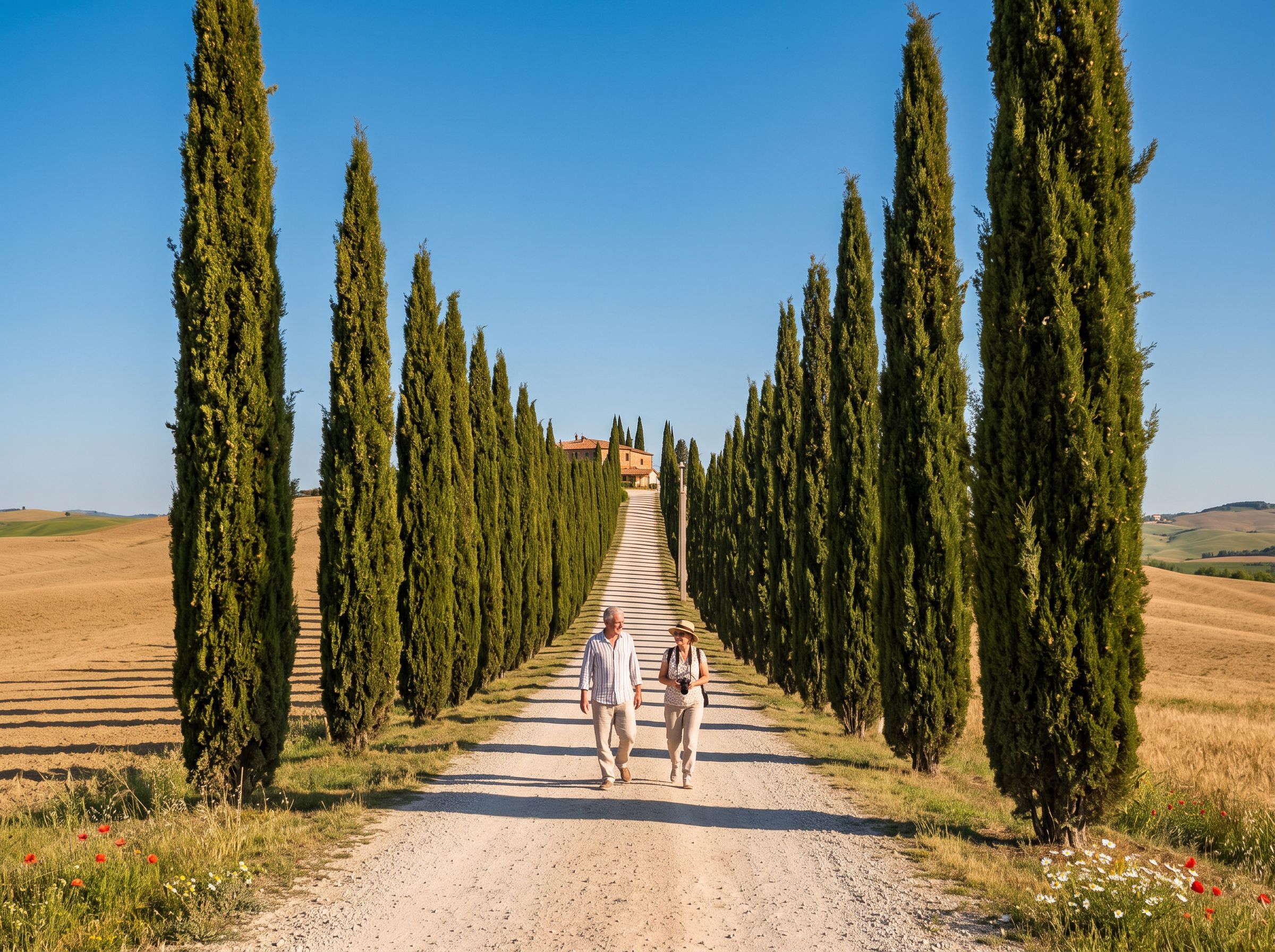
Florence is the cultural anchor—compact, busy, and packed with world-class art. Siena, about 70 kilometres south, is a hilltop medieval city with a dramatic central piazza. Between them lies Chianti, a landscape of vineyards, olive groves, and fortified villages that is best experienced from a car or a winery terrace. Further south, the Val d'Orcia opens into the iconic Tuscan countryside of cypress-lined roads and rolling hills, with small towns like Pienza and Montalcino scattered across the landscape.
For the over-50 traveller, the practical difference between these zones is significant. Florence and Lucca are relatively flat and walkable. Siena, San Gimignano, and most hill towns involve serious climbing. Chianti and the Val d'Orcia are best enjoyed from a seat—at a winery, a farmhouse restaurant, or a scenic overlook. Senior travel forums make the same point again and again: stretch your time out rather than trying to see everything in one go.
Which base is right for you?
Choose Florence if you want art and culture with easy day-trip options; choose Lucca if you prefer a flatter, quieter city with a relaxed pace; choose a countryside base in Chianti or the Val d'Orcia if you want to wake up to vineyards and don't mind driving or hiring a driver for excursions.
Florence is the most common first base, and for good reason. The historic centre is compact, and the main sights—the Duomo, the Uffizi, the Accademia—are within walking distance of each other. The city is also the best transport hub, with high-speed rail connections and a tram network that has recently expanded. As of January 2025, the T2 tram extension is in service, making airport access easier than ever.
Lucca, about 80 kilometres west of Florence, is often recommended for older travellers because it is flatter and more walkable than most Tuscan towns. The city is encircled by Renaissance walls that have been converted into a tree-lined promenade—perfect for a gentle morning stroll. If you want a slower, less crowded experience, Lucca is an excellent choice.
For countryside lovers, a farmhouse or agriturismo in Chianti or the Val d'Orcia offers a different kind of magic. The trade-off is that you will need a car or a driver for most outings. If you are comfortable with that, the reward is waking up to rolling hills and having dinner under the stars.
How accessible is Florence for older travellers?
Florence is one of the more manageable Italian cities for older travellers, with a relatively flat historic centre, but the paving is uneven and the crowds can be intense. With sensible planning—staying near the main sights, using taxis for longer distances, and taking rest breaks at cafes—most visitors in their 60s and 70s manage very well.
The city's historic core is walkable, but "walkable" does not mean "easy." Sidewalks are narrow, cobblestones are common, and the sheer volume of visitors can make navigation tiring. Distance is rarely the problem here; the surface and the crowds are. Treat a cafe table as part of the itinerary rather than an interruption.
That said, Florence has invested in accessibility. Many museums now offer lifts and accessible routes, and the city's tram system is modern and step-free. Hotel Orto De' Medici, a well-regarded property near the Accademia, has a Google rating of 4.8 out of 5 from over 1,500 reviews as of August 2026, with guests consistently praising the staff's helpfulness and the quiet courtyard garden—a peaceful retreat from the city bustle. It sits a four-minute walk from the Galleria dell'Accademia and about fifteen from Santa Maria Novella station. Bathrooms, though, differ sharply by room type: an inspection review found walk-in showers in the Classic and Superior rooms that amount to a showerhead over a floor drain behind a curtain, while the renovated Deluxe rooms have a shower-over-bath. Settle which you are getting before you book.
For getting around, taxis are reasonably priced and can be pre-booked. Tram line T2 runs from the airport to the centre in 20 minutes and, since January 2025, on to the San Marco Università stop beside the Accademia; the operator states that every tram and every shelter is accessible to passengers with reduced mobility, with four anchored wheelchair spaces on each tram. The Tootbus Tuscany pass, launched on 18 March 2026 and running daily until 31 October, lets you move between Florence, Pisa, Siena, Lucca and San Gimignano on a single multi-day ticket—a comfortable option for day trips without the hassle of driving. Check where the coaches stop, though: Piazzale Montelungo in Florence and the Pietrasantina car park in Pisa are each about a thirteen-minute walk from the centre.
What about Siena and the hill towns?
Siena and the classic hill towns are beautiful but physically demanding. Plan short, focused visits of one to two hours, use parking at the top of town where available, and consider a private driver or taxi to avoid the climb from lower parking areas.
Siena's hilltop setting and sloping streets are part of its charm, but they can be exhausting. The famous Piazza del Campo is reached by a gentle descent from the car park, but the return journey is uphill. The Duomo is another climb. For travellers with limited mobility, the advice from senior travel forums is consistent: visit Siena for a few hours, not a full day, and take breaks at cafes along the way. The taxi ride spares you the worst of it and is cheaper than most expect — Siena's radio taxi charged a fixed €10 from the station rank to Piazza Il Campo in August 2026.
San Gimignano, with its famous towers, is even more demanding. The town sits on a hill, and the main street is a steady incline. Volterra, further west, is similarly challenging. The good news is that some towns have made efforts to help. Colle di Val d'Elsa, for example, has the free P1 car park in the lower town — 180 spaces, one marked disabled bay, open around the clock — and from there the Risalita Il Baluardo, a pair of lifts sunk into the bastion to a design by Jean Nouvel and running since February 2006, carries you straight up into the medieval upper town.
Travellers over 50 who post about Tuscany converge on the same rhythm: one hill town per day, an early start, and a long lunch. That is sound advice. The other option is to skip the hill towns altogether and focus on the countryside, where the views are just as spectacular and the walking is optional.
How do I handle driving and ZTL zones?
Driving in Tuscany is manageable if you understand the ZTL system—restricted traffic zones that protect historic centres. Entering a ZTL without permission results in fines, so always check whether your hotel can register your car or arrange a permit before you drive into a town.
The ZTL (Zona a Traffico Limitato) is a common source of stress for visitors. Cameras monitor the entrances, and violations are automatically fined—often months after you return home. The rules vary by town, so the safest approach is to park outside the walls and walk in, or to confirm with your hotel in advance. Many hotels in historic centres can register your licence plate for a limited period, allowing you to drive in for check-in and unloading.
For day trips, consider hiring a private driver for a day or two. This is a popular option among over-50 travellers, and for good reason: the driver handles the ZTL rules, the parking, and the navigation, leaving you free to enjoy the scenery. It costs less than most people assume: one licensed Tuscan chauffeur company lists eight hours with car and driver from €280 in August 2026, and a full-day Chianti tour at the same starting price, with longer days and larger vehicles costing more. Split between four, that is comparable to a rental car plus parking and stress.
If you do rent a car, choose a small model. Tuscan roads are narrow, and parking spaces are tight. Also, be aware that many hill towns have parking at the bottom of the hill, requiring a climb to the centre. Where you park matters as much as where you sleep. In Pienza, for example, the spaces along the walls of the historic centre are reserved for residents, so visitors use the paid lots just outside — the largest of them in Via degli Archi, with about 200 spaces.
What are the best slow-travel experiences?
The countryside is where Tuscany truly shines for slower travel. Wine tastings, farmhouse lunches, scenic drives, and thermal baths all allow you to experience the region's beauty from a seat rather than on foot.
Chianti is the classic wine region, and a visit to a winery is a quintessential Tuscan experience. Most wineries offer guided tastings that include a tour of the cellars—usually accessible, though check in advance—followed by a seated tasting of three to five wines paired with local cheeses and cured meats. The pace is unhurried, and the views are magnificent.
The Val d'Orcia, a UNESCO World Heritage site, is another highlight. The landscape of rolling hills, cypress avenues, and medieval villages is best appreciated from a car or a driver. Stop at the chapel of Madonna di Vitaleta for the classic postcard view, have lunch in Pienza (famous for its pecorino cheese), and watch the sunset from the terrace of a farmhouse.
For a truly relaxing day, consider the thermal baths at Bagno Vignoni or Saturnia. Both have been in use since Roman times, but they work differently today. At Bagno Vignoni you can no longer soak in the ancient pool on the square; the warm, mineral-rich water is enjoyed instead in the spas of the village's own hotels. At Saturnia the natural Cascate del Mulino are free to enter, though the rocks can be slippery—pack water shoes. The operator states plainly that the falls have no walkways or areas designed for people with disabilities; only the paid relaxation area, Il Molino del Bagno, is barrier-free.
Should I use public transport?
Tuscany's trains and buses are workable for day trips, especially between major cities, but they require planning and some walking at both ends. For travellers over 50, the train is often a better option than driving for city-to-city connections, while buses are useful for reaching smaller towns.
Trenitalia operates frequent regional trains between Florence, Pisa, Lucca, and Siena. The trains are comfortable, and the journey times are reasonable—about 1.5 hours from Florence to Siena and about 1 hour 20 minutes to Lucca; it is the shorter Pisa–Lucca hop that takes half an hour. One thing has changed for older travellers: Trenitalia stopped selling the Carta d'Argento on 1 April 2026. In its place, over-60s who join the free X-GO programme get 20% off single regional tickets on selected trains, for journeys up to 30 November 2026.
Buses fill the gaps where trains don't run. The regional operator Autolinee Toscane has been expanding its network, and as of summer 2025, added around 50 new seasonal routes, including later-night service on Florence's city-centre lines until midnight. The Tootbus Tuscany pass runs daily from 18 March to 31 October 2026 and links the major cities on one multi-day ticket—a comfortable option for day trips.
One caveat: public transport in Italy often involves stairs at stations, and not all trains have step-free access. If mobility is a concern, check the station's accessibility features in advance, and consider a taxi for the first and last mile of any journey.
How do I choose a senior-friendly hotel?
Look for hotels with lifts, walk-in showers, and ground-floor rooms, and confirm these details directly with the property before booking. Guest reviews consistently highlight that historic buildings often lack lifts and have compact bathrooms, so verification is essential.
A recurring complaint in guest reviews of Tuscan hotels is the absence of a lift. Historic palazzos and farmhouses were not built with elevators in mind, and even where one exists, it may be small or only serve certain floors. Hotel Casci, a long-established budget address on Via Cavour, sits on the second floor of a building with no lobby at street level at all; the lobby itself is reached by a small lift or a stairway. So the number of steps between the front door and your room is the figure that matters. Ask for it, and ask whether the lift serves your floor.
Walk-in showers are another priority. Many older properties have step-in tubs or small shower cubicles that are difficult to navigate. Hotel Orto De' Medici in Florence shows how little a headline rating tells you. Its 4.8 out of 5 from 1,504 Google reviews in August 2026 is a general score, not an accessibility one: an inspection review calls the walk-in showers in its Classic and Superior rooms little more than a showerhead over a floor drain with a curtain, while the newer Deluxe rooms have a shower-over-bath. The hotel's own website says nothing about a lift; booking platforms list one, which is a listing, not a commitment.
When booking, use the hotel's contact form or email to ask three questions: Is there a lift? Are there walk-in showers? How many steps from the entrance to the room? The answers will tell you a lot about how senior-friendly the property really is.
What are the costs involved?
Tuscany can be as expensive or as affordable as you make it. Budget for €150–€300 per night for a comfortable hotel, €60–€100 per person per day for meals, and from about €280 for a full day with a private driver. Shoulder-season travel costs noticeably less than the July–August peak.
| Item | Budget | Comfort | Luxury |
|---|---|---|---|
| Hotel (double room, per night) | €100–€150 | €150–€300 | €300+ |
| Meals (3 courses, wine) | €40–€60 | €60–€100 | €100+ |
| Museum entries | €10–€20 (smaller sites) | €20–€40 | €40+ |
| Private driver (full day) | from €280 | €400–€600 | €600+ |
| Train (Florence–Siena, return) | €21.60 | €21.60 | €21.60 |
Italy's state museums do not discount by age for older visitors, whatever the guidebooks say. The Ministry of Culture grants free entry only below the age of 18, and the reduced ticket goes to EU citizens aged 18 to 25. An over-65 pays the full price: €25 at the Uffizi on the day of the visit, €29 booked ahead, and €20 plus a €4 booking fee at the Galleria dell'Accademia. What does apply is a disability concession — a visitor whose disability is certified enters free, and so does one accompanying person. Carry the paperwork, and check each venue's own site, because municipal museums set their own rules.
Published tasting prices vary more than the guidebooks suggest. A small Chianti estate charges around €18 a head to taste its classic and reserve wines, and about €30 once olive oil and a plate of Tuscan cold cuts and cheese are added. At Antinori nel Chianti Classico, the region's showpiece winery, the Tinaia tour costs €50 a head and pours three wines. Book ahead, especially in peak season.
When is the best time to visit?
April–June and September–October are the sweet spots: mild temperatures, lighter crowds, and the landscape at its most beautiful. July and August are hot, crowded, and tiring; November can be wet, and December–February is cold but quiet.
The shoulder seasons are ideal for over-50 travellers for several reasons. Temperatures in April–May and September–October typically range from 15°C to 25°C—perfect for walking without overheating. Crowds are thinner, meaning shorter queues and more space in museums. And the countryside is at its best: wildflowers in spring, golden light and harvest activity in autumn.
July and August bring heat that can reach 30°C or more, and the crowds are at their peak. If you must travel in summer, plan your days around the heat: sightsee in the morning, rest in the afternoon, and go out again in the evening. Many hotels have pools, and the countryside is cooler than the cities.
November is wet, and December–February can be cold, though the cities are quieter and prices are lower. Christmas markets in Florence and the festive atmosphere can be charming, but some rural restaurants and wineries close for the season.
How do I stay comfortable and healthy?
Pack comfortable, broken-in walking shoes with good grip, bring a small daypack with water and snacks, and plan regular rest breaks at cafes. If you take medication, carry it in original packaging with a doctor's note, and know where the nearest pharmacy is to your accommodation.
The biggest physical challenge in Tuscany is uneven paving. Cobblestones, worn steps, and cambered streets are everywhere, and they are slippery when wet. Good shoes are non-negotiable. Restrooms in Italy are very often up or down a narrow flight of stairs, so plan breaks accordingly—cafes are your friend, even if a coffee costs more at a table.
Italian pharmacies (farmacia) are excellent and can dispense many medications without a prescription. They are marked by a green cross, and most towns have at least one. For emergencies, a European Health Insurance Card entitles EU visitors to treatment on the same terms and at the same cost as people insured in Italy — which is not the same as free. In Tuscany, an emergency-room visit triaged as code 1, 2 or 3 carries no charge, while codes 4 and 5, the cases judged not serious, carry a ticket of up to €50. Non-EU visitors should have travel insurance.
Heat is the other concern. In summer, carry water, wear a hat, and avoid the midday sun. Many churches and museums are cool, making them good midday stops. And remember: the Italian tradition of the afternoon riposo is not just a custom—it is a sensible response to the heat.
What should I know about safety?
Tuscany is remarkably safe for travellers, with low crime rates and a welcoming atmosphere. The main risks are petty theft in crowded tourist areas and the physical challenges of uneven terrain. Take normal precautions, and you will have nothing to worry about.
Frommer's describes Tuscany and Umbria as "remarkably safe" compared with some bigger tourist hubs. Violent crime is rare, and the main concern is pickpocketing in crowded areas like Florence's San Lorenzo market or on packed buses. Keep your wallet in a front pocket, don't leave bags unattended, and be aware of your surroundings.
For solo travellers, Tuscany is also a comfortable destination. The region is well-touristed, English is widely spoken in tourist areas, and the locals are accustomed to visitors. The evening passeggiata is part of that: a Google review of Florence's Piazza della Repubblica from February 2026 calls it the "perfect piazza to eat a delicious gelato while enjoying a nice evening out."
One practical note: keep copies of your passport and important documents. Since the museum concession turns on a disability certificate rather than on age, that is the paper worth carrying, and a photocopy of your passport saves you taking the original out every day.
Where can I find deeper guides?
This guide covers the essentials, but several topics deserve their own deep dives. For specific itineraries, hotel reviews, and day-trip planning, our dedicated guides offer the detail you need.
If you are planning to combine Tuscany with other parts of Italy, our guide to Lake Garda with grandchildren offers a different kind of family travel, while cycling Lake Garda by e-bike shows how active travellers can explore another Italian region at their own pace.
For those who want to stay active in Tuscany itself, the region offers excellent walking and cycling opportunities. The half-day hikes on Monte Baldo guide, while focused on Lake Garda, demonstrates the kind of moderate, rewarding outdoor activities that suit the over-50 traveller—and similar options exist in the Tuscan countryside.
For a different lakeside perspective, sailing and windsurfing at the north lake shows how another Italian region caters to active seniors. And for those considering a multi-region trip, our practical guides on Italian train travel and driving in Italy provide the logistics you need.
What are the practical details?
Plan for a minimum of five nights, ideally seven to ten, to experience Tuscany without rushing. Book accommodation with free cancellation, confirm accessibility details in writing, and consider travel insurance that covers medical care and trip interruption.
| Item | Detail |
|---|---|
| Minimum stay | 5 nights (7–10 ideal) |
| Best months | April–June, September–October |
| Currency | Euro (€) |
| Language | Italian (English widely spoken in tourist areas) |
| Electrical | 230V, 50Hz; sockets take type C, F and L plugs (L is the Italian three-pin) |
| Emergency number | 112 (pan-European) |
| Senior discounts | None by age at state museums; Trenitalia Senior fares from 60 |
| Train discount card | Carta d'Argento withdrawn 1 Apr 2026; Senior fares for 60+ via free X-GO |
When booking, pay attention to the fine print. Some hotels require a minimum stay in peak season, and cancellation policies vary. For flexibility, book directly with the hotel rather than through an online travel agency—many properties offer better rates and more flexible terms when you book direct.
Travel insurance is essential. Look for a policy that covers medical expenses (at least €1 million for EU coverage), trip cancellation, and baggage loss. If you have pre-existing medical conditions, declare them—most policies will cover them if you do, but may not if you don't.
"We used the ramp at Porta di San Pietro to take a one-hour stroll anticlockwise along the wall. The views of the old city on one side and of the Lucca hills and Apuan Alps on the other are charming and inspiring." — from a Google review of Lucca's city walls, August 2025
Finally, remember that Tuscany is not a checklist to be completed. It is a place to be savoured. The best memories often come from unplanned moments: a glass of wine on a piazza at sunset, a conversation with a shopkeeper, the view from a hilltop that you stumbled upon by accident. Give yourself permission to slow down, and Tuscany will reward you richly.


