
Ubud sits in Gianyar Regency on Bali's inland plateau, and it has become the island's centre for yoga, spa treatments and longer detox programmes. The town's wellness reputation rests on a cluster of retreats and spa resorts that range from central, walkable properties to jungle-set campuses reached by shuttle. For travellers aged 50 to 70 who want rest rather than a punishing schedule, the appeal is the choice: a gentle restorative class in the morning, a massage in the afternoon, and a quiet room at night.
Two things shape planning here. First, Ubud's terrain is uneven: several retreats are built down the sides of ravines, and step counts are rarely published. Second, the town has no rail link, so arrival is by road from Ngurah Rai International Airport (DPS), measured at 42 km with a driving time of about 35 minutes with clear roads. In practice, traffic extends that considerably. Neither point should discourage a visit, but both reward a little preparation.
Which Ubud retreats suit rest and wellness?
Programme styles range from daily drop-in yoga to multi-day Ayurveda retreats.
The clearest distinction is between properties that run structured retreats and those that offer wellness as an add-on to a normal hotel stay. Oneworld Retreats specialises in longer Ayurveda and yoga retreats, and guest feedback on Tripadvisor praises its jungle location alongside comfortable beds and good showers. Hotel Villa-Ubud takes a middle path: yoga studios overlook rice paddies, and daily yoga and massage packages sit alongside ordinary room bookings.
At the softer end, Adiwana Resort Jembawan offers yoga-related activities, massages, spa treatments, a gym and pools, with an eight-night stay described very positively in guest reviews. Ubud Aura Retreat and Tattva Ubud both lean towards quiet, restorative stays rather than intensive programmes.
What do Ubud wellness retreats cost?
Published treatment prices are scarce. The one documented figure comes from Bali Luxury Spa, whose Tibetan-bowl sound healing in Ubud is advertised from IDR 900,000, with another range on the same page stating IDR 700,000 to 1,300,000 for 90- or 120-minute sessions. No retreat-wide rate card is documented.
That gap matters. Most Ubud retreats do not publish treatment prices, package rates or over-65 concessions in the material available, and no source documents senior fares, reduced wellness tariffs or membership passes for the town's retreats. Rates are indicative and vary by season and booking channel, so the sensible approach is to request a written quote covering accommodation, meals and treatments before paying a deposit.
Where dining is included, it is worth asking what full board actually covers. Hotel Villa-Ubud reviews describe some yoga packages including breakfast, lunch and dinner, and guests repeatedly praise freshly prepared breakfasts and wholesome food. Adiwana Resort Jembawan includes breakfast, which can be delivered to the room or balcony, and its Herb Library restaurant draws praise for a wide breakfast choice and an all-day breakfast arrangement.
How quiet are Ubud's wellness retreats?
Quiet is the most consistently praised quality across Ubud's wellness properties, and several central retreats are described as silent despite their location. The clearest documented exception is Om Ham Retreat and Resort, where a Tripadvisor complaint reports traffic audible continuously, including at night.
Central Ubud is not quiet in itself. Jalan Monkey Forest and Jalan Hanoman carry heavy scooter traffic, and sections of both have no sidewalks, so pedestrians share the road. What surprises guests is how quickly that changes behind a gate. Adiwana Resort Jembawan sits on a quiet side street within walking distance of central Ubud, and guests note that traffic noise is not audible inside the grounds. Ubud Aura Retreat is described in reviews as quiet despite its central position, helped by sitting behind a fence or down a quiet lane.
Outside the centre, Naya Ubud drew a Tripadvisor review describing birds, crickets and river sounds replacing traffic at bedtime. Tattva Ubud Retreat & Wellness is described as very quiet, with river sounds and a peaceful natural setting, and its property page reports a 5.0 sleep-quality score, though only 18 reviews are shown, so this is promising rather than firmly established.
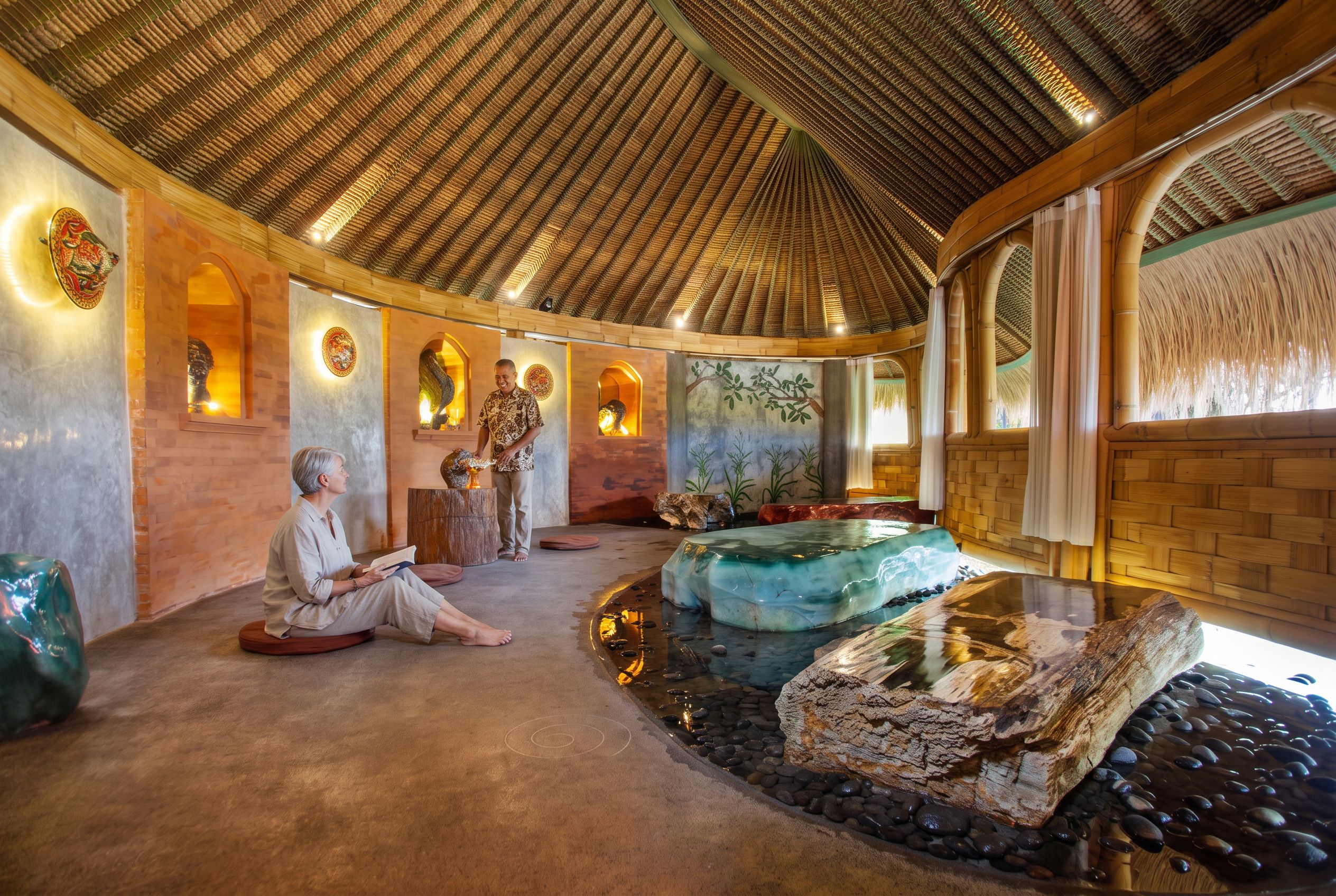 AI-edited
Hotel Villa-Ubud sits among rice fields outside central Ubud, and reviews repeatedly praise quiet nights and separation from city noise. The trade-off is distance: guests note the property is a 25 to 45 minute walk from central Ubud with no pavement on parts of the route, and that online taxis are not permitted to pick up guests at the property. A free shuttle runs into town several times a day, which is the practical answer.
Is Ubud accessible for travellers with limited mobility?
One explicit accessibility statement exists: Anantara Ubud Bali Resort states that wheelchair-accessible accommodation and facilities are available. For every other Ubud wellness property, step-free routes, lifts, handrails, walk-in showers and treatment-room access are not documented and must be confirmed directly.
This is the single most important planning point for older travellers. Ubud's retreats are frequently built on slopes. Oneworld Retreats is constructed on the side of a ravine and involves, in the words of a Tripadvisor report, "quite a few stairs," with the pool at the bottom. Taksu Spa sits in central Ubud but is spread over a ravine. Neither property publishes step counts or gradient details.
Anantara Ubud Bali Resort is in Payangan, Gianyar Regency, at Jalan Raya Puhu No. 88, rather than central Ubud. It advertises a spa, wellness centre, fitness centre, heated swimming pool, adult-only swimming pool, sunrise yoga and immersive wellness experiences. Its accessibility assurance covers accommodation and facilities; it does not specify ramp gradients, steps, lifts, handrails, pool access or accessible bathrooms.
For a broader picture of terrain, transport and practical logistics in the town, see our Ubud guide for travellers over 50.
What wellness experiences can you book in Ubud?
Documented options include resort spas, sound healing, restorative and drop-in yoga, and full-day spa packages. Bali Luxury Spa offers Tibetan-bowl sound healing at its Ubud location and through home service across Bali, with sessions advertised at approximately 2 to 2.5 hours.
Home service is worth noting for anyone who finds travel across town tiring, though the operator does not state that the service is designed for guests with mobility limitations. Bali Luxury Spa says guests may book online around the clock, confirm by WhatsApp or call directly, with same-day appointments depending on therapist availability. It operates daily from 09:00 to 21:00 and states that prices include service charges with no gratuity pressure or upselling. Cancellation terms are not documented.
On the yoga side, Alchemy Yoga is repeatedly suggested for a less commercial, practice-focused experience, with a bamboo shala, several classes each day and a serene atmosphere. Sang Spa & Yoga Centre is recommended for a full-day spa experience combining massage, scrubs, flower baths and lunch. Hesa Spa and Taksu Spa have both been recommended after recent use.
For a sense of how a comparable thermal and spa day is structured elsewhere, our guide to a Zillertal thermal bath spa day sets out what to expect from arrival to treatment.
Can you build a DIY wellness stay instead?
Yes, and for travellers who dislike fixed schedules it often works better.
The same account describes Penestanan as a village with several yoga studios and eateries. Penestanan sits 3.6 km from Ubud by road, about 10 minutes with clear roads, which makes it close enough for an afternoon in town without being in the traffic.
A separate report describes a week at Ubud Aura Wellness Retreat, next to Yoga Barn, attending two Yoga Barn classes daily, receiving massages at the hotel and concentrating on healthy food. Resort schedules can also provide gentle structure without demanding every hour: at Adiwana Svarga Loka, daily yoga was free, while extras such as spa packages, silver-making and cooking classes cost additional amounts.
One practical caution for short trips. A traveller planning a two- or three-day wellness break for a 50th birthday found that many retreats lasted five to seven days, and wanted breathwork or gentle restorative practices close to central Ubud for afternoon outings. If a short stay is the goal, a hotel with daily classes is likely to fit better than a formal retreat.
When should you go?
Bali's drier period runs from approximately April to October, with a wetter period from November to March. May, June and September are commonly identified as the best balance of weather, availability and visitor numbers, while July and August are the busiest and most expensive months.
Ubud sits at inland elevation and is cooler and wetter than Bali's southern coastal areas. A Ubud-focused travel guide gives typical daytime highs of roughly 26 to 28°C for much of the year, with nights in the low 20s, and estimates roughly 60 to 100 mm of monthly rain in drier months against approximately 250 to 350 mm in the wettest months, particularly December through February. Those figures are travel-planning estimates rather than official climate normals.
February is a documented example of a workable wellness season, though not a general guarantee: a traveller account reported spending time in Ubud during February and successfully combining hotel massages with two daily Yoga Barn classes. The post does not compare February with other seasons or report weather problems.
| Period | Conditions | Demand |
|---|---|---|
| April | Transition toward drier conditions, still green with intermittent showers | Moderate |
| May | Generally drier, warm and comparatively comfortable | Shoulder season |
| June | Drier weather, lower rainfall, good for walking and outdoor activities | Rising |
| July and August | Dry and relatively comfortable; August often among the clearest months | Busiest and most expensive |
| September | Generally dry with easing crowds | Shoulder season |
| December to February | Wet and humid, frequent tropical showers | Holiday demand can rise in December |
What about medical help and safety in Ubud?
Ubud has documented medical facilities including UbudCare Clinic 24 Hours in Peliatan and Kenak Medika Hospital Ubud in Mas, both described as operating 24/7, with UbudCare offering ambulance service. RSUD Gianyar is identified as Ubud's closest 24-hour hospital, approximately 13 km east of Ubud.
Emergency numbers applying locally include 112 for general emergencies, 110 for police, 113 for fire and 118 or 119 for ambulance and medical emergencies. Sources give inconsistent emergency-number guidance, so guests should verify the appropriate number with their accommodation or local medical provider before an excursion. Bali tourist assistance is listed at +62 361 224111, and Prima Medika Medical in Ubud at +62 361 972374.
Pharmacies, or apotek, are reported throughout central Ubud, including near Ubud Market and the Monkey Forest area. The most clearly documented pharmacy service is the on-site pharmacy at Ubud Health Care, with locations at Ubud Health Care Clinic Tebasaya on Jl. Sukma No. 37 in Peliatan and UbudCare Clinic 24 Hours on Jl. Raya Teges No. 8, also in Peliatan. The nearest pharmacy to a particular retreat cannot be determined without that retreat's exact address.
The practical risks for older wellness visitors are traffic, uneven or missing pavements, poor lighting outside the centre, petty theft, mosquitoes and macaques at Sacred Monkey Forest. At the Monkey Forest, keep bags closed and do not carry food or hold loose glasses and valuables; the available safety reporting warns that macaques may steal belongings and bite. Mosquito protection is sensible in Ubud's vegetated setting, and dengue is identified as a local health concern.
Anyone with cardiovascular, balance, neurological, sensory or musculoskeletal conditions should obtain clinical advice before using heat, intensive yoga, massage or sound-based treatments. No Ubud property's medical screening rules are documented.
How do you get to Ubud and around it?
Ngurah Rai International Airport (DPS) is 42 km south of Ubud by road, about 35 minutes with clear roads, though the journey is commonly reported as 75 to 150 minutes depending on traffic. Ubud has no railway station, so a door-to-door transfer is the most convenient arrangement for older visitors.
Recorded transfer estimates are IDR 350,000 to 500,000 for a pre-arranged hotel or retreat car and IDR 250,000 to 400,000 by Grab, although fares and journey times vary. Grab and Gojek may face pick-up resistance near Ubud Palace, so a retreat-arranged car or a clearly identified taxi may be more dependable for guests with mobility or safety concerns.
Within the area, transport options include taxis, ride-hailing services, private drivers and some island bus services, with coverage and pick-up conditions varying in central Ubud. Roads outside the centre may be unlit after dark, and rural paths can become difficult in wet conditions. Mandapa, for instance, runs a scheduled shuttle serving Ubud, with later returns made by Grab, which suggests planning excursions around transport rather than assuming they are walkable.
For a comparison of how other destinations handle spa-resort accessibility and quiet, our curated guide to spa hotels on Lake Como covers similar ground in a European setting.
What should you check before booking?
Confirm four things in writing: the number of steps between your room and the facilities you will actually use, whether the pool has step-in entry, what the rate includes, and how you will reach central Ubud. None of these details are published for most Ubud wellness properties.
On comfort, guest feedback is broadly positive. Hotel Villa-Ubud reviews describe spacious, clean rooms, and a Tripadvisor review explicitly records that the guest would stay again. Ubud Aura Retreat rooms are described as clean, spacious and quiet. Adiwana Resort Jembawan rooms are described as spacious with large balconies, and the premier category is specifically mentioned as roomy.
On service, guests repeatedly describe staff at Adiwana Resort Jembawan as attentive and quick to respond, including via WhatsApp, and praise caring, kind staff at Hotel Villa-Ubud, including those who adjusted package inclusions when a guest was injured. Tattva Ubud guests praise friendly hospitality and convenient transfers to restaurants and the surrounding area, useful for anyone without a car.
Two properties warrant a closer look before booking. Lumina Wellness Retreat has only seven Tripadvisor reviews, and its property page notes that lunch and dinner were not available during at least one review period, which limits its suitability for a fully self-contained retreat.
As of October 2026, Hotel Villa-Ubud holds a Google rating of 4.5 out of 5 from 82 reviews. Other properties in this roundup show strong satisfaction in the available reviews, but not enough explicit return-stay comments to claim a recurring repeat-guest pattern.


