
Ubud sits in the Gianyar Regency of Bali, about 42 km by road from Ngurah Rai International Airport, and it rewards a certain kind of traveller: one who is happy to start early, stop often, and let a car cover the distances. The town has been a centre for monasteries, shrines and healing for well over a thousand years, and its name comes from the word ubad, meaning medicine. That heritage shows in what there is to do. Temples, a monkey forest, a royal palace, art museums and rice terraces fill the days, and the town itself is walkable in its core.
What Ubud does well for visitors in their fifties and sixties is choice. A reader who wants to walk the Campuhan Ridge at dawn can do exactly that. A reader who would rather spend the morning at a spa and the afternoon by a pool can do that too, and both can meet for lunch on Jalan Raya Ubud. The town is cooler than the southern coast because of its elevation and vegetation, and hotels range from central properties a few minutes from the palace to riverside resorts up to 30 minutes out. The rest of this guide is about matching those options to your knees, your pace and your season.
Where is Ubud, and how do you get there?
Ubud lies inland in Bali's Gianyar Regency, roughly 42 km by road from Ngurah Rai International Airport, a drive of about 35 minutes with clear roads.
The practical arrival is a pre-arranged hotel transfer or a private car. For anyone carrying luggage, arriving tired, or managing stairs, this removes the guesswork about where a vehicle can actually stop.
One detail matters more than any other when you book: whether the property sits on a road a car can reach. Some Ubud accommodation requires a final walk along a lane. Ask the hotel directly, in writing, and request luggage assistance at arrival and a drop-off at the door.
How do Ubud town, the villages and the rice country fit together?
Central Ubud holds the palace, the water temple, the art museum and the monkey forest within a compact core. The rice terraces, Tirta Empul and Gunung Kawi sit outside town, 16 to 17 km away by road. Hotels spread from the centre to river valleys up to 30 minutes out.
Think of Ubud in three rings. The inner ring is the town centre around Jalan Raya Ubud and Ubud Market, where the main sights cluster and where walking makes sense in the cooler mornings and late afternoons. The middle ring is the surrounding villages and the rice country immediately north and south. The outer ring is the resort belt in the river valleys, which bali.com describes as up to 30 minutes from the centre and notes is significantly cooler, with much more rain than the coast.
Distances between the rings are real. The editorial routing measurements put Ubud to Tirta Empul at 17 km by road, about 20 minutes with clear roads, and Ubud to Gunung Kawi at 16 km, also about 20 minutes with clear roads. Those times assume free-flowing traffic with no stops. In practice, the town's main road is congested around midday, so the same trip can take longer.
 AI-edited
Where should I base myself in Ubud?
For a leisurely trip, choose accommodation within roughly 10 minutes' walk of central Ubud, or confirm the hotel runs a frequent shuttle. Forum contributors repeatedly advise staying in or near the centre so cafés, restaurants and selected attractions are reachable without repeated car journeys.
The trade-off is straightforward. Central properties put the palace, the market and Museum Puri Lukisan within a short walk, but you accept town noise and traffic. Outlying resorts offer quiet and space, but you depend on a shuttle or a driver for every outing. bali.com notes that many hotels outside the centre offer free shuttles to drop and pick up guests near the palace or Ubud market a few times a day. That frequency is the number to check, not the existence of the shuttle.
Guest feedback across the named properties shows what to ask for. At Ubud Village Hotel, some guests reported a nearby outdoor bar with live music and recommended earplugs, while other guests said the music could not be heard from their rooms, so room position matters. A Tripadvisor review of the same property described "tons of needless steps", many not clearly marked, and small but functional lifts. At Bali Moon, a Tripadvisor review reported that the assigned room required climbing steep stairs and was difficult for an ageing couple with knee and hip problems. Ask specifically for a ground-floor or lift-accessible room, a walk-in shower, minimal steps and a room close to reception.
Is Ubud walkable for older visitors?
Central Ubud's main sights can be close enough to combine on foot, but the pedestrian environment is reported as poor, with narrow, uneven and broken pavements. A 2025 Reddit walking discussion described sidewalks as narrow, uneven, sloped and sometimes interrupted by holes, missing slabs or curbs as high as about 40 cm.
bali.com puts it simply: the centre of Ubud is great for walks, but if you stay outside the centre you need some form of transportation. That is the honest summary. Walking works for short central trips if your mobility and balance are good, and it is not reliably step-free.
The practical workaround reported in the same 2025 discussion was to avoid the main vehicle routes during the day and use quieter back roads or marked walking trails instead. A 45-minute walk into town was described as hot, sweaty and partly through rice-field areas without pavements. Walking from a riverside or ridge resort was reported as taking 30 minutes or more, with advice against doing it after dark because of poor lighting, drainage ditches and traffic.
Wear shoes with reliable grip. Slippery stone, mud, uneven paving and sudden changes in level recur in the reports, and the path around Tjampuhan Temple becomes slick with humidity and mud. Carry water in daylight and a flashlight for dimly lit lanes after dark. None of this is documented by an official Ubud accessibility survey, so treat it as planning caution rather than a measured rating.
How do I get around Ubud without a scooter?
A private car with driver is the most flexible option for temples, museums, rice-terrace areas and medical appointments. Taxis and app-based cars work where the vehicle can reach the entrance. Scooters and motorcycle taxis are widely used locally but less suitable for many older travellers, particularly at night or in rain.
One Ubud guide gives an indicative rate of about IDR 600,000 per day for a private driver, though this is not an official tariff and rates vary. A July 2024 Reddit discussion recommends an eight-hour driver who waits while you explore, rather than a rigid online tour, because it lets you shorten the day if heat, traffic or stairs become too much.
There is a local complication worth knowing before you rely on an app. bali.com reports that Ubud's local communities are strict about managing transportation in their territories and have pushed online taxis such as Grab and GoJek out of Ubud, sometimes violently. Confirm the exact pick-up point with your hotel, because some lanes are too narrow for cars and some areas are effectively closed to app-based pickups.
On safety, a Bali health guide identifies motorbike injuries as the leading reason foreigners visit Bali emergency departments. A February 2025 Reddit discussion about travelling with a 72-year-old recommended cars rather than motorbikes for visitors with balance or walking limitations.
What are the main sights, and how demanding is each?
The Sacred Monkey Forest, Ubud Palace, Pura Taman Saraswati, Campuhan Ridge Walk and Tegallalang Rice Terrace are the core sights. The palace and the water temple's outer grounds are the most manageable. The monkey forest, the ridge walk and the rice terraces all involve steps, slopes or uneven ground.
The Sacred Monkey Forest Sanctuary is a 12.5-hectare nature reserve holding approximately 1,260 long-tailed macaques. Sources describe paved paths that are only partly accessible, and the ticket office requires negotiating steps. It is generally open daily from 09:00 to 18:00, with adult admission reported as IDR 130,000 and children aged 3 to 12 as IDR 100,000 in 2026. bali.com notes the monkeys can be quite aggressive, so follow the sanctuary's safety rules.
Ubud Palace is a royal compound in the centre of town with daytime courtyard access reported as free. Traditional dance performances take place in the evening, with sources reporting either nightly performances at about 19:30 or ticket prices of IDR 100,000 to 150,000. One guide reports tickets available at the gate from about 17:00. Pura Taman Saraswati, the water temple known for its lotus pond, can be viewed from the outer grounds without an admission charge, and one source reports opening hours of 08:00 to 19:00, extended to 21:30 on Fridays.
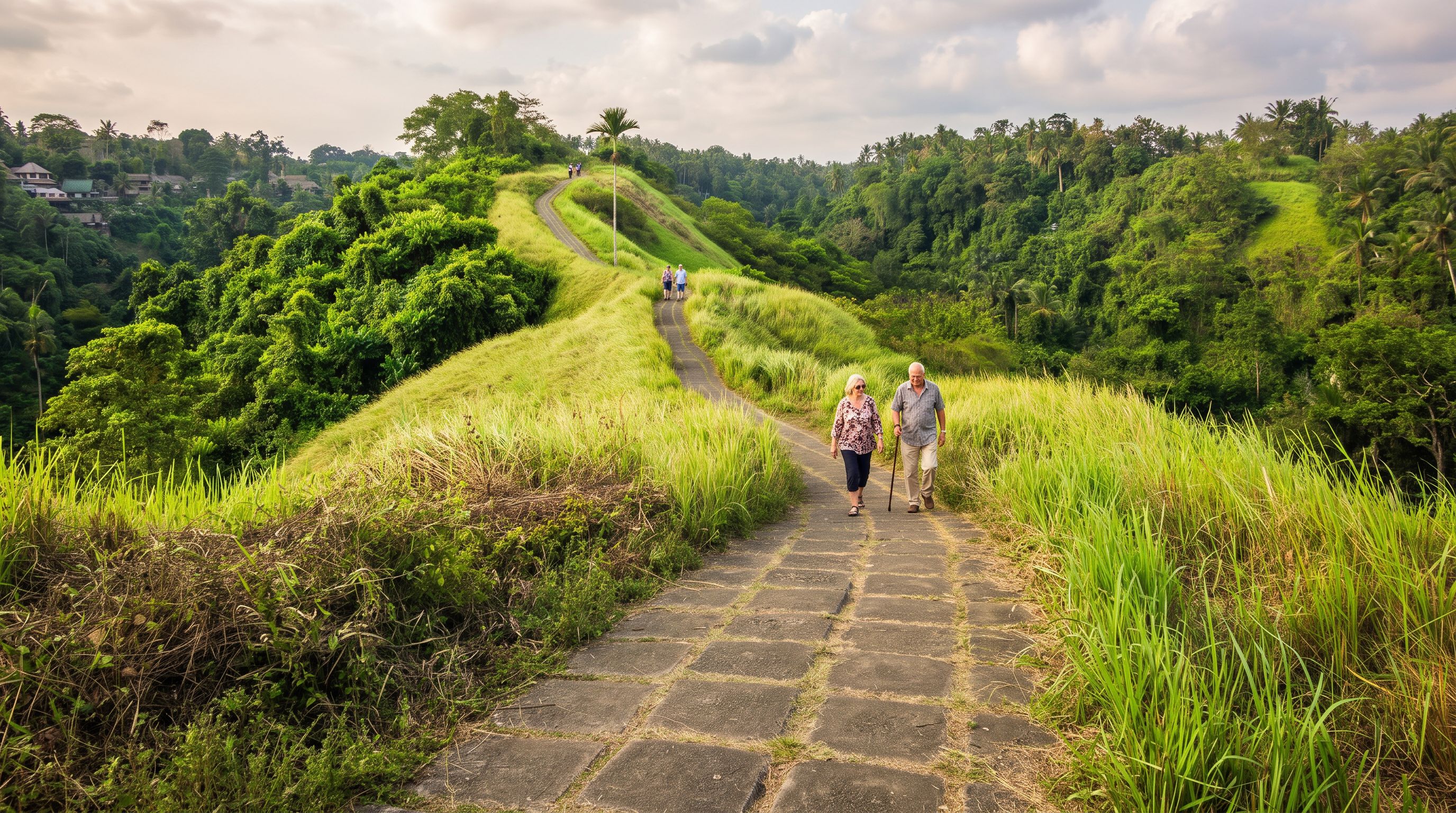
Campuhan Ridge Walk is a free hillside trail, described by one source as roughly a 1.5-hour return walk with a recommended early window of 05:30 to 07:00. Tegallalang Rice Terrace, north of Ubud, carries an entrance charge of about IDR 50,000 and a suggested visiting window of 07:30 to 09:00. The terrain is inherently stepped and uneven.
| Sight | Reported calmest window | Admission reported |
|---|---|---|
| Campuhan Ridge Walk | 05:30–07:00 | Free |
| Tegallalang Rice Terrace | 07:30–09:00 | About IDR 50,000 |
| Sacred Monkey Forest | 09:00–10:00 | IDR 130,000 adult, 2026 |
They also do not state regular closing days or maintenance closures for the named attractions; the reported schedules describe them as generally open daily, but special religious, cultural or operational closures are not documented. Check directly before travelling.
What pace is realistic given the hills, steps and heat?
Plan one major outing per day, not several distant attractions. Build in time for lunch, air-conditioning and an afternoon rest. Forum contributors repeatedly describe fuller sightseeing days as too ambitious, with hundreds of stairs across multiple stops.
The recurring advice is to walk early. For the Campuhan Ridge Walk, the recommended start was around 6 a.m., because later humidity and heat can make the route exhausting, particularly for someone with a knee problem. Udayana University recommends sunscreen, a hat, sunglasses and avoiding the strongest sun between approximately 10:00 and 14:00. That gives you a clean structure: an early outing, a long lunch, an indoor or pool afternoon, and perhaps a short walk again in the cooler late afternoon.
Combining Tegallalang Rice Terrace, Tirta Empul, a ridge walk and other attractions can create a demanding day, with hundreds of stairs across multiple stops. One Reddit itinerary discussion from March 2023 described a family's plan for parents in their early sixties as too ambitious, especially with a bad knee, and replies recommended dropping attractions rather than attempting everything. A separate discussion described arranging a driver for a 72-year-old travelling between Ubud and Sanur; she managed with adjustments, but the discussion stressed that staying in Ubud could be much harder because of damaged sidewalks, chaotic traffic and difficult car access.
What about museums and indoor options?
Museum Puri Lukisan on Ubud's main street is the oldest art museum in Bali, opened in 1956 and founded by Ubud's royal family with the Dutch painter Rudolf Bonnet. It opens daily from 9:00 to 18:00, charges Rp95,000 per adult, and the museum suggests allowing 1.5 hours.
It is about 300 metres west of Ubud Palace along Jalan Raya Ubud, entered through the tall split gate on the north side of the road. The museum advises coming at the 9 a.m. opening or after 3 p.m., since late morning to mid-afternoon is busiest and the main road outside is most congested around midday. Children under 15 accompanied by an adult enter free, though that does not apply to group visits.
Four gallery buildings are arranged around a garden, linked by outdoor paths with some steps. The museum asks that visitors contact it in advance about wheelchair access. The grounds also hold a restaurant, workshop space and a shop. The collection covers Balinese painting and woodcarving from the 1930s onward, representing the Sanur, Batuan, Ubud, Young Artists and Keliki schools, with the North Building holding modern traditional painting of 1930 to 1945 and the Lempad collection.
One closure applies across the island. As with every attraction on Bali, the museum does not open on Nyepi, the Balinese Day of Silence, which usually falls in March. The museum's opening hours and admission details are worth checking before a visit.
What about spas, yoga and wellness?
Ubud is a concentration point for yoga shalas and traditional Balinese healing centres. A private organisation called the Bali Wellness Authority says it evaluates wellness providers through site visits, practitioner-credential checks, facility inspections and client-feedback review, and reports approximately 150 approved providers from more than 300 potential partners.
That accreditation is not automatic for every studio or healer in town. The material does not establish that Ubud itself holds a town-level wellness accreditation, and no source documents a distinct Ubud municipal protection or an official wellness designation applying to the whole town. Visitors should verify whether a particular retreat or practitioner appears in the organisation's current directory before booking a course of treatment.
For readers whose priority is a spa and a pool rather than a ridge walk, this is the section that matters most. The practical approach is to choose a property with the facilities you actually intend to use, confirm the treatment menu and cancellation terms in writing, and treat the wellness ecosystem as a set of individual businesses rather than a town-wide standard.
What health and pharmacy support is available?
Ubud has clinics but no major hospital, and medical options outside southern Bali are more limited. Ubud Royal Medical is a 24-hour clinic in Ubud with English-speaking doctors and an on-site pharmacy, according to the clinic's own website. Apotek Ari Medika in Ubud reports opening hours of 07:00 to 22:00.
A general Ubud health guide states that pharmacies are easy to find in central Ubud, including around Ubud Market and the Monkey Forest area. A listed Ubud medical contact is Prima Medika Medical on +62 (0)361 972374. BIMC Ubud Medical Center is a private clinic serving Ubud with outpatient and limited inpatient services, and Kasih Ibu Gianyar is listed as an option for Ubud-area care.
For serious or complex cases, sources point to hospitals outside Ubud, including facilities in Denpasar and Kuta. Udayana University notes that in south Bali and Ubud there are clinics catering to tourists, and that just about any hotel can put you in touch with an English-speaking doctor. For serious conditions, it advises that foreigners are best served in the costly private clinic BIMC, which caters mainly to tourists and expats, and that visits can cost US$100 or more.
Bring sufficient supplies of regular medication in original labelled packaging. Udayana University's health guidance recommends carrying a physician's letter describing medical conditions and medicines, including generic names. It also recommends reputable pharmacy chains such as Kimia Farma, while other sources warn that counterfeit, poorly stored or expired medicines can occur outside reliable providers. Travel-health sources advise using bottled, filtered or boiled water rather than untreated tap water, as set out in Udayana University's health and safety guidance.
What should I know about heat, altitude and local safety?
Ubud is hot and humid year-round, with typical temperatures from about 22 to 31°C, and it takes most people at least two weeks to adapt to the hot climate. Swelling of the feet and ankles is common, as are muscle cramps caused by excessive sweating.
Rabies is reported as endemic in Bali's dog and monkey populations. After a bite, scratch or saliva exposure, wash the wound immediately with soap and water and seek urgent medical care. Dengue is reported throughout Bali, including Ubud, with higher risk during the wet season; DEET-based repellent, long sleeves and screened or air-conditioned accommodation are recommended. Motorcycle traffic remains the leading cause of foreigner emergency visits, which is another reason to leave the scooter to someone else.
Emergency numbers reported are 112 for general emergencies, 110 for police, 113 for fire, 118 or 119 for ambulance, and 115 for search and rescue. Because emergency-number information is inconsistent across travel sources, ask the hotel or clinic to place the call and give the exact accommodation name, road and nearest landmark. Before departure, obtain the current numbers from your accommodation provider or official Indonesian authorities.
When should I go to Ubud?
May, June, September and October offer the best combination of manageable weather and fewer visitors than July and August. The wettest period is November to March, with January and February generally the wettest months. July and August are the main high-season months, and Christmas and New Year also bring very strong demand.
WeatherSpark describes Ubud as hot and humid year-round, with a wetter season approximately from 10 November to 6 April. Published sources describe Ubud as cooler than the southern coast because of elevation and vegetation, with the exact difference varying by source from roughly 2 to 5°C. bali.com notes the climate is significantly cooler than the coast and that it rains much more.
Month by month, the pattern is consistent. January and February are wet-season months with heavy tropical showers and thunderstorms, and February is the least reliable month for long outdoor itineraries. March continues wet but rainfall begins to ease. April is a transition month and a good shoulder-season option. May is generally drier with more manageable visitor levels. June is drier and relatively comfortable inland, with one source reporting about 38 mm of rain in June. July and August are dry but busy, with higher prices and more traffic. September is an excellent shoulder-season choice. October turns wetter later in the month. November and December bring established wet-season rain, with exceptionally strong demand around Christmas and New Year.
Exact month-by-month rainfall figures are mostly for Bali or coastal reference locations rather than a consistent official Ubud weather station. A 2025/2026 travel guide citing Indonesia tourism data reports approximately 6.3 million annual international arrivals to Bali, with two-thirds concentrated in July, August, December and January. That is an island-wide statistic, not an Ubud count.
What does entry cost, and how much cash should I carry?
International visitors must pay the Bali Tourist Levy of IDR 150,000 through the official Love Bali portal. Local attraction charges are separate from the tourist levy.
Eligibility, passport validity, onward-ticket rules and permitted stay should be checked against current Indonesian immigration guidance, because those details are not provided. the sources state that local temple entrances and parking charges may require cash, with parking commonly reported at IDR 10,000 to 20,000. Temple visits may require a sarong, and one source says sarong rental is usually required at temples and may be included in some admission charges.
On discounts, the position is clear. No source supplied here documents a general over-65 concession, senior pass or reduced tariff at the named Ubud attractions, and they do not establish a general senior discount for Bali attractions. Discounts may be set separately by individual museums, temples, galleries, wellness centres, transport operators and tours. Ask each operator specifically about over-60 or over-65 admission, Indonesian or foreign-resident concessions, mobility-assistance arrangements, multi-site or family passes, and whether a reduced fare applies only to Indonesian citizens.
How many days do you need, and what should you book ahead?
Allow at least three or four nights to cover the central sights and one rice-terrace outing at a comfortable pace. Book accommodation, airport transfer and any private driver in advance, particularly in July, August and the Christmas period.
Booking arrangements vary by site. For Ubud Palace, they document evening dance performances with tickets reportedly available at the gate from about 17:00, but not online booking, cancellation terms or accessibility assistance. For Pura Taman Saraswati, they document the lotus-pond setting and opening hours, but not operator-run classes, guided tours, advance booking or cancellation terms. For Tegallalang Rice Terrace, they report admission and a morning window but no specific operator's tours, classes, shuttles or cancellation policy.
If you are travelling with grandchildren, the planning logic shifts toward shorter days and more pool time, and our guide to Chiang Mai with grandchildren shows how that trade-off works in a comparable Asian destination. If your wider trip takes in Vietnam, the same pacing questions come up in our two-week itinerary across central Vietnam.
What should travellers over 50 expect on the ground?
Expect a town that rewards early starts, a car for anything outside the centre, and a light daily schedule. Expect genuine cultural depth, from the royal palace to the art museums, alongside pavements that demand attention and heat that demands respect.
The forum evidence supports Ubud for active and moderately mobile visitors over 50, but not as a carefree pedestrian destination. Central accommodation, early starts, a private driver and a deliberately light schedule make a substantial difference, and severe mobility limitations may make another Bali base more comfortable. If balance or knee problems are significant, choose car-based sightseeing and confirm the hotel's steps, slopes, bathroom layout and shuttle service before booking.
For travellers with meaningful mobility limitations, a March 2026 discussion suggests replacing demanding outings with places reached by paved roads, such as cafés around Kintamani, Lake Batur viewpoints and accessible hot-spring facilities, rather than waterfalls, Gunung Kawi or rough jeep excursions. Gunung Kawi is singled out as a temple requiring many steps. Contributors also recommended avoiding waterfalls, steep-step temples and slippery stone, and choosing paved-road excursions instead.
Rates quoted in this guide are indicative and vary by season and booking channel. Confirm prices, opening hours and accessibility details directly with each operator before you travel, and treat every schedule here as subject to religious, cultural and operational change.


