
Charleston's house museums and gardens ask something of the visitor: a morning of walking, a few flights of stairs, a willingness to read a room slowly. They give back in kind. The Nathaniel Russell House on Meeting Street holds a three-storey staircase that appears to float, and the Aiken-Rhett House on Elizabeth Street preserves a household in the state history left it. Outside the peninsula, Middleton Place and Magnolia Plantation spread formal gardens and water across hundreds of acres. The differences between them matter more than the similarities, especially for anyone planning around knees, hips or stamina.
This guide covers four properties: what each one is, when it opens, what a ticket costs, and how much walking and climbing each asks. It also covers the Charleston Festival, the spring house-and-garden tours that open private doors across the peninsula. General sightseeing is covered elsewhere in our complete Charleston guide for travellers over 50.
Which historic homes and gardens can you actually visit?
Four properties anchor a Charleston house-and-garden visit: the Nathaniel Russell House and Aiken-Rhett House downtown, both run by Historic Charleston Foundation, and Middleton Place and Magnolia Plantation up the Ashley River. Each is a separate ticket and a separate half-day. The two downtown houses sit within the historic peninsula; the two plantations lie outside it and need a car or a tour transfer.
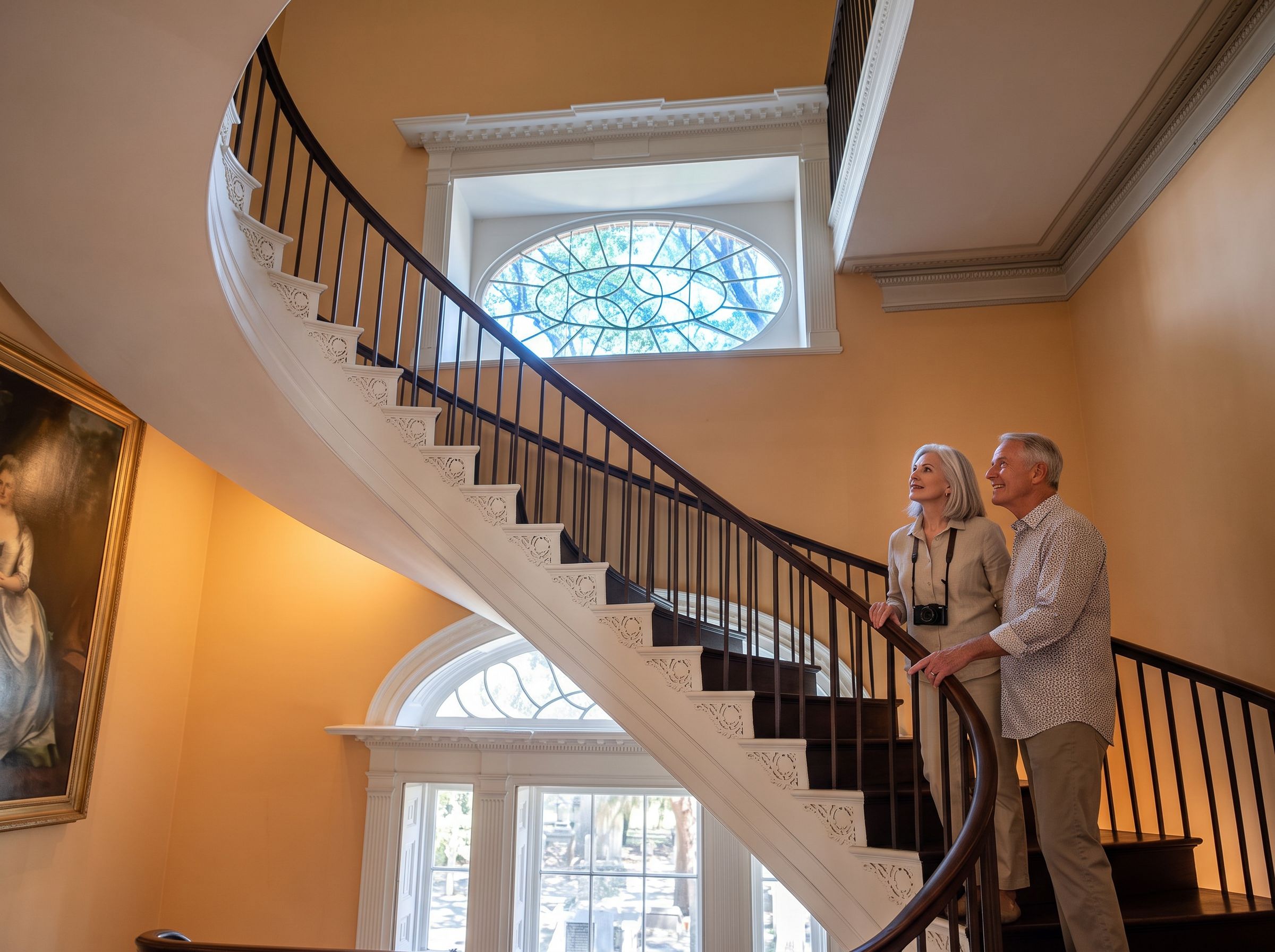
The Nathaniel Russell House stands at 51 Meeting Street, south of Broad and within walking distance of White Point Garden and the High Battery, according to Historic Charleston Foundation. It was built in 1808 and the city's tourism board describes it as a major neoclassical dwelling with elaborate plasterwork, a free-flying staircase and a joggling board in the formal garden.
The Aiken-Rhett House is at 48 Elizabeth Street, in the Mazyck-Wraggborough neighbourhood. It is a self-paced museum, and Historic Charleston Foundation describes it as preserved rather than restored: visitors see the house in the condition time left it, not returned to a period ideal.
Middleton Place is at 4300 Ashley River Road. Magnolia Plantation and Gardens lies nearby and, according to The Liberty Trail listing, holds 66 acres of public gardens plus the Audubon Swamp Garden and boardwalk.
What should you see at the Nathaniel Russell House?
The staircase is the reason most people come. Three storeys of cantilevered steps, each supporting the one above and below, spiral upward without visible support. Around it: restored interiors, curved walls and doors, gilded accents, period furnishings, and a small formal garden that is free to walk through. Guided tours run hourly and guests consistently rate them more informative than the audio version.
Historic Charleston Foundation quotes Nathaniel Russell's great-granddaughter, Alicia Hopton Middleton, on the treads being deep and the ascent easy. Visitors are not permitted to climb the staircase today; guest feedback is consistent on that point. What they do instead is stand beneath it, which is the better view anyway.
The free Historic Charleston Foundation app carries a self-guided audio tour of roughly 45 minutes, with optional extra recordings in each room. Guests report it can be played on a provided device or on your own phone with headphones. The house is air conditioned, something visitors repeatedly mention with gratitude on humid days.
"The Nathaniel Russell is a beautiful historic home. The flying staircase is worth the price of admission. The rest of the house is also great, with nice details including curved walls, curved doors, and gilded accents." (Google, December 2025)
As of November 2026, the Nathaniel Russell House holds a Google rating of 4.6 out of 5 from 1,304 reviews. Docents come in for repeated praise across reviews as knowledgeable and patient with questions.
 AI-edited
When is it open, what does it cost, and how hard is the visit?
Historic Charleston Foundation publishes the schedule: Monday 1 to 4 p.m., Tuesday to Sunday 10 a.m. to 4 p.m., with last admission at 4 p.m. Staff-led tours begin on the hour and the last one starts at 3 p.m. The house closes on Thanksgiving Day, Christmas Eve and Christmas Day. An adult ticket for one house museum is $16; the combined ticket for both downtown houses is $24.
Children aged 6 to 16 are $7 for one house or $12 combined, and under-sixes go free, according to Historic Charleston Foundation. Tickets can be bought at the house or online and expire six months after purchase. Groups of 12 or more can arrange tours with the house manager, with discounts applying.
Sources differ on the closing hour: some official summaries state a final tour at 4 p.m. with visitors allowed to stay until 5 p.m. Confirm the day's last entry at the desk when you arrive.
On mobility, the operator is direct. Historic Charleston Foundation states that touring requires walking across uneven flooring and using stairs, and that the house is not wheelchair- or scooter-accessible. The operator publishes no lift, stairlift or step-free route, and no step count. Staff say they will meet accessibility needs to the best of their ability; ask what that means for your circumstances when you book.
Two practical notes from guest feedback. Cash is not accepted for admission. Seating inside is limited to about one spot, so if standing is difficult, say so at the desk before the tour begins.
What makes the Aiken-Rhett House different?
It is self-paced and unrestored. Where the Russell house shows you a household returned to its 1808 elegance, Aiken-Rhett shows you the same era of Charleston life with the wear left in. Visitors move through at their own speed and may stay as long as they wish within opening hours. The same $16 single or $24 combined ticket covers it.
The hours match the Russell house: Monday 1 to 4 p.m., Tuesday to Sunday 10 a.m. to 4 p.m., last admission 4 p.m., closed Thanksgiving Day, Christmas Eve and Christmas Day, according to Historic Charleston Foundation. Tickets are sold at the property or online.
The operator states that the visit involves uneven flooring and stairs and that the house is not wheelchair- or scooter-accessible. No step count or walking distance is published. Strollers are not permitted on the tour but can be stored, and large bags should be left at the front desk.
Historic Charleston Foundation also lists a special tour about the Revolutionary War trench discovered in the museum's back lot, priced at $25 per person including house admission, running through November 2026.
What will you find at Middleton Place, and how much walking is involved?
Middleton Place is a formal garden first and a house museum second. General admission covers the gardens, the Stableyards, artisans at work, heritage animal breeds and daily guided outdoor tours. Guests describe the grounds as large, the walking as substantial, and a visit as several hours to a full day. Comfortable shoes with good tread are the near-universal recommendation.
The gardens hold allées, terraced lawns, reflection pools, sculptures and ornamental lakes, and Fodor's describes Middleton as the more formal of the two Ashley River gardens. The house museum tour costs extra and covers the surviving South Flanker rather than the original main house, which burned.
Seasonality shapes what you see. Camellias and azaleas bloom in late winter and spring, with fewer flowers in summer, according to guest feedback. A Reddit Charleston thread from January 2024 recommends Middleton for February camellias and mentions very old specimens, though the claim that some are around 250 years old comes from forum discussion rather than an official horticultural record. A Fodor's forum discussion from December 2006 warns that azaleas may have passed their peak by the end of April.
As of November 2026, Middleton Place holds a Google rating of 4.7 out of 5 from 3,149 reviews. Volunteers come in for repeated praise, including help with transport around the property for visitors with mobility challenges.
Middleton Place tickets, hours and access: what should you plan for?
Middleton Place opens daily from 9 a.m. to 5 p.m., closed Christmas Day and open until noon on Christmas Eve, according to its published visitor information. Seniors receive $3 off general admission when buying at the Visitors Center; the discount is not available for online tickets. AAA receives $3 off and active military $6 off, also at the Visitors Center.
The property publishes a wheelchair-accessible route on an accessibility map available from the Visitors Center. It also states plainly that historic garden paths are uneven dirt and gravel, with some sandy areas that may be difficult for wheelchairs, motorised scooters and walkers. Entry to the House Museum involves steps and is not wheelchair- or scooter-accessible.
Walking on the grass is permitted and may help visitors who have difficulty with steps, according to the same visitor information. Handicapped parking and restrooms sit adjacent to visitor parking, and parking is free. Trained service animals are permitted throughout; pets and emotional-support animals are restricted to the main parking lot.
The site warns of free-roaming livestock and natural predators in explaining its animal policy. Guest feedback adds two more cautions: alligators are present in the ponds and along the river, and garden paths can flood after heavy rain. Some visitors have found signage to the parking lot and restrooms insufficient.
Middleton Place does not publish a calmest visiting time. Its daily guided-tour schedule is posted at the Visitors Center, so ask staff about that day's timing rather than relying on a general rule.
Is Magnolia Plantation easier underfoot than the house museums?
Partly, and with conditions. The Liberty Trail listing records accessible parking and wheelchair accessibility at Magnolia, and a small tram reduces the need to walk around the larger plantation grounds, according to a Fodor's forum comparison. The same listing does not specify which garden sections are step-free, the condition of every boardwalk or trail, or whether wheelchairs are available on site.
The listing records 66 acres of public gardens, the Audubon Swamp Garden and boardwalk, walking and biking trails, parking, a wildlife centre and guided Nature Train and "From Slavery to Freedom" tours. Leashed dogs are permitted across the public gardens but not on guided tours.
On tickets, the listing gives a senior category for ages 62 and over, with prices explicitly labelled 2024 admission: $32 for garden admission and $47 including the house tour, against $35 and $50 for adults. Those are 2024 figures; confirm current rates before you travel. Garden admission may be used for one additional visit within the same calendar year. Advance tickets online are encouraged, add-on tours may be available at the Welcome Center, and the Wildlife Boat Tour must be bought on the day because of seasonality and weather.
No defensible ranking of Magnolia against Middleton on ease of walking can be given: the official material documents no terrain detail for Middleton's gardens, and the sources conflict on the comparison. Ask both properties directly.
What is the Charleston Festival, and can you get tickets?
The Charleston Festival, formerly the Festival of Houses & Gardens, is Historic Charleston Foundation's spring programme of house-and-garden tours across the peninsula. It opens private residences and gardens not ordinarily open to the public. The 2027 festival runs from April 1 to 24, 2027, with tickets on sale from December 1, 2026; the 2027 schedule was still listed as to be announced.
The Charleston Visitor website describes the festival as presenting access to approximately 150 grand private homes and gardens, though that result identifies the event generally rather than supplying a full schedule. Historic Charleston Foundation's 2025 press material described the long-running event under its new name, with the house and garden tours continuing alongside new programmes and venues. The foundation's festival pages carry the current programme as it is published.
Separately, the Preservation Society of Charleston runs Fall Tours, with 2026 dates from October 1 to November 7, 2026 and house-and-garden tickets at $75 for members and $100 for non-members. Its published guidance is unusually candid: tickets must be bought online or by telephone in advance with no walk-ins, tours typically involve six or more blocks over uneven streets and sidewalks, many historic sites are not accessible, and restrooms may be a substantial walk away.
How should you buy tickets, and is there a pass worth having?
Buy direct where the discount lives. Middleton's senior reduction exists only at the Visitors Center, not online, so an online ticket costs you $3. The Historic Charleston Foundation houses sell online or at the door, and their tickets hold for six months, which allows a two-visit plan across a longer stay.
The Charleston Essential Passport is a digital product covering selected downtown historic sites, including the Nathaniel Russell House, valid for five consecutive days from first use. It is non-refundable, cannot be used for special events or combined with other discounts, and must be shown on a smartphone. Whether it saves money depends on how many of its sites you plan to see; compare against the $16 and $24 house prices before buying.
Historic Charleston Foundation publishes no senior or over-65 reduction for its house museums. No general over-65 Charleston pass is documented. Cancellation terms for either house museum or for Middleton Place admission are not published; ask when booking.
| Property | Adult ticket | Senior reduction |
|---|---|---|
| Nathaniel Russell House (one house) | $16 | None published |
| Russell + Aiken-Rhett combined | $24 | None published |
| Middleton Place, general admission | Not stated in the cited material | $3 off at the Visitors Center only |
| Magnolia Plantation, garden admission | $35 (2024 rate) | $32 for ages 62+ (2024 rate) |
Which of these is easiest underfoot?
The two downtown houses both require stairs and uneven floors and are not wheelchair- or scooter-accessible. Middleton publishes an accessible route map but also warns of uneven dirt, gravel and sand. Magnolia records accessible parking and wheelchair accessibility without specifying which sections qualify.
What can be said is this: Middleton publishes the most detailed access information of the four, including the accessible route map, the grass-walking allowance and the location of handicapped parking and restrooms. That transparency lets you plan, which is not the same as an easy visit.
For anyone who needs a genuinely low-effort indoor option, the Charleston Museum is documented separately: a travel guide reports free wheelchair loans including electric models, captioned videos, and photographic alternatives for stair-dependent historic houses. Those provisions apply to the Charleston Museum, not to the Russell house or Middleton Place.
Distances between the properties are not published by any of the operators, and no first-hand source gives reliable walking times between the downtown houses. The city's own visitor pages note seven miles of waterfront and public restrooms in downtown parking garages, parks and city buildings, with restrooms sometimes locked and available on request, according to the City of Charleston visitor information.
What else should travellers 50-70 know before setting out?
Parking, heat and medical backup are the three practical threads. Street parking and public garages serve the downtown houses. Visitors with a disability placard or plate park free at city-owned garages, lots and meters, a City of Charleston provision that does not extend to the plantations outside the municipal system. Summer heat is real; Fodor's advises morning garden visits and warns that walking tours can become long and hot.
For emergencies in Charleston and Charleston County, use 911. Roper Hospital at 316 Calhoun Street offers 24-hour emergency treatment downtown, and CVS Pharmacy at 59 George Street is the nearest documented downtown pharmacy. Neither property documents its own medical arrangement; ask at the desk if you have a concern.
Food and drink are prohibited inside both Historic Charleston Foundation houses, though a closed-top water bottle is acceptable. Large bags can be left at the front desk. If you are staying in the city and want a base within walking distance of the downtown houses, our guide to Charleston hotels where comfort comes first covers the practical trade-offs.
For a slower half-day after the gardens, the city's cultural calendar runs through Spoleto Festival USA, the Charleston Wine + Food Festival and the Southeastern Wildlife Exposition. Our Charleston spa hotels guide is the place to look if recovery between walking days matters as much as the itinerary.
How should you shape two or three days around these four properties?
Give each plantation its own morning and pair the downtown houses on a third. The Russell house suits a 10 a.m. guided tour, when docents are fresh and the house is cool. Middleton rewards an early start before the heat, with the senior discount bought at the Visitors Center. Magnolia fits a separate morning, using the tram to spare the legs.
First, the Historic Charleston Foundation tickets last six months, so a return visit to Aiken-Rhett on a later trip costs nothing extra. Second, the Preservation Society's Fall Tours demand advance booking and involve six or more blocks on uneven ground; treat them as a half-day commitment rather than an add-on.
Finally, ask rather than assume. The Russell house publishes no step count and no lift. Middleton publishes no calmest hour and no walking distance from parking to the gardens. Magnolia does not specify which paths are step-free. Each of those gaps is a question for the property, and each is answerable by the people who work there.


