
Ubud has been Bali's artistic capital for the better part of a century, and the reasons are still visible on any evening: gamelan gongs drifting from a palace courtyard, a Legong dancer's fingers tracing the air, a woodcarver's chisel working a block of hibiscus in a village south of town. For culture-minded travellers aged 50 to 70, the appeal is not a single museum or a single show but the density of it all: painting, dance, silverwork and carving within a few kilometres of one another, much of it reachable on foot from the centre.
The practical challenge is equally real. Ubud rewards planning more than it rewards improvisation. Its pavements are uneven, its performances start at fixed hours, its museums sit at opposite ends of town, and its craft villages need a car. This guide sets out what to see, how to pace it, and where the documented facts stop and a phone call to the venue needs to begin.
Why is Ubud considered Bali's cultural heart?
Ubud holds Bali's oldest art museum, a royal palace that stages dance nightly, and a cluster of villages devoted to painting, carving and silverwork. A 2024 study citing Gianyar Regency Cultural Office data counted 72 art studios in Ubud Village alone and 466 traditional dance groups across the regency, a concentration unmatched elsewhere on the island.
The modern story begins in the 1930s. Museum Puri Lukisan, on Jalan Raya Ubud, opened in 1956 and is described by the World Museum Guide as the oldest art museum in Bali, founded by Ubud's royal family together with the Dutch painter Rudolf Bonnet to keep the best Balinese painting and woodcarving on the island. Its four galleries trace modern Balinese art from the Pitamaha movement of the 1930s onward.
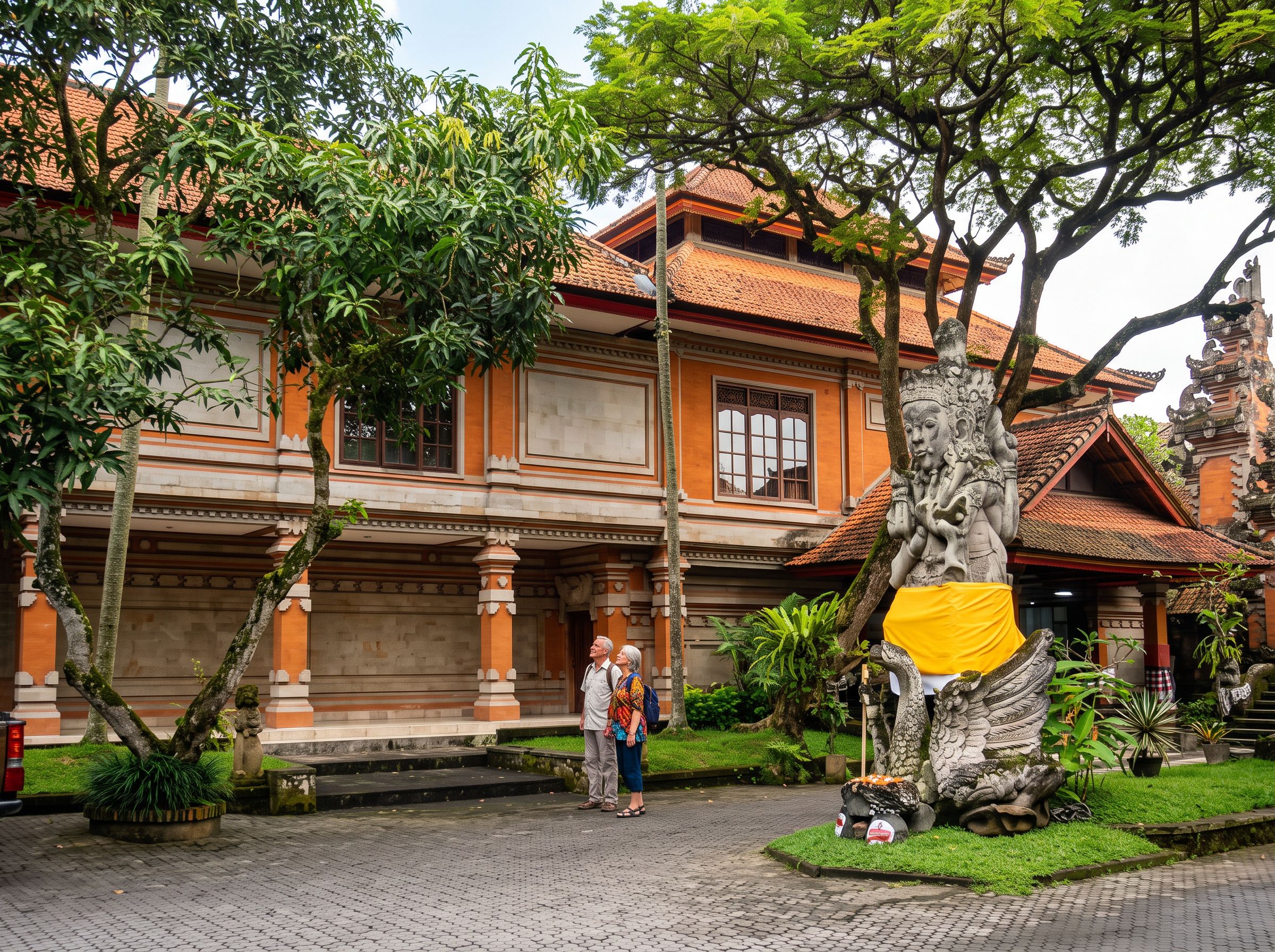
That institutional history sits alongside a living one. Dance and gamelan are not staged for visitors alone; they are performed in temple courtyards and palace grounds as part of ordinary Balinese cultural life, and the tourist audience is a later addition. The result is a town where a museum visit in the morning and a temple-courtyard performance in the evening feel like two parts of the same subject rather than two separate attractions.
 AI-edited
Where can I see Balinese dance and gamelan in Ubud?
Ubud Palace stages traditional dance with live gamelan every evening at 7:30 p.m., with a different programme each night and admission listed at IDR 100,000. Pura Dalem, Pura Saraswati and ARMA run their own nightly or near-nightly programmes, and the Sacred Monkey Forest hosts weekend daytime shows.
The palace programme, published by Ubud Palace dance ticketing, runs 7:30 to 9:00 p.m. each evening with a rotating bill: Sunday Legong Mahabarata, Monday Legong, Tuesday Ramayana Ballet, Wednesday Legong and Barong, Thursday Legong Trance, Friday Barong, Saturday Legong. Daytime access to the palace grounds is reported as free, while the evening performance requires a separate ticket, with published prices of approximately IDR 100,000 per person (Ubud Palace dance tickets).
The alternatives each have a character of their own:
- Pura Dalem Ubud lists Monday Kecak and Fire, Tuesday Legong, Wednesday Bamboo Gamelan, Thursday Barong and Keris, and Friday Kecak and Fire, all at 7:30 p.m. and IDR 100,000. It is the clearest published option for hearing a bamboo gamelan rather than a conventional ensemble.
- Pura Saraswati runs at 7:30 p.m. with Sunday Janger, Monday Joged, Tuesday Kecak, Wednesday Ramayana Ballet, Thursday Kecak, Saturday Legong and no dance on Friday, at IDR 100,000.
- ARMA's open stage starts at 7:00 p.m., separately ticketed from museum admission: Kecak on Mondays and Wednesdays, Barong on Tuesdays, Legong Lasem Peliatan on Thursdays, Ramayana Ballet on Fridays, a Saturday Kecak Sang Hyang Jaran dinner show and Barong Prakpak on Sundays. Most shows are listed at IDR 150,000 per person, with the Saturday dinner performance at IDR 350,000 (Ubud art museums compared).
- Sacred Monkey Forest hosts dance at the Wana Café on Saturdays and Sundays at 11:00 and 16:00.
What should I know about seating and timing at performances?
Evening seating at Ubud Palace is generally unreserved, so arriving well before the 7:30 p.m. start is recommended for a better view.
Practical points for older visitors, drawn from what the venues do and do not publish:
- Arrive early. Unreserved seating means the front rows and the aisle ends go first.
- Performances run roughly 90 minutes at the palace, from 7:30 to 9:00 p.m.
- The temple settings at Pura Dalem and Pura Saraswati may be less comfortable for anyone needing level access or substantial back support.
- No venue documents a dedicated emergency or medical post on site.
Payment methods and cancellation terms are not documented for any of the dance programmes. Confirm both at the point of purchase. If you are staying centrally, the palace and market area is described as relatively flat, which makes an evening walk feasible; the wider pedestrian environment is not reliably accessible, a point covered in our guide to visiting Ubud in the dry season with fewer crowds.
Which Ubud art museums are worth the time?
Three museums anchor the art circuit: Museum Puri Lukisan in the centre, Neka Art Museum in Sanggingan to the north-west, and ARMA in Pengosekan to the south. Each charges around IDR 95,000 to 150,000 for adults, and each rewards a half-day rather than a hurried hour.
| Museum | Location | Adult admission | Hours | Allow |
|---|---|---|---|---|
| Museum Puri Lukisan | Jalan Raya Ubud | Rp95,000 | Daily 09:00–18:00 | About 1.5 hours |
| Neka Art Museum | Sanggingan | Rp150,000 (students and ages 6–12 Rp75,000) | Daily 09:00–17:00 | 2 to 3 hours |
| ARMA | Pengosekan | Rp150,000 | Daily 09:00–18:00 | 2 hours |
Museum Puri Lukisan is the easiest to reach on foot from the palace and the shortest visit. Children under 15 accompanied by an adult enter free, though that does not apply to group visits. No over-65 or senior tariff is documented at any of the three museums.
Neka Art Museum, founded by the collector Suteja Neka and opened in 1982, traces the development of painting in Bali through pavilions set in a garden overlooking a river valley. It also holds a notable collection of Balinese keris. Large bags go in free lobby lockers, last entry is about 30 minutes before closing, and the museum closes on Nyepi, Bali's Day of Silence, which usually falls in March (World Museum Guide's Ubud museum listings).
ARMA, opened in 1996, shows Balinese painting from classical Kamasan work to contemporary art alongside Walter Spies, Raden Saleh and other artists linked to Bali. Set in gardens by rice fields, it is also a busy venue for dance, gamelan and cultural workshops. Photography is generally permitted, though restrictions may apply to particular photographic collections.
The Blanco Renaissance Museum, on Jalan Raya Campuhan in Antonio Blanco's former home and studio, is published at approximately IDR 100,000 with general hours of about 09:00 to 18:00 daily. Confirm the amount and payment method with the venue before making a special journey.
How accessible are the museums for older visitors?
None of the three museums is documented as fully step-free. ARMA occupies landscaped grounds with garden paths and steps, and Neka's collection is spread across pavilions on landscaped grounds including steps and a lower-ground level. Neither publishes a lift, continuous step-free route or accessible toilets.
What the venues do say is worth noting. ARMA's published accessibility note advises contacting the museum in advance about wheelchair access. At Neka, staff can reportedly advise on the easiest route through the grounds. Neither museum documents formal mobility assistance, and Museum Puri Lukisan's sources are silent on steps, lifts, seating and gradients altogether.
Distances between the three are manageable by car but not by foot in a single day. Puri Lukisan is an easy walk from Ubud Palace; ARMA is about 30 minutes' walk south along Jalan Hanoman, and Neka about 40 minutes north-west beyond the Campuhan bridge. Taxis and ride-hail cars cover each hop in around 10 minutes. Ubud has no convenient public bus for visitors. For a broader picture of getting around with limited mobility, see our Ubud accessibility guide for older travellers.
Which craft villages can I visit, and how do I shop without exhaustion?
Mas, south of Ubud, is the woodcarving centre; Celuk is known for gold and silver jewellery; Batuan is a traditional painting area. Village visits themselves are listed as free, with transport and purchases charged separately, and none of the three publishes a standard demonstration timetable or opening season.
The villages are working communities rather than attractions with gates and tickets, and that shapes how to approach them.
- Mas is described as more commercial, with large showrooms and extensive inventory. Tour operators bringing visitors there may receive a purchase commission that is not always disclosed, according to a July 2025 Reddit account.
- Celuk lets visitors buy directly from artisans. An April 2025 FlyerTalk report found one jewellery stop highly tourist-oriented, with a supposed workshop that appeared to lack the appropriate tools; the same party asked their driver to find another workshop, located inside the owner's house, and found it much better.
- Batuan appears in Ubud-area art and craft itineraries as a painting village. No village-wide admission price, fixed route, opening season or workshop schedule is published.
- Pakudui, north of Ubud, is described in a July 2025 Reddit post as a village with roughly 50 carving shops specialising in wooden Garuda figures. It is best reached by car or motorbike, potentially combined with the Tegallalang Rice Terraces.
For shopping without exhaustion, the sensible pattern is one village per outing, ideally in the morning before the heat builds. Ubud's dry season, roughly April to October, is the most comfortable window, though July and August are the busiest months. The practical guide to food and water safety in Ubud covers the heat and hydration side of a long day out.
What about the Ubud Art Market and Sukawati?
The Ubud Art Market sits in the flat palace and market area of central Ubud. No admission fee is documented, and no verified opening time, senior concession or market-wide closure calendar is published. Sukawati Art Market, by contrast, was described in an April 2025 FlyerTalk report as mostly clothing rather than arts and crafts.
The market area is the most practical historic walking zone in Ubud because it is described as largely flat and navigable. That is where the good news ends. Central pavements may be narrow, uneven, broken, obstructed by scooters, and affected by open drains, high kerbs and sudden steps. Benches are reported as almost nonexistent in central Ubud, and no comprehensive inventory of accessible toilets, handrails or rest areas is published.
Specific claims about crowding, bargaining, stall quality, seating or accessibility at the Ubud Art Market are not documented. Treat the market as an unstructured browse rather than a scheduled sight, and pair it with a museum or a palace visit rather than making it the day's sole objective.
How should I pace a cultural visit to Ubud?
One museum, one evening performance and one craft village make a comfortable cultural day. Attempting all three museums plus a village in a single outing is rushed: Neka alone merits two to three hours, and the sites sit at opposite ends of town.
A workable shape, drawn from published opening hours and programme times:
- Morning: one museum, before tour groups and the midday heat. Puri Lukisan if you want a short visit close to the centre; Neka if painting is the priority and you have the morning to spare.
- Midday: a rest. Central Ubud has few benches, so plan to return to your accommodation rather than relying on street seating.
- Late afternoon: a craft village by car, or the market area on foot.
- Evening: a 7:00 or 7:30 p.m. performance, arriving early for seating.
Two annual events are worth planning around. Ubud Open Studios runs 5 to 7 June 2026 at Biasa Gallery, Ubud, per Bali's official Love Bali events calendar, and offers the chance to enter artists' creative spaces and see their working processes. The Ubud Writers & Readers Festival's 2026 programme lists more than 100 events involving over 150 authors, actors, journalists, poets and thinkers across Ubud, including dance performances, exhibitions, painting, Balinese manuscript-writing and tie-dye workshops with Threads of Life.
What else should I plan for?
International visitors pay a Bali tourist levy of IDR 150,000 through the official Love Bali portal, separate from attraction admission. No combined cultural pass covering the museums, performances and craft villages is documented, and no over-65 concession is published for any of them.
On health, BIMC Hospital Ubud publishes a 24-hour emergency department at Jl. Raya Sanggingan No. 21, Kedewatan, with the number +62 361 209 1030 (BIMC Ubud). UbudCare Clinic in Peliatan is reported as operating 24 hours with ambulance service and an on-site pharmacy for patients receiving treatment. RSUD Gianyar is reported as Ubud's closest 24-hour hospital, approximately 13 km east. Published Bali emergency numbers include 112 for general emergencies, 110 police, 118 or 119 ambulance, 113 fire and 115 search and rescue. For a serious incident, accommodation staff or a medical provider should place the call and give the exact road, property name and nearest landmark.
On customs, dress respectfully at temples and ceremonial sites, covering shoulders and knees, and do not step over or disturb offerings.
On where to base yourself, central properties make evening performances and galleries walkable, while quieter resorts improve sleep but can involve steps and transport delays. Our guide to Ubud hotels worth booking for the food covers the dining side of that choice.
Is Ubud's cultural circuit worth the planning effort?
Yes, provided the trip is built around fewer things done well. Ubud offers Bali's oldest art museum, a nightly palace dance programme with live gamelan, three distinct art collections and working craft villages within a short drive, a concentration that justifies the logistics.
The honest summary is that Ubud's cultural life is rich and its infrastructure is uneven. Pavement improvements have been scheduled broadly from the Teges intersection to Kedewatan, with the Gianyar Regency section reportedly including the route from Ubud Palace to the entrance of Campuhan Ridge Walk, but the reporting does not establish that the work has finished or that the redesigned routes will be fully step-free. Construction may mean uneven surfaces and temporary diversions.
Book performances directly and confirm seating, payment and cancellation terms at the same time. Choose one museum per morning. Take a car to the craft villages and agree the stops in advance. None of the venues publishes a senior fare or an assistance service, so a phone call or an email before you travel is the single most useful preparation. Done that way, Ubud's arts scene rewards the effort generously.


