
Charleston rewards the traveller who arrives with a plan rather than a checklist. The historic peninsula is compact, the streets are old, and the city's own visitor office points newcomers toward the harbour, the Old Exchange & Provost Dungeon and the surrounding historic attractions as the central experiences. For readers in their fifties and sixties, the question is less what to see than how much walking, heat and cobblestone a given day can absorb.
The good news is that Charleston offers several ways to slow the pace without missing the city. Narrated harbour cruises, air-conditioned bus tours, carriage rides and a museum with free wheelchair loan all exist alongside the walking tours. The trick is matching the day to the body, and knowing which surfaces and which seasons ask more of you.
How is Charleston laid out for a first-time older visitor?
Charleston's historic core sits on a peninsula between two rivers, with the oldest streets at the southern tip and the main shopping and hotel spine running north along King Street. The compact geography means most sights cluster within a walkable area, but the street surfaces are three centuries old and not uniform.
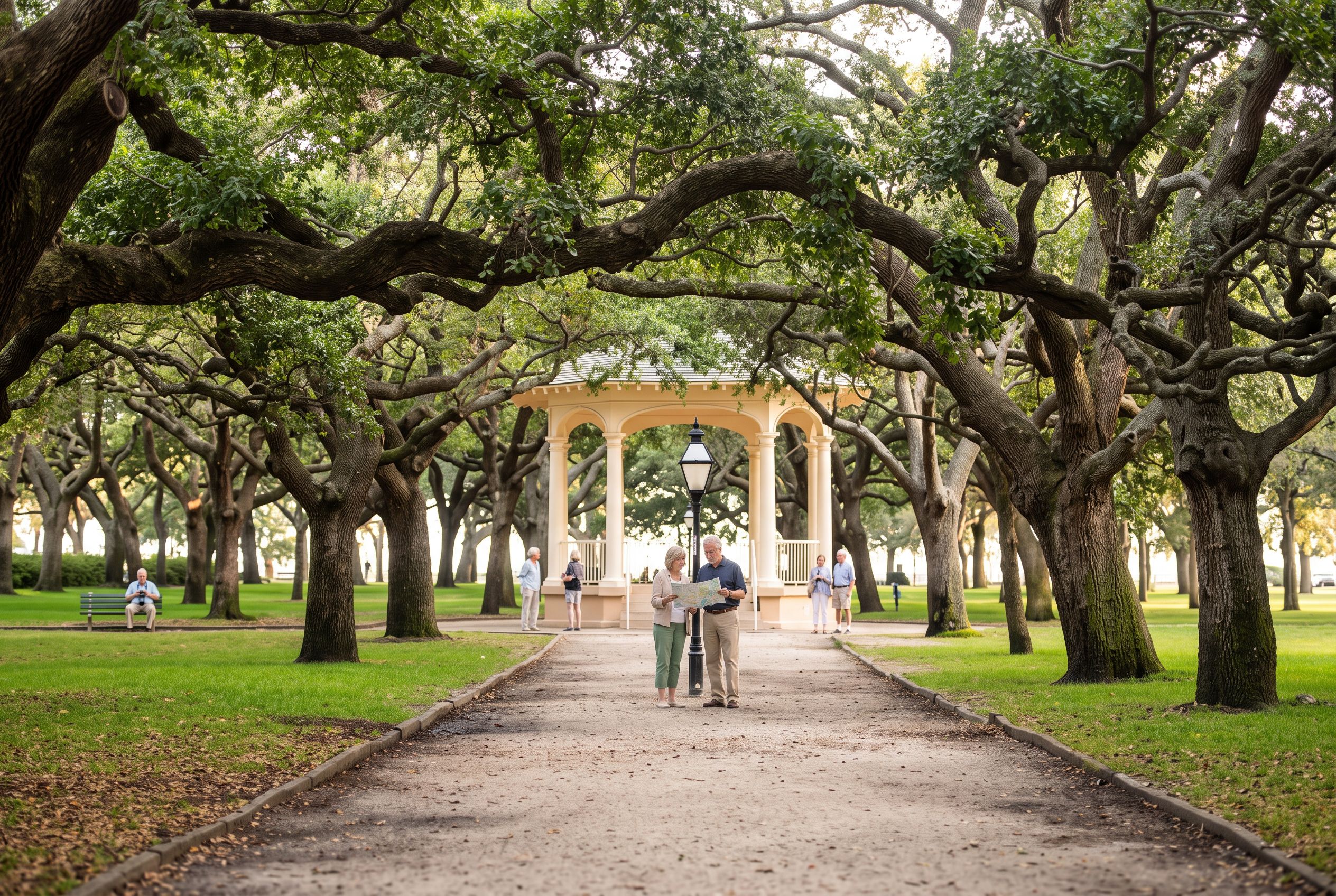
The city's official visitor information treats the harbour and the historic attractions as the heart of a visit, and the Old Exchange & Provost Dungeon is named among the classic downtown sites. South of Broad Street, the peninsula narrows into the residential streets, the Battery and White Point Gardens, where the walking is gentler in spirit even if the pavements are not.
King Street runs the length of the commercial district. From Wentworth Street, King Street is about three blocks east, four or five minutes on foot, and the Battery is about a mile away, according to Charleston Visitor's neighbourhood guidance. That single sentence is a useful measuring stick: the peninsula is small enough that a mile covers a great deal of it.
Two practical facts shape everything. First, the Charleston area has no metro or tram system, so visitors combine walking, the DASH shuttle, regular CARTA buses and taxis or ride-hailing. Second, the historic street network includes old cobblestone and slate surfaces that remain a practical mobility issue, as a Charleston ghost-and-graveyard tour operator warns on its own pages.
 AI-edited
Where should I stay on a Charleston trip?
Choose your base by how much walking you want between bed and dinner. South of Broad puts dinner ten to twenty minutes away on foot; the Wentworth area trades a few minutes' walk for quieter nights; Mount Pleasant and North Charleston cost less and require a car or a ride into the core.
Charleston Visitor's neighbourhood breakdown is the clearest published guide to the trade-offs. South of Broad is 10–20 minutes from dinner, which suits anyone who wants the evening on foot. The area around Wentworth puts King Street about three blocks east, four or five minutes on foot, and the Battery about a mile away, which the same guide says suits people who want the city without sleeping in the middle of it.
Across the water, Mount Pleasant is 10 to 15 minutes over the Ravenel Bridge, rooms cost meaningfully less than downtown, parking is free, and you are on the right side of the water for Shem Creek, Patriots Point, Boone Hall and the beaches at Sullivan's Island and Isle of Palms. North Charleston is 15–25 minutes in, at roughly half the downtown rate.
Further out, Folly is laid-back and surfy, 25 to 30 minutes away; Isle of Palms, 30 to 40 minutes away, has the wider beach and Wild Dunes Resort with its two Fazio golf courses; and Kiawah is the gated resort island about 21 miles south, 45 minutes to an hour by car, which makes sense if the golf is the trip.
Parking deserves its own paragraph. Most downtown hotels have no self-park option at all, so you hand over the keys or you find a garage yourself, according to Charleston Visitor. Valet at the downtown hotels that guide reviews runs $38 to $62 a night, from The Restoration to The Charleston Place, which also adds a $40 nightly amenity fee. City garages charge $1 per 20 minutes ($3 an hour) and cap at $24 for a full day, so a garage a few blocks from your hotel can halve the cost if you are happy to walk and move the car yourself.
Individual hotel reviews, room types and recent renovations have their own dedicated guide on this site; this article stays with the layout and the base.
How walkable is the historic district, really?
Walkable, yes, but not uniformly easy. Preservation Society walking tours generally involve six or more blocks over uneven streets and sidewalks, and many historic properties are not accessible to wheelchair users. The cobblestones and slate are genuine obstacles, not charming detail.
The Preservation Society's own tour pages state the six-block minimum and the uneven surfaces, and note that many historic properties cannot take a wheelchair. A Charleston ghost-and-graveyard tour operator is equally direct, warning that 300-year-old cobblestone and slate streets, graveyards and an uneven dungeon floor can be difficult for wheelchair and stroller users.
The City of Charleston does not publish a block-by-block inventory of kerbs and entrances. Treat any specific route as something to confirm on the ground rather than assume.
Public restrooms are confirmed by the city's visitor information in downtown parking garages, parks and city buildings, though some may be locked and available only on request. A Reddit itinerary discussion from May 2026 warned that there are no public restrooms in Charleston's residential areas, which matters on longer routes through Church Street, the Battery and the Gateway Walk.
What can I do if I cannot walk far?
Charleston has a well-documented set of low-walking options: narrated harbour cruises with an air-conditioned cabin, air-conditioned bus tours, carriage rides, and the Charleston Museum, which lends manual and electric wheelchairs free on a first-come, first-served basis.
Forum contributors have consistently favoured the narrated harbour tour for visitors with limited stamina, because passengers can move between an air-conditioned cabin and the outdoor deck. A contributor described a family member with "really bad knees" enjoying the boat tour because she could sit throughout. Fodor's contributors recommend carriage tours for visitors who want to stay off their feet.
An April 2025 Reddit discussion reported that an air-conditioned downtown bus tour suited a grandmother particularly well, combining sightseeing and history without extended walking. The same thread mentioned Gullah Tours and Adventure Sightseeing as van-tour options.
The Charleston Museum states that it is accessible to visitors with limited mobility. Manual and electric wheelchairs are available free of charge at the admissions desk on a first-come, first-served basis. Service dogs are permitted throughout the museum and its historic houses when identified; therapy dogs and other animal companions are not. Captioned videos support visitors with hearing impairments.
The museum's historic houses require stair climbing. Visitors unable to use stairs can request photographic tours instead, and it is worth asking historic-house staff about those non-stair alternatives before purchasing a combined ticket.
For a gentler waterfront pause, forum contributors recommend the benches at Mount Pleasant Pier and nearby waterfront parks, and they name White Point Gardens and the Battery as low-energy choices where you can sit rather than march. Patriots Point is worthwhile but involves a lot of walking, with a golf cart running from the ticket area to the ship; ask in advance about wheelchair availability.
What should I know before booking Fort Sumter?
Fort Sumter is reached by ferry from Liberty Square downtown or Patriots Point in Mount Pleasant. The excursion lasts about 2¼ hours including roughly one hour at the fort. Book Liberty Square if you use a wheelchair or scooter, and confirm conditions the same day.
Fort Sumter Tours publishes adult daytime admission of $43 and a senior and active-military fare of $39. Tickets can be booked online, by telephone on 800-789-3678 or 843-722-2628, or in person at either departure point; in-person buyers are advised to arrive at least 30 minutes early. Tickets are fully refundable when cancelled at least two hours before departure, and cancellations inside two hours are non-refundable.
Accessibility differs sharply between the two departure points. The Liberty Square boarding ramp can accommodate manual and electric wheelchairs and scooters except during extreme tides. Patriots Point cannot accommodate wheelchairs or scooters for boarding. The boats have lifts and accessible restrooms, but changing tides and weather mean accessibility is not guaranteed.
At the fort, the parade-ground level is accessible, but the museum and upper level require stairs according to Fort Sumter Tours' current published information. A separate Charleston visitor source reported lifts to those areas out of order on 30 October 2026; that operational report should be confirmed directly before travel. Narration transcripts are available for visitors with hearing impairments, and Braille park brochures for visitors with sight impairments.
Lightning detected within 10 miles closes the observation deck, with visitors directed to shelter in the museum or ferry. Tours do not operate on Thanksgiving, 25 December or 1 January. America the Beautiful passes, including the Interagency Senior Pass, do not apply to the ferry fee.
When is the best time to go to Charleston?
October and April are the strongest months for comfortable sightseeing, with October averaging 77.9°F high and 57.7°F low, oyster season open and only November having fewer wet days. July is the hottest month at a 91.3°F average high, and August the wettest at 6.97 inches.
Charleston Visitor's month-by-month analysis gives the figures plainly. July brings a 91.3°F average high and 21.4 days at or above 90°F. August is the wettest month at 6.97 inches. January is the coldest at 60.2°F high and 38.9°F low, with roughly nine nights below freezing.
The airport averages roughly 64 days a year at or above 90°F, and 52 of them land in June, July and August. Charleston gets about 52.5 inches of rain in a normal year, and 25.8 of those inches fall between 1 June and 30 September. Hurricane season runs from 1 June to 30 November, peaking around 10 September according to the National Hurricane Center.
| Month | Average high / low | Average rainfall |
|---|---|---|
| January | 60.2°F / 38.9°F | 3.17 in |
| April | 64.9°F (daily average) | 2.69 in |
| July | 91.3°F average high | 7.34 in |
| August | 80.7°F (daily average) | 6.97 in |
| October | 77.9°F / 57.7°F | 3.02 in |
| November | 57.9°F (daily average) | 2.27 in |
Note that the detailed temperature and rainfall figures describe Charleston International Airport in North Charleston, the official regional station, not downtown Charleston itself. The city's own visitor guidance calls spring and autumn the sweet spot for most visitors, and describes summer as hot and humid with afternoon thunderstorms.
There is no citywide opening season: Charleston runs year-round, though individual attractions keep seasonal hours or close for maintenance. Charles Towne Landing, for instance, removes its Adventure area for annual maintenance from 1 January through 1 April.
How do I handle the summer heat and humidity?
Treat a Charleston summer as a morning and evening city. Build the middle of the day around air-conditioned interiors, a long lunch or a harbour cruise cabin, and carry water. The humidity, not the headline temperature, is what wears a walker down.
The published climate record supports the caution. With 52 of the year's roughly 64 days at or above 90°F falling in June, July and August, a summer visit is a heat-management exercise. Afternoon thunderstorms are a documented feature of the season rather than an occasional nuisance.
The practical response is well documented in visitor feedback: air-conditioned buses, harbour-boat cabins and indoor attractions are consistently preferred when walking tolerance is limited. The Charleston Museum, described by forum contributors as "not too big," is a reasonable indoor anchor, and the aquarium was recommended because visitors can sit and watch the large tanks rather than stay on their feet.
The city's visitor pages do not list cooling centres for tourists. Plan your own shade and water, and keep the day flexible.
How do I get around Charleston without a car?
Walking plus the free DASH shuttle plus CARTA buses plus taxis covers the peninsula. CARTA buses are wheelchair accessible and ADA-compliant, with lifts, kneeling functions, priority seating and wheelchair securement. Service animals are permitted.
The free Downtown Area Shuttle, DASH, links the southern peninsula with the Charleston Museum area, according to a Fodor's Community discussion from October 2025. CARTA also runs regular buses across the Charleston area, and Route 11 Dorchester/Airport connects Charleston International Airport directly with downtown, stopping near airport passenger pick-up and rental-car facilities.
Charleston International Airport sits at 5500 International Boulevard in North Charleston, approximately 12 miles from downtown. Amtrak serves a station in North Charleston rather than the historic centre, so a taxi, ride-hailing service or pre-arranged shuttle is needed for most visitors staying on the peninsula.
CARTA Tel-A-Ride offers origin-to-destination paratransit for eligible passengers who cannot use fixed-route buses. Visitors with qualifying disability documentation may also receive reduced fares on regular routes. The city's accessibility pages set out the detail.
For airport transfers, the cited Frommer's guide records an airport shuttle to downtown with departures approximately every 15 minutes and a reported fare of $14 when that edition was published; fares and schedules should be reconfirmed before travel. Forum contributors repeatedly preferred municipal garages over street parking, because street spaces involve narrow roads, mobile-payment apps and time limits.
Are there senior fares and concessions in Charleston?
Two documented concessions exist. Fort Sumter Tours charges $39 for seniors and active military against $43 for adults. Charles Towne Landing charges $12 for adults and $7.50 for South Carolina seniors. No general Charleston-wide over-65 pass is documented.
The Charles Towne Landing rate is specifically a South Carolina senior rate, so visitors from other states should not assume the same price. The park at 1500 Old Towne Road includes a visitor centre, gift shop, animal forest, adventure area and grounds. Visitor centre and gift shop hours are 9 a.m. to 4 p.m. daily, the Animal Forest operates 10 a.m. to 4 p.m., and the grounds run 9 a.m. to 5 p.m.
Closures at Charles Towne Landing need checking. The visitor centre, Animal Forest and grounds close on Christmas Day. The Adventure area also closes on Tuesdays and is removed for annual maintenance from 1 January through 1 April. Approximately half of the Animal Forest was temporarily closed Monday to Friday during a cited construction period, with weekend operation described as usual.
The park does not document walking distances, slopes, steps, wheelchair provision or advance-booking arrangements. Ask directly before relying on any of it.
What else is worth a half day outside the historic core?
Charles Towne Landing and the Charleston Museum are the two best-documented half-day options, one outdoors and one indoors. Both publish accessibility information, which is more than most sites in the city do.
Charles Towne Landing is a South Carolina state historic site, which places it within the state's heritage-protection system.
The Charleston Museum's accessibility page is unusually specific: free wheelchair loan including electric models, service dogs welcome when identified, captioned videos, and photographic alternatives for the stair-dependent historic houses. What it does not state is senior admission prices, daily closure dates, lift locations or quiet visiting times.
Further afield, Middleton Place house museum was reported closed until April 2026 while it underwent a major reinterpretation, with the planned result a more conventional museum with artifacts and explanatory panels rather than a mainly furnished-house presentation. The Middleton Place Foundation also planned to rethink the visitor entrance and parking area, improve accessibility and add programs after selling the adjacent inn. Check before you go.
Powder Magazine Museum temporarily stopped daily admission because of financial difficulties and later reopened only on Fridays and Saturdays from 1 p.m. to 4 p.m., with the City of Charleston considering a partnership to restore fuller access. That schedule is worth confirming.
What about health services and safety?
The nearest documented downtown pharmacy is CVS Pharmacy at 59 George Street, and the nearest documented hospital for the city centre is Roper Hospital at 316 Calhoun Street, with 24-hour emergency treatment. For a life-threatening emergency anywhere in Charleston, dial 911.
The Medical University of South Carolina at 171 Ashley Avenue is another city-based hospital with emergency services. East Cooper Medical Center at 2000 Hospital Drive is in Mount Pleasant, a separate municipality. The closest documented 24-hour CVS is at 5215 Ashley Phosphate Road in North Charleston, outside the City of Charleston.
Charleston County Emergency Management gives 911 for police, fire or medical emergencies across the county. The city publishes a tourism hotline, 843-709-1985, for tourism questions or complaints; it is not an emergency number.
On ordinary urban safety, the available Charleston guidance describes the main visitor areas as busy and generally well used, while advising standard precautions: secure bags and phones in crowded places such as the City Market, and do not leave valuables visible in parked cars. It advises extra care after dark in quieter or unfamiliar areas beyond the principal visitor districts, with licensed taxis or reputable ride-hailing services recommended when needed. A Charleston-specific, current neighbourhood-by-neighbourhood crime assessment is not documented available.
What do guests say about staying in Charleston?
The recurring pattern in guest feedback is positive: attentive service, comfortable beds, convenient breakfast and walkable locations. Downtown properties often deliver all four, while historic buildings can mean stairs and occasional street or mechanical noise.
As of November 2026, The Charleston Place holds a Google rating of 4.7 out of 5 from 2,512 reviews. Guests there repeatedly describe staff across valet, bellmen, front desk, housekeeping and restaurant teams as welcoming and quick to learn and use guests' names. Rooms are described as well maintained, with housekeeping twice daily and evening turndown. The rooftop pool, hot tub and terrace are cited as a relaxing spot after a day of walking the city, and a hotel car and transportation staff help with getting around town.
"The definition of southern charm exists in this hotel. From the service to the design. A truly wonderful weekend stay it was." (Google, October 2026)
Two planning notes come from the same review set. Renovations were underway during some stays, with the gym temporarily relocated to a small space holding only two treadmills and one set of free weights. Some guests report noise carrying through thin adjoining-room doors. Ask for a room away from adjoining doors and confirm the gym situation when booking.
Across the wider review set, downtown properties are praised for attentive service and walkable dining, and historic buildings can mean stairs and occasional street or mechanical noise. Guests commonly report returning or intending to return.
How should I pace a week in Charleston?
Two anchor activities a day is the realistic rhythm for most readers in their fifties and sixties. One morning outdoors, one afternoon indoors or seated, with a proper lunch between them, covers the city without exhausting anyone.
Charleston's visitor economy is intense. The city's official tourism appendix reports approximately 7.89 million visitors and $14.03 billion in tourism impact in 2024 for the Charleston area, and estimates about 21,903 visitors on the peninsula on an average day against roughly 22,500 residents. That ratio explains why the popular streets feel full, and why early mornings are worth the alarm.
A workable shape for the week: a harbour cruise and waterfront stroll on day one; the Charleston Museum and a garden or house tour on day two; Fort Sumter from Liberty Square on day three, with the afternoon kept free; Charles Towne Landing on day four if you have a car; and the Battery and White Point Gardens on a slow final morning with benches at the end.
Fort Sumter's published schedules show fewer departures in winter, but the operator does not state that any particular departure is the quietest.
What should I book in advance?
Book Fort Sumter and any Preservation Society tour ahead. Preservation Society tours in the cited fall programme require advance online or telephone purchase, and walk-ins are not accepted. Fort Sumter can be booked online, by telephone or in person.
For visitor assistance, Explore Charleston lists the Charleston Visitor Center at 375 Meeting Street and a planning telephone number, 800-774-0006. The principal visitor centre is closed on Thanksgiving Day, Christmas Day and New Year's Day.
Rates across Charleston are indicative and vary by season and booking channel, so treat any figure here as a planning benchmark rather than a quote. The parking and valet figures above come from Charleston Visitor's neighbourhood guide and hold for the hotels that guide reviews.
If your trip includes grandchildren, the pacing advice in our guide to travelling with grandchildren in Ubud translates surprisingly well to a Charleston week: short legs, one anchor a day, and a rest built in. Readers planning a longer multi-stop trip may also find the structure in our two-week Bali itinerary for the over-50s useful for thinking about how to sequence a fortnight without overloading any single day.
The practical summary for a Charleston visit
Charleston suits older travellers who plan around surfaces, seasons and stamina rather than trying to see everything. The peninsula is compact, the documentation on accessibility is uneven, and the difference between a good week and a tiring one is mostly in the booking.
Three things to settle before you travel. First, your base: South of Broad for dinner on foot, Wentworth for a few minutes' walk and quieter nights, Mount Pleasant or North Charleston for lower rates and a car. Second, your season: October and April for comfort, July and August only with a heat plan. Third, your fixed bookings: Fort Sumter from Liberty Square if you use a wheelchair or scooter, a Preservation Society tour bought in advance, and a museum afternoon with a loaned wheelchair if stairs are a problem.
Everything else can be decided on the day. The city's own visitor pages, the Charleston Museum's accessibility page and Fort Sumter Tours' published information are the three documents worth reading before you book, because they state what the others leave out. Where a detail is not published, ask the operator directly. That single habit will do more for a Charleston trip than any itinerary.


