
Located on the western shore of Lake Hallstatt, this small Alpine village gave its name to an entire epoch: the Hallstatt period of the Iron Age. For travellers aged 50 to 70, the draw is twofold—the world’s oldest working salt mine, which has been yielding its white treasure for 7,000 years, and the remarkable prehistoric heritage that surrounds it. This guide covers the practicalities of visiting the Salzwelten salt mine, the bone house at the parish church, and the small but compelling prehistory museum, with honest advice on effort, cold, steps, and which parts suit less-mobile visitors.
 AI-edited
What makes the Hallstatt salt mine unique for older travellers?
The Salzwelten Hallstatt is the world’s oldest working salt mine, offering a 90-minute guided tour through tunnels that have been in use for 7,000 years. The mine and its funicular were closed for a complete rebuild until 28 August 2026 and are back in service from 29 August 2026, and the experience remains one of the most rewarding underground heritage sites in the Alps for those who can manage moderate walking.
The mine’s significance is hard to overstate. It was here that prehistoric miners extracted salt using bronze and iron tools, leaving behind Europe’s oldest wooden staircase, found in 2002 and dated by tree rings to 1344 BC—more than 3,300 years old, preserved by the salt. The tour reaches 400 metres below the surface, where that staircase is now the centrepiece of the underground “Bronze Age Cinema”; the other highlights are the underground salt lake and the ride out on the mine train. The operator asks visitors to allow at least three hours in total and to be at the funicular valley station 45 minutes before their tour starts; from the top station it is roughly a 15-minute walk uphill to the Knappenhaus, where the guided tour begins. As of August 2026, the mine holds a Google rating of 4.6 out of 5 from 6,051 Google reviews, with recent guests noting that the tour is conducted in both German and English, which can make it feel slightly longer for English-only speakers.
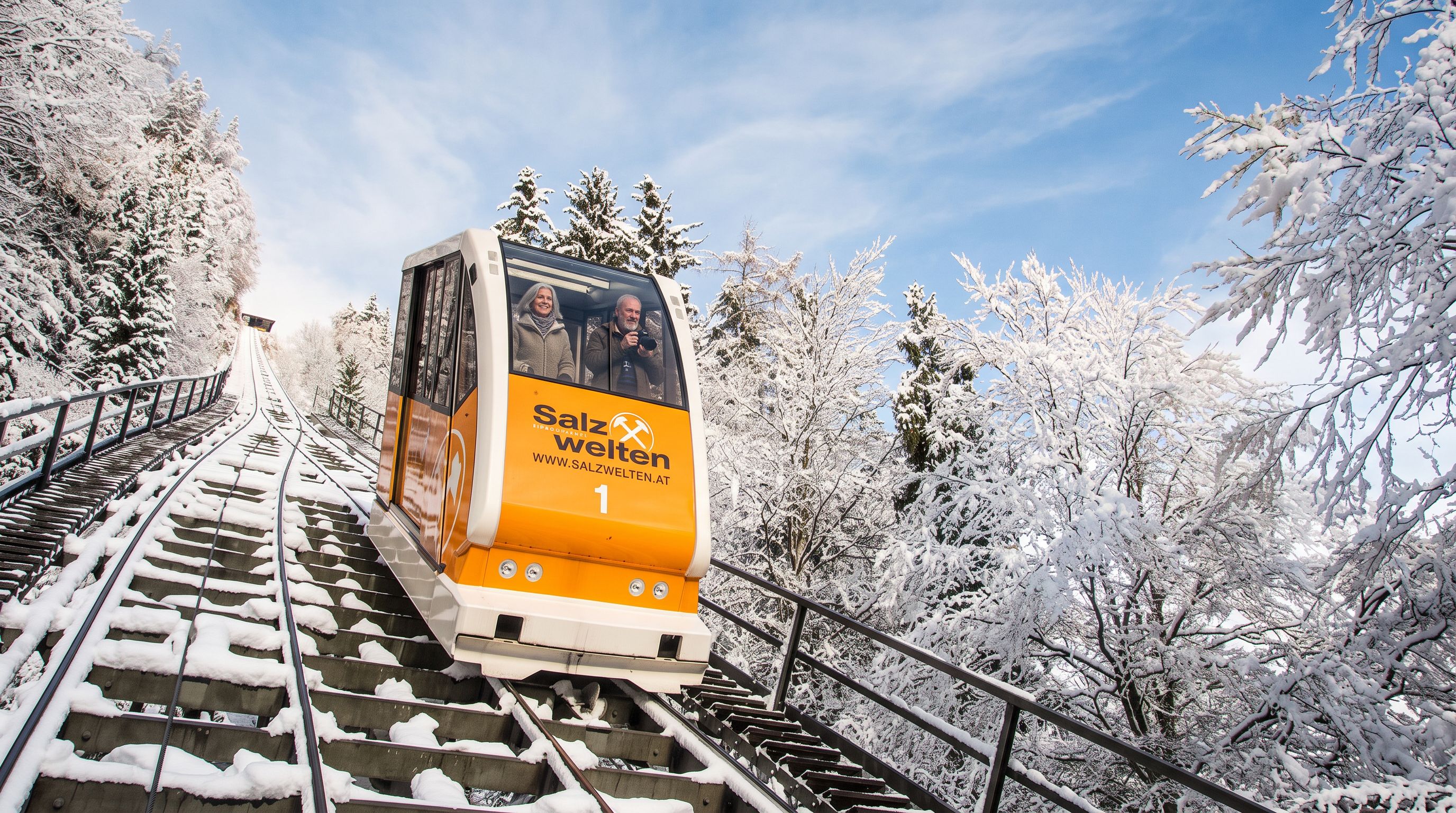
The new funicular is the visible half of a rebuild that took 362 days and cost around €34 million; the Doppelmayr Group and its funicular specialist Garaventa supplied the cableway technology, and each of the two cars now carries up to 60 passengers, double the transport capacity of the old railway. Level-compensation systems hold the cabin floor horizontal whatever the gradient, so boarding is step-free. The mine itself is a different matter: the operator states plainly that “the salt mine is not wheelchair accessible”, and inside it you cover around 2 kilometres on foot past stairs, narrow emergency exits, and the famous miners’ slides.
How physically demanding is the tour—and how do you prepare?
The tour involves an uphill walk of about 15 minutes from the top of the funicular to the Knappenhaus, where the guided tour starts, followed by roughly 90 minutes underground with stairs, wooden miners’ slides and around 2 kilometres on foot before the mine train carries you back out. You are issued coveralls and a hard hat, and the temperature inside stays at a constant 8°C year-round.
Here is what to expect in practical terms. After the funicular ride—which takes about three minutes and lifts you 325 vertical metres over the lake—you face the first challenge: an uncovered path that climbs gently but steadily for about fifteen minutes, past the prehistoric burial field that gave the Hallstatt period its name and its thirteen information boards. This is the part that surprises many visitors. Recent guests note that a “reasonable degree of fitness” is required, and sturdy, comfortable shoes with good grip are non-negotiable. Flip-flops are a mistake you will regret.
Inside the mine, the tour proceeds through tunnels that are well-lit and ventilated. The two wooden miners’ slides are optional: stairs run alongside each one, so you can bypass them entirely. The final section is a ride on the mine train, which carries you out of the mountain; from there the way back to the funicular top station is the path you came up, this time downhill. The operator asks visitors to allow at least 3 hours in total for the round-trip funicular, the Skywalk viewpoint, and the 90-minute mine tour.
What about the bone house—is it worth the climb?
The Bone House (Beinhaus) in St. Michael’s Chapel contains more than 600 hand-painted skulls arranged in a 12th-century charnel house. It stands next to the Catholic parish church in the town centre; the tourist board describes the ascent as “via numerous steps or via the somewhat steeper ‘Kirchenweg’”. Entry costs €2 for adults and 50 cents for children, and both cards and cash are accepted.
The ossuary is small—you can see it in 15 minutes—but it is deeply evocative. The skulls, painted with floral motifs and dates, come from a custom that ran into the 20th century: when an existing grave was reused for a new burial, the skull was moved to the charnel house as part of a second funeral, and the painting preserved the identity of the person. Most were decorated at the end of the 18th and during the 19th century. The chapel itself dates from the 12th century, and the tourist board calls Hallstatt “home to the largest collection of skulls ever”. Recent guests consistently describe it as “not to be missed,” though some travellers find it does not appeal to them. The site is open all year: daily 10:00 AM to 6:00 PM from 1 May to 30 September, daily 10:00 AM to 5:00 PM through October, Wednesday to Sunday 11:30 AM to 3:30 PM from 1 November to 31 March, and daily 11:30 AM to 3:30 PM from 1 April. Local practice is that it stays shut on All Saints’ Day (1 November) and All Souls’ Day (2 November); confirm with the parish if you are travelling then.
Accessibility is limited. The chapel interior has steps and is not wheelchair-accessible. The climb from the market square involves numerous steps or a steep paved path. For those with mobility concerns, the level lakeside road is the easier alternative; the World Heritage Museum is indoors and central, but states on its own website that the building is not barrier-free. Staying overnight in Hallstatt is worth considering, because it lets you reach the bone house early in the morning, before the day-trip crowds arrive. For more on comfortable accommodation, see our guide on Where to Stay in and Around Hallstatt When Comfort Comes First.
What prehistory can you see beyond the mine?
The World Heritage Museum (Museum Hallstatt) in the town centre houses a compact but excellent collection of Iron Age artefacts, including tools, jewellery, and the famous Hallstatt swords that gave the era its name. Entry costs €12 for adults and €11 for visitors aged 60 and over, and the museum is a short, level walk from the market square—though the museum itself warns that the building is not barrier-free.
The museum is small enough to see in an unhurried hour or two—last admission is 60 minutes before closing—but its quality is outstanding. The exhibits trace the development of the Hallstatt culture—a Celtic civilisation that dominated central Europe from roughly 800 to 450 BCE—and explain how salt mining created the wealth that fuelled trade networks stretching from the Baltic to the Mediterranean. The museum is centrally located and easy to reach on foot, and it opens daily—10 AM to 6 PM from May to September, 10 AM to 4 PM in April and October, and 11 AM to 4 PM from November to March. It is an excellent choice for a rainy afternoon, with one caveat that the museum states in bold on its own homepage: the building is unfortunately not barrier-free.
For those interested in the broader Salzkammergut region, the museum provides context for the prehistoric settlements that dot the lake shores. The Dachstein caves, which are a separate topic, are covered in their own dedicated guide elsewhere on this site.
How do you get up the mountain—and is it accessible?
The Salzbergbahn funicular lifts you 360 metres above the town into the high valley, where a panoramic lift and a bridge lead on to the Skywalk viewpoint and a 15-minute walk leads to the mine entrance. It was shut for a complete rebuild through 28 August 2026, and the new railway takes over the following day, on 29 August 2026; the operator describes the ride, the route to the Skywalk platform and the top-station bistro as barrier-free.
During the closure the operator ran a daily shuttle from the Hallstatt bus terminal, leaving at 1:30 PM and back around 5 PM, to the Salzwelten Altaussee salt mine in Styria—€44 for adults including admission, but bookable only until 31 August 2026, so it is not an alternative for later trips. Anyone still considering Altaussee should know that its tunnels are not wheelchair-accessible and that the visit involves about 2.5 kilometres on foot. The old Hallstatt funicular, built in 1980, was not wheelchair-accessible; the new one is the real upgrade. The Skywalk platform, which offers panoramic views over the lake and towards the Dachstein, is reached from the top station by a panoramic lift and a bridge, and the operator states that this route and the funicular “are built barrier-free”.
For those who prefer not to take the funicular, an old miners’ path climbs the 300 vertical metres from the town to the high valley; the regional tourist board gives a walking time of about an hour and says good fitness is required, and the trail was closed for the whole of the construction work. Most visitors take the funicular. The operator’s rates for the 2026 season are €49 for the combo ticket (mine tour plus funicular return), €29 for the funicular return on its own, and €33 for the mine tour without the funicular, the hikers’ rate. The published rate table lists reductions for children, groups and school groups only—there is no senior rate, so budget for the full adult fare.
| Item | Price (adults) | Duration | Accessibility |
|---|---|---|---|
| Salt mine tour (90 min) | €33 (no senior rate) | 90 minutes | Not wheelchair-accessible |
| Combined ticket (mine + funicular + Skywalk) | €49 | ~3 hours total | Funicular barrier-free (from 29 Aug 2026) |
| Funicular only (round trip) | €29 | About 3 minutes each way | Barrier-free after the rebuild |
| Shuttle to Altaussee (bookable until 31 Aug 2026) | €44 incl. admission | Out 1:30 PM, back approx. 5 PM | Altaussee mine not wheelchair-accessible |
What local traditions should you know about?
Hallstatt’s cultural calendar includes the Corpus Christi Boat Procession, held on the lake since 1623, where participants begin their part of the day as early as 6 AM and the flower-decorated boats put out after the 9 AM high mass, and the Krampus Run during Advent, where locals in carved masks roam the streets. The boat procession is watched from the shore or from one of the lake cruise boats; the Krampus Run belongs to the historic market square.
The Corpus Christi procession is a deeply moving sight: the “Fuhre” or “Plätte” boats, decorated with fresh flowers, carry the priest and congregation across the lake while hymns echo off the mountains. It begins with the high mass at the Catholic parish church and continues at the festively decorated market square, where local brass bands play before the procession moves down to the water; in bad weather it is held on dry land instead. For travellers who prefer quieter experiences, the Harvest Festival in autumn and the Christmas Market on December 8 offer traditional crafts, food, and music without the summer crowds.
The Krampus Run is a medieval tradition that can be startling—locals wear elaborate masks and costumes, accompanying Saint Nicholas to “scare” naughty children. It is held during Advent and is best watched from a safe distance. The municipality names the historic market square as the venue—“at the market square the Krampuses rule that evening”—so the square and the lanes around it, not the lakeside road, are where to stand.
“The collection of over 600 decorated skulls, many with names and intricate designs, offers a haunting yet respectful glimpse into Hallstatt’s history and traditions. It’s small but well-preserved, and the setting by the church adds to the atmosphere.” — from a Google review of the Hallstatt charnel house, August 2025
Which parts suit less-mobile visitors?
With the reopening on 29 August 2026, the operator documents the funicular, the panoramic lift, the route to the Skywalk viewpoint and the top-station bistro as barrier-free, and the lakeside road is level and paved. The bone house, the salt mine and the World Heritage Museum are not: the museum states on its own homepage that it is not barrier-free, and the bone house is reached over numerous steps.
Here is a quick reference for mobility levels:
- Documented as barrier-free: the funicular, the panoramic lift, the route to the Skywalk viewing platform and the Salzwelten Bistro at the top station, all from 29 August 2026; the public toilet at the Hallstatt Lahn bus terminal, Seestraße 158, open daily 7 AM to 7 PM and listed by the region as fully ÖNORM-compliant; and the ferry to the railway station, which the shipping company lists as wheelchair-accessible on MS Stefanie and MS Hallstatt.
- Level but not certified: the lakeside road and the market square, which are flat and paved, though no official source classifies them as barrier-free.
- Moderate mobility required: the salt mine tour, with around 2 km on foot, stairs and optional slides, plus the 15-minute walk from the funicular top station to the Knappenhaus.
- Not recommended for limited mobility: the bone house, reached over numerous steps or the steeper Kirchenweg and with steps inside; the World Heritage Museum, which states that it is not barrier-free; and the miners’ path to the high valley, about an hour of climbing over 300 vertical metres.
For travellers who prefer to stay in comfortable accommodation with easy access to the lake and village centre, see our guide on The Best Spa Hotels Around Hallstatt and the Salzkammergut. The village is compact, and most points of interest are within a 15-minute walk of each other.
When is the best time to visit?
The optimal months are May, June, and September, when crowds are manageable and the weather is pleasant. On peak summer days more than 10,000 visitors pass through the village, with long queues at the funicular and bone house. Winter is quiet and beautiful, and the rebuilt mine now runs into the winter season as well—through to 6 January 2027, with the last tour starting at 3 PM from 25 October.
Press reports put Hallstatt at around a million visitors a year in a village of some 750 residents, and the narrow streets become congested in peak season. Arriving early—before 9 AM—is the single most effective strategy for having the lanes to yourself. In the May-to-September season both the bone house and the museum open at 10 AM, so that first hour belongs to the village itself: walk the shore, then be at one of the doors when it opens. Mid-week visits (Tuesday to Thursday) are quieter than weekends.
The climate is temperate: average daily highs reach about 23°C in July and August, but rain is common, and in the long-term record June and July are the wettest months. January nights average around -4°C, and the village is often dusted with snow. The salt mine and funicular reopen on 29 August 2026 after the rebuild; the bone house, the museum and the lakeside road stayed open throughout. For a comprehensive overview of the village, read our Hallstatt: A Senior-Friendly UNESCO Lakeside Village Guide.
Hallstatt’s ancient history is not confined to a museum—it is written into the landscape itself. The salt that built a civilisation still lies beneath the mountain, and the painted skulls in the bone house are a direct link to the generations who came before. For travellers aged 50 to 70, the experience is both physically engaging and intellectually rewarding, provided you plan for the practical demands. The new funicular, which enters service on 29 August 2026, makes the journey up easier than it has ever been. And the village itself—with its lake views, its quiet shore road and its small but remarkable museum—offers a rich encounter with the past that requires very little climbing at all.


