
Lake Como is not a wine region in the traditional sense. There are no rolling vineyards lapping at the water’s edge, no rows of Nebbiolo climbing the hillsides above Bellagio. What the lake does offer is something more practical for the wine-minded traveller: a base from which to explore one of Italy’s most distinctive alpine wine valleys, the Valtellina, and a handful of excellent lakeside enoteche where you can taste those wines without leaving the shore. This guide covers exactly where to taste, how to arrange it, the effort involved, and whether you need a driver.
 AI-edited
Where to taste: lakeside enoteche and the Valtellina cellars within reach
The best wine experiences around Lake Como fall into two categories: relaxed lakeside enoteche in towns like Como, Bellagio, and Varenna, where you can taste Valtellina wines without a car, and dedicated cellar visits in the Valtellina valley itself, which opens east from the head of the lake at Colico: Morbegno is about 20 minutes away by car, Sondrio about 45.
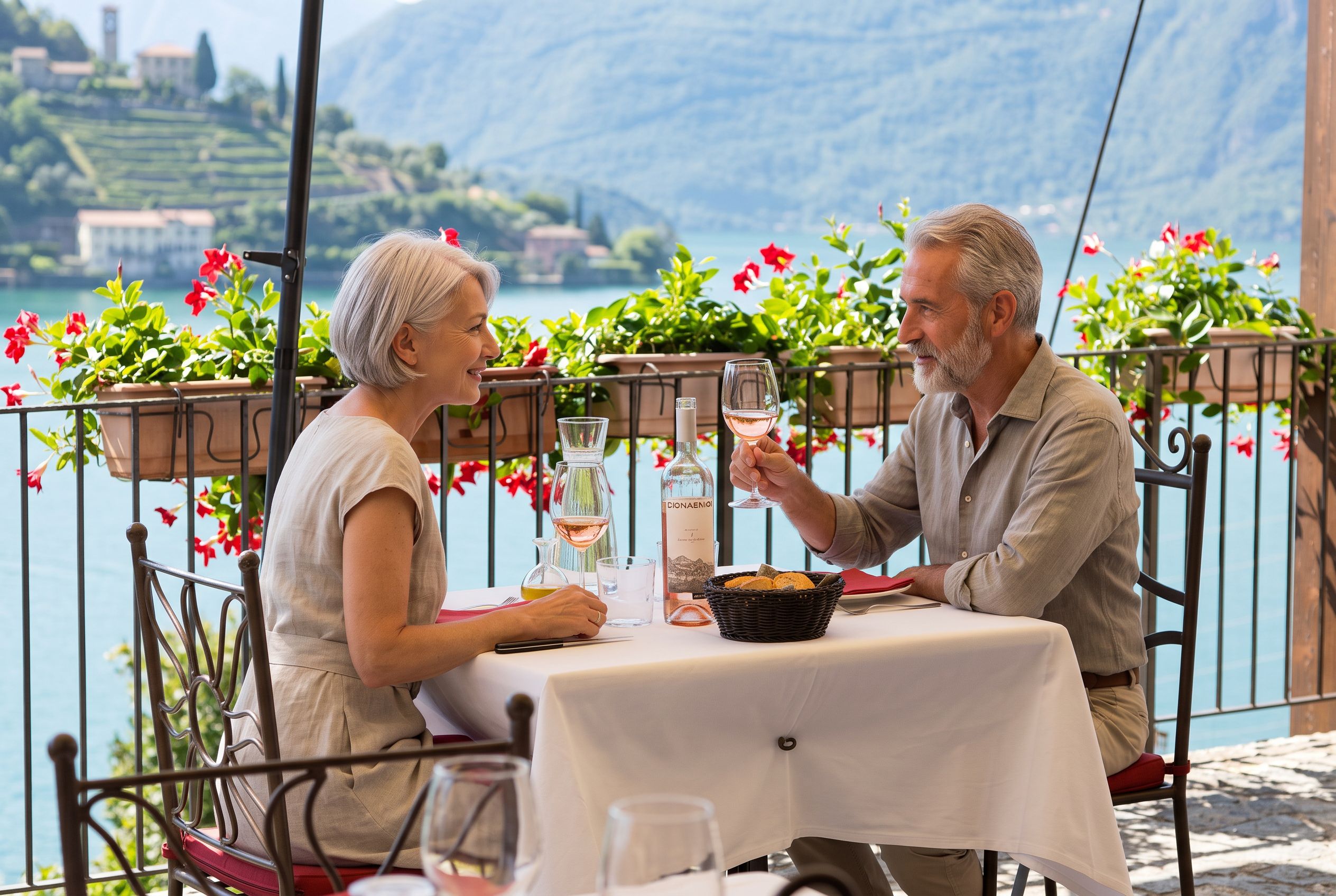
On the lake, your options are wine bars and shops that pour flights of regional wines. Cantina Follie in Tremezzina is a standout: more than 400 Italian labels, a terrace under the vine, and a plate of Valtellina cheeses on the menu at €15. Between 13 March and 1 November it opens daily from 11am to 11pm, with Tuesday given as its closing day; in deep winter it opens only Thursday and Friday evenings and at weekends, and it shuts altogether from 2 November to mid-January. In Como town, Vineria Vitani in the lanes of the old centre describes itself as a wine bar that also runs tastings. And there is one working winery on the lake itself: Sorsasso at Domaso, at the northern end, which grows its own grapes on the slopes above the village. These are zero-effort outings: walk in, sit down, taste. No reservation is needed for a casual glass, though booking ahead for a seated tasting is wise in July and August.
For the full experience, you need to head to the Valtellina valley itself. The Strada del Vino della Valtellina is a 67 km panoramic route from Ardenno to Tirano, a proper road, well signposted, passing through Sondrio, Chiuro, and Teglio. This is where you find the serious cellars: Nino Negri in Chiuro, Ar.Pe.Pe. in Sondrio, and Bottega Fratelli Ciapponi in Morbegno, a grocer trading since 1883 whose back rooms open into vaulted cellars where wheels of aged Bitto rest alongside the wine. It is a shop rather than a bookable cellar tour, so the hours matter: Monday 8am to 12.30pm only, Tuesday to Saturday 8am to 12.30pm and again from mid-afternoon to 7pm, closed on Sunday. As of August 2026 it holds 4.8 out of 5 on Google from 995 reviews.
Which Valtellina wines should you look for?
The Valtellina produces wines almost exclusively from the Nebbiolo grape, known locally as Chiavennasca. The two denominations you will encounter are Valtellina Superiore DOCG and Sforzato di Valtellina DOCG. Sforzato is the more powerful style, made from dried grapes in the passito method, while Superiore is the classic expression.
Here is a quick reference for what to expect:
| Wine | Style | Body | Best with |
|---|---|---|---|
| Valtellina Superiore DOCG | Elegant, red fruit, alpine herbs | Medium | Polenta, aged cheeses, lake fish |
| Sforzato di Valtellina DOCG | Powerful, dried fruit, chocolate | Full | Braised meats, aged salami, dark chocolate |
| Rosso di Valtellina DOC | Lighter, fresh, everyday drinking | Light–medium | Antipasti, cured meats, pizza |
At lakeside enoteche, you will typically find a flight of three Superiore wines from different sub-zones (Maroggia, Sassella, Grumello, Inferno, Valgella). This is an excellent way to understand the region without leaving the lake. For a deeper dive, book a tasting at Butéga Valtellina in Tirano, at the far end of the valley. The shop keeps a dedicated tasting room at Via Stelvio 18 and takes bookings through its own site. As of August 2026 it holds 5.0 out of 5 on Google from 84 reviews.
How to arrange tastings: reservations, timing, and effort
For lakeside enoteche, walk-ins are generally fine, though booking a seated tasting a day or two ahead is wise in July and August. Valtellina cellars work differently: Ar.Pe.Pe. in Sondrio takes visitors by appointment only, Nino Negri in Chiuro runs its short tasting on last-minute bookings but requires a reservation for the full tour, and both open Tuesday to Saturday.
The effort involved varies significantly. A lakeside tasting requires no planning beyond choosing a bar and walking in. A Valtellina cellar visit requires coordinating transport, booking, and a good part of the day: the rail journey up the valley runs to about two and a half hours each way, and the drive to Sondrio to about one hour fifty. The Via dei Terrazzamenti, a 70 km traffic-free walking and cycling route connecting Morbegno to Tirano, threads through the terraced vineyards at between 300 and 700 metres above sea level, so it climbs and falls with the hillside and is closed to cars. To see the vines without walking, take the Strada del Vino instead — that one is a road.
The valley is genuinely easy to reach by rail, although it is not the only wine country near Milan that is: Trenord runs direct trains from Milano Centrale to Sondrio in about two hours and on to Tirano, and Rovato, in the middle of the Franciacorta, is a 54-minute direct ride from the same station. From Morbegno station it is roughly 600 metres on foot to Piazza Tre Novembre, where Bottega Fratelli Ciapponi and a handful of bars and delis sit within a couple of streets of each other.
Should you hire a driver for wine tasting?
Yes, if you plan to visit two or more Valtellina cellars in one day. The valley’s roads are narrow and winding, and parking at small producers is limited. A driver allows you to taste without worry and makes the day feel like an excursion rather than a logistical puzzle.
Private drivers here are priced by the hour rather than by the trip. One chauffeur firm serving Como publishes an all-inclusive €60 an hour for up to three passengers and €80 for up to seven, which puts a four- to five-hour half-day at roughly €240 to €400 for the car, not per person. That is the most comfortable option for anyone who would rather concentrate on the wine than on the driving. Guided tours with transport included exist too, though fewer than you might expect: Bellagio Village runs a "Heroic Valtellina" wine tour that visits historic wineries in the valley itself, while Curioseety's wine outing stays on the lake, at a winery in Domaso.
If you prefer to drive yourself, the Strada del Vino is well-marked and fully car-accessible. Just remember that Italian limits are 50 km/h through built-up areas, 70 only where a sign says so, and 90 on secondary roads outside them, and that the drive from Como to Sondrio takes about 1 hour 50 minutes each way in free-flowing traffic. Do not attempt more than two cellar visits in a single day if you are driving.
For those staying at one of the Lake Como hotels worth booking for the food, many concierges can arrange private drivers or recommend trusted tour operators. This is often the easiest route for a relaxed, well-organized outing.
When is the best time for wine tasting?
September and October are ideal. Average daily highs at lake level run to about 22°C in September and 17°C in October, crowds have thinned after August, and the harvest brings a lively energy to the Valtellina valley. Spring (April–May) is a close second, though rain is more frequent.
Long-run climate records for 1991 to 2020 put May and June at the top for wet days — around 13 to 14 days a month with measurable rain at Como, and closer to 17 or 18 further up the valley at Morbegno and Sondrio — though the showers are often short. July is the hottest month, with average daily highs of 27°C at Como, which can make walking between venues less comfortable. For a full breakdown of seasonal conditions, see our guide on when to visit Lake Como for warm days and small crowds.
Two major wine events are worth planning around:
- Colico in Cantina (13, 19 and 20 June 2026): the old courtyards and cellars of Villatico, in Colico at the head of the lake, become the stops on three tasting routes, taking in both Valtellina wines and Lake Como's own. The pass includes a glass and a glass holder and is sold in advance online, and a free shuttle runs from Colico.
- Lake Como Wine Festival (19–21 June 2026): three days of Italian growers in Como's Piazza Verdi — 2pm to 10pm on the Friday, 10am to 10pm on the Saturday, 10am to 8pm on the Sunday.
One thing that no longer needs planning around: the Milano Cortina Winter Olympics ran from 6 to 22 February 2026 and are behind us, so the extra traffic and the access restrictions in the upper valley, around Bormio and Livigno, have gone with them. The Lecco–Colico–Tirano railway, closed for engineering work through the summer of 2025, is back to normal service as well.
How accessible are the tastings for travellers with limited mobility?
Lakeside enoteche are the easier option, most of them on the flat, paved streets of the town centres. Valtellina cellars are a different matter: the two best known both take visitors underground, Nino Negri through cellars cut beneath a fifteenth-century palazzo and Ar.Pe.Pe. into a cellar driven into the mountain, and neither publishes a step-free route. Always call ahead.
The Via dei Terrazzamenti is a walking and cycling route through the terraces, but it runs between 300 and 700 metres above sea level and rises and falls with the hillside, so it is not the level path it is sometimes taken for. The same caution applies on the lake: the Greenway del Lago di Como is 11.2 km from Colonno to Griante through seven villages, and its own operator is blunt about the surface — stretches of paved road alternate with tracks and cobbled steps, there are uphill sections, and it is passable with neither a wheelchair nor a pram. The full walk takes about three and a half hours; a short there-and-back stretch is the gentler way to do it.
For moving between lakeside towns, the Navigazione Laghi boats spare you the steep climbs and the crowded lakeside road. Boarding, though, is not step-free: the operator describes it as always assisted by staff, over a gangway at least 80 cm wide with a non-slip surface whose slope changes with the level of the lake, and it says plainly that not every landing stage is easy for wheelchair users — Villa Carlotta, Blevio, Pognana and Santa Caterina are the ones it names. For more on staying safe and comfortable, see our health, pharmacies and peace of mind guide.
What do tastings cost, and how much time should you allow?
Valtellina cellar visits are the part with published prices: Nino Negri asks €20 for a 45-minute tasting of three wines and €30 for the two-hour tour with four wines and local cheeses. Lakeside enoteche work by the glass and by the board instead — a plate of Valtellina cheeses at Cantina Follie is €15 — so a relaxed hour there lands in a similar range. Allow 45 minutes to two hours either way.
Here is a cost comparison for different tasting options:
| Type | Cost per person | Time needed | Effort level |
|---|---|---|---|
| Lakeside enoteca, glass plus cheese board | Board €15 at Cantina Follie, wine extra | 45–60 min | Low |
| Valtellina cellar visit, short (Nino Negri) | €20, three wines | 45 min | Moderate |
| Valtellina cellar visit, full tour (Nino Negri) | €30, four wines with cheeses | 2 hours | Moderate |
| Private driver, half day | €60/h up to 3 people, €80/h up to 7 — for the car | 4–5 hours | Very low |
For those seeking a quieter, more restful base, consider staying at one of the quietest hotels on Lake Como, many of which are within walking distance of excellent enoteche.
"Do yourself a favour and visit this incredible shop if you are in Morbegno. There's so much history and wonderful things to eat and try. The smell in the salami and cheese room is absolutely intoxicating (in a wonderful way). If you are in the mood for charcuterie you can get something really special." — one Google reviewer on Bottega Fratelli Ciapponi, February 2025
Frequently asked questions about wine tasting around Lake Como
Can I visit Valtellina wineries without a car?
Yes, but allow more time than you might think. Como to Morbegno takes about 2 hours 25 minutes with one change, at Monza or at Lecco, and Como to Tirano about 3 hours 15. From Morbegno station it is roughly 600 metres on foot to Piazza Tre Novembre, where Bottega Fratelli Ciapponi and several bars sit close together. For cellars further up the valley, such as Nino Negri in Chiuro, you will need a taxi or a pre-arranged driver. Fares start at about €9 each way. If you would rather not build the day around timetables, a guided tour with transport from the lake does it for you.
What is the difference between Valtellina Superiore and Sforzato?
Valtellina Superiore is a classic Nebbiolo-based wine aged for at least two years, with elegant red fruit and alpine herb notes. Sforzato is made from dried grapes (passito method), resulting in a fuller, more powerful wine with dried fruit and chocolate flavours. The disciplinare requires Sforzato to be aged 20 months, at least 12 of them in wood, though many producers go longer; Valtellina Superiore must have 24 months, also with at least 12 in wood. Both are DOCG wines, meaning they meet strict quality standards. If you are new to the region, start with a Superiore from the Sassella or Grumello sub-zones, then try a Sforzato to see the contrast.
Do I need to book wine tastings in advance?
Yes, for Valtellina cellars — though how far ahead varies more than you would expect. Ar.Pe.Pe. sees visitors only by prior arrangement; Nino Negri will take a last-minute booking for its 45-minute tasting but wants a reservation for the full two-hour tour. Both open Tuesday to Saturday. Lakeside enoteche are more flexible, though a seated table is worth reserving a day or two ahead at the height of summer. Passes for Colico in Cantina are sold online in advance, and the Lake Como Wine Festival takes bookings to skip the queue.
Is wine tasting on Lake Como suitable for a relaxed, non-strenuous day out?
Absolutely. Lakeside enoteche require no walking beyond a short stroll from your hotel or ferry stop. Valtellina cellar visits can be as relaxed as you like, especially if you hire a driver or join a guided tour. Nino Negri and Ar.Pe.Pe. both seat you for the tasting, so there is no standing about, though both cellars are underground. For the least effort, choose a lakeside enoteca and pair your tasting with a ferry ride between towns. This is a gentle, enjoyable way to spend an afternoon.


