
Located on the western shore of the Hallstätter See in Austria’s Salzkammergut region, Hallstatt is a UNESCO World Heritage site that has drawn visitors for centuries. Its story is one of salt, survival, and stunning scenery. For travellers aged 50 to 70, this village offers a unique blend of deep history and accessible beauty, but it demands careful planning to navigate its narrow lanes and seasonal crowds. This guide focuses on the practical realities of visiting Hallstatt comfortably, covering the village layout, the salt mine heritage, the best times to go, and what to expect regarding mobility and comfort.
Why choose Hallstatt for a senior trip?
Hallstatt offers a concentrated dose of European history and Alpine scenery in a compact, walkable lakeside setting, with senior-friendly options like boat cruises and a funicular to the main attractions. The key is timing: arrive early or stay overnight to experience the village without the crush of day-trippers.
The village’s appeal lies in its concentrated charm. The village is a single line of houses pressed into a narrow strip between the lake and the rock face, and within that short distance you’ll find a 7,000-year-old salt mine, a museum with Iron Age artifacts, and a lakeside road that feels like a painting. The tourist board allows twenty minutes on foot from car park P1 to the centre, fifteen from P2 and forty from P3 and P4. The challenge is that Hallstatt’s popularity has exploded. The municipality counted 760 residents with their main address here in April 2025; the mayor, Alexander Scheutz, put 2025 at a record 1.2 million day visitors against only 132,000 overnight stays. Nobody counts heads at a gate, so treat any single peak-day figure with caution — what is certain is that most of that traffic arrives and leaves within the same few midday hours. For seniors, this means the difference between a magical visit and a frustrating one comes down to when you go and how you move.
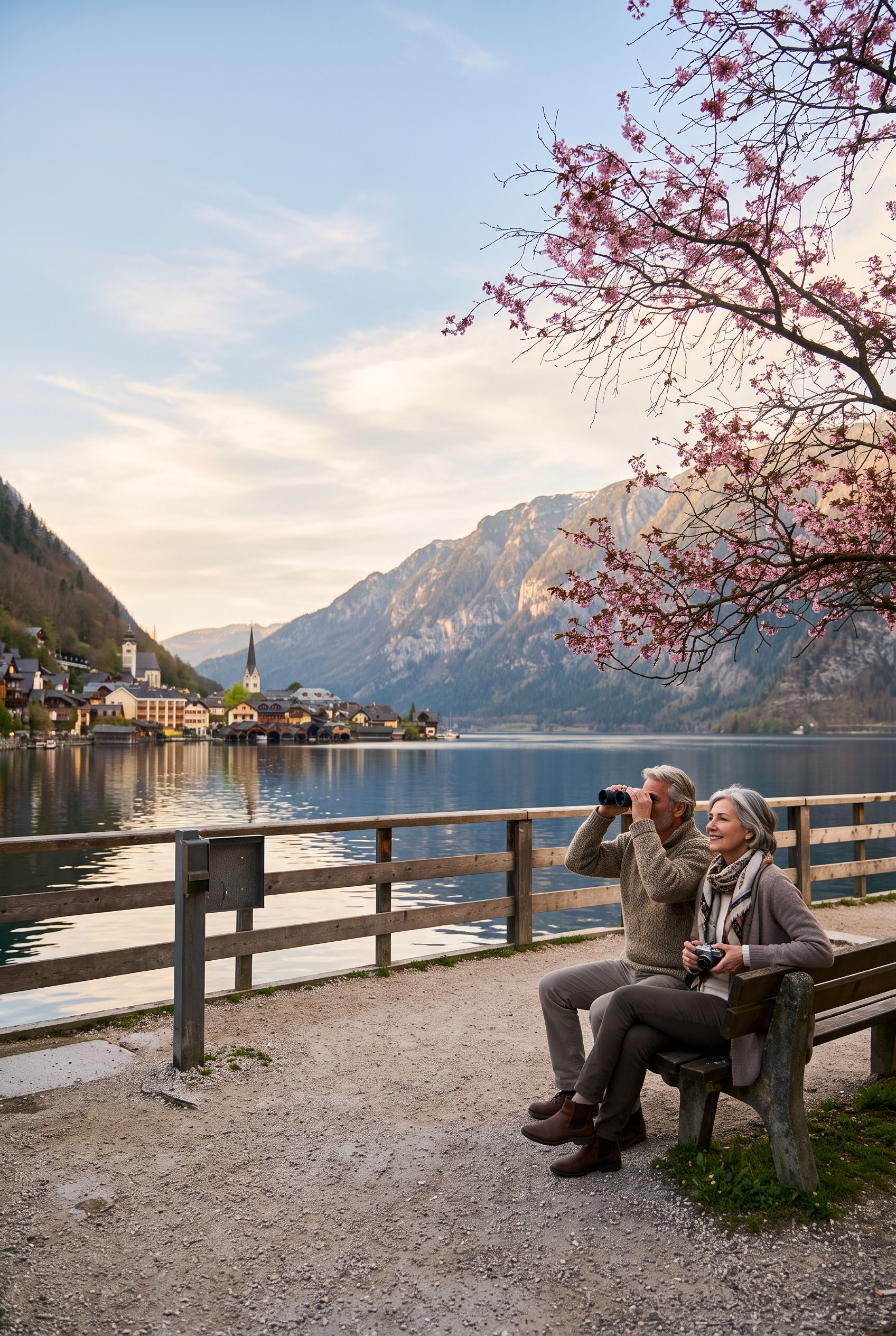 AI-edited
Recent guest reviews consistently highlight that the best experiences come from staying overnight. One Google reviewer noted in September 2024 that Hallstatt “can be very touristy during the day” but “becomes incredibly peaceful after 7 p.m. when most places close”, and recommended arriving “as early as 7 a.m. to avoid the crowds”. The rhythm is built into the logistics. Since 1 June 2020 every coach bringing passengers to Hallstatt has had to book an entry and exit slot, and the exit slot must be at least 2 hours 20 minutes after entry; coaches drop off at the bus terminal at the southern entrance, immediately after the bypass tunnel, then park about 1.5 kilometres towards Obertraun. The village therefore fills through the late morning and empties again in the late afternoon, on pavements too narrow for two people to walk side by side.
How accessible is the village for those with mobility concerns?
Hallstatt is a mixed bag for mobility. The asphalted lakeside road is flat and easy underfoot, but the historic core has cobblestones, stone stairs and short steep climbs, and the Bone House is reached only by numerous steps. The funicular to the Salt Mine and Skywalk reopens on 29 August 2026; it is fully accessible, the mine tour is not.
The village layout presents a clear divide. The main road from the bus terminal and car parks to the boat mooring is relatively flat, and the asphalted lakeside road is the easiest ground in the village for anyone using a stick, a rollator or a wheelchair. Two further options are documented rather than assumed: the scheduled vessel MS Stefanie is listed by its operator as wheelchair accessible, and from 29 August 2026 the funicular carries wheelchairs to the high valley. However, the narrow lanes leading up to the parish church and the famous viewpoint involve steep paths and slick steps, especially after rain. The sidewalks are often too narrow for two people to walk side-by-side, and delivery vehicles occasionally pass through.
For the major attractions, the Salzbergbahn funicular is the accessible route to the Salt Mine and the Skywalk viewing platform. It was taken out of service on 1 September 2025 and rebuilt from the ground up on the same alignment. Salzwelten announced on 12 August 2026 that the new funicular and the modernised salt mine would reopen together on Saturday 29 August 2026 at 9 a.m., after 362 days of construction and an investment of around €34 million. The glass cabins carry 60 people each, more than double the old line’s capacity, and an automatic levelling system keeps the passenger compartment horizontal for the whole ride; boarding is step-free. The operator’s own visitor information is just as clear about the limit: the funicular and the Salzwelten Bistro are fully accessible, the salt mine is not.
What is the best time to visit to avoid crowds?
The best time for seniors to visit Hallstatt is during the shoulder seasons of late September to October, or in April and May. Within any season, arrive before 9 AM or after 4 PM to experience the village without the worst of the crowds. Weekdays are significantly quieter than weekends.
Crowd management is the single most important factor for a comfortable visit. The main tour buses arrive between 10 AM and noon, and the streets become congested until late afternoon. The peak season runs from May to October, with July and August the busiest. The 1991-2020 climate normals for Bad Goisern, the nearest official station, published by GeoSphere Austria, put the mean daily maximum between 15°C in October and 25°C in July. September averages just under 20°C, with cooler nights and far fewer school groups, and that is what makes it the best balance of weather and manageable crowds.
For a day trip, the recommended strategy is to be in the village by 8.30 a.m. That gives you the lakeside road and a quiet coffee before the crowds descend. The Museum Hallstatt opens at 10 a.m. from May to September, at 10 a.m. in April and October and at 11 a.m. from January to March and November to December, with last admission an hour before closing. Alternatively, arrive in the late afternoon around 3 PM, when the day-trippers are leaving, and stay until sunset. The light at this time is dramatic, and the village takes on a quieter, more intimate atmosphere.
What are the must-see attractions for seniors?
The top senior-friendly attractions are the Hallstatt Museum (indoors and compact, though it is not barrier-free), the Lake Hallstatt boat cruise (seated, scenic, and the round-trip MS Hallstatt takes wheelchairs), and the Pfarrkirche Maria am Berg with its Beinhaus, reached only by steps. The Salt Mine and Skywalk stay shut for the rebuild until 28 August 2026 and open again on 29 August with the new funicular.
Here is a breakdown of the key attractions, with practical notes for seniors:
| Attraction | Description | Senior Benefit |
|---|---|---|
| Hallstatt Museum | Houses Iron Age artifacts and local archaeology from the 7,000-year salt mining history. | Indoors and a strong wet-weather option — but the museum itself warns that the building is not barrier-free. Adults €12, visitors aged 60 and over €11. |
| Lake Hallstatt Boat Cruise | A leisurely, seated boat ride across the lake provides stunning views without walking. | Ideal for comfort and scenic beauty; no physical exertion required. |
| Pfarrkirche Maria am Berg & Beinhaus | Hilltop church with a charnel house containing over 600 painted skulls, a unique Catholic tradition. | Reached only by numerous steps or the slightly steeper Kirchenweg. Admission €2. Culturally unique and historically significant. |
| Salzwelten Hallstatt (Salt Mine) | The world’s oldest salt mine, operational since prehistoric times. | Funicular closed for the rebuild until 28 August 2026, running again from 29 August. Combo ticket €49, funicular alone €29 return, mine without the funicular €33. The guided tour lasts about 90 minutes and is not wheelchair accessible. |
| Hallstatt Skywalk | A 12-metre viewing platform, 360 metres above the rooftops of Hallstatt. | Reached from 29 August 2026 by the funicular, then the panoramic lift and the panoramic bridge — no climb involved. The walk on to the mine entrance takes about 15 minutes. |
The Museum Hallstatt is a particular highlight for history enthusiasts, and the obvious refuge on a wet afternoon. One thing to settle before you plan around it: the museum's own website carries an explicit warning that the building is not barrier-free. Admission is €12 for adults and €11 from the age of 60, with the last tickets sold 60 minutes before closing. It offers a deep dive into the Hallstatt culture (800–400 BC), which gave its name to the Early Iron Age period in Central Europe.
How do I get to Hallstatt and where do I park?
Visitors cannot drive into the historic core at all: two barriers close it off around the clock, and guests of the hotels and apartments there are no exception. Park at P1 to P4 and walk — the tourist board allows 20 minutes from P1, 15 from P2 and 40 from P3 and P4. The train station is across the lake, so the last leg is the ferry, a crossing of about fifteen minutes.
The tourist board puts it bluntly: visitors have no car access to the historic centre. Two gates seal it off, and there is no exception for the apartments and hotels inside — guests who have booked accommodation in the centre are driven in from car park P1 by a shuttle bus, daily between 9 a.m. and 7 p.m., on the strength of their parking ticket. Everyone else walks. P1 lies just past the petrol station and P2 at the funicular valley station; the published walking times to the centre are 20 minutes from P1, 15 from P2 and 40 from P3 and P4. One tariff covers all four car parks, and the machines take cash, Maestro, Visa or Mastercard.
If arriving by train, note that the Hallstatt train station is on the opposite side of the lake and cannot be reached from the village on foot. The scheduled vessel Stefanie runs 365 days a year — the operator calls it Austria’s only year-round shipping line — and the tourist board puts the crossing to Hallstatt Markt at about fifteen minutes, almost hourly, with departure times adjusted when trains run late. The landing stage sits just below the station, a two-minute walk on a made-up path that takes luggage without trouble. The fare is €4 one way and €8 for the open return, and there is no card payment on board, so bring cash. For anyone using a wheelchair this is the good news of the arrival: the operator lists Stefanie as wheelchair accessible, which two of its three round-trip boats are not. The last sailing from the village back to the station leaves at 5.45 p.m.
What medical facilities are available in Hallstatt?
There is no pharmacy in Hallstatt, but there is a village doctor. The two nearest pharmacies are in Bad Goisern am Hallstättersee, about 12 kilometres away; the nearest hospital, the Salzkammergut Klinikum Bad Ischl, is about 20 kilometres away and its emergency admissions are open around the clock. Bring your own medication.
This is a critical piece of planning information for senior travellers. The village itself has no pharmacy; the closest two are in Bad Goisern, about 12 kilometres and sixteen minutes away by car. The Edelweiss Apotheke at Obere Marktstraße 4 opens Monday to Friday 08:00-12:00 and 14:00-18:00 and Saturday 08:00-12:00; the Apotheke im Baumhaus is at Bundesstraße 112. What the village does have is a general practitioner. The municipality lists Dr Sonja Gapp, Salzbergstraße 224, as its Gemeindearzt, with surgery hours on Monday, Tuesday and Friday from 08:00 to 12:00 and on Wednesday evening from 17:00 to 19:00, by telephone appointment on +43 6134 8401. For anything more serious, the Salzkammergut Klinikum Bad Ischl is the nearest hospital and keeps its emergency admissions open around the clock. Austria also runs a free health advice line, 1450, staffed day and night. Carry a basic first-aid kit and your own prescriptions all the same.
For general safety, Hallstatt is very safe with low crime risk. The primary risks are nature-related (steep terrain, slippery paths) and crowd-related (pickpocketing in dense crowds). The lakeside promenade has unfenced edges in some places, so care is needed near the water, especially in wet conditions.
What is the climate like throughout the year?
Hallstatt has an Alpine climate with cold, snowy winters and mild, wet summers. The best months for senior travel are September and October, which bring cooler air and thinner crowds. July and August are both the warmest and the wettest months of the year. Winter visits require careful planning for snow and ice on paths.
The 1991-2020 normals for Bad Goisern come to about 1,500 mm of precipitation a year, which makes this a consistently damp valley. July is the warmest month, at a mean daily maximum of 25°C, and also the wettest, at around 183 mm; August is barely behind on either count. September drops to just under 20°C with markedly less rain, which is what makes it the best balance of comfort and crowd avoidance. December to February are cold, with mean daily maxima between 2°C and 5°C, and snow is common. The paths can become icy and slippery, making walking treacherous for those with mobility aids.
For seniors, the practical advice is to pack layers and waterproof footwear regardless of the season. The village’s narrow streets and stone steps become slick after rain, and proper grip is essential. The lakeside promenade, while flat, can be windy, so a light jacket is advisable even on sunny days.
“We were there in autumn. The town and surrounding mountain still looks beautiful even when raining.” — a review left on Google in November 2025
What are the practical entry and visit requirements?
There is no entry fee to enter the village itself. Attractions like the Salt Mine, Skywalk and Museum require tickets; Salzwelten sells its combo ticket online from 1 September 2026 and asks visitors to be at the valley station 45 minutes before their tour. The ferry takes cash only, and cash machines in the village are few.
Here is a quick reference for practical requirements:
| Requirement | Details |
|---|---|
| Entry Fee | No fee to enter the village. Attractions require separate tickets. |
| Parking | No car access to the historic core at any hour; the centre is gated. Park at P1–P4: 15 minutes free, €5 for one hour, €20 for a full day. |
| Tickets | Salzwelten online tickets from 1 September 2026. Funicular return €29; combo with the mine €49; mine without the funicular €33. Museum Hallstatt €12, or €11 from age 60. |
| Cash | The ferry takes cash only — no cards on board. Cash machines are few: a Sparkasse Salzkammergut branch on Seestrasse and a stand-alone machine at Gemeindestiege. |
| Visa/Passport | EU/EEA: ID only. US/Canada/Aus/NZ: 90-day visa-free Schengen (passport valid for stay). Non-EU: check Schengen visa requirements. ETIAS is not yet in operation and is taking no applications; the fee will be €20. |
| Photography | No permit for ordinary holiday photography. Drones are an Austro Control matter rather than a municipal one: every operator must register once, and a drone licence is compulsory above 250 g. |
For seniors, the cash situation is worth noting, though it is narrower than the warnings suggest. The Hallstättersee ferry is the hard case, and its operator says so plainly: no card payment is possible on board. The Beinhaus, by contrast, is listed as taking cards as well as cash, and so are the parking machines. Cash machines in the village are few, so it is still wise to arrive with euros rather than plan to withdraw them here.
What should I know about accommodation for seniors?
Accommodation in Hallstatt is limited and often on steep back streets, but the claim that nothing here suits a wheelchair user is simply wrong: the regional register lists the Heritage Hotel with a step-free entrance and an accessible lift, and the municipality lists the Boutiquehotel Strand as barrier-free with a lift. Book early and confirm your own requirements directly with the house.
Many of the historic buildings do have steps from the street and no lift, so the difference between one house and the next matters more here than in most places. The Heritage Hotel Hallstatt is spread over three listed buildings with three different answers: the main Kainz house at the boat mooring has a lift, the Seethaler house five minutes away on the hillside has one too, and the Stocker house, the oldest building in the village, has none. Its entry in the regional register is unusually specific — step-free and barrier-free entrance, ramps at a 2 per cent gradient, an accessible lift with a cabin over 110 cm wide and over 140 cm deep and a door of at least 80 cm, accessible rooms and an accessible WC — with the honest caveat that not all of the legally stipulated ÖNORM criteria are met. Gasthof Simony, a fifteenth-century house in the historic centre and 100 metres from the boat mooring by its own record, is praised for its lake views and its breakfast garden; some of its rooms have the bathroom down the hall, and it takes cash or bank transfer rather than cards.
For seniors, the key is to book a property that explicitly states it has ground-floor rooms or elevator access. Contact the hotel directly to confirm specific needs, such as a roll-in shower or grab bars. If you are staying overnight, request a room away from the main square to avoid night-time noise from crowds and boats, which can degrade sleep quality. The village is quiet after 8 PM, but lakeside rooms can still pick up ambient noise.
For a broader perspective on Alpine travel, our guide to The Zillertal for Travellers Over 50 offers similar insights into accessible mountain destinations. If you are considering a multi-destination trip, our Two Weeks Across the Italian Lakes itinerary provides a different but equally rewarding lakeside experience.


