
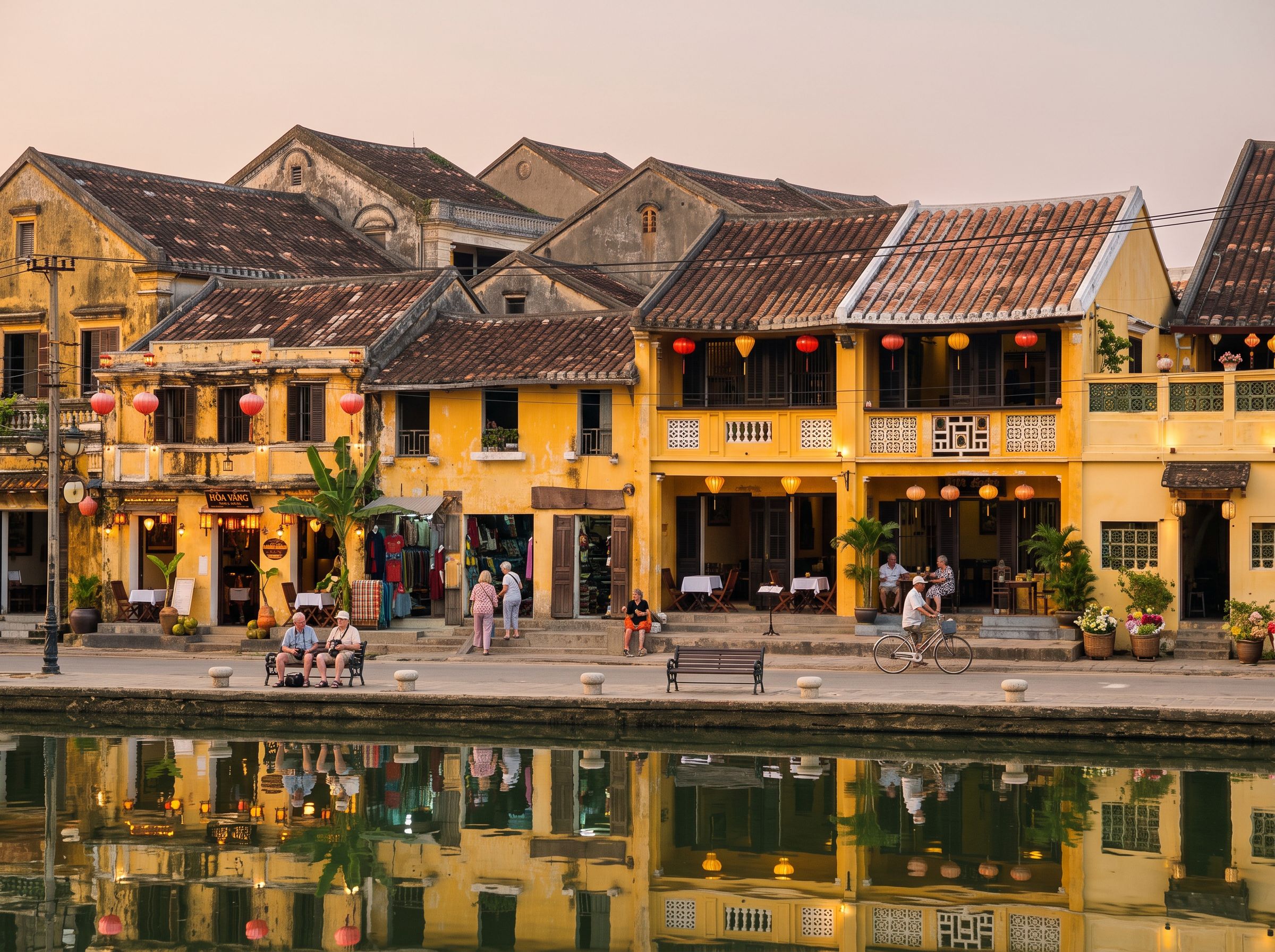
Hoi An's Ancient Town is a UNESCO-listed trading port on the Thu Bon River, and its protected core is compact enough to cross on foot in a morning. The heritage streets themselves are open to anyone; the ticket exists for the interiors of selected monuments, among them the Japanese Covered Bridge, the assembly halls, the old merchant houses and the museums. For travellers aged 50 to 70, the appeal is the scale. Most of what you came to see sits within a short, largely flat circuit, and the day can be paced around courtyards, cafés and riverfront benches rather than long marches between sights.
The town's architecture reflects the merchants who settled here: narrow, deep shophouses with timber frames, Chinese assembly halls built by regional communities, and the small covered bridge that has become the symbol of the place. Walking the lanes costs nothing. Paying for the ticket buys you the right to step inside the buildings that give those lanes their context, and the choice of which ones to enter is yours.
 AI-edited
What does the Old Town ticket actually cover?
The ticket covers entry to selected heritage monuments, not the streets. The official Hoi An heritage announcement lists two products: 80,000 VND for the town landscape, one monument (the Japanese Covered Bridge or Quan Cong Temple) and two further monuments, or 120,000 VND adding one museum and three further monuments.
The Hoi An Centre for Cultural Heritage Management and Preservation, which publishes the official visitor announcement, states that visitors need to purchase a ticket only once and that it remains valid throughout a stay in Hoi An of up to three days. If you have visited all the sites included in your ticket, you are asked to keep the stub for continued access to the ancient town.
Several visitor guides describe the streets, the riverfront, the market and the lanes as walkable and photographable without entering a ticketed monument. The ticket is enforced for the interiors. That distinction matters for planning: you can spend a full morning in the Old Town, take photographs, drink coffee and never buy anything.
How long does it take to walk around Hoi An Old Town?
The historic core is small. One Hoi An guide puts it at about 1 kilometre end to end, while a published walking route places the principal sights within a roughly 30-hectare core that can be crossed in 15 to 20 minutes without extended sightseeing. A comfortable visit with interiors, photographs and pauses is realistically a half day.
The same walking route gives approximate connections between the main sights. From a ticket and information point near the Tran Phu and Hoang Dieu intersection, the Fujian Assembly Hall sits about 200 metres along Tran Phu. Continuing west along the Old Town streets brings you to the Japanese Covered Bridge. Turning onto Nguyen Thi Minh Khai from the bridge area, the Cantonese Assembly Hall is roughly 150 metres further on. Tan Ky Ancient House stands on Nguyen Thai Hoc Street.
For travellers who prefer to know the shape of a day before setting out, that sequence forms a natural loop. It is short, it is mostly level, and it can be interrupted at any point for a seated break. A brisk circuit of the principal streets takes considerably less time than a half day; the half day comes from stopping.
What should I know about the Japanese Covered Bridge?
The Japanese Covered Bridge, also called Chua Cau, stands at the western end of Tran Phu and dates from 1593. It retains an ornate roof, an arched structure and a small temple or altar inside. It is a compact crossing and viewing area rather than a long visit, and it is one of the two principal monument choices within the ticket system.
The bridge links Tran Phu with Nguyen Thi Minh Khai across a small canal. Its exterior can be viewed and photographed from the surrounding streets, while walking across and entering the shrine are treated as ticketed heritage access. Published visitor schedules give split periods rather than uninterrupted access: Monday to Saturday 09:00 to 11:00 and 15:00 to 21:00, and Sunday 09:00 to 11:00 and 15:00 to 21:30.
The bridge closed in December 2022 because of deterioration. A restoration costing more than VND20 billion lasted about 19 months, and according to Hoi An visitor information published in 2026, it reopened formally on 3 August 2024.
Exact step, ramp and lift information for the bridge is not documented. The crossing is narrow and may be busy. The surrounding streets generally offer better opportunities to stop and photograph it than the bridge itself.
Which assembly halls and merchant houses are worth entering?
The ticketed heritage list includes the Fujian Assembly Hall, the Cantonese Assembly Hall and the Chaozhou Assembly Hall, along with old houses such as Tan Ky, Phung Hung, Duc An and Quan Thang, plus the Tran and Nguyen Tuong family chapels. Each assembly hall uses one coupon from the pass.
The Fujian Assembly Hall, also called Phuc Kien, is known for a large courtyard, ornate rooflines and a temple dedicated to Thien Hau, the sea goddess. The Cantonese Assembly Hall, associated with General Guan Yu, sits on the route toward the bridge. The main assembly halls lie along Tran Phu Street, the Old Town's principal east to west route.
Visitor guidance describes Tan Ky Ancient House's preserved timber interior, Japanese-influenced ceiling structure and Chinese decorative elements. Phung Hung and Duc An offer further examples of the narrow, deep merchant-house form that defines the town.
Assembly halls generally involve paved or tiled courtyards, thresholds and occasional steps rather than long staircases. The merchant houses are more demanding underfoot, because visitors move through timber rooms, raised floors and thresholds. A published accessibility guide notes that visitors with mobility limitations may often reach exterior areas and main courtyards, but that universal access is not consistent.
Is the Old Town walkable, and where are the difficult surfaces?
The Old Town is broadly flat, but that should not be read as universally step-free. Guides describe the lanes as narrow and uneven, with stone paving that can become slippery after rain. The easiest ground is the main streets and the riverfront; the hardest is inside the old houses and the bridge shrine.
The riverside path parallel to Bach Dang Street, running from the Japanese Bridge area toward An Hoi Islet, is described as largely paved and relatively flat. The broad approaches around Tran Phu and Nguyen Thai Hoc are similarly manageable. Assembly-hall courtyards are moderately easy, with tiled or paved surfaces that may include thresholds and isolated steps.
More demanding are the merchant-house interiors, the family chapels and the Japanese Covered Bridge shrine, where narrow passages, raised floors or steps may occur. The published material does not provide a uniform step count or a formal accessibility rating for these interiors.
Visitors who require step-free access should confirm each building with the heritage office before paying for a route built around several interiors. The office is at 10B Tran Hung Dao, telephone +84-235-3862367.
Where can I rest, and when is it coolest?
Shaded courtyards, temple forecourts, cafés and the Bach Dang riverfront are the natural places to pause. The published sources do not give a fixed inventory of public benches, so plan rests around courtyards and cafés rather than assuming seating will appear when you need it.
Timing does most of the work. February to May is commonly presented as the most comfortable period for walking, with drier conditions and lower humidity. June to August is hot and humid, and guides recommend using mornings and evenings for walking while avoiding the strongest midday heat. September to early December is the main flood-risk period; streets near the river can flood, businesses may move activity upstairs and tours may be cancelled. Late December to January is generally a cooler shoulder period, though occasional rain and cool fronts are reported.
Flooding is not guaranteed on every visit, but the lower riverside lanes are the part of the Old Town most exposed.
For balance and knee comfort, lightweight supportive footwear is preferable to smooth sandals, and a folding walking stick may help with thresholds. These are practical recommendations rather than published Hoi An authority rules.
When are the streets closed to traffic?
The Old Town is largely reserved for pedestrians and bicycles, with motorbikes permitted only during limited hours. One guide gives summer hours of 9:00 to 21:30 and winter hours of 9:00 to 21:00 for the Ancient Town, while the official heritage announcement gives separate seasonal windows for its own programmes.
Cars and taxis are described as banned from the heritage streets, while bicycles may enter under the rules reported by Hoi An Now. The exact pedestrian schedule should be checked locally, because event days and seasonal controls can alter it. The area is therefore highly walkable, but not necessarily silent or entirely vehicle-free at every hour; bicycles, service vehicles and crowds can still affect narrow lanes.
Grab is used for Da Nang airport transfers, trips outside the town and late-night returns from the beach. It is not the appropriate way to move through the narrow pedestrian heritage core. A Da Nang to Hoi An urban railway is being proposed but is not yet an operating transport link.
What do the museums and cultural performances add?
The ticket system includes a museum selection, and the heritage announcement lists daily performances at the Traditional Art Performance House at 66 Bach Dang Street at 10:15, 15:15 and 16:15, plus a Japanese tea ceremony at the Japanese Culture Gallery, 06 Nguyen Thi Minh Khai Street, at 9:30 and 16:30.
The Hoi An Museum of History and Culture presents the town's development from early settlement through its period as an international trading port, and Vietnam Airlines places it at 10B Tran Hung Dao Street, walkable or cyclable from the Ancient Town. The Museum of Folklore focuses on traditional crafts and includes a performance. The Museum of Sa Huynh Culture interprets the Sa Huynh period, while the Museum of Trade Ceramics displays Hoi An's ceramic and trading heritage.
A nearest pharmacy or medical facility is not documented for any of them, and no senior tariff, over-65 reduction, closing day or maintenance closure is documented either. Visitors who need those details should ask at the heritage office rather than assume.
The evening "Night Town" programme includes bai choi games, folk games, folk singing classes and street performances with traditional instruments. The Lantern Festival falls on the 14th day of each lunar month, when electric lighting is reduced and lanterns and candles dominate the town. That is also the least suitable night for anyone seeking low footfall.
Where does food fit into an Old Town day?
Cao lau is the town's signature dish, made with chewy noodles, pork, crispy rice crackers and herbs in a rich broth. Vietnamese iced coffee, ca phe sua da, is specifically recommended as part of an Old Town visit. Hoi An Central Market at 19 Tran Phu contains produce stalls and a food court.
A travel guide lists the market as operating approximately 6:00 to 21:00. Some stalls cater to international visitors with English-language menus, while others serve mainly local customers. Wikivoyage cautions that tourist-oriented prices may be higher than local prices. No booking is required or documented for the market or food court, and no senior concession, reduced tariff, regular closing day or maintenance closure is documented.
The An Hoi Night Market is described as an evening market with lanterns, souvenirs and street food, operating approximately 17:00 to 22:00 in one guide. Published guidance notes that prices can be tourist-oriented and recommends checking or negotiating prices. No source gives a quantified crowd level or a guaranteed quiet period, though its evening operation and lantern-festival popularity indicate it is not the calmest choice on festival nights.
For a wider look at the region's craft and market culture, our guide to markets and handicrafts in Chiang Mai covers similar ground in northern Thailand.
How should a slower visit be planned?
A comfortable half-day plan is the Japanese Covered Bridge, one assembly hall, one or two merchant houses, and a shaded riverfront or café break. The heritage ticket allows visitors to select from the listed monuments, so a slower itinerary is practical rather than a compromise.
Groups buying at least eight tickets are listed as eligible for a free guide service for the World Heritage Site and the monuments included in the ticket. The official exemption list includes children under 16, people from poor households, journalists and researchers, Vietnam Heritage Association members, and people with severe disabilities as defined by Vietnamese law. A 50% reduction is listed for qualifying Vietnamese groups, including elderly people under Vietnam's Elderly Law and people with disabilities; the official notice does not state a general reduced fare for foreign visitors aged 65 or over.
Sources differ on the child age threshold, with one stating under 15 and another under 16, so the applicable rule should be confirmed at the ticket booth. Because published descriptions also differ on the number of included monuments and validity wording, confirm the exact ticket type and current conditions at an official booth before paying.
Emergency numbers listed in the cited accessibility guide are 113 for police and 115 for ambulance. For accommodation chosen around comfort rather than proximity alone, see our guide to where to stay in Hoi An when comfort comes first, and for a broader orientation to the town, Hoi An for travellers over 50.
What should I expect on the ground?
Expect a commercial, heavily visited heritage district with shops, cafés, ticketed monuments and pedestrian crowds.
The most crowded areas are the lantern-festival evenings, the Japanese Covered Bridge area, the riverside boat area, the An Hoi Night Market and the main market. The 14th lunar night is the least suitable period for visitors seeking low footfall, because the Lantern Festival is specifically promoted as a major visitor event. Late afternoon before the peak dinner rush is described as more manageable than the evening peak.
What is documented is the pattern: mornings are calm, festival nights are not, and the bridge and riverside concentrate the crowds.
For travellers who want the heritage core within a short walk but also want quiet nights, the practical approach is to treat "near the Old Town" as potentially noisier than "a short walk from the Old Town", and to ask specifically about room position when booking. Our guide to spa hotels and wellness resorts around Hoi An covers properties where the balance tilts toward rest.
The Ancient Town itself can be walked in a morning and visited comfortably in half a day. Additional days are mainly for nearby destinations, the beach, the countryside and slower repeat visits rather than for the core monuments alone.


