
Chiang Mai keeps two calendars at once. The first is the ordinary one, printed on airline tickets and hotel confirmations. The second is lunar, and it decides when the city fills to bursting and when it exhales. For travellers aged 50 to 70, knowing which calendar is in charge in any given month is the single most useful piece of planning a trip here. The city's festival year is concentrated and intense, and the months between the big events are genuinely rewarding in their own right.
This guide covers the four anchors of the Chiang Mai cultural year (the Flower Festival in February, Songkran in April, and Loy Krathong with Yi Peng in November), plus the quieter stretches that many visitors overlook. It also sets out what is documented about access, crowds and heat in each period, and what is not. Weather patterns have their own dedicated guide elsewhere on this site; the focus here is the cultural calendar and how to move through it comfortably.
What festivals does Chiang Mai hold through the year?
Chiang Mai's festival year runs from a January umbrella festival in the village of Bo Sang, through the Flower Festival in February, Songkran in April, a Lanna cultural festival in July, and the twin lantern festivals in November. August to October is the quietest stretch, with no headline events.
Four Seasons describes the Bo Sang Umbrella Festival as a January highlight in the village of Bo Sang, a short drive from central Chiang Mai, centred on hand-painted umbrellas and fans. The Chiang Mai Flower Festival follows in February, and Songkran arrives in April. A Lanna cultural festival organised by the Chiang Mai Provincial Office of Tourism and Sports ran 10 to 12 July 2026 at One Square, One Nimman, with free admission and workshop activities covering traditions, cuisine, craftsmanship and music.
The year's centrepiece, however, is November. Chiang Mai is described as a place where Loy Krathong and Yi Peng are experienced together: Yi Peng is linked to northern Thailand and sky lanterns, while Loy Krathong centres on floating krathongs on water. Regional coverage in 2025 described the twin festivals as a signature spectacle of lanterns and krathongs.
 AI-edited
When are Loy Krathong and Yi Peng, and what actually happens?
Both festivals follow the lunar calendar, so the dates shift each year. In 2026 the major Yi Peng celebrations were scheduled for 24 to 25 November. Chiang Mai Municipality staged its annual Yi Peng Festival from 14 to 17 November 2024, with a grand krathong parade and Lanna lantern displays.
Chiang Mai Ambassador notes that Loy Krathong and Yi Peng follow the lunar calendar, so the date shifts each year. That single fact explains why bookings are so date-sensitive. One 2026 forum thread put Loy Krathong in Chiang Mai at 24 to 26 November that year, while another post referred to lanterns planned for 15 and 16 November in a different year.
The two festivals are distinct in character. Loy Krathong is described as free to enjoy, with afternoon krathong-making workshops and the option to leave when ready; no ticket or permission is needed to float a krathong. Yi Peng is different: the mass lantern release is late, crowded and fire-related. Releasing a sky lantern inside Chiang Mai city is illegal, with authorised launches held at approved venues outside the city.
For the 2024 festival, Nation Thailand reported that the Tourism Authority of Thailand's Chiang Mai office said sky lanterns were permitted only on 15 and 16 November 2024, from 7pm to 1am, and only in designated non-airspace zones. City-centre and near-city venues listed at the time included Thapae Gate Square, the Chiang Mai Ancient House Project on Charoen Prathet Road, Mae Kha Canal and Night Bazaar, and Three Kings Monument. Rules of this kind are set annually; confirm the current year's zones and hours with the Tourism Authority of Thailand before travelling.
Is the Chiang Mai lantern festival worth it, and what does it cost?
The organised lantern release is a ticketed, transfer-included evening outside the city, and it draws large crowds. No citywide festival pass or universal lantern ticket price is documented. The official CAD Yi Peng pages list ticket price ranges but do not document senior or over-65 fares.
The CAD Yi Peng event is listed for 24 to 25 November 2026 at the CAD Cultural Center Lanna in Mae On District, which lies outside Chiang Mai municipality but within Chiang Mai province. The official pages say the event includes mass lantern releases plus on-site programmed activities such as craft and art, a tribal village, snacks and Loy Krathong-related activities. The material states that the organised release package includes transfers, dinner, a cultural programme and a lantern countdown.
Two practical points come through clearly. First, a 2026 forum thread reported that CAD Khomloy Yi Peng Festival tickets were sold out, so early booking matters. Second, another post noted that outside-the-city lantern venues can charge high fees and may involve hectic transport and overwhelming crowds. The CAD pages do not document maintenance closures or reduced-mobility assistance.
Where can you watch the festival displays on foot?
The main public festival sights named are Thapae Gate Plaza, the Old City walls, Wat Chedi Luang, Wat Phan Tao and Wat Phra Singh, where lantern displays and cultural pageants can be watched on foot. Time Out's 2024 guide identified Tha Pae Gate as a top spot.
Chiang Mai Municipality and partner organisations staged the annual Yi Peng Festival in 2024 from 14 to 17 November, with activities including a grand krathong parade, Lanna lantern displays, and safety preparations around piers and river areas. The municipality's own coverage lists a grand Krathong parade competition, a Lanna Sapao parade contest, a Yi Peng Goddess and God contest, a krathong-making contest, a Lanna Yi Peng lantern contest, and Luk Thung singing.
For 2024, the Royal Procession and Big Krathong Parade left Thapae Gate at 6pm on 16 November, heading along Thapae Road and finishing at the Municipality Offices past the white roundabout stupa. That route gives a sense of the geography, though the schedule is set afresh each year.
Crowd levels are explicitly described as high for Yi Peng's mass release. A Fodor's poster described Loy Krathong in Chiang Mai as quite pleasant, but said evening crowds become very crowded and very noisy by the river, with fireworks, hot air balloons and hawkers. One 2025 forum thread suggested Lamphun offers a particularly lovely version of Yi Peng, while another post suggested a nearby village or town if the main festival feels too busy.
What is Songkran like in Chiang Mai, and how hot is April?
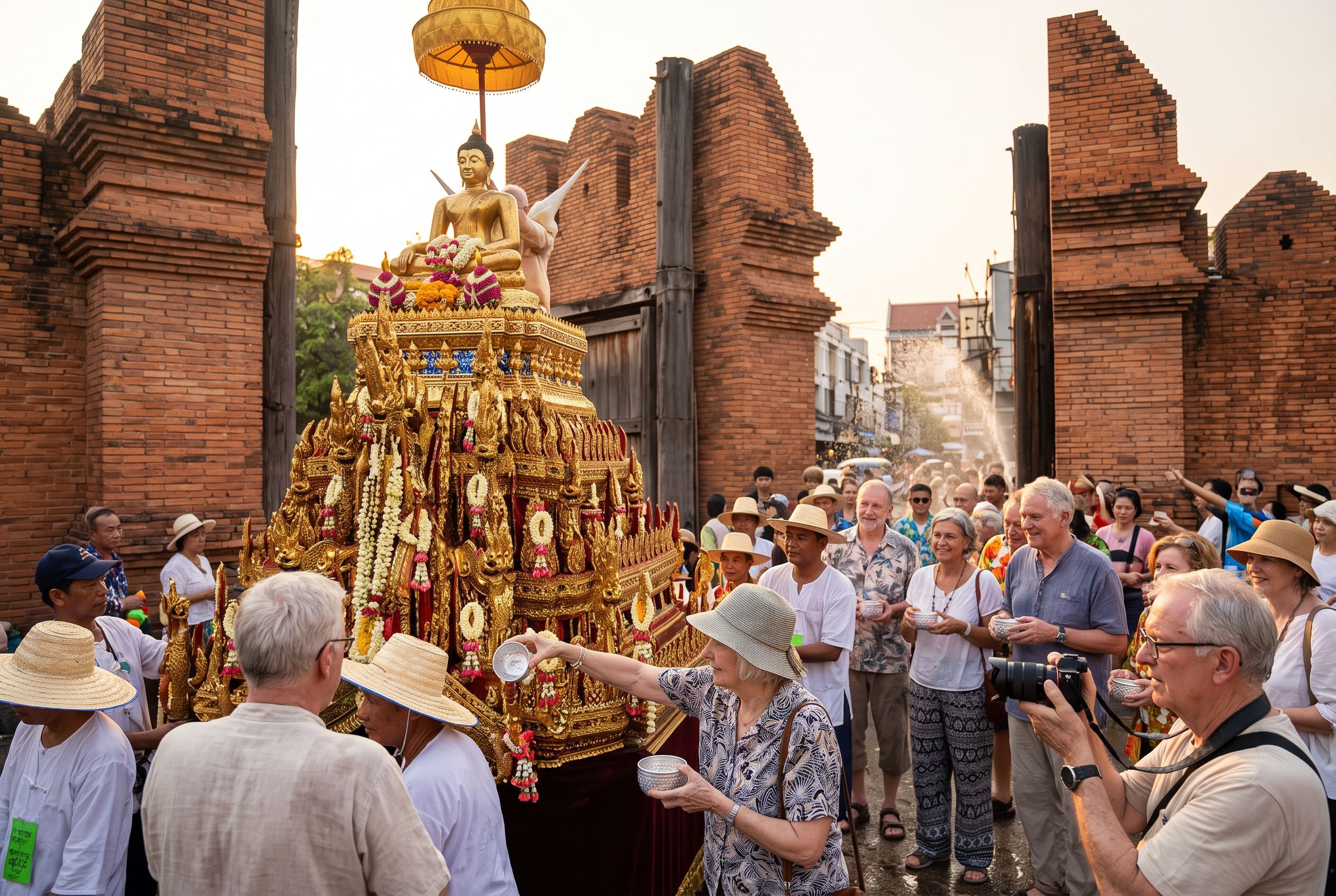
Songkran is Chiang Mai's April water festival and one of its key annual periods. Chiang Mai Travel Hub says the city's celebrations run from 13 to 15 April in 2027, while Chiang Mai Ambassador says city celebrations can extend roughly from 6 to 17 April. Both describe a citywide, high-energy period with temple visits and water festivities.
That gap matters for planning: there is no published route map to work from in advance, so the practical approach is to ask at your accommodation once you arrive.
April is also the month when heat becomes a genuine planning factor rather than a background detail. What they do show is that the festival is citywide and high-energy, which for older travellers usually means choosing a base away from the wettest streets and planning any temple visits for the morning.
Note that Brokenships Chiang Mai, which is open daily from 10:00 to 22:00 with last entry at 21:30, closes on New Year's Day and during Songkran and its substitution holiday.
What happens at the February Flower Festival?
The Chiang Mai Flower Festival is held every February at Suan Buak Hat Park. The 2026 edition ran 13 to 15 February at Nong Buak Haad Public Park, with the opening ceremony and blossom parade on 14 February starting at Nawarat Bridge and finishing at Nong Buak Haad Public Park.
Official city and provincial materials describe flower contests, gardening activities, exhibitions and an OTOP zone, and a 2025 embassy posting says the grounds remained open until midnight. The 2026 festival was explicitly framed by local reporting as attracting thousands over three days.
February is presented as the cool late-winter season, which suits the parade route through the compact old-city edge from Nawarat Bridge to Nong Buak Haad Park. For travellers who prefer a festival they can watch from a fixed, comfortable spot rather than walk through, the parade format is worth noting.
The material does not document step counts, seating, ticketing or assistance services for the Flower Festival. Ask the organisers or your hotel about viewing positions if standing for long periods is difficult.
Which months are quietest, and what is there to do then?
August to October is described as the green season, suited to art and craft shopping and slower exploration rather than major headline festivals. Multiple forum posts name May and June as the low season, while November to March is the cooler, busier high season.
A 2026 forum post said May and June had exceptionally few tourists and that parking at the market was surprisingly easy. Another post said high season still had plenty of activities and sights, but low season was quieter than usual. A further 2026 post described June to August as stunning and serene, with lower prices for motorbike rentals and accommodation mentioned by one poster.
The festival calendar most strongly supports November to February for major events, while August to October is quieter and more relaxed. Outside the festival window, the city's biggest visitor disruptions are more likely to come from construction zones and traffic works than from closures of major attractions. Recent reporting on the city's construction and transport pipeline noted that the cleared former Chiang Mai Women's Prison site in the Old City had been intended for a public park but that the project had stalled and the land was still boarded up. Kad Suan Kaew closed in 2022 and was listed for sale in 2024, which matters for anyone used to the old shopping and dining pattern in that part of town.
Which museums and cultural sites suit older visitors?
The best-documented lower-effort cultural choices are the Chiang Mai National Museum, Royal Park Rajapruek and Chiang Mai Night Safari. Only the museum is explicitly described as having published opening hours and a documented admission structure.
The Chiang Mai National Museum opens Wednesday to Sunday, 09:00 to 16:00, with the office open Monday to Friday, 08:30 to 16:30. It charges 20 baht for Thai visitors and 200 baht for foreign visitors, and no senior concession is shown on the museum's official page. A separate secondary listing says seniors are free and that the site is closed Mondays, Tuesdays and public holidays; that claim is secondary and should be treated as less secure than the museum's own page. Confirm both the closure days and the senior policy directly with the museum.
Brokenships Chiang Mai carries the clearest documented senior concession: adults pay 200 baht, while people with disabilities and seniors aged 65 and over pay 150 baht. It is open daily 10:00 to 22:00, last entry 21:30, and closed on New Year's Day and during Songkran and its substitution holiday.
Chiang Mai Night Safari is described as wheelchair accessible with ramps and designated viewing areas, and wheelchair and stroller rental is offered. Royal Park Rajapruek and the Night Safari are named as low-effort options, but detailed programmes, booking terms and specific calmest times are not documented.
How walkable is the Old City during festival week?
Chiang Mai's Old City is the flat area with the best walking conditions overall, but sidewalks are often narrow, uneven or obstructed, so a fully barrier-free walk is not documented. No festival-specific step-free system is documented for the main citywide celebrations.
For travellers with mobility concerns, the documented note is that the Old City is the flattest walking area, but its pavements are still often uneven or obstructed. The records gathered focus on general city access and specific venues, not on dedicated festival infrastructure for mobility-impaired visitors.
Wat Phra That Doi Suthep involves roughly 306 to 309 steps, but a cable car or funicular bypasses the climb for people avoiding stairs or with limited mobility. That is the clearest documented workaround for a major religious site in the area.
For the festival locations themselves (Thapae Gate Plaza, the Old City festival walk, Wat Chedi Luang, Wat Phan Tao and Wat Phra Singh), the source documents that these are viewable festival locations, but does not document step counts, lifts, booking terms, pharmacy access or formal assistance services for those exact places. The same applies to the Loy Krathong workshops: the source says workshops run in the afternoon and are easy to leave whenever, but it does not document the operator name, booking channel, cancellation terms or mobility details.
If you are building a longer stay around these sites, our five-day Chiang Mai itinerary for the over-50s sets out a paced sequence that fits around festival crowds.
What should you sort out before you go?
The documented local emergency numbers are 1669 for medical emergency and ambulance, 191 for police, 199 for fire and rescue, and 1155 for Tourist Police with English-language support. A UK government healthcare notice states that 1669 is free of charge and usually transfers callers to the nearest available hospital.
A U.S. government travel notice for northern Thailand states that 1669 is nationwide and that medical personnel transport patients to the nearest facility with emergency response, while you may request a specific hospital. Save all four numbers before you arrive rather than relying on finding them in the moment.
The practical answer is to carry water and to identify your nearest clinic on arrival rather than during an event.
For a fuller picture of medical facilities, insurance and vaccination planning, see health, vaccinations and peace of mind in Chiang Mai.
Where should you stay during a festival?
Central Old City and night-market properties are repeatedly praised in guest reviews for quietness despite their location. U Chiang Mai is described as being in the heart of the Old City where any noise is undetectable, and The Chiang Mai Old Town is described as very quiet at night.
Around Chiang Mai's festival periods, some reviews mention street noise, loud guests or live music at night that affected sleep. An Expedia review says nearby live music usually stops before midnight, while others mention noise from neighbouring bars or late-night guests. Meliá Chiang Mai has a Tripadvisor review warning about compromise on soundproofing, and other properties are described as having audible noise from planes, neighbours or school activity.
Two recurring practical points are worth carrying into any booking. U Chiang Mai is repeatedly flagged for having no elevator, with guests warning that people with mobility difficulties will need to manage stairs; Meliá Chiang Mai also draws complaints about slow lifts and having to change lifts between buildings or floors. At Chala Number 6, a Tripadvisor review says a school next door caused music, singing and screaming from morning until late afternoon, which shows that even central quiet hotels can have daytime disturbances.
Guest reviews consistently praise quiet, central stays that still feel insulated from Old Town and night-market bustle, along with friendly staff, strong breakfast offerings and good overall value. If breakfast matters to your morning, our guide to Chiang Mai hotels worth booking for the food covers the properties that draw the most consistent praise for their tables.
For a sense of what a resort-style stay outside the centre looks like, see our review of the Four Seasons Resort Chiang Mai.
What else is worth knowing before you book?
Highway 121 improvement plans could affect traffic in and out of the city. Chiang Mai Citylife reported a proposed elevated-road model for the Don Kaew to Mueang Kaew section, with the study saying it could cut congestion by more than 50% and take about 2.5 years to execute.
Airports of Thailand plans to expand Chiang Mai International Airport to handle 13 million international passengers and 7 million domestic passengers, according to a construction and transport report. The same report noted that the river near the city centre was being dredged after the 2024 flood, and that the Mae Kha Canal was being renovated with house clearances and new walkways.
On fares and passes, no Chiang Mai-wide over-65 fare programme is documented, and no citywide senior or special pass programme was documented. Senior fares, over-65 concessions, accessibility assistance, maintenance closures and seasonal operating calendars for rail, bus, cable car, museums, thermal baths and hotels were not documented in the official pages retrieved. Where a concession does exist, it is venue-specific: Brokenships Chiang Mai is the clear example.
Two smaller notes for anyone returning after a gap. A fire on 23 April 2025 damaged part of the former spa area at Dhara Dhevi Chiang Mai, the hotel's operations largely continued, and the owner planned a 500 million baht renovation with full reopening targeted for the end of 2025. Recent reporting also described Lannatique in the Kalare Night Bazaar area as a 2025 development with shopping, markets and hotels planned.
Finally, the weather question (which months are cool, which are wet, and how the seasons shape a trip) has its own dedicated guide on this site. This article covers only how the festival calendar and the quiet months interact with crowds, heat and access.


