
Chiang Mai has been a craft town for centuries, and its markets remain the most direct way to see that reputation in person. The Sunday Walking Street runs through the Old City on Ratchadamnoen Road, the Night Bazaar occupies Chang Khlan Road on the east bank of the Mae Ping, and the Sankampaeng craft road stretches southeast toward the village of San Kamphaeng. Each has a different character, a different pace and a different set of practical demands. For travellers aged 50-70, the key is knowing which market suits which kind of day, and planning around heat, crowds and distance rather than trying to cover everything in one evening.
This guide covers where to browse and buy, how to pace a visit without exhaustion, and what published sources actually document about prices, hours and access. Food-focused market coverage has its own dedicated guide, and this article stays with the shopping.
What makes Chiang Mai's markets worth a place on your itinerary?
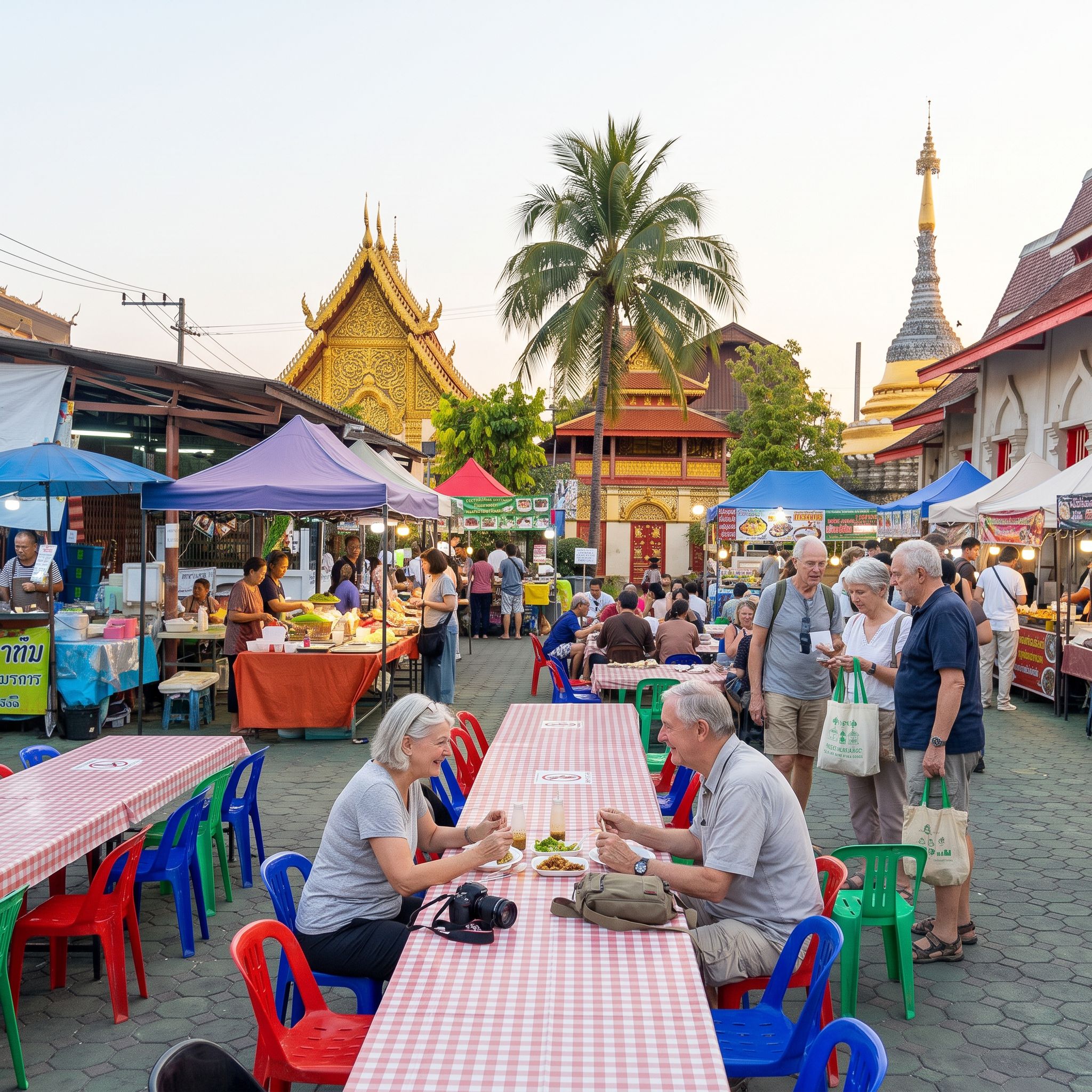
The Sunday Walking Street and the Night Bazaar are the two best-documented craft markets in the city, both free to enter and both in or beside the flat Old City. The Sunday market is the stronger choice for handmade goods; the Night Bazaar is the more convenient nightly option.
The Sunday Walking Street is a weekly Sunday market running on Ratchadamnoen Road through the Old City, with temple courtyards along the route open during market hours, according to Beautiful Chiang Mai's walking street guide. It stretches roughly one kilometre through the historic old city, according to Visit Thailand Today's Sunday Walking Street page.
The Night Bazaar is a long-established night market on Chang Khlan Road, described by the Tourism Authority of Thailand as offering traditional crafts, food, clothing and nightly activity. It sits about 1.5 km south of Tha Phae Gate, roughly a 20-minute walk from the Old City or a few minutes by songthaew.
Chiang Mai Province's tourism page describes the city as a handicraft destination with workshops where visitors can learn silk or silver production and buy hand-crafted souvenirs. That workshop tradition is what separates these markets from a generic souvenir strip.
 AI-edited
What should you know about the Sunday Walking Street?
The Sunday Walking Street opens only on Sundays, with published hours that vary by source. It is busiest between 6:00 PM and 8:00 PM, so arriving closer to opening time allows more comfortable browsing. Entry is free and no booking is required.
Hours are genuinely inconsistent across published sources. Visit Thailand Today gives 5:00 PM to 10:00 PM on Sundays only, and notes that hours or operating days can occasionally vary, so it is worth confirming before making a special trip. The provincial tourism office publishes roughly 5:00 PM to 10:00 PM, while the Thailand Tourism Directory lists a Sunday entry of 10:00 AM to 3:00 PM. These pages conflict, so treat the evening window as the working assumption and check locally on the day.
The market is explicitly documented as strong for local and handmade items. The Thailand Tourism Directory describes the route as selling local goods, clothing, northern-style bags, pictures, handicrafts, local food, snacks, souvenirs and silverware. Chiang Mai Municipality closes the roads on Sunday for local handicraft sellers.
Multiple forum posts describe the Sunday market as better value and more local than the Night Bazaar. A FlyerTalk post specifically names the Saturday and Sunday evening markets on Walai and Rajadamnern roads as the place for high-quality handicrafts, textiles, shoes and clothing at prices well below those at home.
Is the Night Bazaar worth visiting, and how does it differ?
The Night Bazaar runs nightly and is the easier option for travellers who want flexibility. It is flat and fully paved, free to enter, and accessible for wheelchairs and strollers, though crowds at peak times make navigation difficult. Its merchandise leans more commercial than the Sunday market.
The official Chiang Mai Night Bazaar site says the bazaar opens daily from 6:00 PM to 11:00 PM. The Tourism Authority of Thailand page gives roughly 5:00 PM to midnight, year-round. A hotel guide page lists Tuesday to Sunday, 4:00 PM to 11:00 PM. Published hours differ by operator, so confirm on the day if you are making a special trip.
On merchandise, the picture is mixed and worth knowing before you commit. A FlyerTalk post calls the Night Bazaar purely for tourists, says many stalls sell the same imported-looking goods, and recommends walking the whole area before buying. The same post warns that lacquerware and wood bought there can split and crack after a year or so. A Reddit post advises a full walk around first, because stalls mix common-supplier merchandise with some handmade goods, so comparison shopping matters.
That is not a reason to skip it. It is a reason to treat the Night Bazaar as a browsing and comparison stop, and to reserve serious craft purchases for the Sunday market or the Sankampaeng road.
What will you find along the Sankampaeng craft road?
Sankampaeng Road, sometimes called the handicraft highway, runs about 10 km southeast from Chiang Mai to the village of San Kamphaeng. It is the place for silk, celadon, silver, lacquerware, paper and umbrellas, and it is reachable by songthaew in roughly 30 minutes.
According to Visit Chiang Mai's Sankampaeng Road guide, the road carries pottery, stoneware, silverware, lacquerware, paperware, sculptures, jewellery, wood carvings and silk products along its length. The same source notes that the finest pottery of the region is known as celadon, a stoneware with a distinctive green glaze that makes it look like jade.
Named stops documented on that route include Baan Celadon, where you can see the making and painting of celadon pottery; Chiang Mai Silverware, a two-level establishment with modern and antique pieces; the Bo Sang Sa Paper & Umbrella Handicraft Centre, where umbrellas, fans and parasols are made; and the Thai Silk Village, where the whole silk production process is on show. One workshop on the road has a resident master artist known for wall panels that take up to four years to complete.
A Fodor's trip report praises Sankampaeng Road for silk, parasol, ceramic, silver, lacquerware and furniture factories. Another Fodors forum post recommends Baan Celadon, Sop Moei Arts, Studio Naenna and Prempracha's Collection for ceramics and textiles.
What about Warorot Market and the smaller craft venues?
Warorot Market is not documented by an official source in the material available here for accessibility, visitor rules or senior fares. Kalm Village, in the Old City, is documented as an art, crafts and culture centre with a museum component, lifestyle store and workshops, open daily except Wednesday.
Warorot is a well-known name in Chiang Mai, but the gathered official sources do not cover it. The nearby market district is documented around Chang Moi and the Night Bazaar area. If Warorot is on your list, treat it as an unverified stop and check locally for hours and access rather than relying on published guidance.
Kalm Village says it is open Monday to Sunday, 9:30 AM to 6:30 PM, and closed every Wednesday. It describes itself as an art, crafts and culture centre in Old Town Chiang Mai with a museum component, lifestyle store, workshops, exhibitions, residencies and events. For a slower, air-conditioned half-day that still involves craft buying, it is a sensible counterweight to an evening market.
The Chiang Mai OTOP Center describes itself as open daily, 10:00 AM to 6:00 PM, and as a One Tambon One Product distribution and exhibition centre focused on local products including cotton and silk handicrafts. A 2026 Chiang Mai event listing places Sankamphaeng Walking Street at Khuang Sankamphaeng every Saturday, calling it a cultural destination for art and handicrafts; that listing shows a specific Saturday schedule for January and February 2026, so those dates are seasonal and event-based rather than year-round.
How do you shop these markets without exhaustion?
Heat and crowd timing matter more than distance. The Sunday Walking Street is busiest between 6:00 PM and 8:00 PM, and the Night Bazaar gets congested in the evening peak. Arriving early is the single most effective measure, and cash is essential because smaller vendors typically do not accept cards.
One Fodor's trip report says the night market was skipped because the high temperature took too much out of the travellers. That is a familiar pattern. The gathered official pages do not publish detailed seating or heat-relief advice for these exact markets, so plan your own rest stops rather than expecting benches along the route.
Practical pacing for a market evening:
- Arrive at opening rather than at peak. Visit Thailand Today notes the Sunday market is busiest between 6:00 PM and 8:00 PM, and arriving closer to opening allows more comfortable browsing.
- Break the route. The Sunday Walking Street runs about 1 km; temple courtyards along the way are open during market hours and offer a pause.
- Carry cash. Smaller vendors typically do not accept card payments, according to Visit Thailand Today.
- Use rideshare or songthaew rather than driving. Parking in the immediate area of the Sunday market is extremely limited, and red songthaews and Grab are both available in the city centre.
Public toilets are documented at Tha Phae Gate, Three Kings Monument and Wat Phra Singh on the Sunday route. ATMs are available inside the Galare building at the Night Bazaar. Traffic on Chang Khlan Road backs up significantly after 7:00 PM, so a taxi arrival at that hour will be slower.
How accessible are these markets for older shoppers?
The Night Bazaar main strip is flat and paved, with open-air sections generally accessible to wheelchairs and strollers, though uneven pavement and dense crowds make movement difficult at peak times. The Sunday Walking Street runs on a flat central route, but no source documents lifts, formal assistance services, dedicated seating or step-free guarantees for the whole route.
For the Sunday Walking Street, the retrieved sources document it as a pedestrian street market on a flat central route. They do not document lifts, formal assistance services, dedicated seating or step-free guarantees for the whole route. That detail is not published; confirm with your hotel or a local operator if you need it.
For the Sankampaeng craft road, sources document transport access by songthaew and the presence of workshops and craft stops, but do not document step-free access, lifts or assistance services. No reduced-mobility provisions are documented for Warorot Market.
No formal assistance programme is documented on the official pages found for either the Sunday Walking Street or the Night Bazaar. No senior fare or over-65 tariff is documented for these markets either, on the Night Bazaar's own page, the TAT page, or the Sunday market pages. Entry to both is free, so there is no ticket price to reduce.
What do things cost, and how does bargaining work?
Market stall prices are negotiable, and the documented guidance is to start at 50 to 60 per cent of the asking price and meet in the middle. Fixed-price shops and malls do not haggle. No senior tariff is documented for any of these markets.
Visit Thailand Today states that prices at market stalls are negotiable, with a starting point of 50 to 60 per cent of the asking price, and that fixed-price shops and malls do not haggle. That is the only documented bargaining guidance in the material. No published price ranges exist for silk, silver, celadon or umbrellas at these specific venues, so this guide gives none rather than estimating.
On tax refunds, Visit Thailand Today notes that spending 2,000 THB or more at a single store displaying "VAT Refund for Tourists" signs earns a yellow form at the register, and 7 per cent VAT can be claimed back at the airport. That threshold applies per store, not per trip.
No senior or over-65 tariff is documented for the Sunday Walking Street, the Night Bazaar or the craft-shopping pages found for Chiang Mai. No special pass system is documented for either main market. Any rates quoted in conversation are indicative and vary by vendor and season.
When is the best time of year to shop these markets?
November to February offers the most reliable weather, according to Visit Thailand Today. March to May is the period to think twice about, because of smoke and heat. The Night Bazaar operates nightly year-round, and no seasonal closure is documented for it.
For broader context on weather windows, see our guide to when to visit Chiang Mai for comfortable weather and clear skies.
On closures, a baanlyy.com page notes that Chiang Mai Municipality can suspend the Sunday Walking Street for royal observances, mourning periods, election days, public works or severe weather. No recent press item in the material reports a closure, reopening, ownership change or major renovation for the Sunday Walking Street market itself.
The Night Bazaar is a different story. Asset World Corporation's shareholder-approved redevelopment plan, internally called "Lannatique," was reported in April 2024 and described as a roughly ฿11.95 billion multi-year project covering the Night Bazaar building and Kalare. Recent coverage says parts of the Night Bazaar strip are mid-redevelopment and that older descriptions may no longer match the current footprint. Expect the layout to differ from older guides.
In July 2024, Chiang Mai CityLife reported a Collaborative Program to Support Craft Community launched at TCDC Chiang Mai, with CEA and MUJI backing local craft brands in ceramics and natural fabrics. That programme ran March 2024 to March 2025 and included workshops, a community market and product development.
Where should you base yourself, and what about food?
Staying in or near the Old City puts the Sunday Walking Street within walking distance and the Night Bazaar a short songthaew ride away. Guest reviews consistently describe the Night Bazaar area trade-off as excellent market access against variable night-time noise.
Reviews of properties in the Night Bazaar area repeatedly praise being right in the heart of the bazaar area, with friendly staff and convenient breakfast. They also report recurring issues: market noise, live bands from the bazaar, music continuing until after midnight, hard beds, thin walls and limited breakfast variety. Several reviews say higher rooms or rooms away from the market side were quiet.
Translated into planning advice: if you stay beside the Night Bazaar, ask for a room away from the market side and consider earplugs. If sleep quality matters more than proximity, base yourself in the Old City and take a songthaew to the bazaar. For hotel options with a food angle, see our roundup of Chiang Mai hotels worth booking for the food.
Food-focused market coverage has its own dedicated guide, so this article does not cover it in depth. For dining beyond the markets, our guide to Chiang Mai's finest restaurants and riverside dining covers the sit-down side of the city.
What should be on your market checklist before you go?
Cash, timing and a plan for the return journey cover most of it. Both main markets are free to enter, neither requires booking, and no cancellation terms are documented because there is nothing to cancel.
- Bring cash. Smaller vendors typically do not accept card payments.
- Confirm the Sunday market is running before a special trip. Hours and operating days can occasionally vary, and the municipality can suspend it.
- Arrive early. The Sunday market is busiest between 6:00 PM and 8:00 PM.
- Check the Night Bazaar layout on arrival. Parts of the strip are mid-redevelopment.
- Keep the VAT refund threshold in mind: 2,000 THB or more at a single participating store.
- No local emergency numbers are documented for these specific market areas. Save your hotel's number and your embassy's before you go.
No assisted booking services are documented for these markets, and none is needed, since entry is free and unticketed. For health and food-safety planning around market eating, see our guide to food and water safety in Chiang Mai for the over-50s.
The short version: give the Sunday Walking Street one dedicated evening, use the Night Bazaar for flexible nightly browsing, and set aside a half-day by songthaew for the Sankampaeng road, where the workshops behind the crafts are the real attraction.


