
Santa Fe runs on a calendar that is older than the city's tourism industry and considerably more stubborn. The Plaza, which the National Park Service identifies as the meeting point of three historic trails (the Santa Fe Trail, the Old Spanish Trail and El Camino Real de Tierra Adentro), hosts markets, processions and feast days across the year, while the opera season plays out on a mesa north of town and Christmas Eve belongs to candlelit paper bags along Canyon Road. For travellers aged 50 to 70, the useful question is not whether Santa Fe has a festival worth planning around. It is which week suits your knees, your lungs and your tolerance for crowds.
This guide follows the cultural year in order, from the July markets through the August peak, the September burning of Zozobra, the autumn shoulder and the winter fairs, and closes with the Christmas Eve farolito walk. Each section says how busy the period is and what the published record does and does not establish about access. Weather and temperatures have their own dedicated guide, when to visit Santa Fe for comfortable weather and clear skies, and are not repeated here.
When does the Santa Fe festival year really begin?
The cultural year builds from spring and reaches full volume in July, when the International Folk Art Market and the Traditional Spanish Market fall in quick succession. Tourism Santa Fe schedules the Folk Art Market for the second full weekend of July, with roughly 160 artists from more than 50 countries, and the Spanish Market for the last full weekend of July.
The Traditional Spanish Market is the older of the two. SantaFe.com describes it as the nation's oldest and largest juried show of its kind, presented by the Spanish Colonial Arts Society, and the 2026 edition is listed for July 25–26 at Santa Fe Plaza, 63 Lincoln Avenue, running from 9 a.m. Saturday to 5 p.m. Sunday. Hundreds of local artists show Hispanic traditional art, food, music, dance and demonstrations.
Planning-wise, this is an outdoor market in the historic Plaza, and the event listing describes concentrated crowds with standing and walking between exhibitor areas. No admission price and no dedicated accessibility arrangement were published in the supplied listing. If you use a cane or a walker, the sensible approach is to arrive at opening, work the perimeter first and treat the central aisles as optional. The city's own events calendar is the place to confirm dates, because published listings change.
What happens at Indian Market, and how busy is it?
SWAIA's Santa Fe Indian Market is the city's peak weekend, held on the third full weekend of August. The 2026 market is listed for August 15–16 on Santa Fe Plaza and surrounding downtown streets, with more than 1,000 Native artists from over 200 Tribal Nations. The outdoor market is free and open to the public.
Tourism Santa Fe describes it as the world's largest and most prestigious intertribal art market, with fashion, music, dance, storytelling and comedy alongside the booths. The gala and fashion events are separately ticketed. SantaFe.com reports that accommodation around that third weekend of August may sell out up to a year ahead, which tells you most of what you need to know about demand.
Forum reports fill in the texture. A Fodor's discussion from June 2024 warns of road closures, an extremely busy small city, and rooms near the Plaza becoming scarce or very expensive; the same thread recommends staying immediately off the Plaza rather than ten to fifteen minutes away, because the crowds and closures make extra walking less convenient. A Tripadvisor review of Four Kachinas Inn describes a stay for Indian Market on a quiet residential street roughly a ten-minute walk from the Plaza. That is guest feedback, not a published shuttle service.
 AI-edited
The official sources do not state the market's step-free arrangements, accessible toilets, seating, mobility assistance or reduced fares. Ask SWAIA directly before you commit. One further note for older visitors: a Reddit thread from August 2026 contains polemical commentary about the demographic the market attracts. It is not a reliable account of the visitor experience, but it does suggest some locals find the weekend uncomfortable and avoid downtown.
How does the Santa Fe Opera season work?
The Santa Fe Opera season is part of the city's major-events calendar, with productions, concerts and special events published on the Opera's own calendar. Tickets should be bought only through the Opera, by phone, in person or via santafeopera.org, because the company states it is the only official and authorised ticket seller.
The Opera's own page is blunt about this: only tickets purchased in person, over the phone or through santafeopera.org can be guaranteed. The box office numbers are 505-986-5900 and 800-280-4654, and the address is 301 Opera Drive. The supplied official result does not state the complete 2026 season dates or ticket prices, so confirm both with the box office. The Opera publishes an accessibility service, but the supplied result does not give its specific provisions; call and describe your requirements.
Guest feedback on the venue itself is unusually consistent and unusually useful. The theatre is open at the sides under a roof, with sunset and mountain views behind the stage. Individual electronic libretto screens at each seat show an English translation. Seating is steeply raked, so sightlines are clear even from the far side of a row or the upper mezzanine, and an elevator reaches the third-floor mezzanine. Parking is ample and free with attendants directing cars and a shuttle from the lots; arriving one to three hours early secures a close spot and a picnic table. Tailgating before the show is common.
Two practical notes from the same body of reviews. The theatre is partially enclosed and can be hot and stuffy for the first hour, especially in the upper levels, so bring a fan and a breathable layer; temperatures can drop sharply later, so a jacket or blanket earns its place. Access to the seating area begins only about 15 to 20 minutes before the performance, and leaving the lot afterwards can take 15 to 30 minutes. As of November 2026, the Opera holds a Google rating of 4.8 out of 5 from 1,499 reviews.
"The Santa Fe Opera is a beautiful venue, and this was our first time attending an opera. It was an incredible experience. We were lucky enough to have a rain and thunderstorm roll in during the performance, which made the evening even more dramatic." (Google, July 2026)
What are Fiestas de Santa Fe and the burning of Zozobra?
Fiestas de Santa Fe is a ten-day programme in early September, and Zozobra opens it: a 50-foot marionette known as "Old Man Gloom" is burned at Fort Marcy Park on the Friday before Labor Day. For 2026 the gates open at 4 p.m. on Friday, September 4.
The Zozobra tradition began in 1924, created by artist Will Shuster, a member of the Santa Fe Art Colony, and has been part of the city since 1926, according to the event's own listing. SantaFe.com's 2026 calendar lists Fiesta de Santa Fe for September 3–12. The supplied official-calendar material does not specify the complete procession route, the event-by-event schedule, admission rules or fares.
What the listing does say is worth reading twice: all sales are final and tickets are non-refundable. Plan for substantial crowds, controlled entry and walking on or around a hillside park site. The official listing does not document a shuttle, an accessible viewing platform or a mobility-specific route, so anyone with limited stamina should contact the organiser before buying. Because the Fiestas programme runs ten days and uses central locations, expect a busy period around Plaza events and processions; exact crowd levels, street closures and accessible viewing areas are not documented.
Which months are quieter for cultural sightseeing?
Late autumn, winter outside the holidays, and spring are the calmer stretches, with autumn weekdays particularly manageable once the August peak passes.
What is documented: spring, March to May, is a relatively calm period for museums, galleries and historic attractions, with programming building toward summer. Tourism Santa Fe lists Native Fashion Week in May, including runway shows, pop-up shops, panels and parties. Visitor numbers rise in June as outdoor and cultural programmes expand. Autumn becomes more manageable after August, particularly on weekdays, and Indigenous Peoples' Day weekend in October brings three days of dancing, drumming, singing and community programming on the Plaza.
Winter, December to February, is generally the quietest period for cultural sightseeing outside the Christmas and New Year events, which suits travellers who prefer museums, galleries, restaurants and historic walks to crowded outdoor markets. Exact event and opening arrangements should be checked against the city and tourism calendars before booking. For a gentler programme at any time of year, combine the Plaza, one or two museums, Museum Hill and a single evening event rather than attempting everything in a day.
What do the winter markets offer instead?
The Winter Indian Market and Winter Spanish Market move the shopping indoors to the Santa Fe Community Convention Center at 201 West Marcy Street. SWAIA's 2026 Winter Indian Market runs November 28–29, with admission published at $15 per day or $25 for a weekend pass.
The Albuquerque Journal reported an expectation of roughly 160 artists and described the winter event as smaller and more intimate than the summer market, where more than 1,000 vendors occupy the Plaza and surrounding streets. SWAIA's listing describes more than 150 Indigenous vendors, music and dance performances, a silent auction, raffles and food, with makers of jewellery, pottery, paintings and textiles. Hours are published as Saturday 10 a.m. to 5 p.m. and Sunday 9 a.m. to 4 p.m. on the santafenmtrue.com listing; the Santa Fe New Mexican's winter arts calendar gives November 28 as 10 a.m. to 6 p.m. and November 29 as 9 a.m. to 4 p.m. The two published readings of Saturday's closing time differ, so check the current listing before you set out.
The Winter Spanish Market follows on December 5–6 at the same Convention Center, with Saturday hours of 9 a.m. to 5 p.m. and Sunday 9:30 a.m. to 4 p.m. per the Santa Fe New Mexican's calendar. The supplied listing does not publish an admission price, a crowd estimate or specific accessibility arrangements.
| Event | Dates | Venue | Admission |
|---|---|---|---|
| Winter Indian Market (SWAIA) | November 28–29, 2026 | Santa Fe Community Convention Center, 201 West Marcy Street | $15 per day or $25 weekend pass |
| Winter Spanish Market | December 5–6, 2026 | Santa Fe Community Convention Center | Not published in the supplied listing |
How does the Christmas Eve farolito walk work?
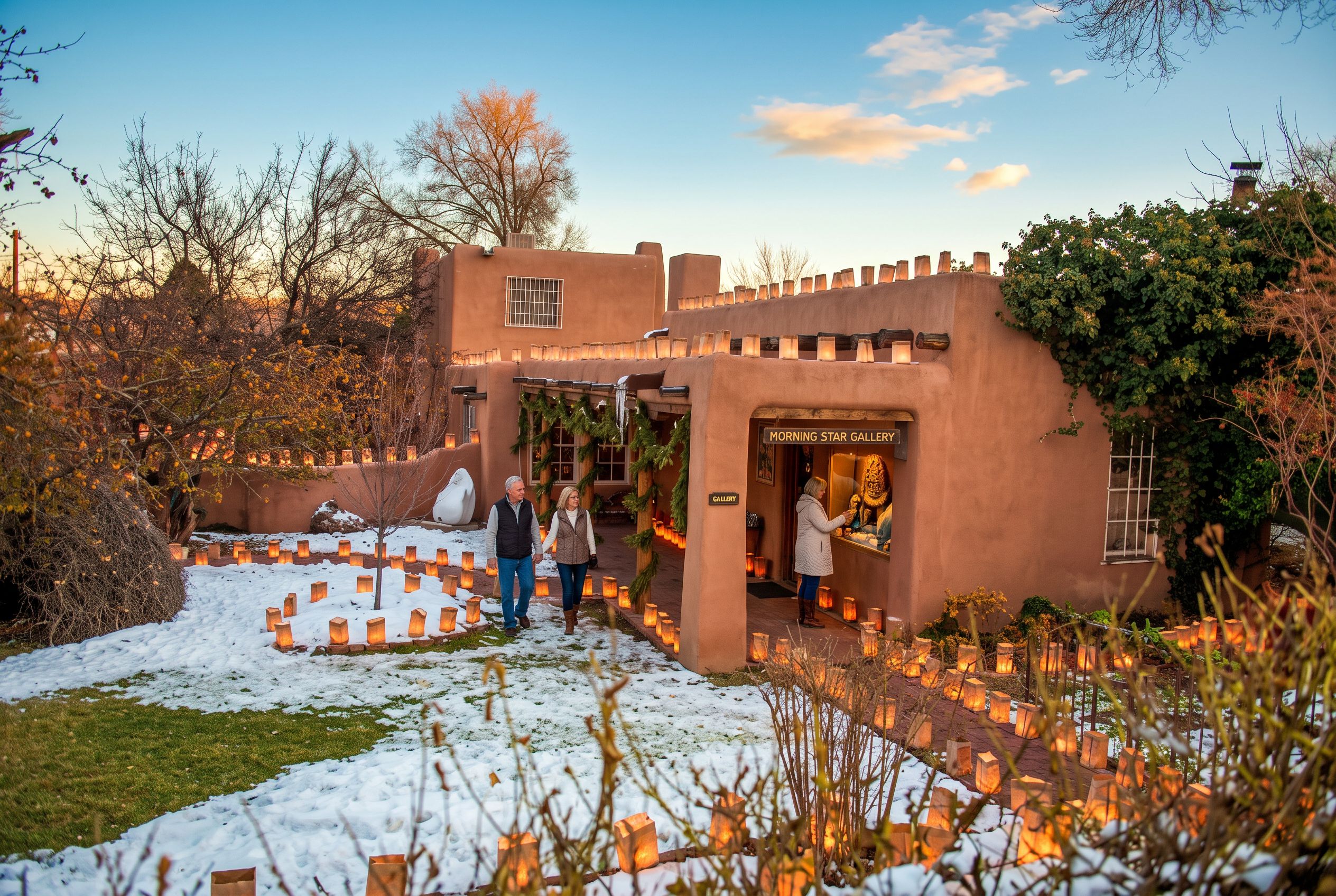
The Farolito Walk takes place on Christmas Eve along historic neighbourhood streets, with thousands of candlelit paper bags lining adobe walls. The published 2026 listing gives December 24 from 6 p.m. at Canyon Road; the 2025 listing gave 6 to 11 p.m., and santafenmtrue.com gives the time as after dusk, 5 to 9 p.m.
Farolitos, as the event listing explains, are little lights made from paper bags, sand and tea candles. Many streets in the area close to vehicular traffic and parking during the walk. Many businesses close on Christmas Eve, though others stay open for last-minute shoppers and offer a place to warm up.
The 2025 city arrangement closed Canyon Road, Acequia Madre and parts of side streets to general traffic until 10 p.m., and Santa Fe Trails ran a free shuttle from 5 to 9 p.m. between the South Capitol train station, the Santa Fe Visitor Center and the Capitol parking lot. Those are prior-year arrangements, not confirmation of 2026 operations; check the current city notice before relying on a route or shuttle. Santa Fe Trails buses have wheelchair ramps and priority seating, according to the city's accessibility information, though that is a city-wide transit provision rather than an assurance that the historic streets themselves are step-free.
This is a pedestrian evening tradition, not a driving excursion. Expect dense foot traffic, darkness and uneven historic streets. The source does not establish that the route is level, continuously paved or suitable for wheelchairs, so anyone using a mobility device should plan a short section rather than the full circuit, and should confirm the year's closures first.
What should older visitors know about access and altitude?
Santa Fe sits at high elevation, and the published record is thin on festival-specific access. Step-free entrances, lifts, accessible toilets, reserved seating, companion seating, mobility-device rules and assistance services are not documented for the named festivals. Ask each organiser before buying.
Altitude is the first thing to respect. A Reddit discussion among grandparents repeatedly cautions that Santa Fe's elevation, described there as about 7,000 feet, can challenge older visitors in the first few days, and recommends frequent water, extra rest and light activity initially. The same thread gives a concrete warning for anyone using a cane, walker or wheelchair: a contributor reports a mother catching a foot on a sidewalk slab raised by about an inch. Downtown walking may need care even when distances are short, and the thread suggests considering wheelchair rental.
For health cover, the City and County of Santa Fe direct police, fire and medical emergencies to 911, as set out in the city's published Santa Fe directory. The New Mexico Poison Center is on 1-800-222-1222, the New Mexico Crisis and Access Line on 1-855-662-7474, and Christus St. Vincent Regional Medical Center on (505) 913-3361. These are city and regional services, not documented nearest facilities for any individual venue. Pharmacies near the Plaza are not identified in the supplied sources; our guide to health, pharmacies and peace of mind in Santa Fe covers that ground.
On reduced fares, the record is specific but narrow. New Mexico residents with identification enter state museums free on the first Sunday of each month, and New Mexico seniors with identification enter free on Wednesdays; these are resident concessions, not general discounts for visiting seniors. The New Mexico CulturePass is reported at $30 for one visit to each participating state museum and historic site over 12 months. No senior fare or concession is documented for Indian Market, Spanish Market, the Opera, Fiestas, Zozobra or the Farolito Walk.
How should you time a visit around your interests?
Match the month to the interest rather than the other way round. Late July to August concentrates the Spanish Market, the opera season and Indian Market into a few weeks. Early September brings Fiestas and Zozobra. Late November and early December bring the indoor winter markets. Christmas Eve brings the farolitos.
For maximum cultural concentration, SantaFe.com's major-events page, updated March 8, 2026, points to late July through August, when the Spanish Market, the opera season and Indian Market occupy the calendar. For a quieter first visit, avoid the Indian Market weekend unless the market is the point of the trip; forum discussions consistently describe heavy crowds, closures, high prices and scarce rooms. For a less expansive market experience, the Winter Indian Market in late November is described in recorded reporting as smaller and more intimate than the summer event.
Two structural notes. First, the Plaza and major tourist locations are the areas the National Park Service explicitly characterises as busy, in contrast to quieter old streets; the Park Service's Santa Fe itinerary leads from the busy Plaza through those older streets, and it is presented as visitor information with no reservation or cancellation terms stated. Second, no festival-specific closing days or maintenance closures are documented, and event dates vary annually, so verify with the current organiser's calendar before booking.
Allow the first day for acclimatisation, schedule museums and short historic walks before longer excursions, and build in a rest afternoon after any evening event. If you are staying centrally, the historic La Fonda on the Plaza puts the market and processional route on the doorstep. For the evenings that matter, our guide to Santa Fe's finest restaurants and special-occasion tables is the place to plan a celebratory dinner, and it is worth reserving early during market and Fiestas weeks.


