
Santa Fe sits at roughly 7,000 feet in the high desert of northern New Mexico, and that elevation shapes everything about its calendar. Days are bright and dry, nights fall away sharply, winters bring snow and hard freezes, and July and August deliver afternoon thunderstorms that arrive with little warning. For travellers aged 50-70 planning around comfort rather than ski season or festival crowds, the published guidance points to two windows: late April into May, and mid-October into November. Those months pair mild afternoons with clear skies and thinner crowds, and they ask far less of lungs and joints than the cold of January or the heat and storms of high summer.
The city rewards that timing. The Plaza core is described by neighbourhood sources as flat, compact and walkable, with museums, shops and restaurants within a few blocks, and the surrounding landscape of piñon and juniper looks its best in the shoulder seasons. What follows is a month-by-month reading of the climate, the crowd patterns and the practical details that decide whether a Santa Fe week feels easy or tiring.
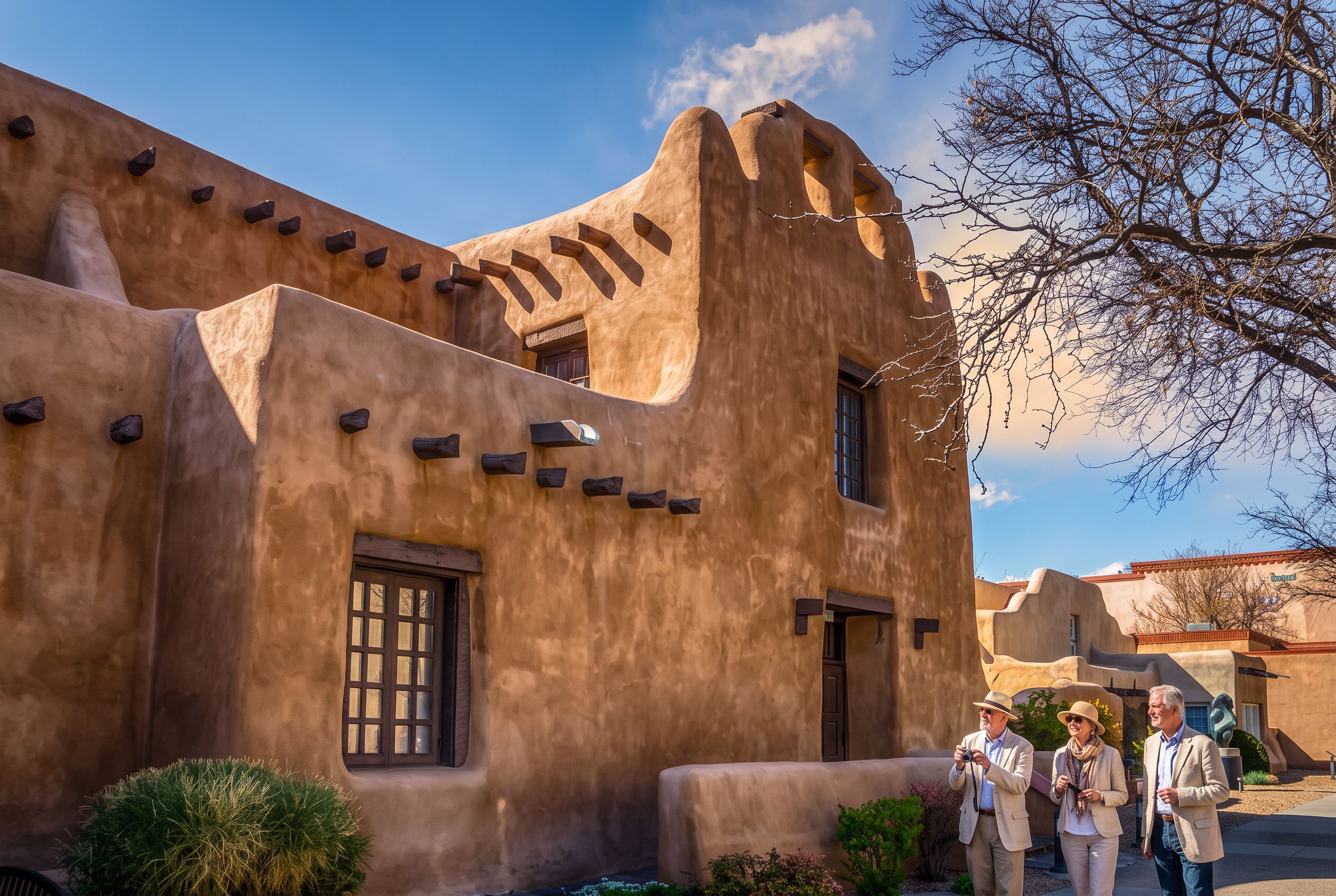 AI-edited
When are the best months to visit Santa Fe?
Late April, May, early June, mid-October and November are the strongest months for comfortable sightseeing, according to published travel sources. May averages a high near 72°F with a low around 42°F, and October averages about 67°F by day and 37°F at night. Both months sit outside the busiest summer and early-autumn event weekends.
Official Santa Fe tourism figures give May an average high of 72°F (22°C), a low of 42°F (6°C) and about an inch of precipitation. September averages 78°F (26°C) by day and 48°F (9°C) at night with 2.1 inches of rain, while October averages 67°F (19°C) and 37°F (3°C) with about 1.1 inches. Late April days average around 64°F (18°C), with nights falling to 33°F (1°C).
Sunshine supports the case. Independent climate data show May averaging about 13.3 hours of sunshine per day with relatively few wet days, September roughly 70% clear-sky conditions and about 11.5 hours of daily sunshine, and October about 69% clear skies and 10.1 hours a day. U.S. News describes autumn as cooler and "a little less busy" than summer.
How big are the day-to-night temperature swings?
They are large and consistent. Annual normal highs run about 67°F against lows near 37°F, a swing of roughly 30 degrees, and individual days can move further. Tourism Santa Fe notes cool nights even in July and August, and a dry climate with humidity sometimes below 20%. Layering is not optional here; it is the core of packing.
A traveller report from early June described cool mornings and evenings that cool rapidly after sunset, with the practical suggestion to carry a sweater or light jacket because the change after dark is more dramatic than expected. The same account recommended planning indoor activity or rest between roughly noon and 3 p.m.
Spring behaves the same way, with added volatility. A Fodor's contributor reported that Santa Fe snowed throughout the first day of a mid-April visit, and Fodor's contributors have described May as windy, with cool nights and wet ground still possible. None of this makes spring a bad choice; it makes a waterproof layer and a warm mid-layer sensible companions.
What is summer like, and what is the monsoon?
June is warm, dry and bright, with the clearest skies of any month: WeatherSpark reports clear, mostly clear or partly cloudy conditions about 78% of the time. July is the hottest month, and from July into August afternoon monsoon showers become frequent, with lightning, heavy rain, sudden cooling and local flooding possible.
The rain is not continuous. The available climate summary records about 11 wet days in July and 10 in August, and the NOAA-based table compiled by PlainClimate gives July about 1.82 inches of normal precipitation and August about 1.96 inches, the highest of the year. Showers commonly arrive in the afternoon, which leaves mornings workable.
Heat at this elevation reads differently. A participant in a discussion about hiking with older parents wrote that 75°F can feel hotter at 7,000 feet than at sea level, and advised starting early while it is cool. Local contributors in a separate discussion said August is usually in the 80s Fahrenheit and "shouldn't be very hot," while still urging hydration and a slow start.
Sources disagree on the peak. Expedia identifies July as the hottest month, while a Reddit discussion about visiting with grandparents described June as usually the hottest before the monsoon begins. Treat either as possible and plan mornings outdoors.
What are Santa Fe winters really like?
Cold, generally sunny and often dry, with freezing nights routine from December through February. January normals run about 44°F by day and 20°F at night, and February carries the year's lowest normal precipitation at roughly 0.35 inches. Days can be clear and pleasant; mornings and shaded pavements are not.
Snow behaves in a way worth understanding before booking a winter week. It may melt in direct sun while shaded pavements stay icy, so a bright winter day does not guarantee safe footing. That single detail decides more winter itineraries than the thermometer does.
Winter is also the quiet season. Travel-planning sources identify January and February as Santa Fe's quietest months, suitable mainly for visitors comfortable with cold mornings, short days and occasional snow, and Expedia identifies December to March as lower-occupancy. December is not reliably quiet, because holiday travel and luminaria activity draw visitors; the Canyon Road Farolito Walk falls on December 24.
Sources differ on the coldest month. Expedia names January, while the NOAA-based table compiled by PlainClimate gives December the coldest nights. Either way, the practical answer is the same: a warm coat, shoes with grip and shorter outdoor stretches.
When are the crowds thickest, and when are the streets quiet?
The broad peak runs late spring through early autumn, with June to August busiest because of warm weather, outdoor recreation, gallery activity and headline festivals. September and early October can also be busy. The quietest stretch is January and February, with late April and mid-October offering the better balance of weather and lighter footfall.
Two August and September events drive the sharpest spikes. U.S. News lists the Santa Fe Indian Market in August and reports that the visitors bureau says rooms for it are typically booked up to a year ahead; the same guide reports an SWAIA estimate of roughly 100,000 attendees and more than 1,000 Native artists, a figure to check with the organiser for the relevant year. Santa Fe Fiesta in early September and the Santa Fe Wine & Chile Fiesta also lift demand. The festival calendar has its own dedicated guide on this site.
October is generally calmer than the major summer market weekends, though Albuquerque's International Balloon Fiesta can create regional demand in early October; that event is not in Santa Fe. November through March is usually the quieter period for galleries, museums and restaurants outside holidays and ski weekends.
No source establishes a universally quietest period for the whole city. The most consistent practical recommendation across them is midweek travel outside the major August and early-September events.
| Month | Average high | Average low | Precipitation |
|---|---|---|---|
| Late April | about 64°F (18°C) | 33°F (1°C) | not stated |
| May | 72°F (22°C) | 42°F (6°C) | about 1 inch |
| September | 78°F (26°C) | 48°F (9°C) | 2.1 inches |
| October | 67°F (19°C) | 37°F (3°C) | about 1.1 inches |
When are the gardens and festival seasons at their best?
Spring is the garden window. A Santa Fe tourism blog describes April and May as bringing blooming gardens and open galleries before the summer rush, with May's normal high about 76°F and evenings averaging about 43°F. Autumn then brings the cultural calendar's heaviest concentration, from Fiesta in early September through the Wine & Chile Fiesta.
The Santa Fe Botanical Garden is the obvious spring stop. Its published notes state that most paths are wheelchair accessible, that the Art Trail is uneven and includes one step, and that only one-quarter of the Piñon-Juniper Woodland trail is ADA compliant. Reservations are required, and admission is $16 for adults, $8 for youth aged 4 to 17, with children aged 0 to 3 and garden members free. No senior discount is stated. During a cited restoration period admission was in person only and Kearny's Gap Bridge was under restoration, with some areas closed; the dates of that work are not given, so confirm before travelling.
For the wider picture of what to see and where to eat once you have chosen your dates, our guide to Santa Fe's finest restaurants and special-occasion tables covers the booking side.
How does the altitude affect how you should time a visit?
Santa Fe's elevation of about 7,000 feet can make the first day tiring and can magnify walking and breathing difficulties. Multiple Reddit contributors warned that it can cause sickness, fatigue or breathing problems even in healthy visitors, suggesting a light first day, frequent water, rest, and a night at lower elevation in Albuquerque before continuing if flying.
The material offers no medical guidance for an individual condition, so the sensible approach is to treat the first 24 hours as a settling day, keep outings short and build in rest. Our guide to adjusting to Santa Fe's altitude goes further into the practical side.
Sun matters as much as air. Santa Fe's high-altitude sun can feel stronger than the thermometer suggests, and the reported pattern favours morning outings, especially for hiking. Flat or gently graded options in the area include Santa Fe Canyon Preserve, La Tierra Trails and Arroyo Hondo Open Space, while Dale Ball and Sun Mountain were described as considerably steeper.
Footing in the historic centre is not uniform. Reports specifically mention cracked or uneven sidewalks, broken curb cuts and uneven cobblestones around the Plaza, and one contributor described a mobility-impaired mother nearly tripping on a raised sidewalk slab. Wheelchair rental was suggested for visitors who tire easily or have unstable footing. Exact step-free routes, seating and pavement conditions for the Plaza and the individual museums are not documented; confirm with each venue. For pharmacies and medical points, see health, pharmacies and peace of mind in Santa Fe.
What should I pack and book for each season?
Pack layers rather than outfits: a warm mid-layer, a waterproof shell for July and August afternoons, a hat and high-factor sunscreen for every month, and shoes with grip for winter ice and Plaza cobblestones. Book museum tickets ahead in peak weeks and check seasonal hours before you travel.
Some booking details are worth noting. The Georgia O'Keeffe Museum is open Thursday to Tuesday, 10 a.m. to 5 p.m., closed Wednesdays, with tickets reported available 60 days in advance and a reduced admission price for visitors aged 65 and over (the amount is not given in the supplied result). Published closures include Thanksgiving, Christmas, New Year's Day and Easter. The Palace of the Governors is listed as open daily, 10 a.m. to 5 p.m., May to October. The New Mexico Museum of Art is at 107 West Palace Avenue, with one source giving Saturday to Thursday, 10 a.m. to 5 p.m., closure on Monday, and evening hours of 5 to 7 p.m. on the first Friday. SITE Santa Fe has free admission with no advance registration required.
Transit is a reasonable fallback for the centre. Santa Fe Trails buses are reported to have wheelchair ramps and priority seating, and reduced fares are reported for people aged 60 and over with valid identification or a Medicare card, at $0.50 one way and $1 for a day pass. The service is listed as operating daily from 7 a.m. to 8 p.m., though the supplied information concerns city transit and does not confirm that every fare or programme is available to non-resident visitors. Ask when boarding.
For a quieter room, our guide to the quietest hotels in Santa Fe for light sleepers covers what guests have reported about noise. Rates across the city are indicative and vary by season and booking channel.
What should you do if the weather turns?
Keep one indoor day in reserve and check the forecast each morning. Afternoon monsoon storms in July and August can bring lightning, heavy rain, sudden cooling and local flooding, and spring can produce late snow. A Fodor's trip discussion advised carrying an umbrella in the rainy season and noted that trails and attractions reopened as conditions improved.
Roadworks are the other practical variable. The City of Santa Fe reported continuing work on Airport Road in 2026, including rehabilitation between Cerrillos Road and NM-599, with traffic control and possible delays and paving dependent on weather. Construction of a roundabout at Cottonwood Drive and Agua Fria Street began in August 2026 and was expected to continue into May 2027, with Agua Fria closed at the Fair Way Village intersection and a detour via San Felipe Road, Airport Road and South Meadows. City announcements also listed closures around Agua Fria Street and South Meadows Road in March 2026.
For emergencies, police, fire and medical calls go to 911 across the City of Santa Fe and Santa Fe County, handled by the Santa Fe Regional Emergency Communications Center, which operates 24 hours a day. The New Mexico Poison Center is on 1-800-222-1222, and 988 covers behavioural-health crises. Alert Santa Fe is the official city-and-county notification system for road closures, evacuations and power outages.
Which window suits you best?
Choose May or mid-October for the best balance of mild weather, clear skies and manageable crowds. Choose late April or November if you want fewer people and can accept colder mornings. Choose January or February only if quiet streets matter more than warmth, and avoid the August and early-September event weeks unless the event itself is the reason for the trip.
The reasoning is straightforward. May gives 72°F afternoons, about an inch of rain and 13.3 hours of daily sunshine, with gardens at their best and the summer rush still ahead. Mid-October gives 67°F days, roughly 69% clear skies and a city that has emptied out after the summer market weekends. Both ask for a jacket in the morning and reward an early start.
Winter suits museum-goers who accept short days and icy shade. Summer suits early risers who can be indoors by early afternoon when the monsoon builds. The high desert is generous in the shoulder months, and Santa Fe's calendar, read honestly, points there.


