
My Son Sanctuary sits in a forested valley about 40 to 60 kilometres southwest of Hoi An, in Duy Xuyen District, Quang Nam Province. It is the archaeological heart of the Champa Kingdom, a UNESCO World Heritage complex of brick Hindu temple towers raised between roughly the fourth and fourteenth centuries. For history-minded travellers, it offers something the merchant town of Hoi An cannot: a direct encounter with the civilisation that shaped this coast long before the trading port existed. The visit is manageable in a half day, and the site's electric shuttle removes the steepest part of the approach.
This guide covers only the My Son outing: how to get there, when to go, what the ground underfoot is actually like, and how to combine the ruins with a river return. Hoi An's own historic streets, and the question of how much walking they demand, are covered in our dedicated guide to seeing Hoi An with little walking and out of the heat.
Why is My Son worth a half day from Hoi An?
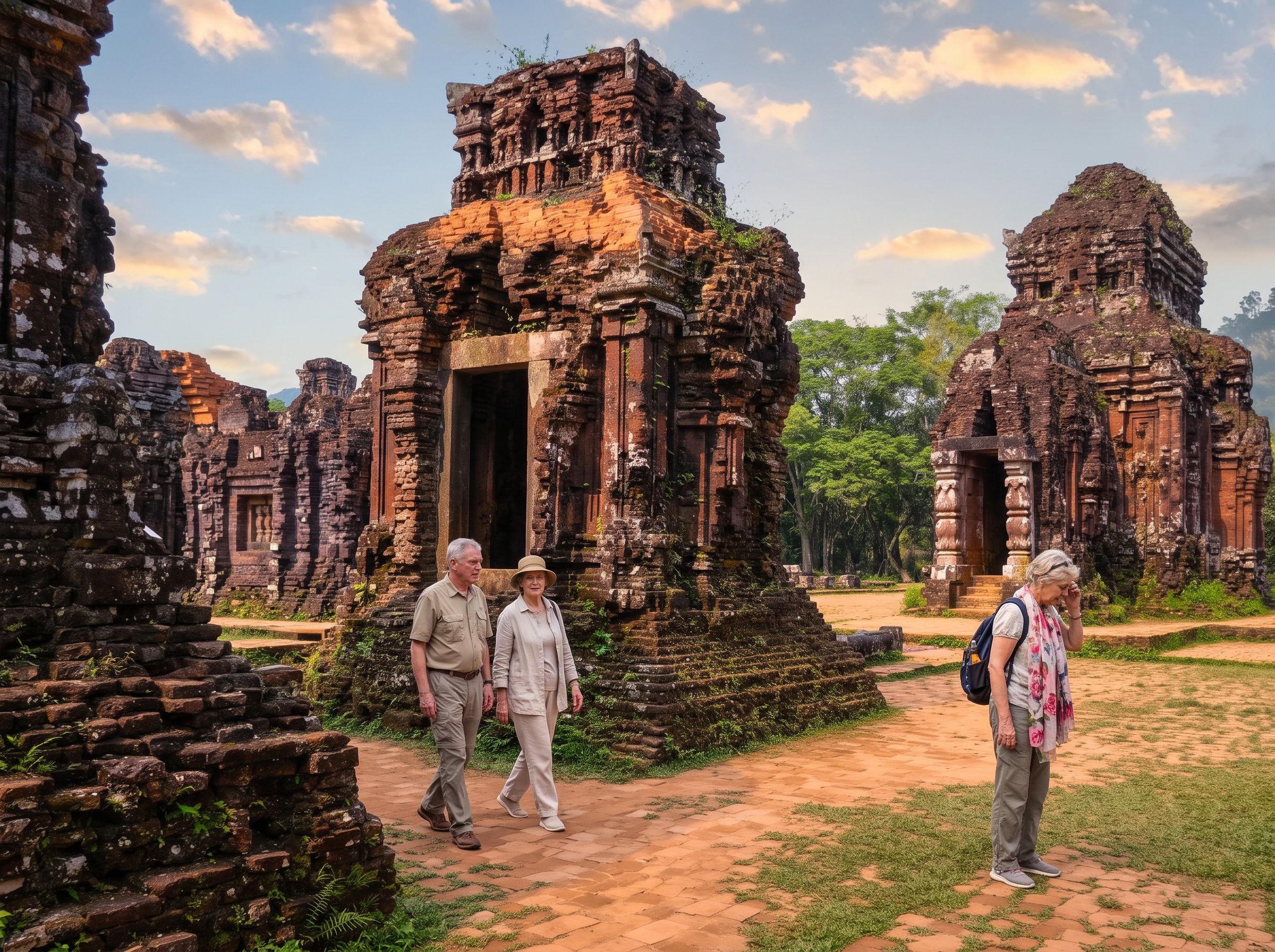
My Son preserves the brick temple towers of the Champa Kingdom, built over roughly ten centuries in a mountain valley. It is a UNESCO World Heritage site, and its setting and architecture differ sharply from Hoi An's low-rise riverside townscape. Most visitors see the main temple groups in about two hours.
The complex is associated with the Champa Kingdom and was developed between approximately the fourth and fourteenth centuries. Its surviving brick towers, sculpture and temple groups give a focused introduction to Champa history rather than the sprawl of a large, intact city such as Angkor. That concentration is an advantage for older travellers: the story is legible in a morning.
The setting does much of the work. My Son occupies a forested valley surrounded by mountains, and a Rick Steves forum report from March 2024 describes the ruins as sitting in hilly country, which contributes both to the atmosphere and to the physical demands of the visit. The same report notes that the temples were later affected by wartime bombing, and that visitors were allowed to wander for around an hour and a half to two hours.
How do you get to My Son from Hoi An?
There is no documented public bus timetable for the Hoi An to My Son route. The practical options are a private car or taxi, an organised shuttle or small-group tour, or a motorbike for experienced riders. A private car allows an early start and a vehicle waiting for the return.
Published estimates for a private car or taxi range from about 500,000 to 900,000 dong round trip, with the advantage of choosing your departure time and arranging a vehicle to wait. Organised shuttle tours are quoted at approximately 250,000 to 450,000 dong in one account, while another lists a Hoi An shuttle at about 200,000 dong round trip, departing around 8:00 to 8:15 a.m. and returning near 1:00 p.m.
Motorbike rental is reported at approximately 150,000 to 250,000 dong per day. The route and traffic make this a less comfortable choice for travellers who are not experienced, licensed and insured riders. Rates are indicative and vary by season and booking channel.
In March 2025, Quang Nam launched the Hoi An to My Son to Dong Giang Heaven Gate tourism route, described by Vietnam Tourism as a 100-kilometre, three-destination heritage and nature journey. The provincial Department of Construction approved a new interprovincial bus route connecting the three destinations. The report does not publish the timetable, frequency, fares, or whether the service suits a same-day return, so confirm locally before relying on it.
 AI-edited
When should you go to avoid heat and crowds?
Go early. Published visitor guidance places the quietest period before about 8 a.m., while larger tour groups commonly arrive later in the morning. Tour operators consistently schedule departures around 5:00 to 5:45 a.m. or roughly 7:30 to 8:00 a.m. to reach the ruins before the strongest heat and the later crowds.
A Reddit trip report from April 2025 describes travellers leaving at 5:00 a.m. and finding the early departure worthwhile specifically for avoiding crowds and heat. A Rick Steves forum report from March 2024 says Central Vietnam was hot and humid enough that the travellers moved their sightseeing to early morning.
The heat is the main planning constraint. One source describes the sanctuary as having limited shade, and the morning is recommended because afternoon heat can be severe. A Reddit report from September 2022 called the site enjoyable but "really hot" when walking in exposed sun. A Tripadvisor listing updated in October 2026, by contrast, describes shaded paths. Sources differ on how much shade the walking routes actually offer; plan for sun and treat any shade as a bonus.
What does entry cost, and what is included?
The entrance ticket for a foreign adult is published as 150,000 Vietnamese dong. Children aged 5 to 15 are reported at 30,000 to 50,000 dong depending on the published tariff, and children under five are generally free. No senior or over-65 discount is documented.
Sources report that the ticket includes the electric shuttle, the Champa Museum and Apsara performances, though the precise inclusions and opening hours should be checked locally because published accounts vary. Several itineraries include a Cham or Champa dance performance, and schedules can vary by operator. An audio-guide app is reported at 70,000 VND per ticket.
Tickets are reported as available at the main entrance. A source also says official online reservation platforms may be available, but it does not identify a booking provider or state cancellation terms. No multi-attraction pass specifically covering My Son and Hoi An is documented.
Opening hours are reported inconsistently. One source gives 06:00 to 18:00 with the ticket office closing at 17:00; another gives 06:30 to 17:30 with final admission at 17:00; a separate 2026 ticket notice reports 07:30 to 17:30 and warns that bad weather can cause temporary closure. Because the published hours conflict, verify the date and the ticket-office closing time before travelling.
| Item | Published figure | Notes |
|---|---|---|
| Foreign adult admission | 150,000 VND | Multiple tour listings state this price |
| Vietnamese adult admission | 100,000 VND | Reported separately from the foreign rate |
| Children 5 to 15 | 30,000 to 50,000 VND | Varies by published tariff |
| Children under five | Free | Generally free across sources |
| Audio guide app | 70,000 VND | Per ticket |
| Senior or over-65 discount | Not documented | No age-based reduced fare appears in the sources |
How much walking and uneven ground should you expect?
Expect roughly 2 to 3 kilometres of paved paths if you explore all accessible clusters, plus uneven brick paving, temple steps, slopes and unpaved sections between monument groups. A free electric shuttle covers approximately 2 kilometres from the entrance toward the ruins, removing the hottest part of the approach road.
The shuttle is the single most useful fact for older visitors. From the entrance area, a free electric shuttle carries visitors approximately 2 kilometres toward the temple groups, avoiding the hottest part of the approach road, as reported by Ahoy Vietnam's My Son Sanctuary guide. The journey takes about three minutes according to one source. A Rick Steves forum report from March 2024 confirms that open-sided shuttles carried visitors approximately 2 kilometres toward the site, reducing the initial walking burden, but notes that the shuttle covers the first stretch, not the entire visit.
Beyond the shuttle stop, the ruins themselves are not fully easy-access. Sources describe uneven brick paving, temple steps, slopes and unpaved paths between monument groups. A 2026 planning account estimates about 2 to 3 kilometres of paved paths if all accessible clusters are explored, and advises expecting uneven surfaces, steps and exposed sections rather than a fully level museum-style visit.
The available material does not document a reliable number or location of seats, so visitors who need regular rest stops should not assume seating throughout the temple area. No official source publishes shade coverage, drinking-water points or the number and location of seats. Step-free access, handrails and widespread seating at the sanctuary are not sufficiently documented; confirm with the site or your tour operator if you rely on any of these.
Is there shade and somewhere to sit?
Sources disagree. One Tripadvisor listing updated in October 2026 describes shaded paths, while a Reddit report from September 2022 describes walking in exposed sun and finding it "really hot." No official source publishes shade coverage, drinking-water points or the number and location of seats.
The sensible plan is to carry water, wear a hat and treat shade as something you find rather than something you count on. The morning visit recommended by tour operators and visitor guidance is itself the main mitigation: the heat builds through the day, and an early arrival puts the walking before the worst of it.
Seating is the weaker of the two. The available material does not document a reliable number or location of seats, so visitors who need regular rest stops should not assume seating throughout the temple area. If you need to sit every fifteen minutes, say so when booking and ask whether the operator can pace the visit accordingly. The sanctuary does not publish a seating plan, and no assisted-visit programme is documented in the available results.
Can you combine My Son with a river return to Hoi An?
Some Hoi An itineraries combine the ruins with a Thu Bon River boat journey back toward Hoi An. One operator gives a boat journey of approximately 2 to 2½ hours depending on water and weather, and says a direct car return can be arranged instead. The river return substantially lengthens the day.
Some Hoi An tour listings advertise a My Son visit followed by a boat return down the Thu Bon River, generally as a package with transport, guide and sometimes lunch. The published package range is approximately US$30 to US$45. The material does not provide a verifiable official departure timetable, pier, boat operator, river section or guaranteed return time for this itinerary.
The documented local boat information in the available results concerns short Hoai River cruises within Hoi An, not a confirmed My Son to Hoi An return route. Availability may depend on the selected morning itinerary, weather and water conditions. If the river return is the reason you are booking, ask the operator directly which pier, which boat and what happens if the water is unsuitable on the day.
For travellers who prefer a predictable afternoon, a private car waiting at the sanctuary is the simpler arrangement. It also lets you leave when you have had enough rather than when the boat departs.
Should you book a tour or go independently?
Both work. A tour solves the transport, timing and commentary in one booking; an independent visit by taxi or private car gives you control over pace and departure time. Published Hoi An options range from approximately US$18 to US$19 per person for basic or small-group products, with other half-day tours around US$30 or more.
Some products exclude the entrance ticket; others include admission, lunch, guide services, electric-car transport or the boat ride depending on the selected package. Check what is included before comparing prices, because the 150,000 dong admission changes the arithmetic considerably.
Guest feedback on the guided version is positive. A Klook summary says reviewers generally praise the complex's significance as a Cham religious centre and its ruins in a jungle setting, and that many consider a half-day visit from Hoi An suitable and recommend a knowledgeable guide. The same platform records praise for guides who explained the site's history clearly. If you want the Champa context rather than just the photographs, a guide earns the fee.
For a wider look at how guided and small-group products work in this region, including what to ask before booking, see our guide to small-group and guided tours of Hoi An. And if you are arranging your own transport rather than joining a tour, our notes on getting around Hoi An by foot, cyclo, Grab and private car cover the local options.
What about health, heat and safety on the day?
The main risks are heat and the terrain underfoot.
Heat is the documented concern. Sources repeatedly warn about heat and humidity rather than giving a reliable month-by-month climate comparison, and a destination guide identifies January through September as the drier visiting period without providing month-by-month rainfall or temperature data specifically for My Son. The available reports cover March, April and September, and all of them raise heat or humidity.
On terrain, the practical guidance is straightforward: wear shoes with grip, take the shuttle rather than walking the approach road, and do not attempt temple steps that look wet or worn.
No sanctuary-specific emergency number appears. If you have a medical condition affected by heat, discuss the outing with your doctor before you travel and tell your tour guide on the day.
What else should you know before you go?
My Son is open daily, including Tet and other holidays according to a recent destination guide, but published hours vary between sources. Bad weather can cause temporary closure. No documented regular maintenance closure or annual revision closure appears.
One source reports a 2026 ticket notice warning that bad weather can cause temporary closure. Given that Central Vietnam's wetter months can bring heavy rain, build flexibility into your plans rather than fixing My Son to a single morning.
On the return to Hoi An, note that the Japanese Covered Bridge may be wrapped in renovation scaffolding, limiting views and photography, according to a recent Hoi An tourism report. That affects your afternoon in town, not the sanctuary itself, but it is worth knowing before you plan the rest of the day.
If you are staying in Hoi An and want a comfortable base for an early departure, our dossier on the Anantara Hoi An Resort covers a riverside property in detail. Wherever you stay, ask the front desk to arrange the car the night before; a 5:30 a.m. departure is much easier when it is already booked.
Is the My Son day trip right for you?
For travellers aged 50 to 70 with an interest in history, My Son delivers something genuinely different from Hoi An: Cham brick towers in a mountain valley, a thousand years of religious building, and a story that a good guide can make vivid in two hours. The electric shuttle removes the hardest part of the approach, and an early start removes the worst of the heat.
The honest caveats are the ground underfoot and the facilities. If you use a mobility aid or need frequent rest stops, plan the visit around the shuttle and the central group, ask your operator to pace it, and confirm the details you depend on before you book. Everything else, from the 150,000 dong ticket to the river return, is a matter of choosing your morning and your way home.


