
Hoi An rewards the traveller who plans around the heat rather than through it. The Ancient Town is compact and largely pedestrian, the streets are free to walk, and the ticketed heritage buildings sit close together. For anyone who tires easily in humidity, the practical answer is short shaded stretches in the morning or late afternoon, a cyclo or a river boat for the middle hours, and a private car for anything beyond the Old Town edge.
This guide covers what works with minimal walking: the Old Town in brief bursts, the Hoai River by boat, cyclo rides through the pedestrian zone, air-conditioned cafés and hotel pools, and a car for the beach and countryside. General accessibility in Hoi An has its own dedicated guide, so this article stays with the low-walking, cool-hours approach.
What is the smartest way to see Hoi An with little walking?
Combine short walks in the Ancient Town with a cyclo, a river boat and a private car. The Old Town is compact and its streets are free to enter, so you can see the general townscape in 20-minute stretches, rest in an air-conditioned café, and use vehicles for everything outside the pedestrian core.
Published Hoi An transport guidance describes the historic centre as flat and compact, with key sites generally close together, though the best-documented descriptions still assume walking between heritage houses, assembly halls and museums.
The working pattern for a hot day:
- Early morning (from opening): one or two heritage buildings while the lanes are still cool.
- Mid-morning to midday: a cyclo ride through the pedestrian zone, then an air-conditioned café or your hotel pool.
- Late afternoon: a second short walk, or a car out to the countryside.
- Evening: the Hoai River boat, which is described primarily as an evening sightseeing experience.
When should you go to avoid the heat?
February to August is broadly the drier stretch, and from May through August the guidance is to start outdoor activity early. October to December can bring rain, flooding and difficult walking conditions. Travellers who dislike humidity most often name February, and sometimes January, as the more comfortable months.
Regional travel material describes February to August as broadly drier and September to January as wetter, though conditions vary within those ranges. From May through August, the same source specifically recommends early starts for outdoor activities in the hot season.
Heat is the recurring theme in traveller discussion. A Reddit thread updated 18 January 2026 repeatedly characterised heat and humidity as exhausting; the traveller's own trip was in April, which they found pleasant, another contribution mentioned February as relatively comfortable and less humid, and January was suggested as potentially cooler. The same thread carried a warning worth repeating: a traveller who visited Vietnam with their 65-year-old mother said that many tourist spots involve a lot of walking in Hoi An, and recommended scheduling a rest day rather than treating Hoi An as a continuous sightseeing stop.
October to December is the period to plan around rather than book through. Historic flooding in late October 2025 submerged the Old Quarter, surrounding villages and riverside eco-tourism sites, according to Vietnam News on 31 October 2025, and by 2 November 2025 tourists had begun returning while many hotels, lantern shops and restaurants were still cleaning up, as reported by Malay Mail citing AFP.
 AI-edited
How much walking does the Old Town actually require?
What is documented is that the streets can be explored on foot, that the district is compact, and that the heritage buildings sit within a small area. Plan on short bursts, not a full circuit.
One guide describes the Ancient Town as accessible 24 hours, while another gives pedestrian-management periods rather than unrestricted all-day vehicle access. Published visitor guidance gives pedestrian periods of approximately 9:00 to 11:00 and 15:00 to 21:00 in the warmer-season schedule, with a shorter evening period in the cooler season. One Hoi An guide gives pedestrian and non-motorised access periods of 9:00 to 11:00 and 15:00 to 21:30, while another gives 9:00 to 21:30 in summer and 9:00 to 21:00 in winter, with Phan Chau Trinh becoming pedestrian-oriented from 17:30.
Those times should be confirmed locally. during pedestrian periods, cars and taxis are reported as banned from the Old Town core, so a car will drop you at the edge rather than at the door.
Which heritage sites are worth the steps?
The Japanese Covered Bridge, the assembly halls and the historic houses are the ticketed monuments.
Hoi An Ancient Town has been a UNESCO World Heritage Site since 1999, according to a Hoi An travel guide. The ticket system applies to designated monuments, museums and the Japanese Covered Bridge rather than automatically charging for walking through every Ancient Town street.
One heritage announcement lists a VND80,000 ticket including the general townscape, either the Japanese Covered Bridge or Quan Cong Temple, and two additional monuments; a VND120,000 ticket includes the general townscape, one of those principal monuments, one museum and three additional monuments. Another guide states that the system changed to VND20,000 per heritage building from 10 August 2026, while other sources continue to list the VND80,000 to VND120,000 packages. The current tariff should be confirmed at an official booth before visiting.
For Phuc Kien Assembly Hall, one travel guide gives an admission price of VND120,000 and opening hours of 07:00 to 18:00, but the source does not establish whether this is a current official tariff. Most ticketed attractions are generally reported as opening around 8:00 to 17:00, but exact hours and access conditions should be checked locally.
Does a cyclo work for limited mobility?
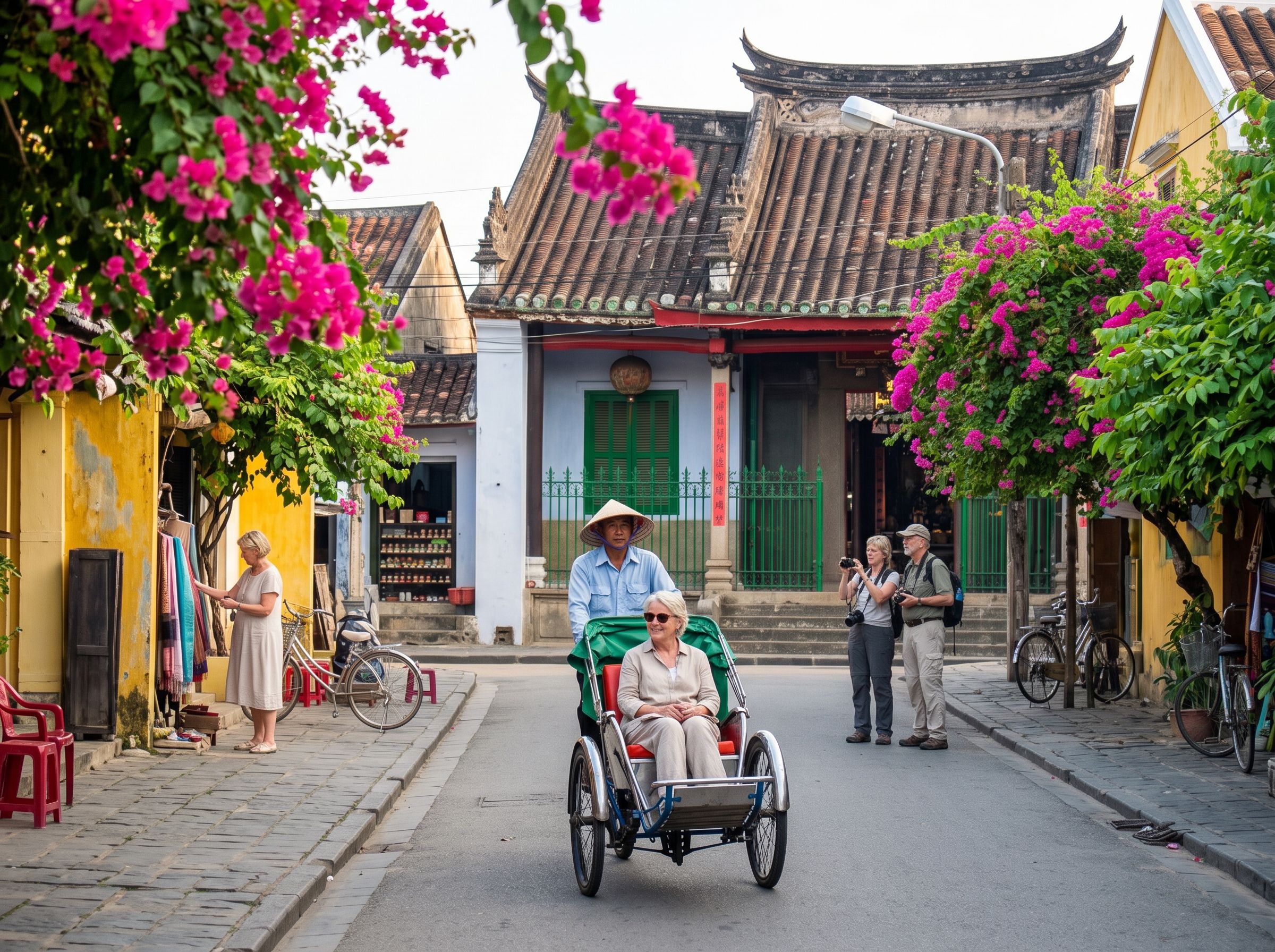
During published pedestrian periods, traditional cyclos are among the permitted non-motorised vehicles in the Old Town, according to the available Hoi An guide. Published transport guidance lists a 15 to 20-minute Old Town cyclo ride at approximately 50,000 to 100,000 VND, or US$2 to $4. No official municipal operator, senior fare or booking website is documented.
A separate Hoi An price guide lists a 30-minute Old Town cyclo ride at 100,000 to 200,000 VND. The difference indicates that the fare varies by duration, negotiation and possibly demand, and neither source publishes a fixed official fare card. Rates are indicative and vary by season and booking channel.
There is no standard named cyclo route, no guaranteed shade, no vehicle accessibility specification and no advance-booking procedure. The published sources do not provide an official list of streets where cyclos may stop.
For a fuller comparison of the options, including taxis and app-based cars, see getting around Hoi An on foot, by cyclo, Grab and private car.
What about a river boat?
The Hoai River boat operates from 31 Nguyễn Phúc Chu in Minh An Ward, with published hours of approximately 17:00 to 21:30 and last admission at 21:00. The listed admission is 36,000 VND. It is described primarily as an evening sightseeing experience rather than transport.
Other published rates differ by operator and duration. A Hoi An tour operator publishes a 15-minute Thu Bon River boat ride at 170,000 VND per boat for up to two people, excluding a lantern, and says the official rowboat ticket can be purchased only at the official ticket booth. Another Hoi An tourism guide lists a 20-minute Hoai River wooden sampan cruise for one to four passengers at 150,000 to 200,000 VND, with tickets sold at Bach Dang riverboat booths; the source does not state a season or whether the rate is an official municipal tariff. Published visitor guidance gives an indicative price of about 150,000 VND for a three-person boat, but says to confirm the boat type and price locally.
Traditional rowing boats are described as the appropriate boats for the Old Town waterway. Boat operations may change during lightning, flooding or strong currents.
Where can you rest in air conditioning?
The available operator and guide material does not identify specific air-conditioned cafés in Hoi An Old Town, and does not publish their cooling facilities, opening hours or prices. Café availability is documented, but a reliable list of fully step-free, air-conditioned venues in the exact Old Town is not established.
That gap has a practical workaround. Hotel pools are repeatedly praised in guest reviews as a way to cool down after sightseeing. Hoi An Historic Hotel reviews describe very comfortable beds and good showers, and guests regularly praise its pool as a useful way to cool down after sightseeing. Son Hoi An Boutique Hotel & Spa is similarly appreciated for its pool after a hot day walking around Hoi An.
Room choice matters more than most travellers expect. Hoian Central Hotel reviews note that some rooms are on the second floor with no lift, with guests advising people with mobility limitations to request a first-floor room. Hai Au reviews likewise mention high-floor rooms without a lift and the need to use stairs. Several properties list walk-in showers among their facilities, which may suit guests avoiding a bath step.
Noise is the other recurring theme. Hoi An Historic Hotel reviews report nearby bars, poor soundproofing, doors slamming late at night and traffic horns from around 5 a.m. Hai Au reviews describe either a quiet rear room or a noisy street and early-morning disturbance from about 7:30 a.m. Ask for a room away from the bar and away from the street when booking.
How do you reach the beach and countryside?
A private air-conditioned car with a driver is the documented option for longer journeys from Hoi An, including a Hoi An to Huế itinerary with flexible sightseeing.
For Cam Thanh, a Hoi An guide lists basket-boat activity with approximate prices of 150,000 VND for 45 minutes or 180,000 VND for 60 minutes, per boat for up to two people, with approximate operating hours of 08:00 to 18:00. No source publishes an official opening season, fixed tariff or accessibility standard for private cars serving the beach, the vegetable village or the wider countryside.
Cycling tours exist but are the wrong tool for this brief. A Tripadvisor-listed countryside cycling trip describes a roughly 16-kilometre route including rice fields, Tra Que, a coconut forest, a basket boat and lunch; traveller comments mention heat, although some describe a gentle pace and mostly flat roads. A Tripadvisor-listed product dated 12 March 2025 describes an easy 9-kilometre ride with village visits, workshops, ferries and lunch, and its listing says it is not wheelchair accessible, although infant seats are available.
If a guided outing appeals more than a self-driven car, small-group and guided tours of Hoi An sets out how the operator-run options compare.
What does a low-walking day cost?
Prices are indicative and vary by season and booking channel. The heritage ticket is the largest single item, followed by a private car. Cyclo and river boat fares are small and negotiable in practice.
| Item | Indicative price | Condition or source note |
|---|---|---|
| Ancient Town heritage ticket | VND80,000 or VND120,000 | Package format per heritage announcement; confirm at an official booth |
| Phuc Kien Assembly Hall admission | VND120,000 | One travel guide; current official tariff not established |
| Old Town cyclo ride, 15 to 20 minutes | VND50,000 to 100,000 | Published transport guidance; no fixed official fare card |
| Old Town cyclo ride, 30 minutes | VND100,000 to 200,000 | Separate Hoi An price guide; varies by negotiation |
| Hoai River boat | VND36,000 | Published hours approximately 17:00 to 21:30, last admission 21:00 |
| Cam Thanh basket boat | VND150,000 (45 min) or VND180,000 (60 min) | Per boat for up to two people; approximate hours 08:00 to 18:00 |
For a wider budget picture, including accommodation tiers and meals, what a comfortable Hoi An trip costs works through the numbers.
What should you know before you book?
Book the car and the hotel room position first, because those two decisions remove most of the walking and most of the heat.
Several practical points sit and are worth carrying into your planning:
- Emergency numbers. Vietnam's commonly published numbers are 113 for police, 114 for fire and 115 for medical emergencies. A published Hoi An contact listing gives the Quang Nam Province Tourist Support Center as 0235 3666 333, at 49 Phan Chu Trinh, Hoi An City. The same visitor guidance lists Mai Linh Taxi's local dispatcher as +84 (0)235 3929 929, noting that a taxi may sometimes reach medical care faster than waiting for an ambulance.
- Senior fares. No source supplied states a senior, over-65 or pensioner discount for the Ancient Town, the Japanese Covered Bridge, Phuc Kien Assembly Hall, Cham Island or the tours. One source states that children under 16 enter heritage buildings free under the tariff it describes, but this conflicts with other published ticket formats and should be verified locally.
- Closures. No reliable closing-day schedule is documented for the named attractions, and no maintenance-closure calendar is documented. Quang Nam proposed a wider restoration programme estimated at VNĐ1.67 trillion for 2030 to 2035, and a separate preservation allocation of VNĐ300 billion covers 75 projects including 25 heritage sites, which could mean intermittent access restrictions or scaffolding at individual sights. No exact closure schedule was reported.
- Medical help. The nearest pharmacy, clinic or medical facility is not documented for the Ancient Town, the Japanese Covered Bridge, Phuc Kien Assembly Hall or Cham Island.
My Son sits outside Hoi An municipality and involves outdoor paths, heat and uneven ground, and the available material does not document a guaranteed step-free route. The measured road distance from Hoi An Ancient Town to My Son is 11 km, about 10 minutes with clear roads and no stops.
How do you put a low-walking day together?
Build the day around two cool windows and one seated activity. Morning for one heritage building, midday for a cyclo and an air-conditioned rest, late afternoon for a car out to Cam Thanh or the beach, and evening for the river boat. That sequence keeps you off your feet during the hottest hours.
The Ancient Town is compact and its streets are free to walk. Cyclos are permitted in the Old Town during published pedestrian periods. The Hoai River boat runs in the evening.
The Ancient Town does not publish an official short shaded route or a senior-accessibility map. Ask at the ticket booth what a specific building involves before you commit to it, and treat each heritage interior as its own decision.
For the riverside base that guests most often describe as a restful one, the Anantara Hoi An Resort dossier covers what returning guests say about its position and gardens.


