
Mount Batur is not a mountain in Ubud. It stands in Kintamani, 1,717 metres high, inside the Batur caldera beside Lake Batur, and the conventional sunrise ascent is a steady two-hour climb over loose volcanic ground with a steep final section where some hikers use their hands. The route is non-technical. It is also, by the account of the operators and reviewers who describe it, moderately challenging rather than an easy senior walk.
For a fit and adventurous traveller in their fifties or sixties, the trek is achievable and the summit panorama is repeatedly described in reviews as worth the effort. What decides the outcome is less age than four things: cardiovascular fitness, downhill confidence on loose gravel, comfort walking in darkness, and a guide willing to hold a deliberately slow pace. This guide sets out the reality of each, then the jeep and viewpoint alternatives that skip the climb entirely.
How hard is the Mount Batur sunrise trek, really?
The decisive test is whether you can walk uphill continuously for about 90 minutes to two hours, with breaks, over volcanic sand and loose rock, then descend the same ground in daylight. The climb is non-technical and needs no ropes, but the footing, the darkness and the steep upper section make it moderately challenging rather than a gentle walk.
Published guidance describes the trek as suitable for reasonably fit adults, while noting that lack of sleep and inappropriate footwear are common reasons people struggle. Reported distances vary substantially by route: roughly 4 km for a shorter approach and about 8.9 to 11 km for longer circuits, according to Tripadvisor. A 2025 travel account describes a short but steep climb and approximately 5 to 6 km of walking depending on the start point, with fit hikers taking about 1 hour 15 minutes uphill and one hour down.
Review evidence is candid about the spread. Tripadvisor's Mount Batur Sunrise Trekking page includes a report calling the roughly two-hour climb "a bit difficult for older people or children," while also praising the guide's gentle pacing. Other Tripadvisor reports call it "strenuous to hard," particularly because the upper section is steep, uneven and difficult on the descent. One Tripadvisor review says it is "very doable" for healthy, fit people; another says it was harder than expected for an older participant.
 AI-edited
What does the volcanic footing actually feel like?
The surface is loose volcanic sand and rock, slippery in places and harder on the descent than the ascent. The upper section steepens enough that walkers may use their hands. Rain makes the ground muddier and more slippery, and a cautious descent can demand more from knees and balance than the climb up.
An operator's recorded traveller account describes "steep, rocky terrain" requiring good footwear and physical fitness. A hiking thread notes that some difficult sections were noticed mainly on the descent, because the ascent took place in darkness. A Reddit report specifically warns against going soon after heavy rainfall, when the trail can become muddy and slippery.
One forum participant used a mountain bike on the way down specifically to protect their knees, describing the descent as steady even though the uphill walking was steep. Several participants report that mountain bikes or motorbikes may carry hikers partway or down, sometimes leaving only the final section to walk. Availability, safety and legality should be confirmed directly with the operator rather than assumed.
They document no formal seasonal timetable and no guaranteed dry-season advantage. Conditions should be confirmed with the operator shortly before departure.
What time does it start, and what does the night cost you?
Sunrise packages commonly begin around 2 to 4 a.m., with the ascent taking about 1.5 to 2.5 hours and sunrise near 6 a.m. Tripadvisor itineraries commonly involve Ubud pickup around 2:00 to 3:30 a.m. The early start can mean sacrificing much of the following day.
Published tour information places starting times at approximately 1:30 to 4:00 a.m., depending on the operator and desired arrival time. The first section is walked before sunrise, usually with a flashlight. A Mount Batur discussion notes that the early start can mean losing much of the next day; another calls waking at 1:30 a.m. harder than the climb itself.
Reviews describe the early start and the long drive as tiring, even when worthwhile. The documented sleep issue is the schedule itself: the early pickup and night ascent can substantially shorten the night, especially when combined with a long return journey.
A summit sunrise is not guaranteed. A recorded Viator account said the group was fortunate to have a clear sunrise, while another account reported that hikers reaching the summit missed sunrise because cloud obscured the top. A guide reportedly warned that some mornings leave hikers inside cloud, and several forum discussions recommend checking the weather before committing.
Do you need a guide, and what does one cost?
Yes. Published local-tour guidance states that independent trekking is not permitted in practice and that access is controlled through the Mount Batur Trekking Guides association. A 2026 travel guide reports that local trekking associations enforce a guide requirement at the trailhead and may turn unaccompanied walkers back.
Reported 2025 to 2026 charges include approximately IDR 100,000 per person for a permit and IDR 300,000 to 600,000 per group for a local guide. These figures come from travel publications rather than a clearly identified official Mount Batur tariff notice. Another published source gives a wider guide range of IDR 350,000 to 500,000 per person and an area entrance fee of about IDR 30,000, noting that charges may vary by starting point such as Toya Bungkah or Pura Jati.
The guide's practical value is pacing, route-finding in darkness, assistance on loose ground and coordination at the trailhead. Civitatis reviews specifically praise guides who adjusted to the group's needs and made sure participants were comfortable. Tripadvisor reviews describe guides allowing climbers to set their own pace, stop for breath and take breaks, and one says the guide was patient and ensured everyone felt comfortable.
Experiences are not uniformly reassuring. A Tripadvisor report says guides may be responsible for a whole group and may not provide continuous physical assistance. For an older walker, that is the argument for asking in advance about a private guide and confirming that the guide will stay with the slowest participant rather than the fastest.
What does the trek cost, and what is included?
Prices vary by operator, date, group size and whether Ubud transport is included, so treat every figure as indicative rather than a single official tariff. Published examples range from IDR 350,000 to 450,000 per person booked locally in Kintamani, up to roughly IDR 450,000 to 750,000 for private or online packages with transport.
Packages booked through an Ubud travel desk are published at IDR 500,000 to 700,000 per person, typically including a guide and return transport from Ubud, with inclusions varying by package. The local Kintamani booking includes guide and some basic inclusions, but transport and some entrance charges may be extra.
They also document no scheduled weekly closing days, maintenance closures or published official revision calendar. A volcano, weather or local safety closure could still occur, so obtain same-day confirmation.
Travel reporting states that in 2026 the BKSDA stopped visits and climbs from 18 to 20 March, with reopening at 9 a.m. on 21 March. This is a recurring Bali-wide religious closure to check around the annual Nyepi dates.
What about the Mount Batur jeep tour?
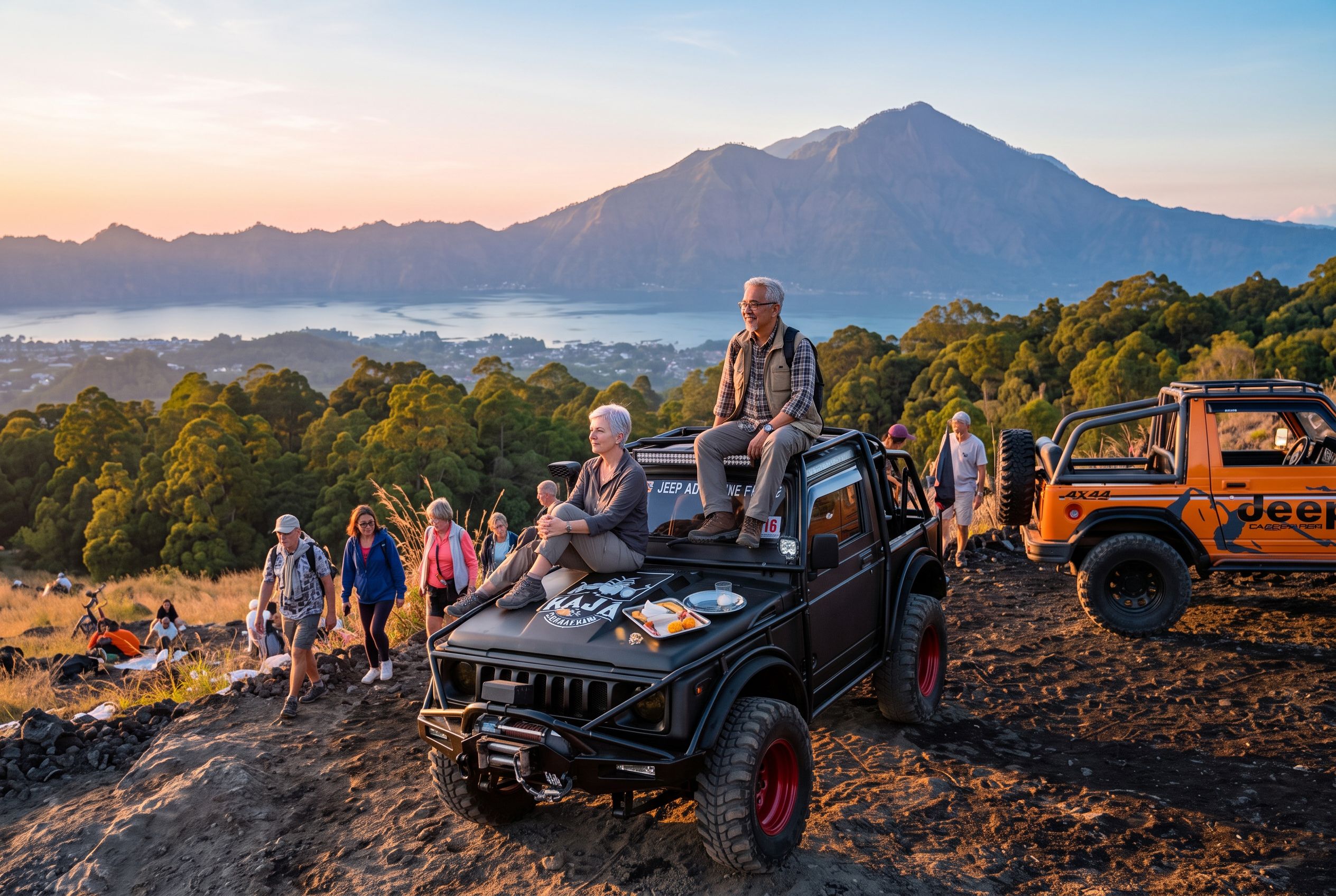
Four-wheel-drive jeeps run on the flank of Mount Batur and reach a sunrise viewpoint commonly around 1,350 to 1,365 metres, roughly 300 metres below the 1,717-metre summit. The jeep replaces the long ascent with a rough off-road ride and is specifically presented as suitable for older family members or people who do not want a strenuous climb.
Published descriptions say 4WD vehicles reach a sunrise viewpoint on the mountain but generally do not drive to the summit. One account says the jeep goes approximately halfway. Reddit reports indicate jeeps generally reach a lower sunrise viewpoint, roughly halfway to 60% of the route in one discussion, rather than the summit itself. Jeep tours are advertised by commercial operators, but no single official authority or definitive operator site is established by the available results.
The view is lower and the experience is different. It omits the summit achievement and much of the quiet walking, but still provides views toward the sunrise, Lake Batur and volcanic terrain. Travel guidance specifically identifies the jeep as the safer option for people with heart or breathing problems, significant knee trouble, poor balance or unusually low fitness.
The ride is not completely effortless. Recorded traveller feedback describes the jeep as bumpy and notes that the wind made the early-morning ride colder than expected. Jeeps are open-topped, the road is rough, and passengers remain outdoors in the cold before sunrise.
How do you book the jeep, and what should you check?
Book through a reputable local operator or hotel desk, and put your questions in writing before paying.
Published descriptions place jeep departure from Ubud at about 3:15 a.m., with the hiking option generally requiring an earlier pickup. Some tours still collect guests around 3:00 a.m., and the ride can be rough and cold.
Jeep pricing is published at approximately IDR 500,000 to 800,000 per person in one guide, with entrance fees and inclusions varying. One published Ubud-area itinerary lists IDR 650,000 per person for two to four people, IDR 550,000 for groups of five or more, and IDR 1,150,000 for one person, with Ubud transfer not included in that example. A Viator-listed Mount Batur jeep excursion was advertised from US$21 per person, while another was listed from US$20; these are marketplace prices and may change.
Ask exactly where the jeep stops: summit, sunrise viewpoint or lower trail, since forum descriptions differ. Some products called "jeep tours" include an optional or short walk, while others drive directly to a viewpoint. Confirm whether the quoted price includes transfers, entrance fees, breakfast, the black-lava field visit and any walking required after the vehicle stops. One discussion describes a jeep covering the more troublesome lower climb followed by approximately 40 minutes on foot to the peak; the precise arrangement depends on the operator.
After sunrise, many jeep itineraries continue through the black-lava fields, and some add Toya Bungkah hot springs. Tripadvisor's Mount Batur Sunrise Jeep reviews consistently highlight safe, friendly drivers, smooth hotel collection, photography, breakfast and views without walking to the summit.
Is the trek accessible for reduced mobility?
No. A Tripadvisor Mount Batur hike listing explicitly states that the activity is not wheelchair accessible. The jeep alternative removes most of the ascent, but it is not a completely accessible transport experience: reviews describe a bumpy, loose, off-road drive, and the sunrise stop may still involve uneven ground.
For the exact Mount Batur sunrise trek, the material does not document step-free access to the trailhead, summit or sunrise viewpoint; lifts, ramps or adapted mountain transport; wheelchair-accessible toilets; reserved seating or rest shelters; a formal porter or personal-assistance service; an official reduced-mobility policy; or guaranteed transfer assistance.
The trek should therefore not be assumed suitable for wheelchair users or for anyone who cannot safely manage steep, loose and uneven ground. A private jeep arrangement may be more realistic, but its accessibility must be checked case by case.
For anyone with significant knee, balance, heart or respiratory problems, or uncertainty about walking downhill in darkness, medical advice is sensible before booking. The published tour material reviewed here provides no senior-specific medical threshold.
Where is the nearest medical help?
Two Ubud clinics are reported with round-the-clock cover. UbudCare Clinic in Peliatan offers 24-hour emergency services, doctors, laboratory services, a pharmacy and an ambulance service at Jalan Raya Teges No. 8, telephone 0811 3977 911. BIMC Hospital Ubud reports a 24-hour emergency department at Jl. Raya Sanggingan No. 21, Kedewatan, telephone +62 361 209 1030.
Reported Bali emergency numbers are 112 for general emergencies, 110 for police, 113 for fire, 118 or 119 for ambulance or medical emergencies, and 115 for search and rescue. A Bali Tourist Police hotline of +62 361 224 111 is also reported.
Staying in Kintamani or near the mountain shortens the pre-dawn transfer and is a recurring recommendation in forum discussions. If one member of a couple wants to hike while the other takes the jeep, that only works if the operator can coordinate meeting points; otherwise a shared jeep is simpler.
What else should fit over-50s know before booking?
The trek is not a quiet wilderness experience. Sunrise groups and summit crowds are part of the normal experience, according to recent travel coverage. One report describes a long line of people ascending in the dark; other discussions mention 100 or more people and narrow sections where hikers must stop to let others pass.
Tripadvisor reports say the summit becomes busy by sunrise, although guides sometimes use quieter trails or arrival timings to reduce the problem. Forum contributors suggest sunset as a quieter alternative, avoiding the overnight departure and the largest sunrise crowds, though this is a different experience and should be arranged with a guide.
Breakfast at the summit is generally a light trail meal rather than a full restaurant breakfast: bread, fruit, chocolate, banana, boiled eggs and hot tea or coffee are recurring descriptions. Reviews praise the fact that food and hot drinks are available while waiting for sunrise. Reports advise carrying water, snacks and an electrolyte drink such as Pocari; one participant said the included food was insufficient.
Guest feedback is broadly positive. Tripadvisor's Mount Batur Adventure page includes reviewers saying they would do the experience again when returning, and other reviews use strong recommendations. The principal service complaint is a single operator-specific case of inconsistent transport coordination on a Kuta pickup, which should not be generalised to every Ubud operator.
If you would rather keep your walking gentle and your mornings civilised, the magazine's guide to seeing Ubud with little walking and out of the heat covers the central alternatives. For the wider region, including other volcano and temple excursions, see day trips worth making from Ubud, which has its own dedicated guide. Booking through a vetted small group is covered in small-group and guided tours of Ubud and Bali.
So should an active over-50 attempt it?
If you walk hills regularly, are confident on loose ground in the dark and can accept a short night, the trek is a reasonable challenge with a guide who paces to the slowest walker. If knees, balance, breathing or sleep are doubtful, the jeep delivers the sunrise without the climb.
Published guidance describes the trek as suitable for reasonably fit adults, and the Asia by Locals Mount Batur sunrise guide notes that lack of sleep and inappropriate footwear are common reasons people struggle. Both are within your control. The operator guidance for older adults on Mount Batur sets out difficulty and expectations in more detail.
Choose a dry-weather window and avoid the trail immediately after heavy rain. Ask for a private guide, a deliberately slow pace and frequent stops. Confirm where the jeep stops if you take that route. Carry layers, a headlamp, water and electrolytes. And check the Nyepi closure dates before you fix your dates, because a volcano does not consult your itinerary.


