
Bali rewards a slower route than the one most first-timers take. A fortnight allows a traveller in their fifties or sixties to link the cultural heartland at Ubud with a southern beach base, the calm east-coast village of Sanur, the rice-terrace country around Sidemen and the diving coast at Amed, and still leave room for a northern or island add-on. The whole journey runs by private car and, where the plan crosses water, by boat. Nothing here depends on scooters, night driving or long unbroken days in the heat.
The logic is simple. Bali's road network is slow and its sights are spread across several regencies, so the sensible approach is to move base every few nights rather than commute from a single hotel. Each stop below has its own dedicated guide on this site for the detail; this article is the spine that holds them together.
How many days in Bali is enough for a two-week trip?
Fourteen days is the practical figure for a multi-base Bali journey aimed at travellers 50-70. It allows three or four nights in Ubud, two or three on the south coast, two in Sanur and three or four across the east, with a night or two spare for a northern or island add-on. Ten days works only if one region is dropped.
What the material does support is the shape: Ubud alone justifies more than a single day, and a forum itinerary discussion warns that traffic can be severe, which argues against day-tripping from one base to everything else.
A ten-day version keeps Ubud, Sanur and the south coast. A fourteen-day version adds Sidemen and Amed, which is where the trip becomes genuinely varied rather than a beach holiday with temples attached.
What does a two-week Bali route for over-50s actually look like?
The route runs airport to Ubud, Ubud to the south coast, south coast to Sanur, Sanur east to Sidemen and Amed, then back west. Each leg is a single car transfer of between 28 and 48 kilometres, and no leg needs to be driven in the dark.
Ubud sits inland in Gianyar Regency, roughly 42 km north of I Gusti Ngurah Rai International Airport by road, a drive of about 35 minutes with clear roads. In practice the airport run commonly takes 60 to 90 minutes and can stretch further in congestion, so a pre-booked private transfer is the sensible arrival. Grab and Gojek operate from designated airport pick-up areas, but vehicle accessibility is not established.
The sequence below keeps the longest drives early in the day and puts a rest day after each move.
| Base | Nights | Why here |
|---|---|---|
| Ubud | 4 | Palace, water temple, Monkey Forest, museums, rice terraces |
| South coast (Seminyak or Uluwatu) | 3 | Sea-level rest, sunset, beach clubs |
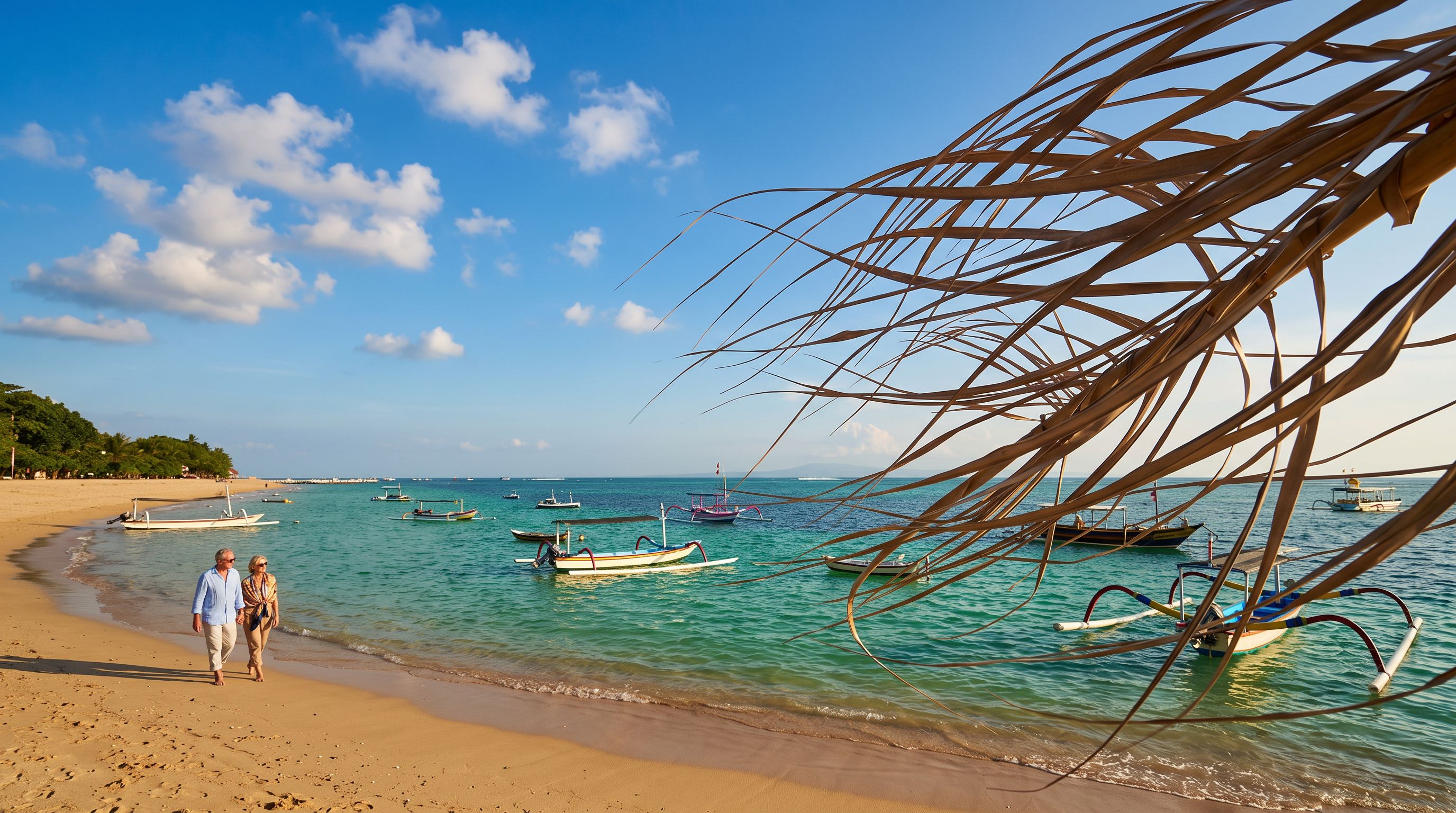
| Sanur | 2 | Flat beachfront promenade, boats to the islands |
| Sidemen and Amed | 4 | Rice terraces, quieter roads, snorkelling coast |
| Spare | 1 | Northern add-on or weather buffer |
 AI-edited
Why does Ubud deserve the first four nights?
Ubud suits a car-based cultural itinerary with short, selective walks rather than a walking holiday. The central sights sit close together, but pavements, temple steps, uneven paths, heat and traffic make independent walking tiring for many older visitors. A private car and driver is repeatedly described as the most flexible option.
The central cluster is compact. Ubud Palace to the Monkey Forest entrance along Jalan Monkey Forest is approximately 1.5 km, or about 20 minutes on foot before heat, traffic and stops are counted. One guide recommends the centre between 07:00 and 09:30, before tour buses arrive. The art market on Jalan Raya Ubud, directly opposite the palace, is fullest in the first hours after dawn and thins by 8:00, with souvenir stalls generally open between 8:00 and 10:00 and closing between 17:00 and 18:00, according to the Visit Bali Guide art market page.
Outlying sights need the car. Tirta Empul is about 30 minutes from Ubud by car according to Indonesia's tourism portal as quoted, and approximately 17 km by road in clear traffic by another reading. Tegallalang's rice terraces charge about IDR 50,000 at the gate, with a suggested quiet window of 07:30 to 09:00. The gentler and fuller options on the terraces are covered in the guide to Ubud's rice terraces.
For travellers who want to limit walking and stay out of the midday heat, seeing Ubud with little walking sets out the short-loop version. Day trips beyond the town, including temples, volcanoes and waterfalls, are covered separately in day trips worth making from Ubud.
How do the transfers between bases work?
Every leg of this route is a single private-car transfer. Ubud to Sanur is 28 km by road, about 30 minutes with clear roads. Ubud to Seminyak is 39 km, about 35 minutes with clear roads. Ubud to Uluwatu is 47 km, about 40 minutes with clear roads. All assume free-flowing traffic.
Those figures are measured road distances on the actual network, and they assume no stops and no rush-hour crossings. Treat them as the floor, not the plan. A forum discussion describes the drive from Ubud to the coast as approximately one hour but explicitly qualifies this by traffic, and a traveller who stayed three nights in Ubud and five in Uluwatu reported the transfer taking about four hours.
Book each transfer through the hotel or a driver known to it. Around central Ubud, including near Ubud Palace, pick-up restrictions or resistance may make a pre-arranged hotel car more dependable than a ride-hailing app. One rural property is reported by guests as channelling taxi arrangements through local services, which is worth knowing before you rely on an app for a 6am departure.
Should the south coast come before or after Ubud?
The south coast works best as the second base, after Ubud. It gives a sea-level rest after the cultural mornings, and it is where a forum itinerary suggests travelling from Ubud to Seminyak or Canggu for lunch by the sea, an afternoon of rest and sunset, usually around 6:00 to 6:30pm.
Both Seminyak and Canggu are described in the same discussion as beach destinations with cafés and beach clubs rather than secluded coastal bases. That matters for expectations: this is the sociable, built-up stretch, not a quiet cove. A traveller who wants the water should note a report from Canggu that the water was beautiful but the currents strong.
Uluwatu sits 47 km from Ubud by road, about 40 minutes with clear roads. One longer itinerary began with several days in Uluwatu specifically to relax after a 24-hour journey before moving on through Canggu, the Nusa islands and Ubud, which is the reverse order and equally workable if you would rather decompress at the coast first.
What makes Sanur a good two-night stop?
Sanur offers the easiest walking of the trip. Its beach and boardwalk extend far enough to see the main areas in about an hour, with a walking trail running the length of the beach. It is also the practical departure point for boats to the Nusa islands.
Ubud to Sanur is 28 km by road, about 30 minutes with clear roads. Two nights is enough to use the promenade properly, and the same forum advice recommends rising by 6am for sunrise.
Sanur's flat seafront is the reason it earns a place in a trip built around limited walking. It also functions as the buffer between the cultural interior and the east, so the drive onward to Sidemen or Amed starts from the coast rather than from the hills.
How should the east, Sidemen and Amed, be handled?
Treat Sidemen and Amed as one eastern block of three or four nights, with Sidemen for the rice-terrace country and Amed for the coast.
Sidemen sits in the terraced interior of Karangasem Regency, and Amed on the northeast coast. The two are usually paired because they are reached on the same loop. Neither is documented with the level of place-by-place detail available for Ubud, so this guide keeps to the shape of the stay rather than the contents of each day.
Ubud to Mount Batur is 48 km by road, about 60 minutes with clear roads, but a Reddit itinerary report calls the sunrise hike underwhelming and says the writer would skip it. The Mount Batur sunrise question is examined on its own terms for active over-50s.
Is a northern or island add-on worth the extra night?
Yes, if you keep one night spare. The Nusa islands are reached by boat from Sanur, which makes them the simpler add-on. A northern loop by car is the alternative.
The island option fits naturally into the Sanur stop, because Sanur is where the boats leave. The northern option fits at the end of the eastern block, returning west afterwards. Either way, keep the spare night at the end of the trip rather than the middle, so a delayed crossing or a wet day does not cascade through the rest of the itinerary.
How should heat and pace be managed across two weeks?
Build the day around two active windows, early morning and late afternoon, and keep the middle of the day indoors or in the water. Ubud's daytime temperatures sit around 27 to 31°C, with annual averages close to 28°C, and humidity is high year-round.
Rainfall, not temperature, is what changes across the year. Ubud's drier period, broadly April to October, is described as the most popular tourism period, with June to September the strongest weather window, according to Bali.com's Ubud weather page. July and August are identified as peak tourist months, while September is described as drier with fewer visitors than July and August. The wet season runs roughly November to March, with the wettest conditions usually in January or December depending on the dataset.
For a two-week trip, that argues for May, June or September. August is the driest but busiest month.
What practical arrangements should be made before leaving home?
Three things: pay the Bali tourist levy, book a private transfer from the airport, and confirm your hotel's vehicle access. International visitors pay IDR 150,000 through the official Love Bali system, separate from attraction admission and applying island-wide, including Ubud.
The levy does not cover Ubud Palace events, the Monkey Forest, temples, museums or rice-terrace charges. Attraction fees are separate and vary: the Monkey Forest charges IDR 130,000 for adults and IDR 100,000 for children aged 3 to 12, with hours of 09:00 to 18:00 and last admission at 17:00. Ubud Palace daytime courtyard access is reported as free, with evening dance performances generally around 19:30 and tickets reported at IDR 100,000 to 150,000.
On health, UbudCare Clinic 24 Hours in Peliatan reports 24-hour emergency care, doctors, laboratory services, an ambulance and an on-site pharmacy. BIMC Ubud Medical Centre in Kedewatan states that it operates 24 hours daily and provides emergency care, pharmacy support and ambulance transfers. The nearest documented 24-hour hospital is RSUD Gianyar, approximately 13 km east of Ubud.
On mobility, accessibility is generally very limited across Indonesian public transport, lodging, communications, information and infrastructure, according to the U.S. State Department's Indonesia guidance. Ordinary taxis and ride-hailing vehicles are not established as wheelchair-accessible. Ask the hotel to confirm the vehicle can carry any mobility equipment in its required configuration.
On timing, Nyepi, Bali's Day of Silence, stops normal activity across the island for about 24 hours, including transport, sightseeing and evening performances. The date changes each year according to the Balinese calendar, so check it before fixing your dates.
Where should over-50s stay in each base?
In Ubud, choose a property with easy vehicle access and confirm the stairs. Tripadvisor's Ubud listings carry a municipality-level warning that some properties require substantial walking and stair access because they follow the contours of valleys and ravines. This applies to Ubud generally, not to every named hotel.
Reviews across several Ubud properties show staff working around stairs rather than eliminating them. At The Ubud Village Resort & Spa, staff reportedly helped with first-floor breakfast seating and arranged buggy access as close as possible when walking was difficult. At The Udaya Resorts & Spa, staff carried luggage and offered room service when a restaurant route included several stairs. At Kappa Senses Ubud, staff moved a massage appointment to a lower-floor room for a guest who could not climb stairs. Each of these is a service response, not evidence that the property is step-free.
The practical request when booking is a ground- or lower-floor room, with the bathroom design confirmed directly. The available reviews do not consistently document lift availability or genuinely accessible walk-in showers for the named properties.
For the south coast, Sanur and the east, the same principles apply: vehicle access, a lower floor, and confirmation of the route from room to restaurant.
What else should a first-time over-50s visitor know?
Bali is workable for older travellers who plan around the roads and the heat. The main hazards documented for Ubud are traffic, uneven or missing pavements, obstructed walkways and poor lighting outside the central area, with petty theft among the local risks reported.
At the Sacred Monkey Forest, macaques may steal bags or loose belongings and may bite. Keep bags closed, do not carry food openly, and secure glasses and valuables. A calm reported period is 09:00 to 10:00.
Living temples may restrict access during ceremonies, and inner sanctums are generally reserved for worshippers. Check at the entrance on the day. Odalan, a temple anniversary, falls every 210 days, and Galungan and Kuningan occur twice yearly.
For emergencies, sources cite 112 for general emergencies, 110 for police, and 118 or 119 for ambulance or medical emergencies. Because published guidance is inconsistent, confirm the applicable numbers with your hotel on arrival.
Rates quoted anywhere in this guide are indicative and vary by season and booking channel.


