
The Dolomites reward a very specific kind of family holiday: one where the grandparents set the pace and the grandchildren get the altitude. The formula that emerges from the official visitor material is consistent. Ride a lift up, walk a short and level path, let the children loose on a playground or an alpine coaster, eat at a mountain hut, and ride back down. Nothing about that requires fitness, stamina or a head for exposure. It requires choosing the right valley and the right lift, and knowing which of the region's 36 accessible trails and 13 lift-served viewpoints actually suit a mixed-age group.
This guide covers the areas where that formula is best documented: Seiser Alm (Alpe di Siusi), Val Gardena, Val di Fiemme, San Martino di Castrozza and the lake country around Braies. It leaves out the long traverses, the via ferrata and the multi-day hut treks, which have their own dedicated coverage. What follows is what the operators and authorities actually publish, so that a grandparent can plan a week that works for a seven-year-old and a seventy-year-old on the same afternoon.
Are the Dolomites suitable for children?
Yes, and the region publishes the infrastructure to prove it. The UNESCO Dolomites accessible-trails programme lists 36 routes and 13 panoramic viewpoints reachable by fully accessible lift systems, explicitly designed for people with limited mobility, older visitors and families with small children. Beyond that, the valleys hold playgrounds, alpine coasters, farm visits and short lake circuits.
The accessible-trails programme is a coordinated effort between the UNESCO Dolomites Foundation and local accessibility associations, and it is the single most useful planning document for a multigenerational trip. The routes span forests, lakes, valleys and high plateaus across the nine mountain systems that make up the World Heritage site. Each trail comes with a technical sheet, a map, GPS coordinates and environmental detail, so a family can judge in advance whether a route matches the slowest member of the group.
That last point matters more than it sounds. The Dolomites do not publish one region-wide difficulty standard. The UNESCO route sheets are the closest thing to a common language, and they are worth reading before anything is booked.
Which base works best for grandparents and grandchildren?
Ortisei in Val Gardena and the Seiser Alm plateau above it are the most consistently recommended bases for a multigenerational group. Ortisei combines a walkable village with lift access straight to the meadow, while Seiser Alm offers flat terrain, benches and accessible facilities at the key stations. Corvara and San Martino di Castrozza are the alternatives.
The case for Ortisei is practical. The village sits at the foot of the Alpe di Siusi cable car, so a grandparent can be on the high meadow within minutes of leaving the hotel, without a car or a long transfer. Val Gardena also publishes a barrier-free lift network with accessible viewpoints and benches in the villages, along the promenades and on the higher hiking trails. For a family splitting up during the day, that means one group can ride up while another stays in the village square.
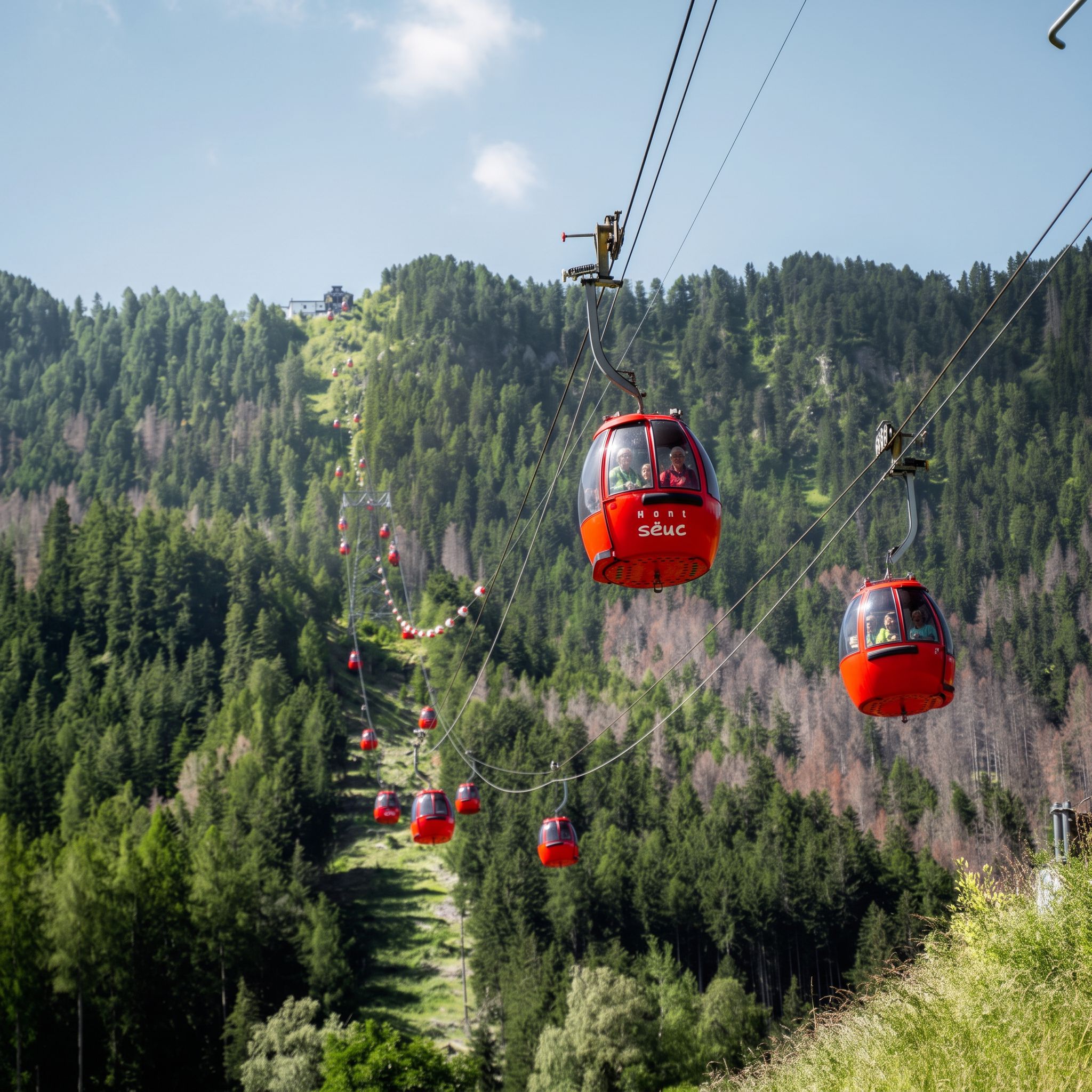
Seiser Alm itself is described by the operator as the largest high alpine meadow in Europe, with barrier-free paths crossing it and accessible toilets at key stations and villages. The ropeway page notes that the lifts make it possible for people who cannot manage long distances on foot to explore the entire plateau, and that all ropeways carry pushchairs. That single sentence is the most useful line in the whole research file for a grandparent travelling with a toddler.
 AI-edited
Corvara, Alta Badia and La Villa are cited as family-friendly and well placed for the major passes. San Martino di Castrozza, further south, has its own lift system and a free playground at the top of the Tognola gondola. The one piece of forum advice worth repeating is to hold a single base for five nights rather than moving between valleys, because the transfers eat the mornings.
What do the lifts and fares cost?
Fares are set operator by operator, and senior reductions are not uniform across the Dolomites. The clearest published senior rate is the Seiser Alm cable car, where adults born in 1960 or earlier pay €18 one way and €26 return in summer 2026. Family tickets and multi-journey passes exist alongside it.
The Seiser Alm cable car publishes its 2026 summer season as running from 22 May to 2 November 2026. In that window, the standard adult fare is €21 single and €30 for ascent and descent, while a family ticket defined as two adults with their children born after 1 January 2008 costs €46 single and €65 return. A three-return-journeys-per-season pass is published at €73 and is non-transferable. Children under eight born after 1 January 2018 ride free, and juniors under 18 pay a discounted fare.
Val Gardena publishes summer 2026 operating dates for its main gondolas: Ortisei to Furnes runs 22 May to 2 November 2026, Ortisei to Alpe di Siusi runs 1 May to 2 November 2026, Dantercepies I and II run 12 June to 4 October 2026, and Forcella Sassolungo runs 30 May to 11 October 2026. Those dates are what make a single-base stay work: whichever week a family picks, at least two lifts into the high country are likely to be running.
| Lift | Summer 2026 window |
|---|---|
| Ortisei to Alpe di Siusi | 1 May to 2 November 2026 |
| Ortisei to Furnes | 22 May to 2 November 2026 |
| Forcella Sassolungo | 30 May to 11 October 2026 |
| Dantercepies I and II | 12 June to 4 October 2026 |
The Dolomiti Supersummer Card for Val Gardena is published at €415 for adults, €290 for juniors under 18 born after 1 January 2008, and €210 for children under eight born after 1 January 2018. The general Dolomiti Supersummer reduction page gives €205 for children born after 1 January 2017. These are seasonal cards, so they only make sense for a long stay. For a week, day tickets bought at the valley stations are the simpler route.
One caution on figures. A Dolomites panoramic-routes guide gives indicative gondola prices of roughly €36 to €42 for a funivia and €28 to €32 for Seiser Alm round trips, but presents them as estimates rather than official tariffs. Rates are indicative and vary by season and booking channel, so the operator's own page is the one to check before travel.
Which easy walks suit both generations?
The best-documented family walk in the Dolomites is the circuit of Lago di Braies, a 3.6 km loop on a mostly flat path suitable for strollers and people with reduced mobility. On Seiser Alm, barrier-free paths cross the meadow itself. Both allow a grandparent and a grandchild to walk the same route at the same pace.
Lago di Braies (Pragser Wildsee) is described in the family guide material as one of the most beautiful walks in the Val Pusteria and suitable for all ages, requiring no special fitness. The lake has no entrance fee. Parking at Parcheggio Lago di Braies varies by season and time, with roughly €30 per day in high season and cheaper or free rates for a short off-peak stop. The lake itself is open 24 hours a day, year-round as a natural site, but road access can be restricted in peak season and parking fees may apply in high season.
On Seiser Alm, the accessible paths are the point of the plateau rather than an add-on. The meadow is flat, the trails are wide, and there are benches and accessible toilets at the key stations and villages. A family can walk for twenty minutes, sit, walk another twenty, and reach a hut for lunch without ever gaining serious altitude. The UNESCO route sheets for the wider network include stopping points with access for all, which is exactly the detail a grandparent needs when planning a morning.
Elsewhere, the Dragon Forest in Val di Fiemme is an easy 1.4 km flat thematic ring path for children and families. The Balcony over the Dolomites at San Martino di Castrozza can be reached in about 15 minutes from the lift and is suited to a baby carrier, though not to pushchairs. That distinction is worth holding onto: a path can be short and still be unsuitable for wheels.
Where are the playgrounds and alpine coasters?
The Dolomites have playgrounds at the top of several cable cars and at least one alpine coaster in Val di Fiemme. The Alpine Coaster Gardonè in Predazzo runs daily from 14 June to 14 September in summer 2025, with a published 2026 start of 13 June. Fares are €6 for adults and €4.50 for children aged 8 to 17.
The Gardonè coaster is the most concretely documented family attraction. It operates in summer and winter, and only when weather conditions permit. Combined cable-car-and-coaster tickets are published at €25 for adults and €18.50 for children and young people aged 8 to 17, and children under eight ride free. The coaster follows the operating seasons of the Predazzo-Gardonè cable car, which is closed in spring and autumn, so a family visiting in late September should not count on it.
Playgrounds are spread across the valleys. The Alpe delle Marmotte park at Tognola in San Martino di Castrozza is a free playground open to all, with slides, nets and tunnels. Valdaora-Olang has a forest playground combined with a water and climbing world. The Furnes-Seceda area has playgrounds at the top of the cable cars. Val Gardena, Val di Fassa, Val di Fiemme, Val di Funes and Dobbiaco all appear in the family guide material with playgrounds or adventure parks.
Accessibility at these sites is not uniform. A family travel guide notes that some playgrounds and adventure parks in the Dolomites offer accessible features, but that users should check ahead because accessibility varies by site. That is the honest position: the region publishes the existence of the playgrounds, not a step-free guarantee for each one.
Can grandparents and grandchildren do a farm visit?
The Dolomites region offers farm stays and agritourism experiences where children can connect with animals, learn about sustainable living and eat home-cooked local cuisine. This is documented as a broad regional offering rather than a single-property listing, so the specific farms need to be identified valley by valley.
That distinction is worth stating plainly, because it shapes how a family should plan. The regional guides describe the category, not the individual farm. A grandparent who wants a morning of animals and a farm lunch should ask the local tourist office in the chosen valley for the farms currently accepting day visitors, rather than assuming a farm visit can be arranged from any base.
What the region does document well is the mountain hut as a family stop. Rifugi on the main routes serve food on the trails, and the atmosphere and meals are as much the appeal as the walking. For a grandparent, a hut lunch is the natural midpoint of a lift-assisted morning: it breaks the day, provides a toilet and a hot meal, and gives the children somewhere to sit before the descent.
For the cultural side, the Museum Gherdëina in Ortisei covers Val Gardena's Ladin history, woodcarving and natural history. Adult admission is €10 and senior admission for those aged 65 and over is €8. The museum does not document wheelchair access or step-free access, so a family with mobility needs should confirm directly before visiting.
What about museums and weather days?
Two Messner Mountain Museums sit within reach of a family base, and they differ sharply in suitability. MMM Corones is documented as suitable for disabled visitors and opens with the cable cars, running 10:00 to 16:00 daily with last entry at 15:30. MMM Dolomites at Monte Rite is explicitly not suitable for disabled visitors.
MMM Dolomites on Monte Rite opens from 1 June to 30 September, 10:00 to 17:00, with last entry at 16:30, and is closed on Tuesdays. Large trekking backpacks and hiking poles are not permitted, dogs are not allowed, and flash photography is prohibited. The senior fare for those aged 65 and over is €10 against €12 for adults. Given the explicit note that it is not suitable for disabled visitors, it is not the natural choice for a group that includes anyone with mobility limitations.
MMM Corones is the better wet-weather option for a mixed-age group. It is suitable for disabled visitors, opens with the cable cars and runs 10:00 to 16:00 daily with last entry at 15:30. It is not reachable by car, so the visit is tied to the lift timetable. The concession fare is €12 against €14 for adults.
Neither museum publishes booking, cancellation or assistance terms. A family planning around a weather day should contact the museum directly rather than relying on walk-up entry.
What should grandparents know about pacing and safety?
The strongest pattern across the official family pages is a lift up, a short walk, a playground or hut stop, and a lift down. The local emergency number documented for the Dolomites is 112 for mountain rescue and urgent medical emergencies. For the Veneto Dolomites, the health emergency number is 118, active 24 hours a day.
Pacing is the whole game with two generations. The published family material consistently emphasises short lift rides, free or low-effort playgrounds and easy lake circuits rather than strenuous hiking. A day that starts with a gondola and ends with a gondola has a natural exit at any point, which is what makes it work when a four-year-old tires or a grandparent's knee starts complaining.
That is a gap in the published information rather than a statement about what exists. A family should ask the hotel or the local tourist office on arrival where the nearest pharmacy and doctor are, rather than assuming it will be obvious in a mountain village.
On access rules, standard Dolomites hiking and mountain activities require no special permits. EU citizens need standard identification, and non-EU visitors need a valid passport and any visa required by their nationality. The Rifugio Auronzo access road to Tre Cime di Lavaredo operates a reservation system during peak summer weekends in July and August, limiting daily vehicle entries to 300 cars. That applies to that specific access road, not to the Dolomites as a whole.
When should a family avoid the Dolomites?
July and August bring access restrictions and fees on some roads, with Lago di Braies a documented example, and the Tre Cime access road capping entries at 300 cars on peak summer weekends. May, June, September and October are cooler and more changeable shoulder seasons.
For a grandparent planning around school holidays, the practical answer is to go in the shoulder weeks if the grandchildren's term dates allow, and to book the peak weeks with the restrictions already understood. The Seiser Alm road closure between 9:00 am and 5:00 pm during the season actually works in a family's favour: the plateau itself is car-free during the busiest hours, which makes it calmer on foot.
Two events in 2026 are worth checking before booking. The 2026 Biennale Gherdëina runs across three locations in Val Gardena from 31 May to 13 September 2026, with an opening in Ortisei on 30 May 2026. That is not a transport closure, but it is a major visitor event that can affect accommodation availability and crowd levels in summer 2026. Separately, the 3 Zinnen Dolomites area is in an active upgrade phase, with the Helmissimo gondola project at Monte Elmo progressing toward a 2026-27 completion and the older Vierschach-Helm gondola retired to make way for it. Visitors should expect ongoing construction impacts there.
For anyone considering Cortina, press reporting in February 2026 described unfinished cable car work and visible construction around the Olympic site, with organisers asking for temporary school closures because the transport system was under strain. Families planning a Cortina base should check the current access and traffic arrangements locally before travelling.
For a broader look at how the valleys connect over a longer stay, our guide to two weeks across the South Tyrol and the Dolomites sets out a slower route through the same region. Readers who prefer their mountain time on two wheels rather than two feet will find the terrain notes in our cycling and e-biking guide to the Dolomites valleys useful for planning valley-floor days. And for anyone weighing a winter visit with grandchildren, the lift and sledging information in our guide to gentle skiing and rodelbahn in the Dolomites covers the season when the same valleys operate very differently.
How should a family book and plan?
Book lifts and museums individually, because the Dolomites publish no region-wide standard for accessibility, senior fares or assistance. The UNESCO accessible-trails programme is the one coordinated resource, with 36 trails and 13 lift-served viewpoints documented across the nine mountain systems. Everything else is operator by operator.
The UNESCO accessible routes are described as varying in difficulty, with detailed maps and technical sheets so visitors can judge whether a trail matches their ability, as set out on the UNESCO Dolomites accessible trails page. That is the document to read first. It covers the whole World Heritage site rather than one valley, and it is the only place where the region speaks with a single voice about what a mixed-ability group can actually do.
For the family attractions, the regional family pages are useful for identifying what exists without committing to a specific site. The Dolomites family holidays pages cover playgrounds, farm stays and easy excursions across the valleys, including the Valdaora-Olang children's world with its forest playground and water and climbing area.
On booking terms, the picture is patchy. The Seiser Alm cable car page does not document online booking, cancellation terms or staffed assistance beyond priority boarding and ID requirements. The Val Gardena accessibility page does not document booking or cancellation terms for the valley-wide network. The museums do not publish booking or cancellation terms either. The practical approach is to buy lift tickets at the valley station on the day, keep the group flexible, and treat any advance booking as something to confirm directly with the operator.
One final piece of planning information. The Dolomiti Bus network runs shuttle services, including a shuttle for Tre Cime di Lavaredo, and the Skibus service for the 2025/2026 season is active. The Dolomiti Bus homepage does not document a senior tariff or reduced-mobility assistance, so a family relying on buses should confirm both with the operator before travelling.
Get the base right, pick the lifts that are open in your week, and build each day around a short walk and a long lunch. The Dolomites do not ask a grandparent for anything more than that.


