
The Dolomites have a reputation as a road cyclist's theatre, all hairpins and suffering on the passes made famous by the Giro d'Italia. That reputation is deserved, and it is also only half the story. Below the jagged limestone peaks runs another network entirely: mostly flat valley cycle paths, several of them built on the beds of former railways, that carry riders from village to village with barely a climb worth the name. For active travellers in their fifties and sixties who want distance, scenery and a decent lunch without a summit effort, this is the Dolomites that matters.
the Pustertal and the San Candido to Lienz descent, the Val di Fassa and Val di Fiemme path, the Alpe di Siusi loop, and the hillier trails of Val Gardena. Each has a different character, and each suits a different kind of day. What follows is what the operators, tourism boards and route sheets actually publish, so you can match the ride to the rider.
Why are the Dolomites valleys good for older cyclists?
The Dolomites cycling network includes numerous mostly flat valley cycle paths that are easily navigable with e-bikes, according to the official tourism page, and the region's own cycling pages describe valley routes across Val Gardena, Val Pusteria, Valle Isarco and Val di Fassa as manageable with electric assistance.
That framing matters. The Dolomites are superb but not easy unless the route is chosen carefully, and the flat, traffic-light valley bike paths around Val di Fassa, Val di Sole, Valsugana and the Toblach and Cortina corridor stand out in rider reports as the most comfortable options for older cyclists. The climbs, by contrast, can be genuinely tough, and gearing matters more than pride.
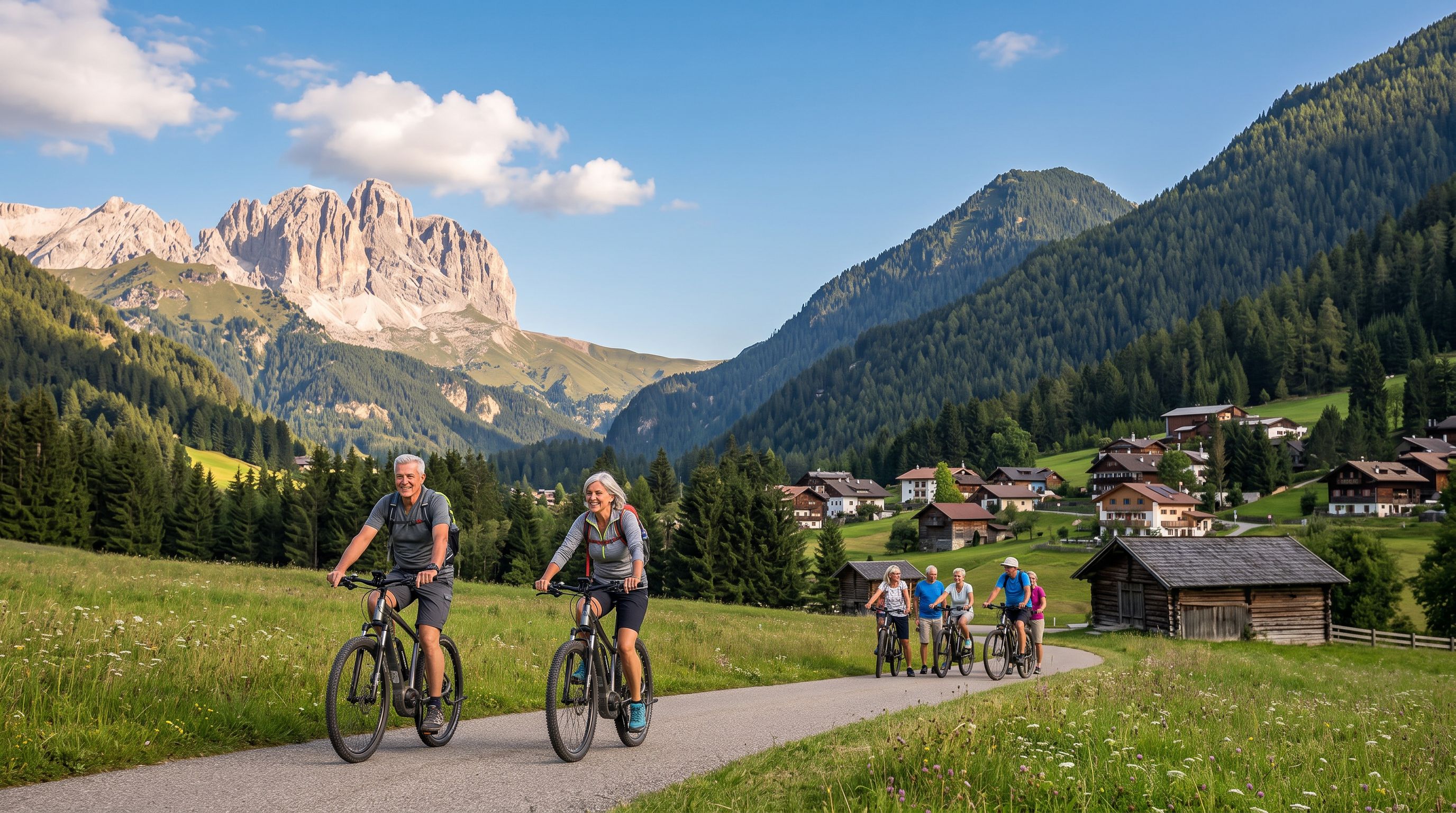
The practical consequence is that you can build a week here without ever riding a pass. Valley paths link towns with train stations, bike hire points and e-bike charging, and the regional cycling pages highlight bike-return logistics by buses, trains and private bike shuttles. That combination, a flat path plus a mechanical way home, is what makes a fifty-kilometre day realistic at sixty-five.
 AI-edited
How hard is the San Candido to Lienz descent?
The Drava Cycle Path from San Candido to Lienz is listed by Südtirol's official cycle-route page as easy, 44.8 km with 0 m elevation gain, and the route leaflet describes a descent from 1,175 m at San Candido to 673 m at Lienz, suitable for all types of bicycle and especially families and beginners.
This is the closest thing in the Dolomites to a guaranteed good day. The published figures vary slightly by source: Südtirol's official route page gives 44.8 km with no elevation gain, the route leaflet gives 44 km with 500 m of descent, and the hire operator Papin Sport, based at San Candido railway station, gives 45.2 km with 9 m of ascent and 519 m of descent. All three agree on the essential point, which is that the ride runs downhill or level almost the whole way.
Rent and Go's published route note describes the ride as descending about 500 m on a gentle 1 to 2 per cent gradient, and one published description says it can be ridden without excessive effort. For a rider in their sixties on an e-bike, that gradient is barely perceptible; on a touring bike it is a long, kind glide.
Two practical details belong in the same breath. The route crosses a state border, so bring an identity card, and the return can be made comfortably by train. Papin Sport specifically offers return transport for rental bikes from Lienz. The leaflet explicitly advises booking bikes a few days ahead, which is worth taking literally in July and August.
| Source | Distance | Elevation | Grading |
|---|---|---|---|
| Südtirol official cycle-route page | 44.8 km | 0 m gain | Easy |
| San Candido–Lienz route leaflet | 44 km | 500 m descent | All bicycle types |
| Papin Sport, San Candido station | 45.2 km | 9 m ascent, 519 m descent | Easy |
Hire points named in a published San Candido rental list are Papin Sport – Rent a bike, Trojer Martin, and Rent & Go Drei Zinnen Punka. The Pustertal tourism board's page on the Drava Cycle Path is the operator-side reference for the route.
What is the Val di Fassa and Val di Fiemme cycle path like?
The official Fassa page describes a cycle and footpath through the Fassa and Fiemme valleys running 48 km from Canazei to Molina di Fiemme along the Avisio river, and the Val Gardena outdoor route page gives the same route as 49.2 km with only 13 m of ascent and 690 m of descent, suitable for families, cycle tourists and e-bike riders.
The two published distances disagree by just over a kilometre, which is the kind of discrepancy that comes from measuring to slightly different endpoints. Either way, the profile is the story: a valley that tilts gently downhill from Canazei toward Molina, with a few short climbs rather than sustained ones. The route passes through forest, meadows and villages including Campitello and Pozza.
One caution is documented and worth carrying into your planning. The same Val Gardena route page says to take extra care in built-up areas, because the cycle path is interrupted there and follows local roads open to traffic. That is normal for an Italian valley path, and it means the flat, protected sections alternate with short stretches where you are sharing space with cars.
Val di Fassa's 2026 press material says the bike season now begins in the second half of April, with the Fassa and Fiemme Cycle Path open as part of the core offer. The same report describes the valley broadening its cycling offer to include road passes, valley cycling, forest-road routes and altitude trails. The tourism board frames the area as combining cycle paths, mountain passes, lifts, guides, rental shops and bike-friendly facilities, set up for mixed-ability cycling rather than pure road racing.
For reference, the road distance from Canazei to Molina di Fiemme is 79 km, about 85 minutes with clear roads and no stops. That is the shuttle or car transfer figure, not the ride.
Is the Alpe di Siusi loop suitable for an e-bike?
Alpe di Siusi is described as a top cycling spot with e-bike and regular mountain-bike hire at the bottom of the Mont Sëuc gondola, and a 24 km loop via Compaccio, the Edelweiss refuge and Saltria. The route is mixed paved, gravel and dirt, with a couple of steeper sections.
This is the ride that sits between the valley paths and the passes. It is not flat throughout, and the surface changes under your wheels, so it rewards a bike with wider tyres and a rider who is comfortable changing gear on loose ground. The source says riders can take the gondola with bikes, which removes the climb to the plateau entirely if you want it removed.
Access to the plateau by road is restricted. The road up to Seiser Alm is closed to private traffic from 09:00 to 17:00 when the cable car is operating. Holders of an official European Disability Card may drive up to Seiser Alm and Compatsch at any time, but only after prior registration and an access permit through the municipal portal.
The Seiser Alm cable car summer 2026 season runs from 22 May to 2 November 2026, daily until 18:00 and until 19:00 in the high season from 7 June to 6 September 2026. The ride from Seis to the Seiser Alm takes about 15 minutes. For those born in 1960 or earlier, the summer 2026 senior fare is €18 one-way and €26 return. Wheelchair users, blind passengers and people with 100% disability travel free, and one source says people with other disabilities and a valid certificate pay the same reduced fare. Discounted tickets can only be purchased at ticket offices; the operator does not document online booking terms or cancellation terms.
Is Val Gardena too hilly for a relaxed ride?
Val Gardena is explicitly described as hillier, with e-bikes recommended to make steep terrain easier, and e-bike and equipment rentals are available at multiple bike-rental stations. The valley's official homepage identifies Rodaval as the cycle path in Val Gardena.
This is the honest answer to a fair question: Val Gardena is the hilliest of the four areas covered here. The valley-wide official page confirms the route exists but does not publish gradient, length or hire-price details on the page captured, so treat those specifics as something to confirm locally rather than something documented in advance.
What is documented is the lift support. The Gardena Card covers lifts in the region, lasts three or six consecutive days, and bike transport costs €5 per bike extra. The Dolomiti Supersummer ticket covers all lifts in the wider network and includes bike transport. That combination lets a rider use the lifts to skip the worst of the climbing and ride the sections that interest them.
Summer traffic in Val Gardena is heavy from mid-July to end-August, and the tourism board advises planning at the start or end of summer. Work is under way to adapt pass roads with dedicated cycling lanes, with some already existing on Passo Sella and Passo Gardena.
Which passes should I leave to the racers?
The Sellaronda is a four-pass circuit on the roads around the Sella massif, and Val Gardena describes the classic pass rides as mountain roads that suit experienced cyclists better than casual riders. The passes are reserved for cyclists only on Sellaronda Bike Day, which happens twice a year, in early summer and autumn.
Outside those event days, the standard Sellaronda routes are mixed with normal traffic. Rider reports describe the Sella Ronda loop and the climbs over Pordoi, Sella, Gardena and Campolongo as highlights, while noting that none of these routes are completely free of traffic, though traffic is relatively light. The climbs around Passo Giau, Passo Valparola and Passo Fedaia are described as worthwhile but many ascents are quite challenging if you are not adequately prepared.
Val Gardena says the Sellaronda tour can be done very comfortably with an e-bike, but riders still need at least a basic technical level. That is a fair summary of the whole pass question: the motor helps, the descending and the traffic do not disappear.
If you want the passes without the cars, the calendar is the answer. Val Gardena names early summer and autumn as the two Sellaronda Bike Day windows. Cortina d'Ampezzo's 2026 notice says Passo Giau, Passo Falzarego and Valparola will close for the Maratona dles Dolomites on 5 July 2026, with reopening after the cyclists pass, and that Passo Falzarego and Valparola in the Municipality of Cortina will be closed on 20 June 2026 for Dolomiti Bike Day, from 9:00 a.m. to 3:00 p.m. The 2024 Alta Badia coverage confirms Sellaronda Bike Day and Dolomites Bike Day continue as traffic-free cycling events on the passes.
Where can I hire an e-bike, and what does it cost?
Hire is documented across the valleys: Alta Badia publishes e-bike sharing at cable-car stations with rental points at Piz Sorega, Piz La Ila and Col Alto, LiveCivetta publishes an e-bike rental point at Pecol next to the cable car and Camping Civetta, and San Candido has three named hire points.
The Alta Badia system is framed as a shared one, allowing pick-up at one lift and return at another. The operator states plainly that an e-bike is not to be treated as a motorcycle and that riders should stay on marked trails. The 2024 Alta Badia report says riders can take e-bikes on some cable cars and chairlifts, and describes guided bike tours with multiple weekly dates and e-bike sharing above 2,000 metres with pick-up and drop-off stations near the Col Alto, Piz La Ila and Piz Sorega lifts.
LiveCivetta's rental point at Pecol, next to the cable car and Camping Civetta, opens on Saturday 31 May. Its published 2026 season prices are given as ranges: E-BIKE FULL from €50.00 to €270.00, E-BIKE FRONT from €40.00 to €180.00, and E-BIKE BIMBO from €20.00 to €130.00, with a supplement of €40.00, €25.00 and €10.00 respectively on the top tier. Accessories including helmets, child seats, backpacks, Nordic walking poles, via ferrata kits and GoPro cameras are also available. These rates are indicative and vary by season, duration and booking channel.
La Mobilite, with its main rental in Pederoa and further points in Val Badia, publishes that you can rent any day of the week during the summer season, that a weekend rental can be collected Friday by 19:00 and returned Monday before 9:00, and that e-bikes can be delivered to accommodation in Val Badia on request. Battery chargers, helmets, backpacks, inner tubes, pumps, padlocks and multi-tools are available. Its theft policy provides for payment of the value of the stolen bike.
Charging is less of a worry than newcomers expect. LiveCivetta says you can recharge e-bike batteries at almost all mountain huts in the area, and La Mobilite says many mountain huts in Val Badia are equipped with chargers of the main e-bike brands or allow you to plug in your own charger over lunch.
When should I ride, and what about traffic?
Mid-July to end of August is the busiest period on Val Gardena's roads, according to the tourism board, and June, September and early July are described as the most practical compromise for open lifts, good weather and fewer crowds.
Season windows are published valley by valley rather than for the Dolomites as a whole. Summer lift operations run from May to November across South Tyrol, Trentino and Belluno, but exact opening dates vary by operator and some services are limited in shoulder months. The Fassa & Fiemme Bike Express runs from May to October. The Seiser Alm cable car runs 22 May to 2 November 2026. Mid June to late September is the operating window published for one guided e-bike traverse in the Dolomites.
Heat is a real planning factor on exposed routes. A summer rider reported 39°C with no shade at all on many mountain passes. Valley paths along rivers and through forest are more forgiving than pass roads, but an early start remains sensible in July and August.
On traffic, the picture is route-specific. The Dolomites cycle path from Calalzo di Cadore to Dobbiaco is described as largely protected and closed to motorised traffic, with an average slope of 1.3. The Valsugana corridor east of Trento was called mostly flat and mostly bike paths without cars. The roads in the Friulian Alps and eastern Dolomites were described as peaceful and in great condition. The passes, as above, are a different matter.
What should I check before booking?
Check the route sheet for the specific path, confirm bike hire a few days ahead in high season, and check whether your chosen lift carries bikes and on what ticket. The UNESCO Dolomites Foundation publishes route sheets in Italian, German and English with technical details, maps and GPS coordinates.
The UNESCO programme documents 36 accessible trails and 13 panoramic viewpoints reached by fully accessible lift systems across the nine mountain systems of the World Heritage Site. Those route sheets are planning support rather than an on-site escort service, and the exact suitability of any given trail depends on the individual sheet, which the source says should be checked route by route.
No pharmacy or medical help is documented for the cycle paths or bike areas covered here, and none of the retrieved valley cycling pages state local emergency numbers. The unified emergency number 112 is documented as applying across the Dolomites and all of Italy, with multilingual assistance. None of the retrieved official valley sources document step-free access, assistance services, seating or other reduced-mobility provisions for these cycling routes or valley bike systems; confirm with the operator if that matters to you.
For those who want the scenery without the saddle, the region's lift-linked terraces and level meadows are covered in our guide to seeing the Dolomites with little walking. Mountain hiking has its own dedicated guide, including half-day hikes in the Dolomites for active over-50s and easy meadow and lakeside walks, and is not covered here.
How do I book hire and plan a day?
Book bikes a few days ahead in peak season, decide whether you want a one-way ride with a train or shuttle return, and confirm the lift's bike policy and ticket before you commit to a route that depends on it.
The San Candido leaflet explicitly advises booking bikes a few days ahead. Papin Sport offers return transport for rental bikes from Lienz, which removes the need to ride back up the valley. On the Fassa and Fiemme path, the Bike Express covers the return leg from May to October. In Val Gardena, bike transport on the Gardena Card costs €5 per bike extra, and the Dolomiti Supersummer ticket includes bike transport.
Alta Badia's e-bike sharing is designed around one-way logistics, with pick-up and drop-off at different lift stations. That model suits riders who want to descend rather than climb, and it is worth asking at the lift station which stations are currently participating.
none of the sources retrieved document over-65 fares or senior reductions for the cycling routes or lifts discussed, and the Dolomites cycling-route pages and the Dolomiti.it e-bike overview are informational route pages rather than fare pages, so no senior fare is documented there. The Seiser Alm cable car senior fare is the exception, at €18 one-way and €26 return in summer 2026 for those born in 1960 or earlier. Ask at the ticket office for anything else.
Rider reports consistently point to a format that works: staying in one base and doing daily loops, or a self-guided point-to-point trip with luggage moved for you. The Corvara area was described as a very good base, and one rider said they would stay longer in the Alta Badia area next time after enjoying the classic passes and the lightly trafficked routes.


