
A fortnight linking Bolzano, the Val Venosta, the Dolomites and Lake Garda works best as a chain of three or four bases rather than a single hotel with long day trips. The published material supports a journey built around cable cars, short plateau walks and low-gradient trails, with trains and buses doing the heavy lifting between valleys. This guide sets out the stops, the nights per base, the transfers and the pace, and points to the dedicated guides for each area.
South Tyrol's official mobility pages state plainly that it is best to travel without a car, and that mountain passes can be reached on foot, by bike, by cable car or by public transport. Regional trains in South Tyrol run on the Brennero–Trento and Malles–San Candido lines, and local buses, cable cars and shuttle services connect valleys, towns and accommodation throughout the province, according to South Tyrol's official tourism and mobility pages. For travellers aged 50-70, that combination is the whole point: the mountains come to you by lift, and the valleys pass by the window.
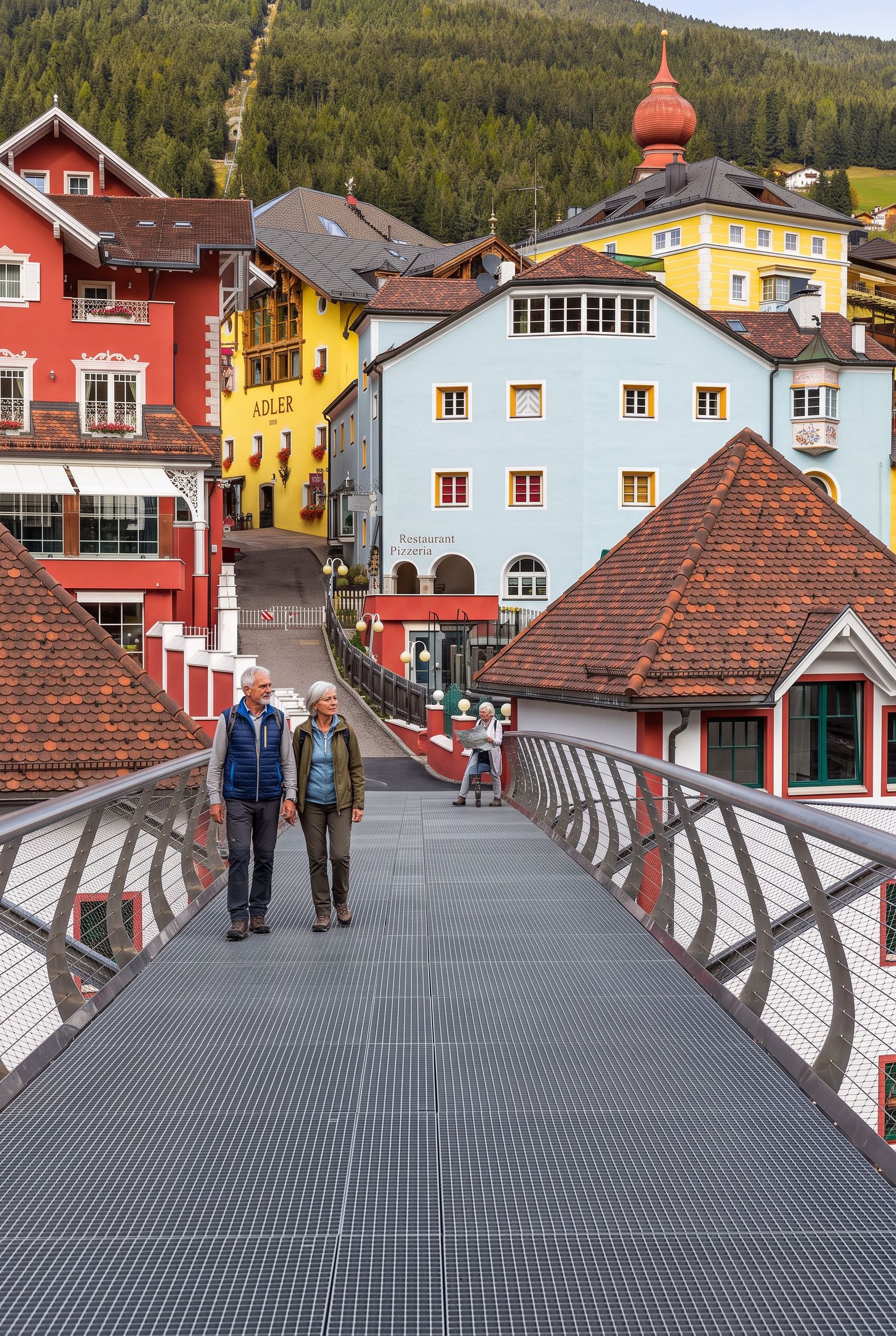 AI-edited
How many bases do you actually need for two weeks?
Three bases cover the ground comfortably: Bolzano or Val Gardena for the Dolomites, a Val Venosta or Merano stop for the western valleys, and one Lake Garda base to finish. Four is possible if you add Cortina, but each move costs half a day in packing and transfers, so fewer bases mean more walking.
The strongest all-round base in the published material is Ortisei in Val Gardena, because lifts leave directly from town and buses link Ortisei, Castelrotto, Selva, Bolzano, Bressanone and Brunico. Siusi and the Alpe di Siusi suit gentle scenic days, and Santa Maddalena in Val di Funes works as a quieter side base, no more than a 50-minute drive from Ortisei.
For the western half, the Val Venosta sits on the Malles–San Candido railway line, which the Südtirol Guest Pass covers for regional trains. Lake Garda closes the loop with warmer air and lower altitude, and it has its own dedicated guide on this site.
How do you get there, and does the train really work?
Bolzano is the rail-transfer hub for the Dolomites region and the place where reduced-mobility assistance is explicitly available at the railway station, according to South Tyrol's official mobility pages. Regional trains are mostly low-floor, many stations have raised platforms and lifts, and buses are barrier-free with ramps.
From Bolzano, the Südtirol Transfer shuttle connects train stations and long-distance bus stops to accommodation on request, and it is described as barrier-free. The Dolomites Region Eggental states that the area can be reached from Bolzano station by bus, taxi or the Südtirol Transfer shuttle. In the Odles Slow Dolomites area, assistance for travellers with reduced mobility is available at Bolzano railway station.
One practical warning from published trip reports: arriving a day early proved wise when a one-day Italian rail strike affected connecting travellers. Build a spare night at the start rather than a tight same-day connection into the mountains.
Where should the Dolomites nights go?
Val Gardena and the Alpe di Siusi carry the strongest senior-access evidence in the published material. The Seiser Alm cable car is documented as fully accessible, carries up to 16 passengers per cabin, and the plateau has barrier-free paths. Allow five to six nights here.
The Alpe di Siusi is identified in official material as the largest high alpine meadow in Europe. One published barrier-free walk runs from the Mont Sëuc cable car station to Hotel Sole: 1.4 km, partly asphalted and partly gravelled, some flat and some uphill. That mix matters. Barrier-free does not mean perfectly flat throughout, and the route page advises wheelchair users to be accompanied so help is available quickly if needed.
Private cars are barred from the Seiser Alm access road from 9:00 to 17:00 during the operating season, according to the Seiser Alm operator. Holders of an official European Disability Card may drive up to Seiser Alm and Compatsch after prior registration and an access permit through the municipal portal.
For lift dates, Dolomiti SuperSummer's own pages state the 2026 summer opening periods by area, including Val Gardena and Alpe di Siusi from 1 May to 2 November 2026, Plan de Corones from 16 May to 8 November 2026, and 3 Cime Dolomiti from 23 May to 8 November 2026. Individual areas open and close on different dates, so check the area you are actually using. For shorter walking days in this valley, see our guide to half-day hikes in the Dolomites for active over-50s.
| Area | 2026 summer season |
|---|---|
| Val Gardena | 1 May to 2 November 2026 |
| Alpe di Siusi | 1 May to 2 November 2026 |
| Plan de Corones | 16 May to 8 November 2026 |
| 3 Cime Dolomiti | 23 May to 8 November 2026 |
| Cortina d'Ampezzo | 6 June to 18 October 2026 |
| Alta Badia | 13 June to 4 October 2026 |
| Val di Fassa | 30 May to 11 November 2026 |
What does the Val Venosta add to the trip?
The Val Venosta gives you the western valleys on a railway line rather than a road. The Malles–San Candido regional train runs the length of it, covered by the Südtirol Guest Pass, and the Mals-to-Merano bike route runs around 60 km on paths. Give it three nights.
Glurns is described in trip reports as tiny and beautiful, and it makes a gentle half-day. The Guest Pass system in the Odles Slow Dolomites area covers regional trains, local buses, the Renon cable car, Meltina, Verano and Colle cable cars, the Renon tram, the Mendola funicular, and the PostAuto Switzerland line between Malles and Müstair. It also includes free admission to the Klausen outdoor swimming pool and one free entrance per card to the Mineral Museum Teis.
The card is personal and non-transferable, valid for the duration of your stay at a participating accommodation, and cannot be purchased. It is digital, and the operator recommends saving it in a smartphone wallet or as a screenshot and activating it via the QR code before each use. If cycling appeals on the flat valley floor, our guide to cycling and e-biking the Dolomites valleys covers the practical side.
How does Lake Garda fit at the end?
Lake Garda works as the decompression week: lower altitude, warmer evenings and a lake rather than a plateau. Two to three nights is enough to close the trip, and the lake has its own dedicated guide on this site covering the individual resorts in depth.
The published material gathered here does not document a single Dolomites-wide or Garda-wide senior fare, and it does not document a region-wide over-65 transport pass for the Dolomites as a whole. Reductions are set by specific operators or areas. The clearest published concession is the Seiser Alm cable car, where people born in 1960 or earlier pay €18 one-way and €26 return in summer 2026, according to the Seiser Alm operator.
For the province-wide picture, südtirolmobil's own pages state that the 65+ pass is for residents aged 65 or over, with annual fees of €153 for ages 65 to 69, €77 for 70 to 74, and €21 for 75 and over. It is valid on regional trains to Trento but not on long-distance or high-speed trains, and bike or pet transport and Nightliner use carry an extra fee. Visitors should not assume it applies to them.
What do the transfers between bases actually look like?
Transfers are short if you sequence the bases geographically: Bolzano to Val Gardena, then west to the Val Venosta, then south to Lake Garda. The one long leg is Bolzano to Cortina, measured at 346 km by road, about 190 minutes with clear roads and no stops.
For the Val di Funes side trip, Brixen station to Santa Maddalena is 19 km by road, about 20 minutes with clear roads. By public transport the same connection runs about 40 minutes with no change on the published weekday timetable for 7 October 2026, operated by altoadigemobilità. Timetables change, so check the operator before travelling.
| Connection | Distance or time | Condition |
|---|---|---|
| Brixen station to Santa Maddalena | 19 km by road | About 20 minutes with clear roads |
| Brixen station to Santa Maddalena | About 40 minutes by bus | No change, weekday timetable for 7 October 2026 |
| Bolzano station to Cortina | 346 km by road | About 190 minutes with clear roads |
Seasonal shuttles fill the gaps that ordinary buses do not: the Alpe di Siusi lines 10, 11 and 12, line 444 from Dobbiaco to Misurina and Rifugio Auronzo near the Three Peaks, line 440 from Passo Monte Croce through Val Fiscalina to Sesto, lines 439 and 442 toward Braies, and the Val Gardena Wanderbus, line 333. These are listed in the Südtirol Guest Pass material. The DolomitiBus network information sets out the Dobbiaco and Sesto lines in more detail.
What pace suits travellers in their fifties and sixties?
Plan around lifts, plateau walks and short valley promenades rather than long ascents. The published sources consistently frame the Dolomites as lift-assisted and short-walk friendly, not uniformly easy on foot. One full rest day in every four is a reasonable rhythm.
Published trip reports describe a deliberately light-on-walking itinerary using cable cars around Siusi and Ortisei and the bus system across the Alpe di Siusi in summer. Another reports an easy 3.5-mile walk at Mont Sëuc taking under 1.5 hours in total.
Kronplatz guidance is worth repeating: easy routes still need checking for exact gradient, surface, weather and obstacles, and suitability depends on the individual mobility aid. The same page directs visitors to the tourist office for current conditions. A documented barrier-free walk at Spiaggetta Ciamaor near San Vigilio runs 1.3 km.
When should you go, and what needs booking?
July and August are the busiest months, while May, October and November often bring limited lift operations and some accommodation closures, according to recorded guidance on the Dolomites. The proper hiking season runs from mid-June to mid-October. Book the Tre Cime access road in advance.
Some access is now controlled. For the Auronzo road to Rifugio Auronzo, a source states that a mandatory online reservation is required and the road is closed to all private traffic except those with a valid booking. For the Braies Valley, one source states a seasonal private-traffic closure from 1 July to 15 September 2026, 9:00 to 16:00, with parking reservation required. The published materials do not provide a single Dolomites-wide entry rule; closures and access conditions are property- or valley-specific.
Expect lift closures or construction around cable cars in places such as Campitello and Val Gardena, according to regional tourism reporting. Expect temporary road restrictions around major events, especially in Val Gardena and Cortina. The Dolomiti SuperSummer card details set out the lift pass products, which are sold as day, multi-day, season and value cards; bicycle transport is included in some products, and Seceda ascent is excluded from the pass.
For winter travel in the same valleys, our guide to gentle skiing and the Rodelbahn for the over-50s covers the season that this itinerary does not.
What practical details should you settle before leaving?
The single European emergency number 112 is stated for the Dolomites region in mountain-safety guidance and works for mountain rescue. In the Veneto Dolomites, the health emergency number is 118 and is described as active 24 hours a day. Exact nearest pharmacies for the named sites are not documented.
South Tyrol's official mountain-pass guidance says safety comes first, recommends checking traffic restrictions and real-time road-work or closure updates before travelling, and notes that winter tyres or chains may be needed on some Dolomite passes. Winter tyres or snow chains are stated as mandatory from 15 November to 15 April on the Great Dolomites Road, and temporary winter closures can occur in heavy snowstorms.
For accessibility questions about specific hotels, restaurants, museums and trails, the "South Tyrol for Everyone" portal is identified as the key source to check actual accessibility. The Seiser Alm region site allows accessible accommodation to be filtered, and the Seiser Alm operator states that people with disabilities can receive discounts or free travel on the Seiser Alm cable car, with free travel for blind passengers, people with 100% disability and wheelchair users, and reduced fares for other disability categories.
Rates for accommodation are indicative and vary by season and booking channel. Cancellation terms for most named places and operators are not documented in the published material; ask the property directly when booking.
What should you expect on the ground?
Expect a region that rewards planning and punishes improvisation late in the season. Lift maintenance, weather and rail disruptions all matter. The Dolomites are spectacularly beautiful, but they are not a place to arrive without a reservation in October.
The Great Dolomites Road, the historic 110-km scenic route from Bolzano to Cortina d'Ampezzo, is spectacular but narrow and steep in places, with hairpin bends and many stops needed for photos and short hikes. One published account reports taking a full day because of stopping at least 20 times. That is a warning for anyone trying to combine driving with sightseeing in a single day.
Hut-to-hut hiking is described as the way forward for hikers in the region and can be cheaper than staying in towns, which suits fit travellers who want to minimise packing and transfers. For a more technical mountain day, our cautious introduction to via ferrata for the over-50s sets out what is involved.
A single Dolomites-wide maintenance or closure calendar is not documented; closures are valley-, lift- or road-specific. A single Dolomites-wide senior-fare system is not documented either. Check the individual operator before you rely on any figure.


