
Hoi An rewards the traveller who slows down. The Ancient Town is flat, compact and, for long stretches of the day, closed to motor traffic, which makes it one of the more forgiving heritage centres in Southeast Asia for visitors in their fifties and sixties. The practical question is not whether you can walk it (you can, mostly) but how to handle the heat, the uneven paving and the short hops out to An Bang Beach and the rice fields beyond the centre. This guide covers the four modes that matter: your own two feet, the three-wheeled cyclo, the Grab app and a private car with driver.
Each has a clear role. Walking suits the core. The cyclo suits a slow circuit when your knees have had enough. Grab suits the beach run and the rainy afternoon. A private car suits a full day out and any journey where you want the door-to-door arrangement settled in advance. What follows is how each works, what it costs, and where the documented gaps are.
Is the Old Town genuinely walkable?
Yes, with caveats. Hoi An's Ancient Town is flat and compact, and the streets are largely pedestrian-oriented during traffic-restricted periods, reported as roughly 9:00–11:00 and 15:00–21:00 or 21:30. Uneven paving, gutters, raised thresholds and steps into historic buildings are documented challenges, and a fully step-free route through the town is not documented.
The core is a UNESCO World Heritage property and the streets themselves carry no ticket. Entry to designated heritage sites does: a 2026 combined ticket priced at 120,000 VND covers five entries selected from the historic houses, assembly halls, museums and the Japanese Covered Bridge. Tickets are reported as available from booths on Nguyen Thi Minh Khai and Tran Phu streets. The bridge, the town's centrepiece, reopened in early August 2024 after a restoration costing more than VND20 billion.
What this means in practice is that you plan around surfaces rather than distances. The flatter areas around the heritage centre are more manageable, but published accessibility guidance identifies uneven surfaces, bridge approaches, crowds and flood-prone routes as barriers. Historic buildings may have narrow doors, raised timber thresholds, steps and upper floors without lifts. The town does not publish a step-free route map. Ask at your hotel about the specific buildings you intend to enter.
 AI-edited
When do the traffic restrictions apply?
Motorised vehicles are excluded from the central pedestrian zone during designated daytime and evening periods, reported as approximately 9:00–11:00 and 15:00–21:30, though published times vary slightly by source and season. Pedestrians, bicycles and authorised cyclos may continue to enter. Cars and Grab vehicles stop at the perimeter during those hours.
This is the single most useful thing to understand before you book a car or call a Grab. During restricted periods, a driver cannot reach a historic-house door. You will be collected at the edge of the pedestrian zone and walk in from there. The same applies in reverse when you leave.
The restrictions are part of the town's pedestrian-oriented visitor programme, and they are operating rules rather than a closure of Hoi An itself. Individual heritage houses, museums and attractions keep their own hours and may close occasionally for conservation. The town does not publish a consolidated list of current closures. Check locally on the day.
Cultural programming can also affect movement. Hoi An's official creative-city platform reports continuing events including the monthly "Hoi An Legendary Night" on the 14th night of the lunar month. Those evenings draw larger pedestrian crowds and make central streets busier and less convenient for cars and scooters. If your visit coincides, see our guide to the Hoi An Lantern Festival and the year's rhythms for how the calendar shapes the town.
How do cyclo rides work, and what do they cost?
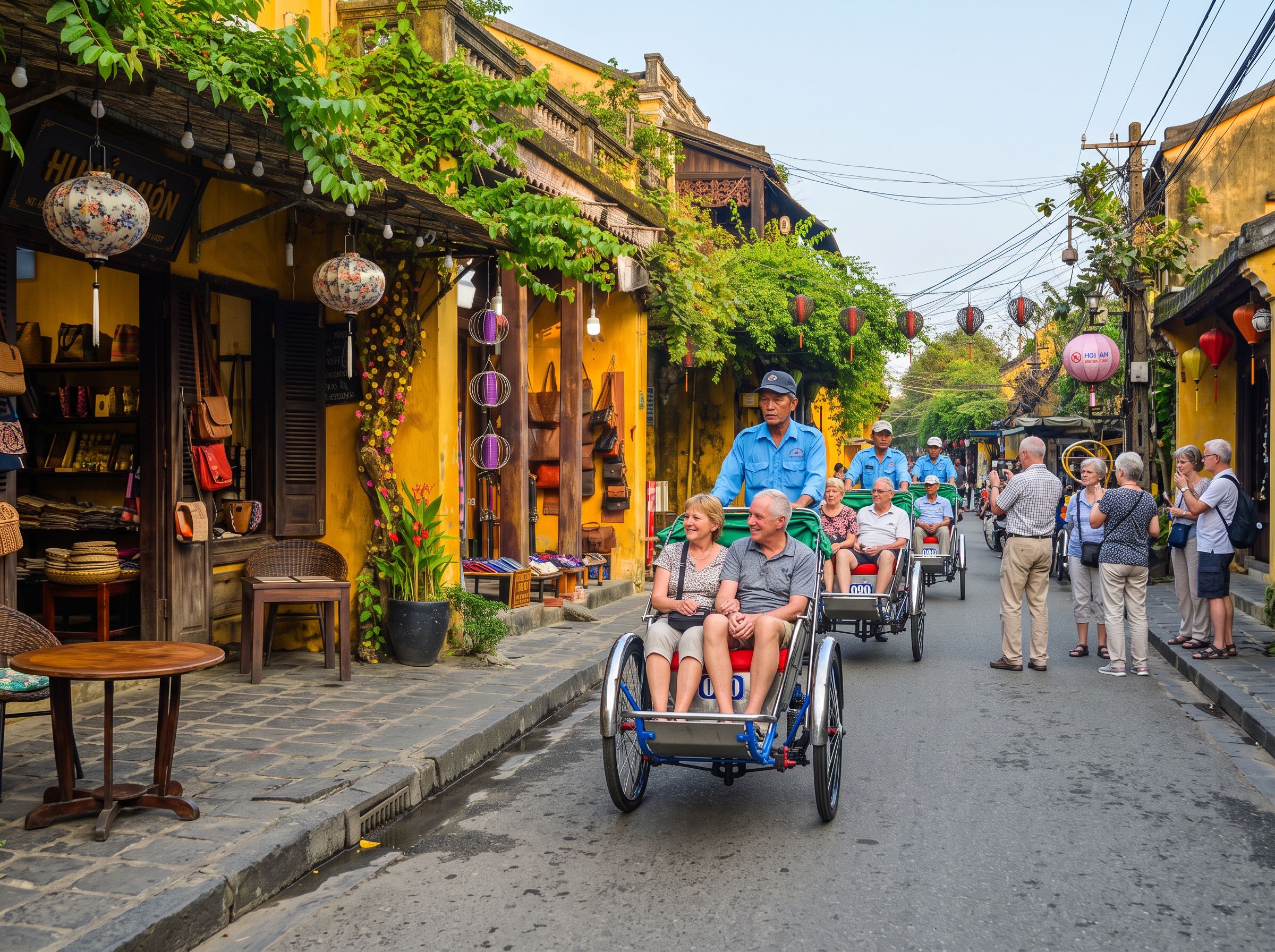
Cyclos operate in the Ancient Town and suit a slow sightseeing circuit on the pedestrian streets. A town circuit is commonly quoted at about 50,000–100,000 VND, with the fare agreed before boarding. Reported prices range from roughly 40,000–80,000 VND for a short ride to 150,000–200,000 VND for a roughly 20-minute loop.
The cyclo is the passenger-in-front, driver-pedalling-behind tricycle you will see throughout the centre. It is well matched to the pedestrian periods, when the streets are quiet and the pace is naturally slow. The critical rule, repeated across published local guidance, is to agree the complete fare before you get in. Ask whether the quoted price covers the full circuit or a one-way transfer, and confirm any waiting arrangement.
A step-free boarding arrangement or a wheelchair-compatible cyclo is not documented. The retrieved forum material contains no sufficiently specific firsthand account from Hoi An describing a cyclo ride, its price, route, comfort or safety. the cyclo is a documented and widely used option, but its suitability for a traveller with significant knee or hip limitations is not established in the available material. Inspect the vehicle before committing, and if the step up is too high, walk away.
How does Grab work in Hoi An, and what will it cost?
GrabCar and GrabBike operate across Hoi An and are particularly useful for An Bang Beach, rainy weather, luggage and late-night travel. The app displays the fare before you confirm, which removes the need to negotiate. During vehicle-restricted periods, drivers collect passengers at the edge of the Ancient Town rather than at a historic-house door.
Booking requires the app. You enter the destination, the upfront fare appears, and you confirm. Published estimates for a GrabCar or taxi from Hoi An to An Bang Beach range from 50,000–100,000 VND one way, depending on the exact pickup point and traffic. GrabBike, the motorbike service, has reported short-hop prices beginning at roughly 12,000–25,000 VND. GrabBike is not an equivalent accessible transport option; it is a motorbike.
One source reports possible surge pricing during approximately 11:00–13:00 and 18:00–20:00. That is a fare pattern rather than a confirmed crowd measure, but it is worth knowing if you are flexible about timing.
Forum accounts are broadly positive. A traveller who had spent a month in Hoi An described Grab as "really reliable," though that is a personal assessment rather than a measured service record. One comment in a Reddit thread claimed Grab drivers might face restrictions in the evening or at night; other comments in the same thread said the service worked normally. A dedicated wheelchair-accessible taxi or Grab fleet for Hoi An is not documented. The practical arrangement described for Vietnam is generally a standard car with a folding wheelchair and a passenger transfer. Confirm vehicle size, door width, boot space and the exact drop-off point in advance.
How do I get to An Bang Beach?
An Bang Beach lies approximately 4–5 km east of the Ancient Town, in Cam An Ward. A GrabCar or taxi takes roughly 10–15 minutes and costs a reported 50,000–100,000 VND one way. The beach itself is free to enter; parking, loungers, umbrellas, showers and water sports may incur separate charges.
The route sits outside the heritage pedestrian zone, so a car can normally approach more closely than it can in the Ancient Town. That makes the beach run one of the easiest journeys in Hoi An. A Rick Steves Travel Forum itinerary estimated about 10 minutes by car from the beach area, and a separate Reddit discussion described An Bang as roughly a 10-minute Grab ride from Hoi An.
Cycling is the other documented option. The route follows Hai Ba Trung Street or quieter village routes through the rice fields, taking about 15–20 minutes on generally flat roads. Hotel bicycles are often free, and published rental prices are approximately 30,000–60,000 VND per day. Hoi An is flat, and cycling is practical for the beach, rice fields and nearby villages, as Discover Hoi An's local transport notes set out. If you do cycle, avoid rural roads after dark: some are reported to have potholes and unlit sections.
Electric buggies are also described for transfers between the Ancient Town area and An Bang or Cua Dai Beach, with reported prices varying from approximately 50,000–180,000 VND depending on route and whether the vehicle is privately hired. Sources describe them as an easy option for seniors, but ramps, step height, wheelchair capacity and priority boarding are not documented. Buggy prices are reported as varying by route and hire type; confirm the fare before boarding.
Should I hire a private car with driver?
A hotel-arranged private car is the most practical option for travellers who need air-conditioning, luggage space, a planned pickup or assistance with a folding wheelchair. It is also preferable for day trips beyond Hoi An, where exact door-to-door access can be agreed in advance. Published local guidance recommends registered Grab rides and reputable taxi companies over unsolicited roadside drivers.
For a full day out, the private car removes the friction of repeated short bookings. You agree the itinerary, the stops and the drop-off point once. The terrain inside Tra Que and Cam Thanh is not documented. Ask your driver what the walking surface is like before you commit to a long stop.
Metered taxis are the alternative. Mai Linh and Vinasun are identified as reputable metered operators, with a reported fare from the Ancient Town to An Bang of approximately 60,000–80,000 VND. Quang Nam travel guidance recommends registered Grab rides and reputable taxi companies rather than accepting unsolicited roadside drivers. The same guidance notes that in an urgent situation, ordering a taxi (Mai Linh is specifically mentioned) may be quicker than waiting for an ambulance.
For longer day trips, a hotel or licensed driver is the most comfortable arrangement. A hotel shuttle, taxi or private car is the documented recommendation for travellers who prefer not to cycle. If you are building a multi-day plan, our five-day Hoi An itinerary for the over-50s sets out how the days fit together.
What should I budget for getting around?
Fares are trip-specific rather than age-based. No official Hoi An-wide senior or over-65 fare, reduced tariff or transport pass is documented for walking, cyclos, Grab, private cars or bicycles. Grab and private-car prices are normally calculated per journey. Budget from the ranges below and treat them as indicative.
| Mode | Journey | Indicative price |
|---|---|---|
| Cyclo | Short ride | 40,000–80,000 VND |
| Cyclo | Roughly 20-minute loop | 150,000–200,000 VND |
| Cyclo | Town circuit (common quote) | 50,000–100,000 VND |
| GrabBike | Short hop | From 12,000–25,000 VND |
| GrabCar or taxi | Ancient Town to An Bang | 50,000–100,000 VND one way |
| Metered taxi | Ancient Town to An Bang | 60,000–80,000 VND |
| Electric buggy | Beach transfer | 50,000–180,000 VND, varies by route and hire type |
| Bicycle | Per day | 30,000–60,000 VND; hotel bikes often free |
Rates are indicative and vary by season and booking channel. No documented Hoi An-specific coffee price appeared in the available results, and no Hoi An-specific budget calculation was documented for a two-week Vietnam trip. For a fuller picture of what a comfortable stay costs, see what a comfortable Hoi An trip costs.
When is the best time to be moving around Hoi An?
February to May is the broadest recommended visitor window, with February to April described as especially favourable. June to August is hotter and more humid, with afternoon temperatures in June reaching about 35°C. October and November carry the greatest reported flood and rough-sea concerns.
Timing shapes every transport decision. A March 2024 Reddit discussion warned that the period from 12 p.m. to 4 p.m. can be scorching and recommended early-morning activities instead. Cycling to An Bang is described as more comfortable in the morning or late afternoon, when temperatures are lower. The same logic applies to walking the Ancient Town.
Flooding is a genuine planning factor. Recent reporting has documented flooding in Hoi An's old streets after heavy rain and upstream water releases, with shops closing and visitors sometimes moving through waterlogged streets. Conditions can temporarily disrupt walking, cycling and car access. Allow extra time for journeys during heavy rain, flooding or major cultural events. Coastal protection works are also under way: reporting in 2026 described emergency coastal-defence construction following severe erosion during the 2025 storm season, including a planned 1.95-kilometre embankment through Hoi An Dong and Hoi An Tay wards. The reporting does not identify specific closures at An Bang Beach.
What if I need medical help while out and about?
Pacific Hospital at 6 Phan Đình Phùng, Minh An Ward, is the documented hospital within Hoi An city, telephone +84 235 3921 656. Vietnam emergency numbers documented as applying in Hoi An are Police 113 and Ambulance 115. Hotel reception can assist with language and location details.
Pharmacies are documented at specific addresses. Long Châu Pharmacy operates at 509 Cửa Đại and at a branch at 105 Nguyễn Thị Minh Khai, with published hours of 07:00–22:00, as listed in Quang Nam's published health and practical guidance. Dapharco BLU is at 684 Hai Bà Trưng, Minh An Ward, with published hours of 07:30–21:30. Dr. Cuong General Clinic is at 114 Trần Cao Vân, Minh An Ward, telephone +84 91 474 74 14.
No source establishes which pharmacy is geographically nearest to every point in Hoi An, because that depends on your hotel or neighbourhood. The available results did not document a separate Hoi An-specific emergency number. If you are managing a chronic condition, note the addresses above before you set out and keep your hotel's address written down for the return journey.
What should travellers with mobility limitations know?
A fully step-free route through Hoi An Ancient Town is not documented. Accessibility guidance warns that historic buildings may have narrow doors, raised timber thresholds, steps and upper floors without lifts. Wheelchair routes, lift or ramp provision at individual heritage buildings, accessible toilets and mobility equipment rental are all undocumented.
This is the area where the honest answer is a list of gaps. For An Bang Beach, step-free boarding, beach-access mats, accessible toilets and wheelchair assistance are not documented either. The beach is reachable by taxi, Grab, electric buggy, bicycle or motorbike, but accessible paths from roadside drop-off points to the sand are not documented.
The practical approach is to confirm rather than assume. Check the route from the vehicle drop-off to the hotel or attraction rather than assuming that a "pedestrian" street is step-free. For a wheelchair or other mobility equipment, send measurements and equipment details before booking and obtain written confirmation of the vehicle, loading method and drop-off point. Cam Châu, An Hội and the beach areas may offer easier vehicle access than the pedestrian core, but each hotel and route requires confirmation.
For accommodation, accessibility limitations recur at smaller or boutique properties. Tripadvisor reviews state that The Signature Hoi An has no elevator and advise guests who do not manage stairs well to request a first-floor room. Hoian Central Hotel likewise has rooms reached by stairs, including a second-floor room explicitly described as having no lift. Hai Au Boutique Hotel & Spa is also reported as having no lift. Walk-in showers are identified at some properties, including Legacy Hoi An Resort and Hoian Central Hotel. If a walk-in shower matters to you, ask before booking. For a sense of how a larger resort handles these arrangements, see our closer look at Four Seasons Resort The Nam Hai, Hoi An.
What the sources do not tell you
Several practical details are simply not documented. There is no published over-65 fare, no reduced tariff for disabled visitors or carers, no multi-day transport pass, no documented cancellation terms for Grab or cyclos, and no documented wheelchair-accessible vehicle availability. Hoi An's attractions do not publish routine closure days.
Where a fact is missing, the useful move is to ask the party who would hold it. Your hotel reception is the practical first stop for transport arrangements, cyclo bookings and beach transfers. The Hoi An Center for the Conservation of World Cultural Heritage is the public institution responsible for conservation functions in the town, operating under the local Department of Culture, Sports and Tourism structure; it is the body to approach with questions about individual heritage buildings.
Two planned rail schemes appear in recent reporting: a proposed Da Nang–Hoi An urban railway, reported by VietnamPlus in September 2025 with an initial target of completion by 2030, and a separate October 2025 report on Da Nang's long-term urban-rail plan through 2045. Neither is an operating service. Do not plan around them. Road transport remains the only documented option.
One final note on the pedestrian periods. Published times vary slightly by source and season. Treat the 9:00–11:00 and 15:00–21:30 windows as indicative, and check the current schedule locally if a specific journey depends on it.


