
Chiang Mai rewards a slower rhythm. The Old City is compact and largely flat, temples sit within a short walk of one another, and the city's red songthaews and ride-hailing apps make short hops easy. For grandparents travelling with grandchildren, that combination matters more than any single attraction. The city also offers a genuine ethical elephant visit, hands-on cooking classes and markets that come alive after dark. What follows is a guide to pacing, rest points and the practical details that make a multigenerational trip work, drawn from operator information, official tourism sources and aggregated guest feedback.
Why does Chiang Mai suit grandparents and grandchildren?
Chiang Mai suits three generations because the Old City keeps temples and food close together, transfers between them are short, and the city's pace is relaxed rather than rushed. A family report published in September 2026 noted that grandparents adored the Old City precisely for this reason, spending three nights there and exploring slowly on foot.
The Old City is described as Chiang Mai's best area for walking, with relatively flat conditions. Sidewalks, however, are often narrow, uneven or obstructed, and ramps are not always usable, so a short walking segment with a rest stop works better than a long loop.
A February 2026 discussion about bringing a grandmother reports that a three-hour guided tour covering Wat Chedi Luang, Wat Phan Tao and Wat Phra Singh involved only about 20 to 30 minutes of actual walking, because the temples are close together. The pace was described as relaxed.
That is the model to copy. Build each day around one anchor, add a pool or café break in the early afternoon, and keep the evening short.
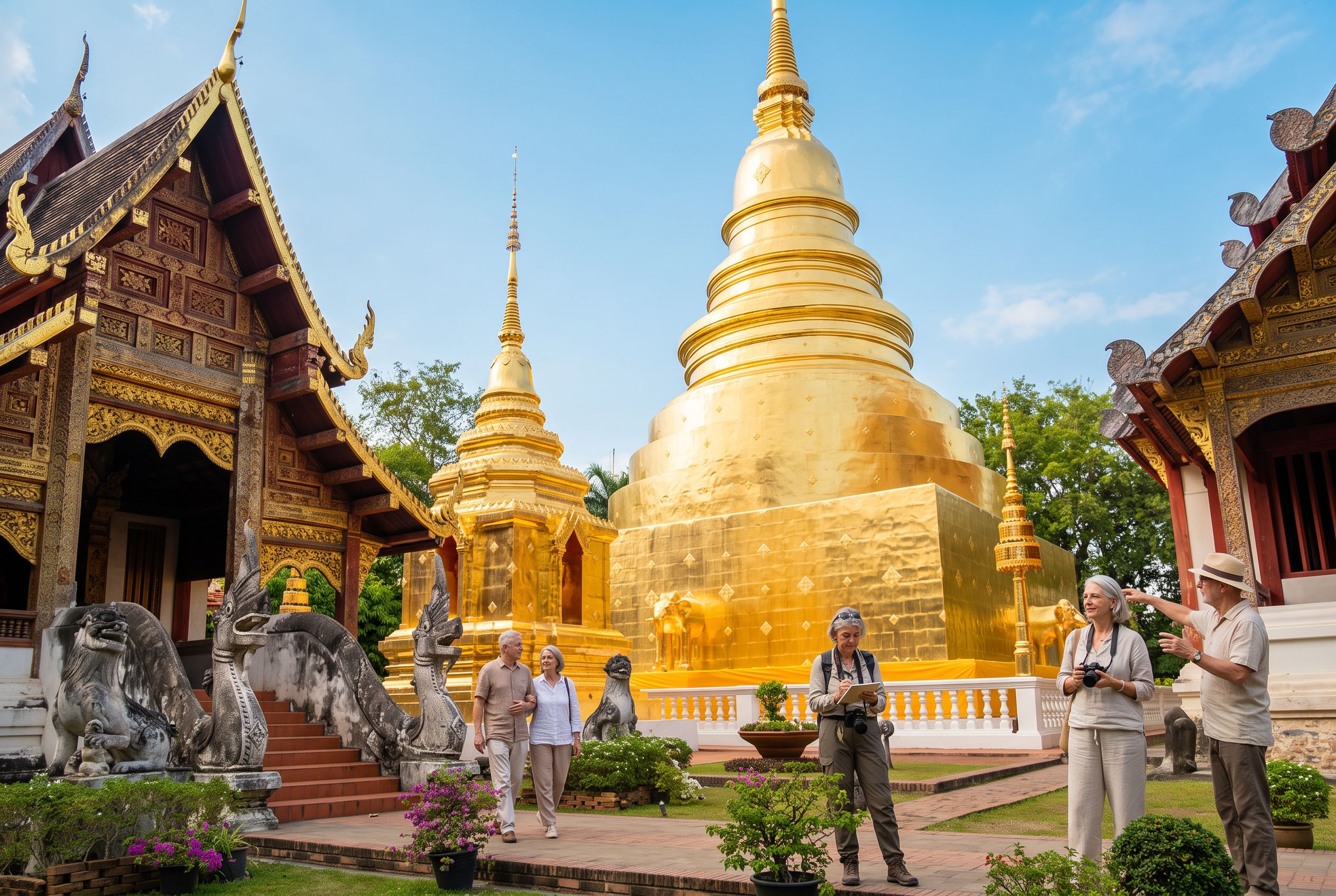 AI-edited
When is the best time to visit with grandchildren?
November to February offers the most reliable weather, according to operator guidance, and is described as peak season. March to May brings smoke and heat, and June to October is greener with a greater chance of afternoon rain.
For an outdoor day at an elephant sanctuary in the Mae Taeng valley, the record describes November to February as cooler and drier and the most comfortable period for a full day outside. March to May is recorded as hot and hazy, and June to October as greener with more afternoon rain.
Crowds peak in December, January and around Songkran in April, and going early in the day usually means fewer people, according to the same operator guidance. Heat and humidity peak from noon to 3 pm.
A December 2025 family itinerary discussion specifically advises parents to investigate smoke effects on children's health. The available forum material does not give a reliable exact start and end date for the smoke season, so check conditions shortly before travel.
Three to five days is suggested by one Chiang Mai activity guide, which suits families better than packing several distant excursions into consecutive days.
How do we choose an ethical elephant visit?
Look for observation-based programmes that state plainly that riding is not offered. Elephant Nature Park publishes observation-based visits rather than riding or performance programmes, and Elephant Jungle Sanctuary Chiang Mai states that its day involves feeding and mud with rescued elephants, with no riding and no tricks.
Elephant Nature Park, in the Mae Taeng valley, says visitors observe rescued elephants living in chosen herds and may see feeding and natural bathing. Its half-day morning programme collects from hotels at approximately 7:30 to 8:00 am, and the afternoon programme at approximately 12:00 to 12:30 pm. The published half-day price is ฿2,500, with children aged 3 to 11 paying 50% and babies aged 0 to 2 paying 25%. The full-day programme starts at approximately 7:30 to 8:00 am and returns around 4:30 to 5:00 pm, at a published ฿3,500 with the same reductions.
Elephant Jungle Sanctuary Chiang Mai sits in Karen hill country at Mae Wang, roughly 60 km southwest of the city, and its herds live in semi-wild family groups. Half-day, full-day and overnight programmes are all offered, and each includes hotel pickup from Chiang Mai (Elephant Jungle Sanctuary Chiang Mai programme details). The operator notes that the day is built around care, from cutting sugarcane and rolling vitamin balls to hand-feeding, and that it is popular, so you will not have the place to yourself, and you will get filthy. Bring clothes you do not care about and something to change into.
One separate elephant-and-waterfall tour excludes people with mobility impairments, wheelchair users, people with several medical conditions and people over 70. A combined cooking-and-elephant itinerary is listed as unsuitable for children under five and wheelchair users. These exclusions belong to those specific operators, not to every sanctuary, so read each listing before booking. Our dedicated guide to an ethical elephant sanctuary visit from Chiang Mai covers the wider choice in more depth.
Which temples work best across three generations?
Wat Chedi Luang and Wat Phra Singh are the easiest Old City choices, sitting within a short walk of each other on largely flat ground. Wat Phra That Doi Suthep is the more demanding outing, about 15 km west of the city at roughly 1,080 metres, and is best treated as a single morning rather than combined with several Old City temples.
Wat Chedi Luang's restored Lanna chedi was reportedly once about 98 metres high and 54 metres wide before earthquake damage in 1545, according to Chiang Mai Province. The Tourism Division of Chiang Mai Province lists opening hours as 8:00 am to 5:00 pm. A guide reports a foreigner admission charge of approximately ฿40.
Guest feedback on Google, where the temple holds a 4.7 out of 5 rating from 19,118 reviews as of October 2026, repeatedly notes benches around the pagoda for sitting and looking up at the structure, and describes the grounds as quiet and uncrowded in the morning and late afternoon. Monk chat sessions, where novice monks practise English and answer questions about Buddhism and Thai culture, are frequently mentioned as a highlight for visitors of all ages. Reviewers suggest allowing roughly 45 to 60 minutes. Shoulders and knees must be covered, and wraps are available at the entrance for a fee or a refundable deposit.
"We visited around 7:00 pm, and the place was calm and serene, ideal for a peaceful evening. The benches around the pagoda create a relaxed atmosphere, and the night lighting adds a beautiful ambience." (Google, February 2026)
Wat Phra Singh houses the Phra Singh Buddha image and is described as one of Chiang Mai's most revered temples. Sources report free admission and daily opening broadly from 6:00 am to 6:00 to 8:00 pm. The Tourism Division of Chiang Mai Province lists Wat Phra That Doi Suthep opening hours as 6:00 am to 5:00 pm.
Doi Suthep's principal approach is a naga staircase of roughly 306 to 309 steps, but a cable car or funicular provides an alternative for visitors who cannot manage the stairs. One guide reports approximately ฿30 admission and about ฿20 to ฿50 for the funicular or cable car. A February 2026 discussion found the summit generally accessible once at the top. Exact lift dimensions, accessible toilets, internal distances and wheelchair suitability beyond the ascent are not documented, so confirm with the operator before paying.
Is a cooking class realistic with young children?
Yes, if you choose a short one. Published Chiang Mai listings commonly include a market visit, an herb or farm garden, hands-on cooking and a meal, and classes range from about 3.5 hours to a full day. Pick the shorter format for younger children or grandparents who need rest.
Some classes involve markets, outdoor kitchens, farm walking and collecting ingredients. Request a chair, a shaded workspace and an alternative to floor-level preparation. Some listings offer hotel pickup and vegetarian or vegan options.
The September 2026 family report particularly enjoyed a half-day class that began with a market visit, followed by cooking and eating dishes including tom yum goong and chicken curry. That half-day format, with the market visit folded into the morning, keeps the afternoon free for a pool or a nap.
Senior discounts, over-65 fares, child fares, passes and closure days were not stated in the available listings. The available official material does not document a named Chiang Mai cooking school's current route, class frequency, age rules or published fare, so ask the school directly. A Thai cooking class in Chiang Mai: what to expect sets out the format in more detail.
What should we eat at the night markets?
Chiang Mai's walking streets run on fixed evenings: Wua Lai on Saturday, Tha Phae Sunday, both 5:00 to 10:00 pm according to Chiang Mai Province. San Kamphaeng Walking Street runs Saturday, 3:00 to 10:00 pm, with handicrafts, food, souvenirs and traditional music.
The official source publishes market times but does not publish entrance fees, and there is no published admission fare in the record. For children, ask vendors about chilli, allergens and uncooked ingredients; those details were not specified.
Warorot Night Market was described by a family group in October 2025 as cheaper than Chiang Mai Night Bazaar, with bargaining especially useful for bulk purchases. Chiang Mai evening food tours are advertised as roughly 2.5 hours, with hotel pickup and a minimum of eight tastings on one listed itinerary.
The Chiang Mai provincial tourism site describes one street market as facilitating disabled and elderly visitors, with a purpose-built slope and level, smooth, linked walking paths suitable for wheelchair users. The available extract does not clearly identify the market by name, so do not assume the statement applies to Sunday Walking Street, Saturday Walking Street or any other specific market.
Where do we cool off in the afternoon?
They do not document a named Chiang Mai city hotel or public swimming pool's current opening hours, day-use rules or entrance prices.
Public pools, hotel-pool accessibility, lifeguard provision, child restrictions and senior rates in Chiang Mai are not documented. Pool suitability needs to be confirmed with the individual hotel or facility, including a shaded seating area, a lift or step-free route to the pool deck, pool steps or a handrail, children's depth and supervision rules, changing-room accessibility and lifeguard hours.
For an air-conditioned alternative, HarborLand, described by *Chiang Mai Citylife* as Northern Thailand's largest indoor playground, opened at Central Chiangmai Airport on 5 October 2026. The Chiang Mai National Museum is another indoor option, with its exhibition zone reported as open Wednesday to Sunday, 9:00 am to 4:00 pm, closed Monday, Tuesday and public holidays. The reported fee is ฿20 for Thai visitors and ฿200 for foreign visitors, with no senior concession shown. Lifts, steps, wheelchair routes, seating, accessible toilets and the walking distance between galleries are not documented, so confirm before you go.
How do we plan around mobility and rest?
Use the Old City for short sightseeing segments, arrange vehicle transfers to hill and garden attractions, and confirm the exact step-free route directly with each operator.
The contrast between wheelchair-accessible Jing Jai Market, called large with extra artisan stalls and described as completely wheelchair accessible in a February 2026 discussion, and the stair-heavy Doi Suthep and Monk's Trail is a useful way to plan days around older adults. Wat Umong is reported as wheelchair-accessible in the same discussion. Ban Kang Wat was considered small and cramped for older visitors in that mobility discussion, while an October 2025 family discussion recommended it as an alternative to a long-neck-village visit because of its cafés, shopping and craft activities.
The shaded Monk's Trail is suitable for children but difficult with a stroller and may require carrying a tired child, according to a separate family discussion.
Several elephant programmes exclude wheelchair users or people with mobility impairments. Lifts, ramps, accessible vehicles, wheelchairs, mobility assistance, rest benches and accessible toilets are not documented at the elephant sites, temples, markets or cooking schools. A booking should specify the grandparent's walking limit, ability to climb vehicle steps, need for seating and whether they can opt out of wet or hilly sections.
How do we get around with two generations?
Chiang Mai's red songthaews are shared pick-up trucks, and Grab operates in the city centre. A September 2026 family report used Bolt for cars and motorbikes and Grab for rides and food delivery, but paid cash to avoid possible double-charge issues.
Splitting the stay between the Old City and Nimman is recommended by the September 2026 report, which spent three nights in each area, because it provides different atmospheres without repeatedly crossing the city. Nimman Road and MAYA Hall were found vibrant but a bit noisy after dark. The same report's strongest practical lesson was its relaxed rhythm: nearby Old City sightseeing, one half-day cooking class and a manageable private day trip rather than a packed schedule.
The contrast between the convenient Old City and noisier Nimman suggests requesting a quiet room, avoiding nightlife-facing streets and limiting hotel changes. For longer excursions beyond the city, our guide to day trips worth making from Chiang Mai for travellers 50-70 covers the options. For a wider northern route, two weeks across Northern Thailand sets out how Chiang Mai fits with Chiang Rai, Pai and the Golden Triangle.
What practical details should we settle before we go?
U.S. citizens entering Thailand for tourism for fewer than 60 days do not require a visa, but pre-arrival online registration is required according to the U.S. State Department, which also strongly recommends passport validity of at least six months beyond arrival. Other nationalities should check with the Royal Thai Embassy.
Visitors to temples should expect shoulders and knees to be covered and shoes to be removed before entering a main hall. The Chiang Mai National Museum is closed Monday, Tuesday and public holidays.
For temples, museums and gardens where no precise mobility information is published, confirm steps, seating, toilets, transport and assistance directly before paying.
The available search material does not document the locally applicable emergency numbers for Chiang Mai. They should be confirmed through the accommodation, the Tourism Authority of Thailand's Chiang Mai office or an official Thai government source before departure.
What pace actually works?
One anchor activity per day, a rest window from noon to 3 pm when heat and humidity peak, and an early evening outing rather than a late night. That rhythm is what the September 2026 family report landed on after trying a fuller schedule.
The group explored the Old City over several days rather than trying to combine many distant attractions in one outing. They chose an ethical sanctuary where they fed and walked with elephants, paired it with waterfalls on a private SUV day, and kept the rest of the trip close to base.
For grandparents, that means accepting that Doi Suthep is a single morning, not a morning plus two Old City temples. It means booking the shorter cooking class. It means treating the night market as a two-hour visit with a planned exit, not an evening that drifts.
The city rewards that approach. Temples, food and markets sit close together in the Old City, and the flat ground between them makes short, repeatable outings possible. Build the trip around that, and both generations get what they came for.


