
Located in the heart of the Austrian Alps, the Zillertal is one of those rare valleys that genuinely works for a three-generation holiday. The secret isn't finding the most thrilling attraction; it's finding the rhythm that lets everyone enjoy the day at their own pace. The Zillertal delivers that rhythm in spades.
The valley runs for more than 47 kilometres along the Ziller, from the Inn valley south to the Hochfeiler, at 3,509 metres the highest peak of the Zillertal Alps, and its towns are strung along the valley floor like beads on a string. What makes it special for grandparents travelling with grandchildren is the sheer variety of things to do that don't require strenuous effort. You can ride a steam train, glide up a mountain in a gondola, watch the kids race down a summer toboggan run, and still be back at your hotel in time for a relaxed afternoon swim. The key is knowing where to base yourselves and how to pace your days.
 AI-edited
Which towns are best for a multigenerational base?
Zell am Ziller and Fügen are the most senior-friendly bases, with flat, compact centres and paved paths that make walking easy for all ages. Mayrhofen is walkable but hillier, while Finkenberg and Hintertux have steeper terrain and fewer level pavements.
Zell am Ziller, as Fodor's describes it, is "a real working community rather than just a resort town," and that authenticity shows in its reasonable prices and family-friendly atmosphere. The town centre is flat, with a pedestrian zone, the Freizeitpark Zell, and direct access to the Zillerpromenade—the riverside path the Zillertal Arena calls an easy walk that also suits families with prams, running all the way to Mayrhofen. Fügen lies about 15 kilometres further down the valley, equally flat and compact, with the Therme Zillertal—still called the Erlebnistherme in older guides—right on its doorstep.
Mayrhofen is the valley's largest resort town, with more restaurants and shops, but its streets are noticeably hillier. The Neuhaus Zillertal Resort stands directly at the railway station, and Zillertal Tourismus describes its spa as a 5,800-square-metre Badehaus with an infinity pool over the rooftops, set in a 15,000-square-metre garden with a natural bathing lake. The house also puts live music on in the guest garden in the evenings, so if quiet sleep is a priority, ask at booking for a room away from it, or consider Zell am Ziller instead.
What summer adventure parks work well for mixed-age groups?
Spieljoch Mountain near Fügen and the Rosenalm adventure area in Zell am Ziller are the top choices for families with grandparents, offering cable-car access to age-spanning activities without requiring any hiking.
Spieljoch is marketed as an "adventure mountain," and it earns that label honestly. At the top station the operator lists the Kristalldörfl crystal village, the Öxltal show mine with its tunnel maze, a water park, a barefoot trail, a high-ropes course with a Flying Fox, MountainCart hire and a tubing run. The key for grandparents is that all of it sits around the summit station, and that is more than marketing: the Austrian cable-car association's datasheet of November 2024 records that every attraction directly at the top station can be used in a wheelchair, that both sections of the Spieljochbahn are wheelchair-accessible, and that two of the restaurants up there are accessible. You can sit with a coffee while the grandchildren explore within sight. In 2026 the lift runs from 23 May to 26 October, daily from 09:00.
The Rosenalm area in Zell am Ziller is equally well-suited, and the Rosenalmbahn is the one Zeller Bergbahnen lift the same datasheet records as wheelchair-accessible, climbing from 580 to 1,744 metres. At the top lies the Fichtenwelt: the Fichtenschloss, a timber castle over more than 5,000 square metres with four climbable towers, an 18-metre lookout, a treetop walk and a water-and-sand play area, plus a hammock wood for anyone who has had enough. A little further on, the Fichtensee is a bathing lake at 1,700 metres. The Fichtenweg circuit linking the two is a surfaced forest track, and the datasheet is honest about it: wheelchair users need a companion, because some stretches are steeper.
Are the family toboggan runs suitable for grandparents?
Yes, within clear limits. The valley's summer toboggan run is the Arena Coaster in Zell am Ziller, and because every sled has its own brake it is the grandparent who sets the pace. But children under four are not carried at all, and from four they may only ride with someone over sixteen.
One detail makes the Arena Coaster unusually easy for three generations: it starts at the valley station of the Rosenalmbahn in Zell am Ziller, so no cable car is involved at all. A tow section pulls you 325 metres uphill before the 1,125-metre descent begins. The Zillertal Arena's conditions of carriage are the thing to check before anyone gets excited. Children under four are not carried. From four, a child may ride with a companion over sixteen. Only from ten, and at a height of at least 1.30 metres, may a child ride alone; staff check ages against a document, so bring one.
The ride is 1,450 metres long with 140 metres of height difference and takes about seven minutes, past a 360-degree and a 540-degree loop and a run of jumps. The queue can be long on peak summer afternoons, so go early: from 1 July to 31 August the coaster opens at 09:30 and runs to 18:00, otherwise 10:00 to 17:00, with the 2026 season closing on 26 October. A single ride costs €8.00 for adults and €5.30 for children born from 2011 onwards.
"Just my kind of ride. I'm not very fond of roller coasters but when I'm able to control the speed myself it's just great." — one Google reviewer on the Arena Coaster in Zell am Ziller, July 2025
Where are the best gentle river walks?
The Zillerpromenade between Zell am Ziller and Mayrhofen is the valley's best easy riverside walk, running about 8 kilometres along the Ziller from the Zillerbrücke in Zell. The Zillertal Arena calls it a comfortable, easy walk that also suits families with prams; no source describes it as a wheelchair route.
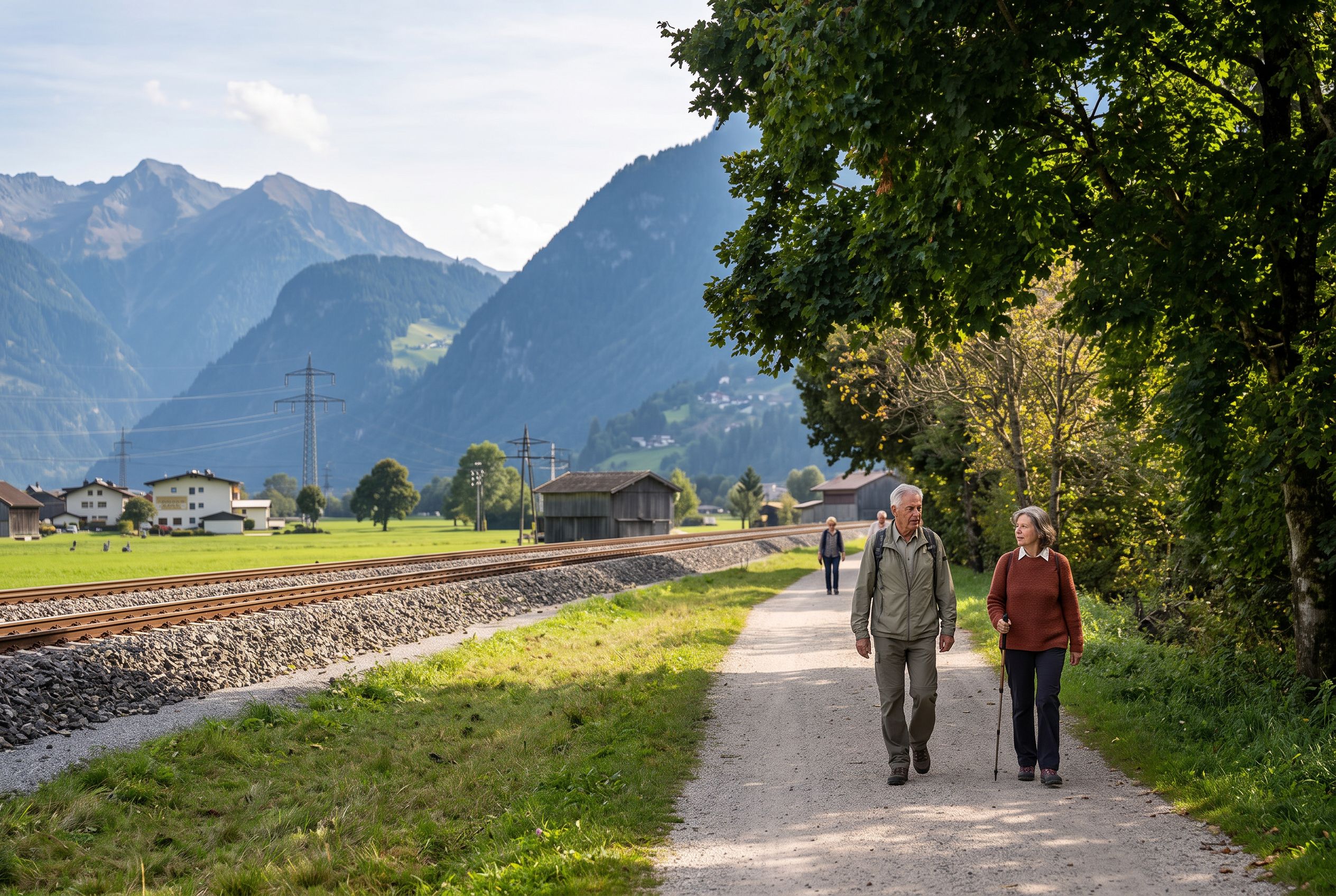
This path is the backbone of any multigenerational trip to the Zillertal. It follows the river through meadows and small forests, and the operator puts just 10 metres of ascent on the signed 3.5-kilometre circuit, which is rather the point. The best feature for a mixed-age group is structural: a bridge crosses the Ziller roughly every 1.5 kilometres, so you can turn back along the far bank the moment the youngest or the oldest has had enough. Hippach lies 4 kilometres from the Zillerbrücke, Mayrhofen 8. The path is popular with cyclists too, so keep to the pedestrian side; for a longer day, walk the full 8 kilometres and take the Zillertalbahn back.
If you are based further down the valley, the same path runs the other way from the Zillerbrücke: 4 kilometres to Aschau and 8 to Kaltenbach, which brings you within reach of Fügen. For that end of the valley the Therme Zillertal at Badweg 1 makes the obvious pairing, and a gentle walk followed by a swim is the least demanding day the Zillertal offers.
Is the Zillertalbahn steam train worth the trip?
Absolutely, if your dates fit. The Zillertalbahn runs a heritage steam train alongside its regular narrow-gauge service, on Tuesdays to Thursdays from 2 June to 24 September 2026. It is one of the valley's best experiences for grandparents and grandchildren alike: slow, scenic and full of character.
The train runs on a narrow-gauge track through the entire valley, passing through fields, forests, and small villages. The operator calls its steam locomotives over 120 years old, and the carriages are restored originals with wooden benches and opening windows. The run is unhurried rather than quick: Jenbach 10:44, Mayrhofen 12:16, back at 13:35 for Jenbach at 15:04. Grandchildren love leaning out the window to wave at cows, and there is a children's carriage with a play compartment; the third child of a family travels free. Zillertal Tourismus records the steam train as barrier-free, with a vehicle carrying a lifting platform and a compartment for passengers with reduced mobility, and the crew helping with boarding.
The regular service is a different animal: half-hourly trains, every day, on the 32-kilometre line between Jenbach and Mayrhofen. For those the Verkehrsverbund Tirol makes no blanket accessibility promise. Its timetable enquiry shows for each connection whether the train is low-floor and whether a wheelchair space and an accessible toilet are on board, and the space is booked in advance on +43 5 17 17 5. A decarbonisation programme is under way: in November 2025 the Land Tirol cleared the way to tender for six battery-hybrid trainsets, each with an accessible toilet, for the 2026 to 2030 programme period. The station in Zell am Ziller is about 400 metres from the Dorfplatz.
Where can we swim and rest between activities?
The Therme Zillertal in Fügen is the best documented wellness stop for older travellers: the operator names barrier-free entrances and comfortable pool entries, and it opens daily from 10:00 to 22:00. Zell am Ziller's Freizeitpark offers outdoor swimming, a large playground and adventure mini-golf.
The Therme Zillertal at Badweg 1 in Fügen holds 1,000 square metres of indoor and outdoor water at 32 to 34 degrees, seven sauna and steam cabins, and the 272-square-metre Zillantis children's world with a toddler pool; the Black Hole, at 134 metres the longest water slide in western Austria, is what the grandchildren will queue for. On access the operator's wording is worth keeping as it stands: barrier-free entrances and comfortable pool entries. It says nothing about a pool hoist or adapted changing rooms, so ask in advance if that matters. It opens daily from 10:00 to 22:00, the sauna and spa from 13:00, and closes for maintenance from 7 to 20 June 2027. Grandparents can take the morning in the thermal pools while the grandchildren use the slides, then meet at the self-service restaurant.
The Freizeitpark Zell, redesigned in 2018, covers more than 45,000 square metres. The operator lists an adventure open-air pool with a sports basin, a giant slide and a children's pool, adventure mini-golf, a large gold-diggers' playground, a bouldering tower, a bowling alley and a café-restaurant with a mountain view. It is the perfect place for a low-effort afternoon: let the grandchildren run wild while you sit with a book and an ice cream. The park lies about 800 metres from the Dorfplatz but only 460 metres from the railway station, and it is one of the marked start points of the Zillerpromenade circuit.
For planning around toilets and level entrances, the accessibility datasheets the Austrian cable-car association publishes for each lift company are more use than any brochure. The Fügen sheet of November 2024 lists barrier-free toilets at all three Spieljochbahn stations; the Zeller sheet names the Rosenalmbahn valley station as the ideal barrier-free entry point, with a ramp until level gondola boarding arrives.
What practical tips should we know before we go?
Book accommodation near a flat centre, use the Zillertalbahn and cable cars for terrain control, and focus on valley-floor attractions plus one or two mountain lift experiences. Check lift operation dates and construction windows individually, as some cable cars have seasonal closures.
The Zillertal's climate is typical of the Austrian Alps: warm summers with occasional afternoon thunderstorms, and cold, snowy winters. GeoSphere Austria's 1991 to 2020 records for Mayrhofen put the mean daily maximum at 24.8°C in July and 24.2°C in August, the two warmest months, and July also carries the most days of measurable rain, just over 15 in an average month. Late May to mid-October is the practical window: the Rosenalmbahn and the Spieljochbahn open on 23 May 2026 and the Ahornbahn on 13 June, while winter is ideal for snow but requires more care with footing and weather variability.
Traffic congestion is a live issue in the valley, especially on peak changeover days. In January 2025 the Land Tirol and ASFiNAG presented the rebuilding of the A12 motorway junction at Wiesing, the gateway to the Zillertal, at a cost of €54 million split between them; until it is finished, use the Zillertalbahn for longer transfers rather than driving. The nearest hospital is the Bezirkskrankenhaus Schwaz, about 35 kilometres and 34 minutes by road from Zell am Ziller, with an emergency outpatient unit staffed 24 hours a day; the Austrian number for an ambulance is 144. There are pharmacies in Zell am Ziller (Gerlosstein Apotheke, Dorfplatz 3a) and Ramsau im Zillertal (Europa-Apotheke, Talstraße 74).
For grandparents travelling with grandchildren of different ages, the key is to plan one main activity per day and leave the rest unstructured. The valley is built for exactly that, and it rewards letting it set the pace.


