
Charleston's historic heart sits on a peninsula between the Cooper and Ashley rivers, and almost every visitor faces the same decision before booking: which patch of that peninsula to call home for a few nights. The choice shapes how much you walk, how much you hear at midnight, whether you need a car and how easily you reach the sights you came for. Five areas come up again and again in the planning: South of Broad, the French Quarter, the Market area, Upper King and Mount Pleasant across the harbour. Each suits a different kind of traveller, and none suits everyone.
The city is busy. According to the City of Charleston, the peninsula receives an average of approximately 21,903 visitors per day against a resident population of about 22,500, and the city recorded roughly 7.89 million visitors in 2024, generating an estimated $14.03 billion in economic impact, as reported in the city's tourism appendix. That volume matters when you choose a base: the quiet streets and the loud ones are a few minutes apart, and the difference is worth understanding before you book.
Which Charleston neighbourhood suits which traveller?
South of Broad suits travellers who want quiet, residential streets and historic architecture within walking distance of the waterfront. The French Quarter suits those who want galleries, restaurants and the City Market on the doorstep. Upper King suits anyone who wants restaurants and nightlife on foot. Mount Pleasant suits drivers who prefer chain hotels and accept a crossing into town.
The neighbourhoods are close together, and the peninsula's grid means most of them connect on foot. What separates them is character, noise and the practical business of parking and pavements. Charleston has no metro or tram; visitors generally combine walking with CARTA buses, the free DASH shuttle, taxis and ride-hailing services, according to The Senior Traveler.
For a first visit, published Charleston guidance supports the central downtown peninsula as the most walkable choice, a span that takes in King Street, the French Quarter, Harleston Village, Ansonborough and South of Broad. That is a broad recommendation rather than a ranking, and the sections below set out what each area actually offers.
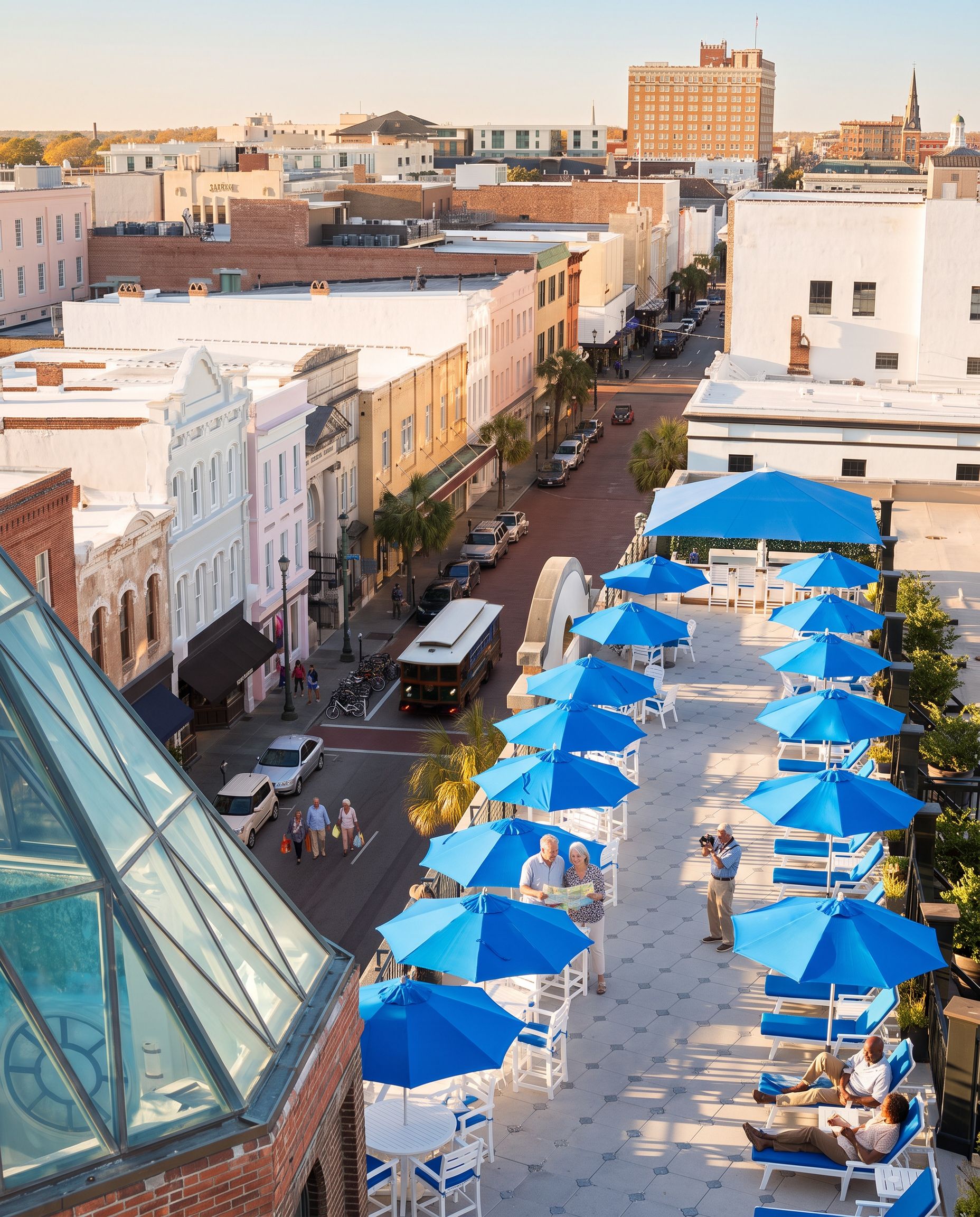 AI-edited
What is South of Broad like as a base?
South of Broad is predominantly residential and generally quieter than King Street, with White Point Garden, the Battery, Rainbow Row and historic house museums nearby, according to AFAR and U.S. News Travel. It rewards walkers who value calm streets and architecture over late-night restaurants, and it puts the waterfront at the end of the road.
The area's streets include cobblestone alleys and waterfront promenades. Charleston's historic street network includes old cobblestone and slate surfaces, which can present a practical mobility problem, according to The Senior Traveler. no source in the available material documents a block-by-block step-free route audit for South of Broad, so the condition of any particular street should be confirmed rather than assumed.
Evening noise is the other consideration. South of Broad is characterised as quieter and residential in the published neighbourhood guidance. That is a description of the district's character, not a measured noise level, and no source documents decibel readings for individual streets.
Distances are walkable but not trivial. From Hotel Bennett beside Marion Square, published guidance gives approximately 20 minutes on foot to Broad Street and 30 minutes to White Point Garden; those figures apply specifically to Hotel Bennett and not to every address in the district. For the house museums and gardens that draw many visitors here, see our guide to the historic homes and gardens of Charleston.
Is the French Quarter a good compromise?
The French Quarter is described in published guidance as a strong compromise between King Street and South of Broad: historic buildings, galleries and restaurants, with the City Market and the waterfront close by. It suits travellers who want atmosphere and dinner on foot without committing to the busiest stretch of King Street.
Forum contributors describe the French Quarter as close to the Market and most major tourist sites. That is consistent with the district's position between the two poles of the peninsula, and it makes the area practical for anyone who wants to walk to several different things in a day rather than commit to one zone.
Walkability here is genuine but should be understood as convenience rather than certification. King Street is described as having wide, pedestrian-friendly sidewalks, but that description is not an official accessibility certification, according to Charleston Real Estate's local guide to King Street. the sources describe the district's character, not the condition of every threshold and curb.
Parking is the practical weak point of the whole central peninsula. Travel + Leisure notes that parking can be difficult downtown, and car hire is optional for visitors concentrating on the historic peninsula. A car is useful for plantations and the wider region; it is a liability for a French Quarter base.
What is the Market area like for a stay?
The Market area sits between the French Quarter and Upper King, with the City Market, restaurants and shops within a short walk. It suits travellers who want to be in the middle of things and are comfortable with steady foot traffic through the day, and it keeps several major sights within walking distance.
Hotels on and around King Street describe themselves as within walking distance of the City Market, the South Carolina Aquarium and Waterfront Park. Both the Hyatt House Charleston/Historic District and The Lowline Hotel, at 560 King Street, list those attractions among their neighbours. That is the operator's own description of the location, and it is a fair summary of what the Market area delivers: the waterfront, the market and the shopping spine all on foot.
Noise is the trade-off to plan around. The hotels themselves describe King Street as "bustling", which supports an energetic urban setting rather than a reliably quiet one. Neither property publishes a noise rating or a measured nighttime level. Guests who are sensitive to street sound should ask for a room away from the street when booking, and should treat that request as something to confirm rather than assume.
Who should base themselves on Upper King?
Upper King suits travellers who want restaurants, bars and nightlife within a few minutes of the hotel door, and who are happy with a livelier evening atmosphere. It is the northern, more recent end of the King Street spine, and it puts the historic core a longer walk or a short ride away.
King Street changes character along its length, from antiques and fashion to restaurants and nightlife, according to published neighbourhood guidance. Forum contributors draw a similar line, describing the preferred downtown stretch as anything near King Street from Cannonborough to South of Broad, with Cannonborough characterised as the newer, more tourist-oriented end and South of Broad as more traditional.
The restaurant trade itself reads the geography this way. When Sorghum & Salt moved from Coming Street to 186 St. Philip Street and opened its larger premises in June 2025, expanding from 38 seats to more than 60 and adding a 12-seat bar, owner Tres Jackson told The Post and Courier in July 2025 that the new neighbourhood was "much more friendly" for the restaurant because it is closer to the Upper King nightlife district. That is a useful signal for anyone weighing a quiet base against a convenient one.
Upper King also carries the city's main north–south walking route. The sidewalks are described as wide and pedestrian-friendly, though, as noted, that is a description rather than an official accessibility certification. The South Carolina Department of Transportation lists a downtown project covering King Street, Meeting Street, Calhoun Street and St. Philip Street, so street conditions and traffic patterns on this spine can change; the city also says it is studying traffic, parking and mobility on Coming Street, Rutledge Avenue and Ashley Avenue, including whether some corridors should become two-way streets.
Is Mount Pleasant a practical base?
Mount Pleasant, across the Cooper River, is suggested in forum discussion for cheaper chain hotels, with the water taxi mentioned as a way into downtown. It suits travellers with a car who want easy parking and lower rates, and who accept that the historic peninsula becomes a trip rather than a stroll.
The trade is straightforward. A Mount Pleasant base removes you from the peninsula's walking distances and its parking difficulties, and it puts the city's restaurants and historic streets a crossing away. The water taxi is the pleasant option when it is running; the material does not document its timetable, fares or seasonal operation, so those details should be checked with the operator before you rely on it for an evening out.
For travellers arriving by air, CARTA Route 11, the Dorchester/Airport route, connects Charleston International Airport with downtown and serves the airport passenger pick-up and rental-car areas, according to The Senior Traveler. Our guide to getting to Charleston by airport, train and transfer covers the arrival end in more detail.
How do you get around without a car?
Charleston has no metro or tram; visitors combine walking with CARTA buses, the free DASH shuttle, taxis and ride-hailing. DASH runs three free routes on the peninsula, and CARTA buses are wheelchair accessible and ADA-compliant, with lifts or kneeling functions, priority seating and wheelchair securement.
DASH serves the peninsula on three free routes (Orange 210, Green 211 and Purple 213), which interchange at the Visitor Center, 375 Meeting Street, according to Things To Do SC. The material does not document the step-free condition of every DASH stop or every sidewalk connection, so a stop that looks convenient on the map should be checked for the actual boarding point.
CARTA's accessibility features are documented by The Senior Traveler, including lifts or kneeling functions, priority seating, wheelchair securement and permission for service animals. Uber and Lyft are widely available in Charleston, according to Travel + Leisure.
Walking remains the main mode for the historic districts, and the terrain deserves honest planning. Those mobility details are not documented and should be confirmed with your hotel for the specific route you plan.
What should you know about parking and extra fees?
Parking is difficult downtown, and car hire is optional for visitors concentrating on the historic peninsula, according to Travel + Leisure. Hotels vary in what they charge and how they handle cars, and the material does not publish a rate comparison across the neighbourhoods.
The Hyatt House Charleston/Historic District lists self-parking, van-accessible self-parking and valet parking. The Lowline Hotel lists self-parking and van-accessible self-parking. Neither publishes its rates in the cited material, so the figures have to come from the property at the time of booking.
Fees at the desk are a recurring theme in forum discussion. One contributor staying at The Vendue avoided its valet charge by parking in a garage a few streets away. That is a single account rather than a published rate, and no official price list exists; travellers should ask at reservation what the parking charge covers and whether a nearby public garage is an option.
Rates across Charleston are indicative and vary by season and booking channel. The material carries no published price range for the neighbourhoods in this guide, so no figures are given here.
What should travellers with mobility needs check before booking?
Accessibility documentation varies sharply by property. Some Charleston hotels publish detailed information on lifts, roll-in showers and accessible routes; others publish little. The practical approach is to ask the specific property about the specific feature you need, in writing, before you commit.
Among the properties whose published information is more detailed, the Courtyard Charleston Waterfront, at 35 Lockwood Drive, explicitly has elevators, accessible entrances at the main entrance, pool, business centre, fitness centre, meeting spaces and restaurant, and interior-corridor access to rooms and suites. Its documented bathroom features include roll-in showers, transfer showers, adjustable-height handheld shower wands, bathtub grab rails, bathtub seats and non-slip grab rails. The hotel advises guests to call +1 843 722 7229 for information about physical features or special services relating to a specific disability.
The Lindy Renaissance Charleston Hotel, at 68 Wentworth Street, also documents elevators, an accessible main entrance, accessible fitness centre and business centre entrances, accessible meeting spaces, an accessible on-site restaurant and interior-corridor access to rooms. Documented room features include mobility-accessible rooms, roll-in showers, transfer showers, wheelchair-height toilets, accessible vanities, non-slip grab rails, bathtub grab rails and bathtub seats. Its number for questions about accessible-room features, common areas or special disability services is +1 843 534 0300.
On King Street, the Hyatt House Charleston/Historic District documents accessible routes from the public entrance to the restaurants, business centre, swimming pool, guest rooms, registration area, fitness facilities and spa, with accessible guest-room doorways of 32 inches clear width and accessible rooms with roll-in showers. The Lowline Hotel documents accessible routes to the fitness centre, spa, swimming pool, registration area, business centre, restaurants, guest rooms and meeting room, with the same 32-inch doorway width, and lists both accessible-tub rooms and an accessible roll-in-shower room.
Two details are not documented for the King Street properties. The cited Hyatt sources for both the Hyatt House and The Lowline do not explicitly confirm elevators, so lift availability should be confirmed with the property when booking. Neither source specifies entrance steps, thresholds or the complete route from the street.
Hotel Bennett publishes walking times to Broad Street and White Point Garden but does not state elevator availability, step-free access, roll-in showers, accessible room dimensions or street conditions in the cited material. Those details should be requested directly.
Where will you sleep quietly, and what about safety and services?
Quiet depends more on the room than the neighbourhood. King Street is described as bustling and South of Broad as quieter and residential, but neither description is a measured noise level, and no property in this guide publishes room-by-room sound data. Ask for a room away from the street and confirm it at check-in.
Guest reviews across Charleston properties show how much room position matters. A Tripadvisor review of Mills House, page updated 2026, reported that Saturday-night music remained clearly audible four floors up and on the opposite side of the building; the reviewer still intended to return but recommended earplugs. Reviews of Zero George describe both a quiet location close to King Street and, in other rooms, street traffic and sound carrying through the building. The lesson is not about any one hotel but about the question to ask: which room, facing where, on which floor.
On health services, the nearest documented downtown pharmacy is CVS Pharmacy at 59 George Street, and the nearest documented hospital for the city centre is Roper Hospital at 316 Calhoun Street, with 24-hour emergency treatment, according to The Senior Traveler. The Medical University of South Carolina at 171 Ashley Avenue also has emergency services.
Downtown Charleston around the Historic District is generally described as safe, but it remains a busy city rather than a risk-free resort environment, according to U.S. News Travel, which advises normal city precautions, particularly at night. For police, fire or medical emergencies in Charleston, dial 911, as directed by the Charleston County Sheriff's Office. The city's tourism hotline, 843-709-1985, handles tourism questions and complaints and is not an emergency number.
When is the best time to base yourself in Charleston?
March to May and October to November are identified as especially favourable visiting periods, while January to mid-February and July to September are described as comparatively quieter or less desirable because of winter conditions or summer heat and humidity, according to The Senior Traveler.
The climate figures back the advice. NOAA's 1991–2020 climate normals for the Charleston City station give July an average daily high of 87.5°F and a low of 77.1°F, with June, August and September close behind. October averages 75.6°F by day and 63.2°F at night; November averages 67.1°F and 53.1°F. For walking tours and unhurried days on the peninsula, those autumn months are substantially more comfortable.
Season affects the neighbourhood choice too. A summer base with a pool and a shuttle, such as the Courtyard Charleston Waterfront, offers a different rhythm from a South of Broad address where the day's walking is the point. Charleston itself is a year-round city rather than a seasonal resort, and no citywide opening season is documented in the official material.
For a sense of what fills the days once you have chosen, our selection of Charleston's finest experiences chosen for the over-50s pairs well with any of these bases, and a slower afternoon is easy to arrange with a spa day in Charleston.
How should you weigh the five areas up?
Choose South of Broad for calm and architecture, the French Quarter for a central compromise, the Market area for the waterfront and the City Market on foot, Upper King for restaurants and nightlife, and Mount Pleasant for parking and lower chain rates with a crossing into town. Match the base to how you plan to spend your evenings.
The single most useful question is what you want within a ten-minute walk at the end of the day. If the answer is a quiet street and a view of the water, South of Broad and the lower peninsula fit. If it is a restaurant and a short walk back, Upper King and the Market area fit. If it is a car park and a straightforward drive, Mount Pleasant fits.
Two practical points apply wherever you land. First, confirm the specifics that matter to you with the property directly, because published detail varies and silence in a brochure is not a guarantee either way. Second, treat the neighbourhood descriptions in this guide as character sketches rather than measurements: they tell you what an area feels like, not what your room will sound like or how many steps lie between the pavement and the lobby.
Charleston rewards a base chosen deliberately. The peninsula is compact enough that a well-chosen address turns a good trip into an easy one, and the differences between these five areas are real, legible and worth ten minutes of thought before you book.


