
Charleston rewards a certain kind of traveller: the one who would rather see four things properly than twelve in a blur. The historic peninsula is compact, the free DASH shuttles knit the sights together, and the city's own visitor material notes that most attractions sit within reasonably close proximity on the lower peninsula. What follows is a working shortlist for travellers aged 50 to 70, from those who walk five miles before lunch to those who would rather watch the harbour from a bench. Each entry carries its effort level, its seating and rest options, and the timing that keeps you out of the worst heat and the densest crowds.
The city's official visitor guide is unusually clear about the trade-offs. Traffic can be heavy and parking difficult, which is why many visitors see the sights primarily on foot. The fare-free DASH shuttles provide three routes covering most of downtown's historic and tourist attractions, and they connect at the Visitor Center at 375 Meeting Street. That combination, walking in stages with a free trolley as backup, is the single most useful planning fact in this guide.
When should over-50s visit Charleston to avoid heat and crowds?
Charleston's official visitor guide names March through May and October through November as the best time to visit, when the weather is warm without being too hot and humid. It identifies two off seasons: high summer from July through September, and winter from January through mid-February. In summer, the guide states, temperatures are high and humidity can be extreme.
That is the framework for everything else. A spring or autumn visit lets you treat the historic district as a series of short walks rather than a survival exercise. A July visit is still possible, but it has to be built differently: outdoors before ten, indoors or on the water through the middle of the day, outdoors again after five.
The city's own figures explain the crowd problem. A City of Charleston document reports an average of approximately 21,903 visitors per day on the Charleston peninsula, against a resident population of about 22,500, as cited on the City of Charleston visitor information page. You are, in effect, sharing the peninsula with a second city every single day.
How walkable is the historic district, really?
The layout is walkable; the surfaces are not uniformly easy. Charleston's historic streets include cobblestones and slate, and a senior-oriented guide reports that Preservation Society walking tours commonly cover six or more blocks over uneven streets and sidewalks. The city's free DASH trolley is the documented way to cut the longer hops.
Treat "walkable" as "walkable in stages". The city's visitor material describes the historic district as compact, with many sights, restaurants and shops a few blocks apart, and notes that for the more distant peninsular attractions the fare-free shuttles and other ride services provide an alternative to driving. That is your plan: pick a cluster, walk it slowly, then ride.
Footwear matters more than any other packing decision. Forum contributors on both Fodor's and the Rick Steves boards describe the old streets as uneven and advise good walking shoes. Confirm each attraction before you arrive rather than assuming.
- Free DASH shuttles: three routes covering most of downtown's historic and tourist attractions, connecting at the Visitor Center at 375 Meeting Street.
- Visitor Center hours: open daily 8:30am to 5pm, closed Thanksgiving, Christmas and New Year's Day, with parking in the adjacent garage or lot at $1 per hour.
- Restrooms: available at the Meeting Street Visitor Center and at listed city parking garages; the city notes restrooms may be locked and available upon request.
- Disabled parking: free at city-owned garages, lots and meters for vehicles displaying a disability placard or plate.
Rainbow Row and the Battery: how much walking is involved?
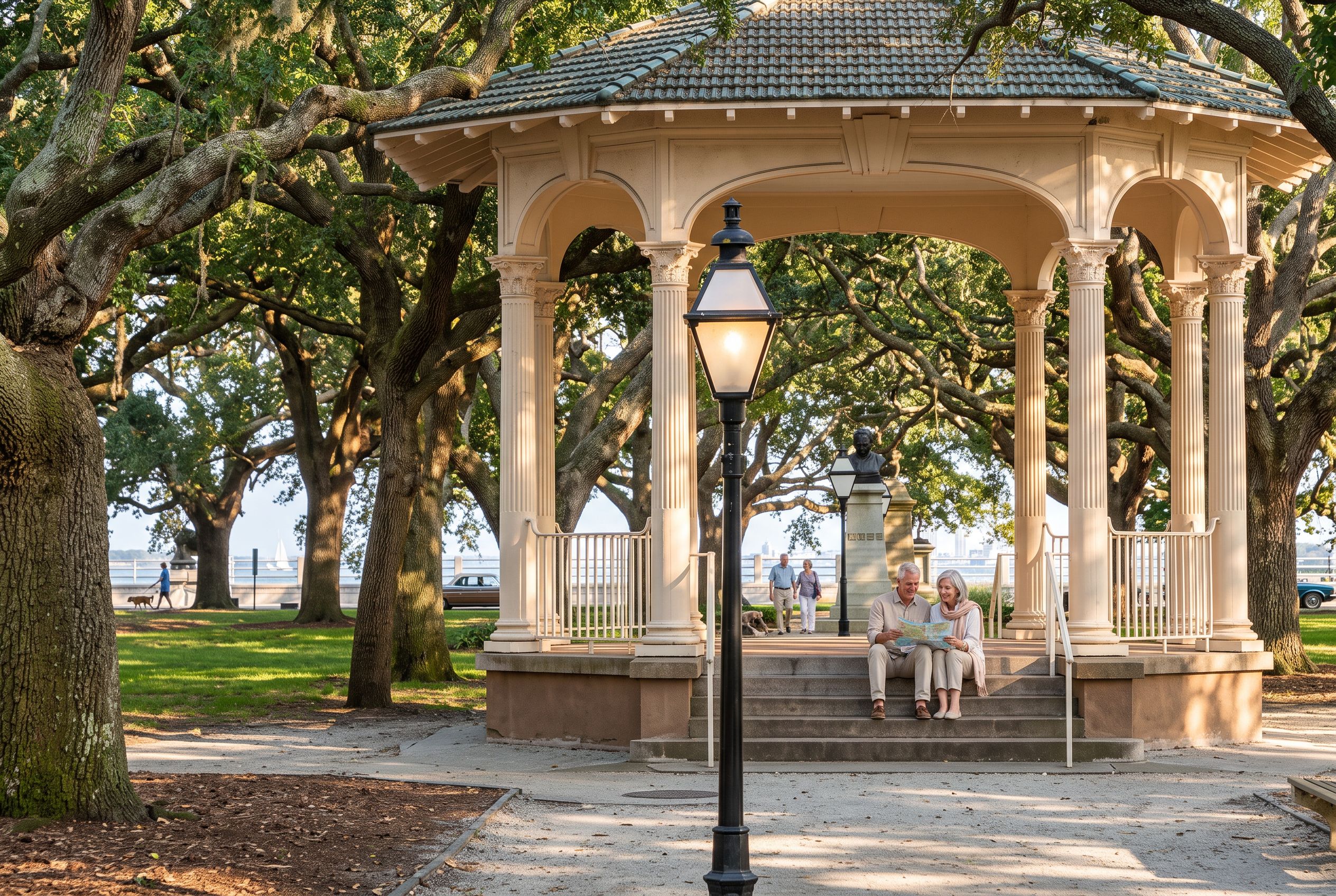
This is the most rewarding low-effort stretch in the city. Rainbow Row and the Battery appear on the official tourism board's list of free attractions, and White Point Garden at the southern tip offers a wide waterfront walkway, benches throughout and heavy shade from live oaks. Treat it as a short scenic stroll, not a hike.
Guest feedback on White Point Garden, which holds a Google rating of 4.7 out of 5 from 3,559 reviews as of November 2026, repeatedly mentions the harbour breeze and describes the park as a cool, quiet place to rest during hot weather. Benches are distributed throughout, and the live oaks cast substantial shade. Historic markers, Civil War cannons and monuments are placed around the grounds, and the gazebo in the centre is a common spot for photographs.
"My son proposed to his girlfriend in front of the gazebo here. It was absolutely beautiful. And the pictures turned out great." (Google, September 2026)
Two practical notes. The park has no public restrooms or water fountains; the nearest documented restrooms are at Waterfront Park, about a 15-minute walk away. Street parking around the park is free but limited to two hours, and neighbourhood streets require a permit. Guest feedback also records construction fencing along the waterfront blocking water views and cannon displays during some visits, with the sea wall and road around the park undergoing upgrades. Ask at the Visitor Center what is currently open.
 AI-edited
Is a Charleston harbour cruise worth it for older travellers?
Yes, and it is the single best answer to midday heat. A narrated harbour cruise puts you in an air-conditioned cabin with an open deck you can move between, gives you the skyline and Fort Sumter from the water, and asks nothing of your feet. Charleston's water and harbour tours are the largest category in the city's tour market.
According to a Charleston visitor market capture of 154 tours in August 2026, water and harbour tours number 31 products with a median price of $61 per person, against a median of $50 across 134 per-person tours citywide. Those are market figures, not operator rates, and prices vary by departure and season.
For Fort Sumter specifically, the fort is reached by ferry, and a senior-oriented guide reports a senior fare of $39 against $43 for adults. The same source states that only Liberty Square can board wheelchairs and scooters. The cited material does not document the vessel's onboard lift, the fort's internal terrain, accessible toilets or rest areas on the island. Ask the operator directly when booking.
What does a carriage tour give you that walking does not?
A carriage tour is the seated way to understand the city's geography before you commit to walking it. Forum contributors on Fodor's recommend them for visitors who need to stay off their feet, and the same discussions advise taking the ride early in the visit, then returning on foot to the streets that appealed.
According to the same August 2026 market capture, carriage tours number three products at a median of $50 per person. That is a market median rather than a published operator rate; confirm the current price and the route with the operator when you book.
The strategic value is orientation. Charleston's historic district is a grid of streets that all look plausible from a map and quite different on the ground. An hour seated, with narration, tells you which two blocks you actually want to return to. That is worth more to a traveller with limited stamina than a longer walking tour would be.
Ask when booking, particularly if you use a mobility aid.
Which indoor attractions handle heat and tired legs best?
The Charleston Museum and the South Carolina Historical Society Museum are the two strongest indoor options, and both publish accessibility detail. The Charleston Museum offers free wheelchairs, ramps at the entrance and elevators to the second floor. The Historical Society Museum has a wheelchair entrance on Meeting Street and elevator access to both floors.
The Charleston Museum holds a Google rating of 4.6 out of 5 from 2,379 reviews as of November 2026. Guest feedback consistently describes the exhibits as informative and well organised, covering Charleston and Lowcountry history from prehistoric times through the Civil War, the civil rights era and the modern period. A natural history section with a whale skeleton, fossils and a giant sloth draws repeated mention, as do the clothing and silver collections.
For rest, guest feedback notes benches placed throughout the galleries and collapsible portable seats available for visitors who need to pause while walking. Staff are repeatedly described as friendly and helpful, and the museum can store luggage during your visit. Plan roughly two hours for a brisk visit and four to five hours if you read most of the display text; exhibits span two floors.
The museum's own accessibility page states that manual and electric wheelchairs are available free on a first-come, first-served basis and are permitted throughout the museum and historic houses. Its historic houses require stair-climbing, but photographic tours are available for visitors unable to climb.
The South Carolina Historical Society Museum is the quieter alternative. It occupies a National Historic Landmark building and presents the people, places and movements that shaped South Carolina and the nation. Admission is $1, tickets are bought on site, and the visit is self-guided. It opens Tuesday to Saturday, 10am to 4pm, with recommended last admission at 3:15pm, and closes Sundays, Mondays and listed public holidays including Thanksgiving, Christmas Eve, Christmas Day, New Year's Eve and New Year's Day.
Where can you find a garden without leaving the city?
Charleston's gardens divide into two kinds: the small, enclosed historic gardens attached to downtown houses, and the landscaped grounds at Charles Towne Landing. The first suits a short, shaded stop; the second is a half-day excursion. Both have their own detailed treatment elsewhere in this magazine.
For the downtown historic gardens and the houses they belong to, our guide to Charleston's historic homes and gardens covers what is open, what the entry involves and what to expect on the ground. Garden detail is deliberately kept out of this article so that each subject gets the depth it deserves.
Charles Towne Landing, at 1500 Old Towne Road, combines history, gardens, grounds and the Adventure ship. South Carolina Parks lists adult admission at $12, a South Carolina senior rate of $7.50, youth aged 6 to 15 at $7, and children aged 5 and under free. The grounds open daily 9am to 5pm and the Visitor Center 9am to 4pm, closed Christmas Day. The Animal Forest runs 10am to 4pm daily, and the Adventure 10am to 4pm but closed Tuesdays. The Adventure leaves each winter for annual maintenance and is expected back in spring, with dates that vary by year.
The park's own pages do not document path surfaces, gradients, step-free routes or wheelchair provision. Ask before you go if any of that matters to your party.
Where should you stop to eat, and when?
City Market is listed by the official tourism board among the city's free experiences, and local planning material describes it as an open-air market with sweetgrass baskets, local art and Lowcountry food, open daily, with advice to visit early because weekend afternoons are busiest.
That timing advice is worth taking literally. A Fodor's discussion likewise advised visiting City Market early, before it becomes hot and crowded. For a traveller managing heat and stamina, a 9am browse through the market, before the crowds and the midday sun, is a different experience from a 1pm one.
The Visitor Center is a useful anchor for a meal break: it sits at 375 Meeting Street in a historic train station building in the north of the Historic District, with parking at $1 per hour in the adjacent garage or lot and public restrooms inside. All three DASH routes connect there.
Individual restaurant recommendations, opening hours and reservation policies are not documented in the material behind this guide, so none are given here. Ask at the Visitor Center, which runs a planning-assistance line, or check with your accommodation.
How do you get around without exhausting yourself?
Use the free DASH shuttles for the long hops and walk the short ones. The three routes cover most of downtown's historic and tourist attractions and meet at the Visitor Center. For anything beyond the peninsula, taxis and rideshares bridge the gaps that regional public transport does not.
CARTA buses serving Charleston carry wheelchair lifts, kneeling functions, priority seating, mobility-device accommodation and operator assistance securing mobility devices, and service animals are permitted. CARTA's Tel-A-Ride provides origin-to-destination paratransit for eligible passengers unable to use fixed-route buses; visitors may use it with suitable disability certification from their home transit system.
Arriving by air, Charleston International Airport is 12 miles from downtown. Amtrak's Palmetto and Silver Meteor serve Charleston daily in both directions, though the station sits in North Charleston, roughly 8 miles north of downtown. Our guide to getting to Charleston by air, rail and transfer sets out the options in full.
One caution on driving: the city lists the Ashley River Crossing as a current project, with reported nighttime and daytime lane closures on northbound US 17 connected with the work. The Meeting Street Road Diet is also listed, with a reported closure between Discher Street and Four Mile Lane for railroad-crossing repairs. Check current conditions before committing to a car for an evening out.
What should you know about rest stops, pharmacies and medical help?
A senior-oriented Charleston guide identifies CVS Pharmacy at 59 George Street and Roper Hospital at 316 Calhoun Street as downtown resources, with Roper providing 24-hour emergency treatment. For police, fire or medical emergencies in Charleston, call 911. The city's tourism line, 843-709-1985, handles visitor questions, not emergencies.
The pharmacy's published hours are Monday to Friday 8am to 10pm, Saturday 9am to 6pm and Sunday 10am to 6pm, though the same source also describes the store as open 24 hours. Confirm the pharmacy-counter hours before relying on overnight service. The Medical University of South Carolina, at 171 Ashley Avenue, also has emergency services.
Rest options are the other half of the health picture. Documented seating exists at White Point Garden (benches throughout, heavy shade) and at the Charleston Museum (benches in the galleries plus collapsible portable seats). The city notes that restrooms at garages may be locked and available upon request, and that the Visitor Center has public restrooms. Specific pavement conditions and rest-seat provision along the open streets are not documented in the official material.
How should you pace a visit?
One major attraction per half-day, with a seated lunch or an indoor museum between outings. That pattern recurs across traveller reports on Charleston: the city is manageable for active older visitors, but comfort depends on treating the historic district as walkable in stages rather than as an invitation to cover four or five miles without a break.
A workable shape for a spring or autumn day: a short self-guided walk in the morning from the historic district toward Rainbow Row, Waterfront Park and the Battery, stopping frequently rather than treating the route as a continuous hike. Midday, the Charleston Museum, a harbour cruise or an air-conditioned city tour. Afternoon rest, then a carriage tour or a focused museum visit. Outlying sites such as Patriots Point or Magnolia Plantation deserve their own half or full day rather than being bolted onto a downtown morning.
If you are choosing where to base yourself for this kind of pacing, our guide to Charleston hotels where comfort comes first covers the properties and the questions worth asking before booking. And if the trip is partly about recovery rather than sightseeing, the spa hotels of Charleston have their own guide.
Charleston does not demand that you rush it. The city's own visitor material points out that most of its historic sights sit close together on the lower peninsula, and the free trolleys cover the rest. The reward for slowing down is the thing most visitors miss: a bench under a live oak at White Point, the harbour breeze, and nowhere else to be for the next twenty minutes.


