
Rome rewards the traveller who picks the right patch of it. The city's historic core is compact enough that a well-chosen base puts the Pantheon, the Piazza Navona and the Capitoline Museums within a manageable walk, and the difference between a good week and an exhausting one often comes down to which side of the Tiber you sleep on. For travellers aged 50 to 70, the variables that matter are consistent: how far it is to the nearest bus or tram, whether the pavements are smooth or cobbled, how loud the street gets after dark, and how easily a taxi can reach the door.
This guide compares six areas that between them cover most of what a first or second visit needs: the centro storico, Monti, Trastevere, Prati near the Vatican, the Spanish Steps area, and the streets around Termini. It deals with neighbourhoods only. Individual hotel reviews, and the question of which specific properties document step-free access, are covered in our separate accommodation guide.
Which area of Rome suits which kind of traveller?
The centro storico suits travellers who want the Pantheon and Piazza Navona on foot and flat ground under them; Monti suits those who want the Colosseum and Termini within walking distance; Trastevere suits those who prize evening atmosphere over quiet; Prati suits those who want a relaxed residential base near the Vatican; the Spanish Steps area suits confident walkers who want the shopping core; and Termini suits anyone whose priority is rail connections.
Forum contributors on the Rick Steves boards repeatedly favour a central hotel where the day can be planned at an easy pace, and the areas most often named in that context are Monti, the centro storico, Prati and the streets around Piazza Navona rather than more peripheral districts. That is a useful starting principle: in Rome, central usually means fewer long transfers, and fewer long transfers usually means a gentler day.
The trade-offs are real, though. Central Rome is cobbled, and the recorded accessibility guidance warns that pavements and the final approach to monuments often involve uneven basalt setts. Noise is the other recurring theme. Guest feedback across both Monti and Trastevere reports night-time noise as the single biggest issue, more strongly in Trastevere and in street-facing rooms in Monti. Neither area is uniformly quiet.
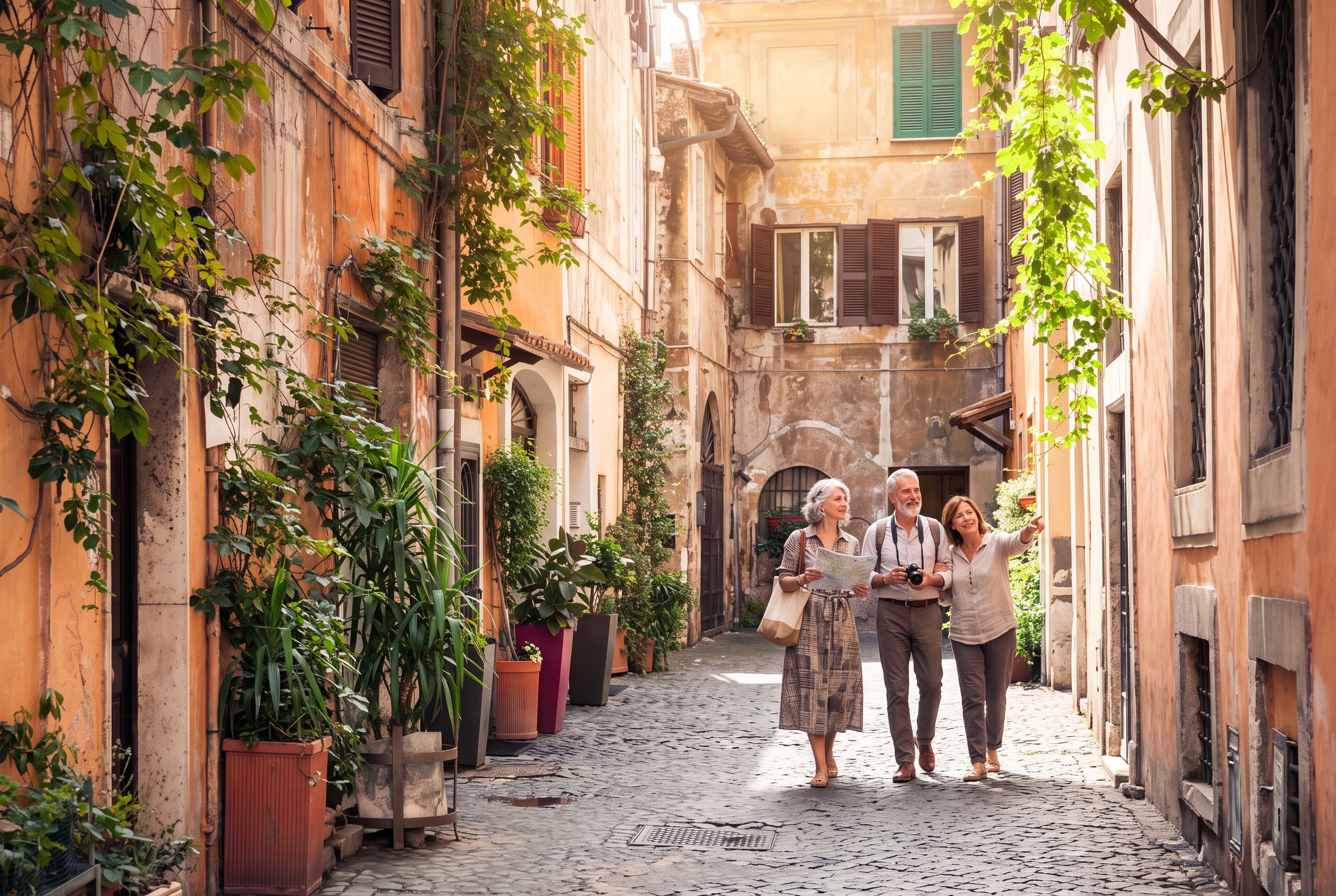 AI-edited
Is the centro storico the easiest base for walking?
The centro storico is the most consistently recommended base for travellers who want flat, manageable walking and immediate access to the Pantheon, Piazza Navona and Campo de' Fiori. A Fodors forum contributor described the area as flat, manageable and interesting, and recommended staying near Largo Argentina because it is a major hub for taxis, buses and trams.
The same discussion called a base near Piazza Navona ideal, and another contributor cited the ground between Campo de' Fiori and Piazza Navona as useful. The logic is straightforward: this is the flattest, most walkable part of the historic centre, and Largo Argentina in particular gives you bus and tram routes in several directions without a long walk to reach them.
Two practical notes. First, the Pantheon, the anchor sight of this district, is open daily from 9:00 am to 7:00 pm, with later summer evening openings in August except Thursdays, according to the Pantheon page published by the Direzione Musei Romani. Visitors with disabilities or reduced mobility may enter via the external ramp on the Via della Minerva side, the same page states.
Second, restoration work has affected the area's landmarks. Reporting in 2024 noted that fountains at Piazza Navona and a fountain in front of the Pantheon were boarded up for restoration. Sightlines and photo opportunities around the core can therefore change from season to season.
What makes Monti a good base for older travellers?
Monti is the best-documented central base for travellers who want major sights within walking distance and a reasonable chance of a quieter night. It sits close to the Colosseum, the Roman Forum, Santa Maria Maggiore and Termini, and Rick Steves forum contributors describe being able to walk to much of the city and reach other parts easily on foot.
Reddit contributors call Monti the better choice for proximity to landmarks and transport, and describe it as ideal for easy walking and moving around the city scenically. Those are guest impressions rather than a guarantee, and they come with an important qualification.
Monti properties are not uniformly quiet. Reviews of several Monti hotels report soundproofing that could be better, noise from restaurant and bar staff late at night, corridor and stairwell noise, and in one case noise from a breakfast area starting around 6am. The practical response is to read reviews specifically for noise before booking, and to ask for a room away from the street and away from the breakfast room.
Accessibility within Monti's older buildings varies. One Monti property is documented as being on the third floor without a lift, and another has small elevators with steps to reach the breakfast room and some rooms. These details are property-specific and are not documented for every building in the district; ask when booking.
Is Trastevere too noisy for a quiet holiday?
Trastevere is the most atmospheric of the central districts and the least reliable for sleep. Guest reviews describe the area coming alive at night, rooms noisy late into the night, and considerable noise from outside the windows. One source recommends it as the best Rome neighbourhood for senior travellers in spring, citing a quieter atmosphere and better accessibility than central tourist zones, but that sits against a substantial body of guest feedback about night-time sound.
The district's transport profile is different from Monti's. A Rick Steves forum contributor noted there are no Metro links close by in Trastevere, though walking to Piazza Navona, the Pantheon and the Capitoline Museums was manageable, and trams were easy to use. Tram disruption has been a recurring feature of the wider network: Rome temporarily replaced much of the tram network with buses while the Porta Maggiore tram depot was rebuilt for larger trams, affecting lines 2, 3, 5, 14 and 19 on staged dates.
Taxi drop-offs and cobbled lanes make the final approach to some Trastevere addresses less straightforward than in the centro storico. One guest review of a Trastevere property did report a quiet room and no trouble sleeping despite being steps from active streets, which suggests the outcome depends heavily on the individual building and room position.
If atmosphere matters more to you than an early night, Trastevere delivers. If you want to be asleep by ten, look elsewhere, or insist on a room set back from the street in a well-insulated building.
"Trastevere is louder at night than Monti" because it is full of restaurants and popular with younger people, a Rick Steves forum contributor wrote, recommending that travellers check lodging reviews for noise levels.
What is Prati like as a base near the Vatican?
Prati is described in Rick Steves forum posts as a really, really great neighbourhood, with relaxed evening street life, restaurants at different price points, and walking distance to the Pantheon. It is residential in feel and calmer than the tourist core, which makes it a strong choice for travellers who want the Vatican close and the crowds at arm's length.
The Vatican Museums are usually open Monday to Saturday, 9:00 AM to 6:00 PM, with Sundays closed except the last Sunday of the month when admission is free, according to the retrieved Vatican access page. The same page states that a dedicated entrance for people with reduced mobility exists on Viale Vaticano, and that wheelchairs are available free of charge on request, subject to availability. Free admission is documented for visitors with disabilities over 74% and, if applicable, a companion. No general senior fare is documented on that page.
Transport around the Vatican has been unsettled. Turismo Roma reported that the Ottaviano station near the Vatican was closed for a major makeover and then reopened, with work continuing afterwards, and that the planned closure ran from 22 July to 9 September during a period of lower attendance. The Cipro station remained open with some areas temporarily restricted. For a fuller picture of visiting the Vatican's collections without rushing, see our guide to the Vatican and Rome's great museums at an unrushed pace.
Should you stay near the Spanish Steps?
The Spanish Steps area is central, elegant and convenient for shopping, but it has been the most disrupted of the central districts for metro access. The Spagna station was closed for renovation and later reopened, with continuing restyling work reported afterwards, and ATAC states that Spagna is one of four Line A stations without lifts or stair lifts to the platforms.
That combination matters for anyone with mobility concerns. ATAC, the city transport operator, says all metro stations are accessible except Line A's Spagna, Barberini, Repubblica and Vittorio Emanuele, which do not have lifts or stair lifts to the platforms. ATAC also states that 100% of the bus fleet has boarding platforms and a wheelchair area, which makes the bus network the more dependable step-free option in this part of town.
Turismo Roma reported that the Spagna station closure was planned for 15 July to 3 October during a period of lower attendance. Rome's Metro A has also repeatedly closed early on Sunday to Thursday evenings, with buses replacing late trains: from Sunday to Thursday the last departure of Metro A trains from the terminus is at 9 p.m., after which passengers can use the MA shuttle bus line, while on Fridays and Saturdays the last departure from the terminus is at 1.30 a.m. as usual, according to Turismo Roma.
The area remains one of the most attractive in Rome for an evening stroll and for access to the shopping streets. It simply asks more of you when the metro is your intended mode of travel.
Is staying near Termini a good idea?
Near Termini is the strongest choice for rail connections and assistance desks, and the weakest for a calm environment. Recorded safety guidance flags Termini as a crowded pickpocket hotspot, so it suits travellers who want transport convenience and can manage a busier, noisier setting.
The rail case is genuine. The recorded sources document rail assistance from Roma Termini, Roma Ostiense and Roma Tiburtina, and accessible taxi booking services. For day trips, Trenitalia's Senior Offer gives discounts of up to 50% for CartaFreccia and X-GO members over 60 on Frecciabianca, Intercity and Intercity Notte services, and the offer's validity is ongoing. That makes a Termini base genuinely useful for slower-paced excursions. Our guide to getting to Rome by airport, train and transfer covers the arrival side in more detail.
Station works have affected the immediate area. Turismo Roma reported that the Vittorio Emanuele station was closed from 8 April to 30 June for extraordinary maintenance, with passengers directed to the nearby Manzoni station about 400 metres away or to Termini, reachable on bus lines 5-14-105-360-590-649.
Rome's broader accessibility picture is set out by ATAC: the bus fleet is fully ramped, the metro is accessible except for the four Line A exceptions named above, and the Termini to Centocelle line is not accessible to passengers with reduced mobility. ATAC also publishes a live accessibility and services page.
How much do cobbles, hills and heat affect the choice?
Cobbles and heat affect every district in central Rome, and the recorded guidance is explicit that the historic centre's cobblestones and stairs can make independent mobility challenging. The mitigation is not a different neighbourhood but a different daily rhythm: buses over metro, mornings over afternoons, and shorter walks with more stops.
Rome's climate figures, from the World Weather Information Service dataset for the city, show why timing matters. July has a mean daily maximum of 30.3°C and August 30.6°C, with July the driest month at 19.2 mm. The wettest months are November at 115.4 mm and October at 113.3 mm. April, May, September and October sit in the comfortable middle, and Tripadvisor identifies mid-March to mid-June and September to October as shoulder season, when prices are lower and the weather is pleasant.
For anyone prioritising step-free movement, the recorded pattern is that bus access matters more than picking a neighbourhood with an easier metro station. That single point reframes the district question: check which bus routes serve your shortlist, not only which metro stop is nearest.
| Month | Mean min / max | Rainfall |
|---|---|---|
| January | 3.1°C / 11.9°C | 66.9 mm |
| April | 7.5°C / 17.7°C | 80.5 mm |
| July | 18.0°C / 30.3°C | 19.2 mm |
| August | 18.3°C / 30.6°C | 36.8 mm |
| October | 11.3°C / 21.4°C | 113.3 mm |
| November | 6.9°C / 15.9°C | 115.4 mm |
What should you check before booking, if mobility matters?
Check the specific building, not the district. Where a detail is not published, ask the property directly before you book.
It does so for named properties. Step-free access is explicitly documented for Hotel Tritone on Via del Tritone, Hotel Marcantonio Rome on Via Cavour, Hotel Nazionale Roma on Piazza di Monte Citorio, Hotel Artemide on Via Nazionale, and River Palace Hotel. Elevator counts are documented for Hotel Tritone at three and Hotel Marcantonio Rome at two, while River Palace Hotel is noted as having spacious elevators with a concern about elevator size recorded in the same source. Grab bars and adapted fixtures are documented for Hotel Nazionale Roma, Hotel Artemide and River Palace Hotel.
Walk-in showers are not documented for any of those five properties. That is a gap in the record, not a statement that they are absent. Ask the property directly, and ask for the bathroom layout in writing.
On medical matters, the recorded sources give nearest-hospital times for those properties but do not document the nearest pharmacy to any of them. Pharmacies in Rome can be located through the official portal that finds the closest pharmacy and shows opening hours. The European Consumer Centre Italy lists major emergency hospitals in Rome including Policlinico Umberto I, Ospedale San Camillo-Forlanini, Azienda Ospedaliera San Giovanni-Addolorata, Ospedale Pediatrico Bambino Gesù and Ospedale CTO Andrea Alesini. No single nearest hospital to a specific district is documented.
On concessions, one source mentions direct-booking discounts for guests aged 65 and over, typically 10 to 20% off at many Rome hotels when booked direct by email or via the hotel website, but this is not documented for each of the named properties individually. No senior or over-65 fare for Rome's public transport or attractions was documented available. A secondary article summarising Rome's transport concessions reports that residents aged 70 and over with an ISEE up to €35,000 can receive a free annual Metrebus Roma pass; because that comes from a summary rather than ATAC's own page, treat it as reported guidance and confirm with ATAC.
How do the six areas compare at a glance?
The centro storico wins on flat walking and taxis, Monti on sight access and a better chance of quiet, Trastevere on atmosphere, Prati on calm and the Vatican, the Spanish Steps area on shopping and centrality, and Termini on rail. No single area wins on everything, and the right answer depends on which of those you will use most.
Two further points apply across the city. First, Metro A has repeatedly closed early on Sunday to Thursday evenings, with buses replacing late trains, so areas that do not depend heavily on Metro A late at night carry less transport uncertainty. Second, the historic centre's pavements and the final approach to monuments often involve uneven basalt setts, and the metro's most central Line A stations are the least accessible.
For a wider look at what to see once you have chosen, our selection of Rome's highlights chosen for the over-50s sets out the sights worth building a day around. If a slower afternoon appeals, a spa day in Rome is a documented option for resting tired legs.
Rates across all six areas are indicative and vary by season and booking channel. Rome's peak season runs June to August, with Easter and Christmas also busy, according to Tripadvisor. Booking in the shoulder months of mid-March to mid-June or September to October generally means lower prices and easier walking weather.


