
Rome's three great museum collections reward a different approach from the one most visitors bring. The Vatican Museums, the Galleria Borghese and the Capitoline Museums each publish their own access arrangements, booking rules and mobility support, and each is large enough that a single determined push through every gallery will end the day early. For travellers in their fifties and sixties, the practical question is not which masterpiece to see but how much walking, standing and queuing the day should contain. The answer, in all three cases, is decided before arrival, at the booking stage.
The good news is that the two best-documented collections, the Vatican Museums and the Galleria Borghese, both publish detailed accessibility pages, both require or strongly reward advance booking, and both operate systems that cap the crowd around you. The Capitoline Museums sit on the Capitoline Hill above the Roman Forum, and their own notices record ongoing restoration work that affects routes. What follows is the booking, mobility and pacing information each institution publishes, and how to use it.
What does each of the three collections actually hold?
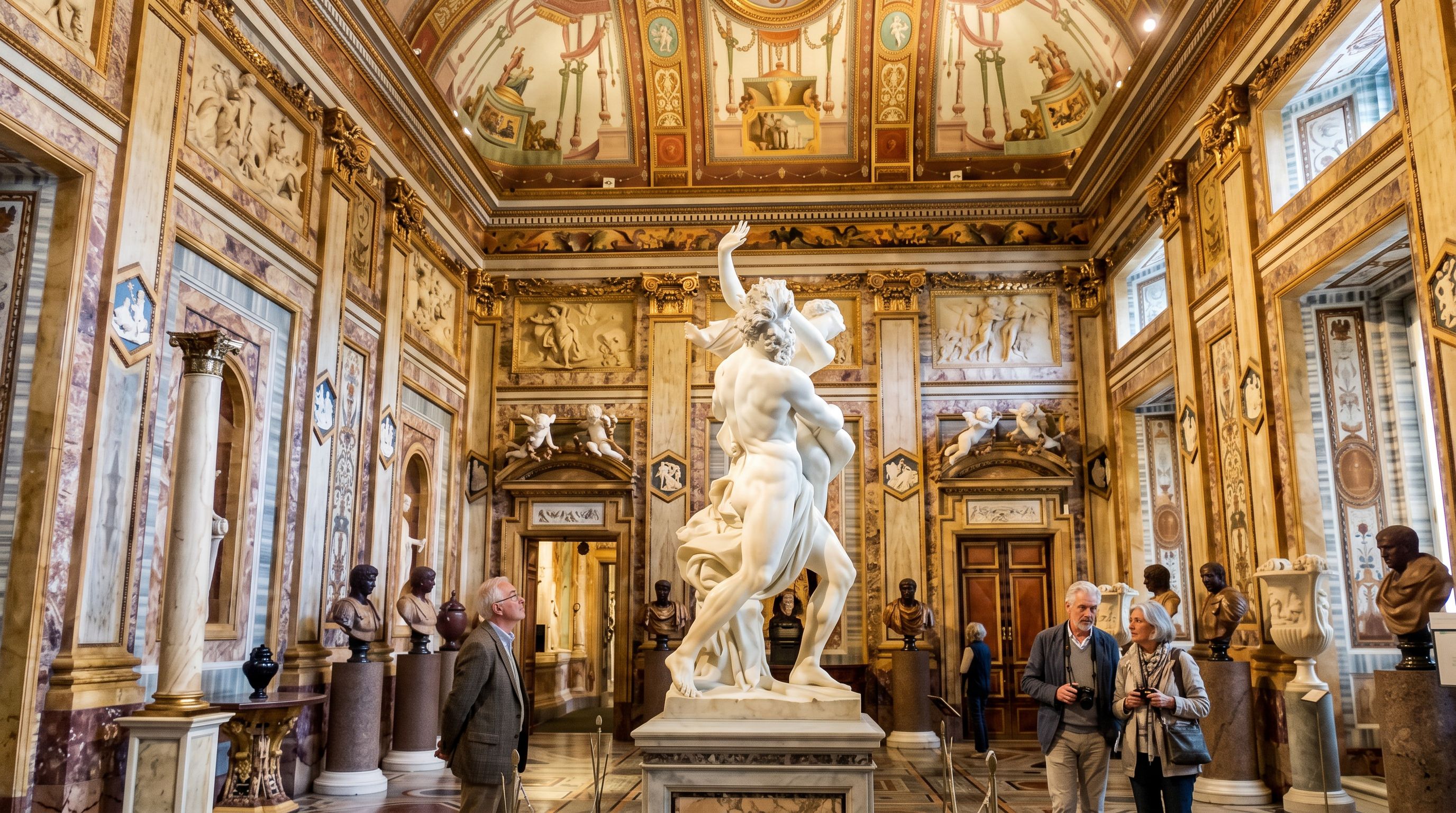
The Vatican Museums hold the Sistine Chapel, the Raphael Rooms and the classical sculpture collections, all on one continuous circuit. The Galleria Borghese holds Bernini sculptures and Caravaggio paintings in a villa with a strict two-hour limit. The Capitoline Museums hold the bronze she-wolf and the Tabularium's view over the Forum.
These are three very different buildings with three very different rhythms. The Vatican Museums are vast, with a main visitor route that runs through galleries, courtyards and the Sistine Chapel at the end. The Galleria Borghese is compact and timed: the gallery publishes two-hour visits, with shifts for a maximum of 180 people each, and the visit lasts two hours except for the 5.45 p.m. shift, according to the Galleria Borghese's official visit page. The Capitoline Museums occupy two palaces facing each other across Piazza del Campidoglio, with an underground route linking them.
That difference in scale matters more than any list of highlights. A Vatican visit is a long walk with art on both sides. A Borghese visit is a short, intense, time-boxed appointment. A Capitoline visit sits between the two, and its underground galleries add stairlifts and lifts to the route.
 AI-edited
How do I book, and what does it cost?
Book online in advance for all three. The Vatican Museums' only official online ticket site is tickets.museivaticani.va, where a full entry ticket costs €20.00 without online booking and a reduced ticket costs €10.00, or €10.00 plus €5.00 with "Skip the Line" booking on the official site. The Galleria Borghese requires reservation for every ticket category.
The Vatican Museums publish their own prices clearly. A full entry ticket is €20.00 without online booking, and a reduced entry ticket is €10.00 without online booking, or €10.00 plus €5.00 with "Skip the Line" booking on the official Vatican Museums website, according to the museum's prices and tickets page. The entry ticket entitles the holder to visit the Museums and Sistine Chapel solely on the day it is issued, and tickets cannot be refunded.
The Galleria Borghese states that reservation is required for all ticket categories, including free-of-charge tickets for visitors under 18. The gallery's ticket office is open from 8.30 a.m. to one hour before closing time. A €2 reservation fee applies, except for certain exempt categories that include disabled visitors and one companion, though booking remains mandatory for them too.
Is there a senior discount at any of the three?
No age-based senior fare is documented on the official pages reviewed for any of the three collections. The Vatican Museums' published concessions cover disabled visitors, children and certain professional categories. The Galleria Borghese documents a reduced rate for visitors aged 18 to 25. Free entry for disabled visitors and one companion is documented at all three.
This is worth knowing before budgeting. The Vatican Museums' official pricing page lists concessions for disabled visitors, children under 7 and certain professional categories, and no general senior discount by age appears there. The Galleria Borghese's official ticket page documents a reduced €2 rate for visitors aged 18 to 25, but does not document a senior discount for over-65s.
What is documented, and generously so, is disability access. At the Vatican Museums, all disabled visitors with a certified invalidity of at least 67% qualify, with appropriate documentation or the European Disability Card required, and where the visitor is not self-sufficient, free entry extends to a companion. The Capitoline Museums state that admission is free for disabled visitors and one family member or companion. The Galleria Borghese exempts disabled visitors and one companion from the reservation fee.
How do I avoid the queues and the crowds?
Book a timed slot in advance, arrive early enough to clear security and bag check, and avoid the Vatican Museums on the last Sunday of the month, when entry is free and demand is highest. The Galleria Borghese's timed-entry system caps the number of people inside at any one time, which keeps the galleries contained rather than crowded.
The Vatican Museums' official site notes free admission on the last Sunday of the month, subject to the museum opening and closure calendar. That is a high-demand day, and for anyone seeking priority access it is the day to avoid. The museums are otherwise open Monday to Saturday, 08:00 to 20:00, with last entry at 18:00, and on the last Sunday of the month from 09:00 to 14:00, subject to the calendar of openings and closures.
The Galleria Borghese publishes two-hour timed visits with a maximum of 180 people each, in published shifts. Tickets sell out weeks ahead, especially in summer. The timed system is the gallery's main crowd-control measure, and it works in the visitor's favour: the experience is designed around scarcity and control rather than volume, so there is no sense of competing with a crowd for a view of a Bernini.
What mobility support exists inside each museum?
The Vatican Museums publish the most complete mobility support of the three: a separate accessible entrance, free manual wheelchair loan from the cloakroom, lifts connecting all levels, ramps at level changes, accessible toilets on all three floors and a dedicated wheelchair viewing area in the Sistine Chapel. The Galleria Borghese publishes ramps, lifts and accessible restrooms. The Capitoline Museums publish lifts, stairlifts and wheelchairs on loan, with current restoration work affecting one palace.
At the Vatican Museums, the accessible entrance is on Viale Vaticano opposite the Pinecone Courtyard, on the same street as the main entrance but at a different gate, according to an independent accessibility summary based on the museum's official route. Free manual wheelchairs are available to borrow from the cloakroom to the right of the main entrance, with a valid photo ID and a refundable deposit. Lifts connect the ground floor, upper floor and basement, and the main visitor route is navigable by wheelchair with ramps at all level changes. Accessible toilets are available on all three floors and clearly signposted. Inside the Sistine Chapel, perimeter seating runs along the walls, and there is a dedicated wheelchair viewing area near the chapel entrance; ask a guard on arrival and they will direct you to it.
The museum's own accessibility pages add that visitors with disabilities may use a barrier-free visit itinerary, that guided tours can be arranged by reservation, and that the museums are accessible by mobility scooter and electric wheelchair, though some areas are not permitted because of space limits. Lightweight portable seats are available from cloakroom staff for visitors who can walk short distances but need to sit frequently.
The Galleria Borghese states that it is wheelchair accessible, with ramps and elevators available, accessible restrooms on every floor, service animals welcome, and assistance devices such as audio guides available on request. Its accessibility page says people with disabilities or reduced mobility can use the stair lift located to the left of the external staircase on the front façade. A detailed visitor guide published in 2026 describes the accessible entrance at the back of the building at Piazzale Scipione Borghese 5, with an elevator connecting both floors and accessible restrooms on the ground floor near that entrance.
How far will I actually walk inside?
None of the three museums publishes step counts or internal walking distances, so no reliable figure exists for any of them. What is documented is the shape of each route: the Vatican Museums run a long continuous circuit ending at the Sistine Chapel, the Galleria Borghese is a compact two-floor villa, and the Capitoline Museums spread across two palaces with an underground link.
The Vatican Museums' route is the longest of the three by a wide margin, and it is a one-way circuit rather than a set of rooms you can leave and re-enter at will. The museum publishes a barrier-free itinerary to help visitors reach main services and points of interest with assistance from the Guard Corps, which is the closest thing to a short route the institution offers.
The Galleria Borghese's two-hour limit is a natural brake. The gallery's own visit page states the visit lasts two hours except for the 5.45 p.m. shift, which means the building itself sets the pace and no visitor can over-extend. For anyone worried about museum fatigue, that constraint is an advantage.
The Capitoline Museums' route includes an underground section reached by stairlifts from Palazzo dei Conservatori to the Galleria Lapidaria and the Tabularium. The stairlifts have a maximum capacity of 300 kg, and the smaller platform measures 77 by 83 cm, according to an accessibility summary based on museum notices. That measurement is worth checking against your chair before you commit to the underground route.
What is closed or disrupted right now?
The Capitoline Museums carry the most current disruption of the three. A notice dated 9 June 2026 states that wheelchair access to Palazzo Nuovo is barred during wall restoration work on the ground-floor rooms that provide access to the lift. The Vatican Museums and the Galleria Borghese publish no comparable route closures in the material reviewed.
The Capitoline Museums' own notices also show that the Lapidary Gallery, the Tabularium Gallery and Palazzo Nuovo can close earlier for security or public-order reasons on specific dates; on 8 May 2026 they were scheduled to close at 3.00 p.m. with last admission at 2.00 p.m. The Halls of the Horti of Maecenas are closed for maintenance, and the Pietro da Cortona Room is temporarily closed.
Sources differ on the exact state of Capitoline access. One tourism board page states that from 10 June 2025, access to the staircase from Palazzo Nuovo to the Lapidary Gallery is suspended because of accessibility-project work on a new stair-lift system, while the museum's own notice dated 9 June 2026 bars wheelchair access to Palazzo Nuovo during wall restoration. The two readings cannot be reconciled here. Confirm the current route by phone before travelling, particularly if you use a wheelchair.
Elsewhere in the city, the Museum of the Roman School reopened on 17 September 2025 in the Casino Nobile with a renovated itinerary and a new focus on making the visit easier to follow. The Centrale Montemartini branch of the Capitoline Museums completed a PNRR-funded accessibility project after about 22 months, improving routes, services, wayfinding and information for physical and sensory access. That branch is a quieter option for anyone who values clearer visitor flow over the headline collections.
What are the practical rules on bags, tickets and timing?
At the Galleria Borghese, medium and large bags, shoppers, backpacks and baggage cannot be brought in; only small fanny packs and purses no larger than 21 x 15 cm are allowed. Visitors are asked to leave disallowed bags in the wardrobe. At the Vatican Museums, the cloakroom is a free service, and the museum has two cafeterias and toilets on every floor.
The Borghese bag rule is stricter than most visitors expect, and it is the single most common cause of a stressful arrival. The gallery asks visitors to leave not-allowed bags in the wardrobe, and the ticket office opens at 8.30 a.m., one hour before the first shift. Arriving with the right bag, or with time to check a larger one, removes the main friction of the visit.
The Vatican Museums' cloakroom is free, and it is also where wheelchair loan and portable seats are arranged. The museum publishes two cafeterias and toilets on every floor, which makes a mid-visit break straightforward rather than a logistical problem. Since 1 January 2024, the museums have extended public hours to 19:00, with later closing on some high-season days, capped guided groups at 20 visitors, introduced nominative tickets with identity checks, and begun a gradual expansion of air conditioning across the galleries.
For anyone combining museum days with a longer stay, the practical question of where to sleep matters as much as which gallery to book. Our guide to where to stay in Rome when comfort comes first covers the neighbourhoods that shorten the morning journey, and the city's spa hotels and wellness retreats are worth considering if a long museum day is followed by a rest day.
How should I pace the visits across a trip?
One major collection per day, with the longest (the Vatican Museums) given its own day and nothing else planned after it. The Galleria Borghese's fixed two-hour slot makes it the easiest to pair with a short walk in the surrounding park. The Capitoline Museums sit above the Roman Forum, which has its own dedicated guide.
Older visitors discussing the Vatican Museums in public forums have reported changing their strategy after a first attempt, reducing museum time and making St Peter's Basilica the main goal, with a slower lunch afterward rather than pushing through everything. That pattern is worth considering: the museums and the basilica are separate buildings with separate queues, and treating them as one outing is what exhausts people.
Skip-the-line tickets are widely described as essential for the Vatican Museums, with buying on site not recommended. That reflects a strong expectation of long queues and unnecessary standing rather than any published figure. The booking itself is the intervention.
Rome's ancient sites, including the Forum and the Colosseum, are covered in our complete guide to Rome for travellers over 50 and are not repeated here. The three collections in this article are indoor, seated where seating is published, and bookable in advance, which is what makes them the sensible backbone of a museum-focused trip.
What else should I know before booking?
The Vatican Museums offer free guided tours in Italian Sign Language for deaf and hard-of-hearing visitors on scheduled days and times, and the Galleria Borghese offers free guided tours by V.A.M.I. staff for visitors with various disabilities, by reservation. The Galleria Borghese is closed on Mondays, 25 December and 1 January.
The Galleria Borghese's accessibility page gives contact details for accessibility planning and says a video-call information service is available for deaf visitors on request. The gallery can also arrange guided visits in Italian Sign Language, International Sign and American Sign Language. The Vatican Museums' sign-language service is offered free of charge to deaf visitors, with specific booked time slots.
Emergency numbers for the Vatican Museums, the Galleria Borghese and the Capitoline Museums are not documented on the official pages reviewed, and neither is the location of the nearest pharmacy or medical help to any of the three. Ask at the information desk on arrival rather than relying on a plan made in advance.
Rome opened the Colosseo–Fori Imperiali station in 2025, and coverage says the line will eventually extend toward Piazza Venezia and then the Vatican area. That extension is future-facing rather than immediate, so plan museum days around the transport that exists now.
For the wider city, from restaurants to day trips, our Rome guide for over-50s covers the ground this article deliberately leaves alone. The three collections here are best treated as a sequence of appointments rather than a checklist, each with its own booking, its own entrance and its own published pace.


