
Rome rewards a certain kind of traveller more than any other city in Europe. The historic centre is compact enough that the Colosseum, the Forum, the Pantheon and Piazza Navona sit within a few kilometres of one another, and the city's own museum authority has spent years adapting its major sites for visitors who no longer want to sprint between them. The catch is that cobblestones, standing time and crowds decide how a day actually feels, not the map. This guide takes the headline sights one at a time and sets out the effort each one asks of you, where the benches are, and when to go.
It is written for travellers aged 50 to 70, from those who still walk five kilometres before lunch to those who prefer a taxi between every stop. Both approaches work in Rome. What does not work is over-ambition, which is the single most common piece of advice older visitors pass on to one another in travel forums. Pick two sights a day, build in a long lunch, and let the city come to you.
What makes Rome work for older travellers?
Rome works for over-50s because its major sights cluster tightly, its state museums offer free entry to EU citizens aged 65 and over on the first Sunday of each month, and several headline sites have documented step-free routes. The trade-off is uneven ground: cobblestones in the historic centre and a Forum that is harder to navigate than the Colosseum.
The city's own museum authority, Musei in Comune Roma, publishes a concessions page confirming free admission to everyone on the first Sunday of each month, and a 50% reduced rate for non-resident visitors every Wednesday in the last two hours of each museum's opening time. Those are real savings, though the free Sundays are also the busiest days of the month.
The Vatican Museums run a separate scheme. Visitors with a certified invalidity of at least 67% enter free, and where the visitor is not self-sufficient, one companion enters free too. Those tickets cannot be booked online; they are issued in person at the Special Permits or Welcome Desk in the museum entrance hall, and the disabled visitor and companion are guaranteed priority entry without queuing.
For everything else, the practical rule is to plan around terrain rather than distance. A taxi between the Colosseum and the Vatican removes the least rewarding part of the day. If you are arriving by air, our guide to getting to Rome by airport, train and transfer covers the arrival end of the trip.
Is the Colosseum manageable with limited mobility?
The Colosseum is one of Rome's better-adapted heritage sites. It has an accessible entrance on the south side, lift access to the main visitor levels, and a principal route that can be completed without stairs. The arena floor is also reachable with the upgraded ticket.
That combination makes it the most straightforward of the ancient sites for anyone with mobility concerns. The main tier can be navigated without climbing, which is unusual for a building of its age and scale, and the lift removes the worst of the vertical effort.
Rome's official ticket channels and the Colosseum's own pages should be checked directly before you commit, and official websites or ticket offices are consistently recommended over street vendors. Ticket touts and unsolicited "skip the line" offers around the Colosseum and the Vatican are widely treated as scams by regular visitors.
 AI-edited
On timing, no source documents the calmest hour or day at the Colosseum specifically. What is documented is a general pattern that older visitors report working well: start early, take the hottest hours indoors or in an air-conditioned room, and use taxis for the longer hops rather than assuming midday walking is comfortable.
How hard is the Roman Forum and Palatine Hill?
The Forum and Palatine area is explicitly flagged as more difficult than the Colosseum, with accessibility described as moderate rather than good.
That is worth taking at face value. Where the Colosseum has a documented accessible entrance and lift, the Forum does not carry the same level of published provision in the material available. Treat it as the more demanding half of the ancient-centre pair, and decide on the day rather than committing in advance.
The general rule that applies across state museums, free entry for EU citizens aged 65 and over on the first Sunday of the month, is stated for the museum system rather than for this site individually, so confirm at the ticket office.
If the Forum looks like too much on the day, the Colosseum alone still gives you the scale of ancient Rome, and the view down into the Forum from the surrounding streets costs nothing and involves no uneven ground.
Can you see the Vatican Museums without stairs?
Yes. The Vatican Museums operate a designated wheelchair and limited-mobility route through the main galleries that avoids steps entirely, with elevator access at the major staircase points. The route runs through the Egyptian Museum, the Gallery of Maps, the Raphael Rooms and the Sistine Chapel.
That is the single most useful fact for anyone worried about the Vatican. The museums are vast, and the standard visit involves a great deal of walking, but the step-free pathway means the walking can be paced rather than interrupted by staircases. Benches are also available for resting along the way, which visitors consistently note as making the museums manageable.
On tickets, the official Vatican Museums price page lists standard adult entry at €20.00 without online booking, and €20.00 plus a €5.00 booking fee when reserved through the official site. Reduced entry is listed at €10.00 without online booking, or €10.00 plus €5.00 with the "Skip the Line" booking service. There is also a €5.00 tier without online booking, and €5.00 plus €2.00 with the booking service.
| Ticket type | Without online booking | With booking on the official site |
|---|---|---|
| Standard adult entry | €20.00 | €20.00 + €5.00 |
| Reduced entry | €10.00 | €10.00 + €5.00 ("Skip the Line") |
| Lower tier | €5.00 | €5.00 + €2.00 ("Skip the Line") |
| Full entry ticket | €12.00 | Not stated |
Free entry applies on the last Sunday of the month, subject to the museum's calendar of openings and closures, and children below the age of 7 enter free. The Vatican Museums do not document a general over-65 discount. Their documented concession is disability-based: free admission for all disabled visitors with a certified invalidity of at least 67%, extended to a companion where the visitor is not self-sufficient.
For a slower, more structured approach to the city's collections, our guide to the Vatican and Rome's great museums at an unrushed pace goes deeper into pacing the galleries.
What about St Peter's Basilica?
St Peter's Basilica is supported only indirectly, through the Vatican Museums' accessibility guidance. Exact mobility details for the basilica itself are not documented in the material available, so any specific claim about its entrance, lifts or seating would be guesswork.
What can be said is that the Vatican area as a whole is served by the museums' published provisions, and that the surrounding piazza is open ground. Beyond that, the honest position is that the basilica's own access arrangements should be confirmed with the site directly rather than assumed from the museums' information.
This matters because the two are often treated as one visit.
Which central sights are easiest on the legs?
Piazza Navona is the standout. One source describes the square as easy to visit in a wheelchair, with fairly uniform cobblestones and mostly flat ground. As a public square it has no entry requirement and no booking system, so it can be visited for as long or as short a time as you like.
That combination, flat ground, no ticket, no queue, makes Piazza Navona the natural anchor for a gentle day in the historic centre. The clustered baroque sights around it are also described as being on the flat and doable on a very gentle self-guided walk with coffee or cocktail stops built in.
The Pantheon sits in the same general area of the centre.
An evening piazza stroll is one of the few Rome experiences that costs nothing and demands nothing. The city's historic centre holds UNESCO World Heritage status as part of the listing for the Historic Centre of Rome, the Properties of the Holy See and San Paolo Fuori le Mura, which is a formal way of saying that the streets themselves are the attraction.
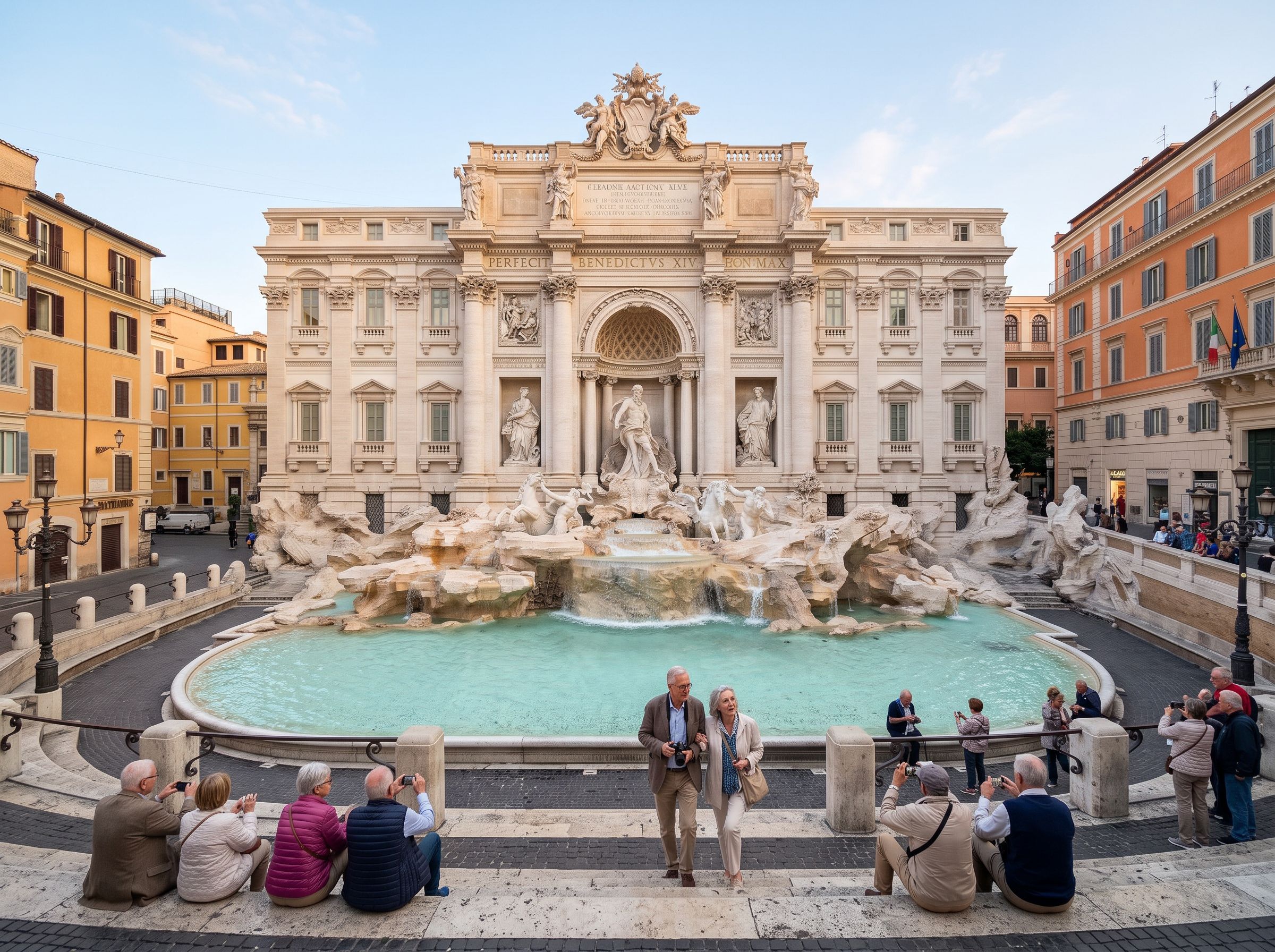
Is a gelato by the Trevi Fountain worth the crowd?
A gelato nearby is a pleasure best taken as a short stop rather than a planned visit.
Because no source in the material documents the calmest time at the fountain, the sensible approach is the one older visitors report using across the city: go early, or go late, and do not expect to linger. The fountain itself is viewed standing, and the surrounding lanes are narrow and uneven.
The gelato is the easy part. Take it a street or two away from the fountain, where the pavement widens and the crowd thins, and treat the fountain as a passing view rather than a destination you settle into.
When should over-50s visit Rome?
April to May and September to October are the practical sweet spots, with milder temperatures and lower rainfall than late autumn. Rome's climate data show January at 3.1°C to 11.9°C with 66.9 mm of rain, July at 18.0°C to 30.3°C with 19.2 mm, and November as the wettest month at 6.9°C to 15.9°C with 115.4 mm.
Those figures describe the city of Rome itself rather than the wider province. They also show why the shoulder seasons work: July's heat is dry but real, and November's rainfall is nearly six times July's.
Rome is not a seasonal destination in the usual sense. The documented climate pattern shows it can be visited all year, with weather rather than closures shaping the best time to go. Officially documented tourism-seasonality data for the municipality were not found, so no claim is made here about which months are busiest beyond the general note that the free-entry days are crowded.
Heat is the main planning consideration for older visitors. The recurring advice from experienced travellers is to explore early, spend the heat of the day indoors or in an air-conditioned room, and rely on taxis when energy runs low.
How do you get around Rome without exhausting yourself?
Use taxis between major sites and reserve walking for shorter, flatter segments. On the metro, ATAC states that all stations are accessible to passengers with reduced mobility except Line A stations Spagna, Barberini, Repubblica and Vittorio Emanuele.
The Termini-Centocelle line is also not accessible to passengers with reduced mobility, according to ATAC. Bus travel is generally reported by independent accessibility guides as the most reliable low-step option, though the official basis is ATAC's metro access framework rather than a bus-by-bus assessment.
Metro A has been subject to rolling closures and early shutdowns tied to the Jubilee 2025 programme. According to Turismo Roma's notice on the Metro A renovation works and station closures, from Sunday to Thursday the last departure of Metro A trains from the terminus is at 9 p.m., with a shuttle bus service (the MA bus line) covering the rest of the evening. Friday and Saturday late service runs longer.
Stations including Spagna, Ottaviano, Furio Camillo and Lepanto were affected at different points, and press coverage noted that a reopened station did not always mean fully finished works. Check the current status before relying on a specific stop.
For health and safety, Rome's emergency system uses 112 as the European single emergency number, with 113 for police, 118 for medical emergencies and 115 for fire, as set out in this guide to Rome's emergency numbers. Tourist police assistance is listed at Via del Corso 482, Rome, on +39 06 6729 5287.
| Number | Service |
|---|---|
| 112 | General European emergency number |
| 113 | Police |
| 118 | Ambulance and medical emergency |
| 115 | Fire brigade |
| +39 06 6729 5287 | Tourist police, Via del Corso 482 |
Are there passes or reduced fares worth knowing about?
The Roma Pass is the main city card. The official card pages state it gives free entry to selected sites, reduced rates to others, public transport and free P.stop toilets, and it is sold in 48-hour and 72-hour versions. The official pages do not describe an age-based senior fare.
The structure is straightforward: free entry to the first one or two selected sites, reduced tickets thereafter, and free public transport for the duration of the card. The Roma Pass page also flags that most museums are closed on Mondays, and that many are also closed on 25 December, 1 January and 1 May, with individual site pages needing verification.
Beyond the pass, the clearest official value for older visitors is not a broad over-65 discount. It is the combination of the free first Sunday for EU citizens aged 65 and over, and the Wednesday 50% rate for non-residents in the last two hours of opening, both published by Musei in Comune Roma.
For visitors who prefer less strenuous sightseeing, the most consistently accessible official options in the material are the municipal museums, the Vatican Museums' disability provisions, and the National Roman Museum, whose accessibility page states that all its museum sites are accessible to persons with limited mobility via designated pathways that avoid structural and architectural barriers. That page also notes lifts and accessible restrooms on the ground floor and second floor, wheelchairs available at each site, and that visitors can sit, relax and read in the exhibition spaces.
How should you pace a Rome day?
Two sights a day, an early start, a long indoor break during the hottest hours, and a taxi rather than a walk between distant points. That is the pattern older travellers consistently recommend, and the most common regret reported is over-ambition rather than missed sights.
Staying central helps, because it turns the day into something you can walk at your own pace rather than a sequence of transfers. It also makes it easy to return to a room during the heat of the day and go out again in the evening, which is when the piazzas are at their best.
If you want to build rest into the trip rather than just into the day, our guide to Rome's spa hotels and wellness retreats covers where to recover between sightseeing days, and where to stay in Rome when comfort comes first deals with the accommodation side in detail.
One final piece of practical advice that recurs across traveller reports: keep some cash for taxis, book through official channels rather than street sellers, and treat any unsolicited "skip the line" offer as something to walk past.


