
Hoi An divides into three practical bases for a longer stay: the historic Old Town and its buffer streets, the riverside districts immediately outside the pedestrian zone, and the coastal strip at An Bang and Cua Dai. Each solves a different problem. The Old Town removes the need for daily transport. The riverside keeps you close to the heritage core while stepping back from its evening crowds. The beach trades convenience for quiet, a pool and a slower rhythm. For travellers aged 50 to 70, the choice usually comes down to how much walking you want, how much heat you can take, and whether you would rather book a shuttle than flag a car.
Hoi An Ancient Town sits in Quang Nam Province, on the north bank near the mouth of the Thu Bon River, according to UNESCO's World Heritage listing, which inscribed the town in 1999. The inscribed property covers 30 hectares with a buffer zone of 280 hectares, and it holds 1,107 timber-frame buildings arranged in tight, unbroken rows along narrow pedestrian streets. That geometry explains almost everything about where to sleep. The lanes are short, the shophouses front the street and open to the river behind, and the whole historic core is compact enough to cross on foot in a morning.
 AI-edited
Which base suits you best?
The Old Town suits travellers who want to walk to dinner, the riverside suits those who want quiet within reach of the heritage core, and An Bang or Cua Dai suits anyone prioritising resort facilities and a pool over daily sightseeing. The beach is 4 to 5 km from the Old Town and needs a bicycle, a car or a hotel shuttle.
The strongest practical argument for the Old Town is that it removes transport from your day entirely. Attractions, restaurants, cafes, tailors and evening activity are concentrated in and around the historic core, and the streets are described as walkable and pedestrian-friendly. There are few hotels inside the UNESCO-designated area itself; most recommended accommodation sits in the surrounding buffer zone, including Son Phong and Cam Pho.
An Bang Beach, by contrast, is about 4 to 5 km from the Old Town, with a quieter, relaxed atmosphere and beachfront restaurants, cafes and bars. It is not within walking distance of the town. Sources describe reaching it by bicycle, motorbike, Grab or hotel shuttle instead. Cua Dai lies about 5 km out and is characterised by larger resort properties and a resort-style atmosphere.
What is the Old Town actually like to stay in?
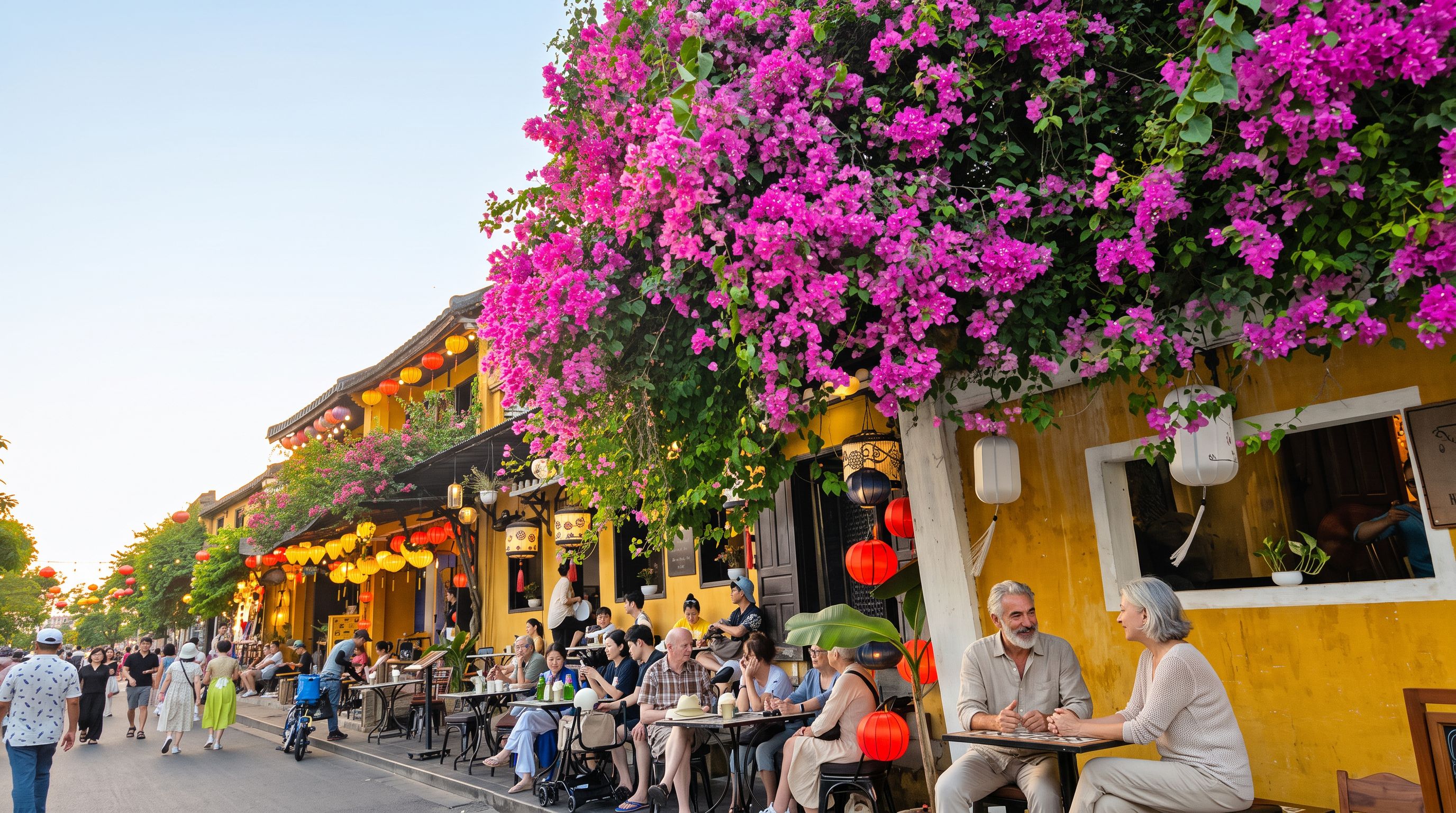
The Old Town is busy, well lit into the evening and the most convenient base in Hoi An. Vehicles are restricted during published hours, which creates a quieter pedestrian environment but can mean walking from the vehicle-accessible edge with your luggage. It is the strongest base for heritage, evening atmosphere and walking.
The heritage core closes to motorised vehicles during published periods: 08:00 to 11:00 and 15:00 to 21:30 according to TravelFish, leaving the streets open to pedestrians and cyclists. A separate local guide describes the central closures as roughly 07:00 to 09:00 and 16:00 to 21:30, so guests should confirm the current hours locally rather than plan around a fixed window.
That restriction cuts both ways. It gives you lantern-lit streets in the evening and a visible tourist-police presence. It also means a car cannot reach your door during those hours, so anyone with luggage or limited mobility may need to walk from the edge of the zone. For a guest who walks independently but tires easily, a hotel near the edge of the pedestrian zone is more practical than one deep in a narrow lane.
Entrance to the monuments is ticketed. The official visiting notice lists tickets at 80,000 VND and 120,000 VND depending on the number and type of included monuments, and visitors need to purchase a ticket only once, valid throughout a stay in Hoi An of up to three days. Summer opening hours are generally 9:00 to 21:30 and winter hours 9:00 to 21:00. Phan Chau Trinh Street runs 17:30 to 21:30 in summer and 17:30 to 21:00 in winter, per the Hoi An Heritage Centre notice. A 50% discount applies to several categories, including elderly people under Vietnam's Elderly Law, but the notice is explicit that this is for Vietnamese visitors; no general international senior fare is published.
What does "riverside" actually mean in Hoi An?
Riverside is not one officially defined district. The experience depends entirely on whether the hotel sits beside the Old Town, on the southern bank toward Cam Chau, or farther out toward Cam Thanh. A riverside base can be quieter than the centre while remaining close to it, but proximity depends on the exact bank and address.
An Hoi Island is described as pedestrian-friendly and connected to the riverside by An Hoi Bridge. Riverside accommodation offers views toward the Old Town and convenient access to restaurants and evening activity. Properties close to the historic centre retain much of the town's dining and sightseeing convenience while avoiding some of its evening congestion.
If you are choosing on the basis of an easy walk, that detail has to come from the property, not from a map.
Is the beach worth the commute into town?
For a resort-centred stay, yes. An Bang is quieter than the Old Town and has beachfront restaurants, cafes and bars, but it is not walkable to the heritage core. Guests rely on bicycles, Grab, taxis or complimentary shuttles, and a scheduled shuttle is generally more comfortable than cycling in heat or rain.
Some accommodation providers reportedly offer free shuttles to the Old Town, commonly several times daily, but schedules must be confirmed directly with the property. One Tripadvisor description places the journey from the beach area to town at roughly ten minutes by taxi. A free shuttle is praised as useful, with guests advised to reserve ahead and arrive on time, which indicates that it runs to a schedule rather than on demand.
An Bang connects to Hoi An by relatively flat roads and is commonly reached by bicycle. One forum contributor put the beach at roughly ten minutes by bicycle from near Tra Que village, another at about fifteen minutes by pedal from the town-side area.
Cua Dai, farther south than An Bang, is described as quieter, with larger resort properties and fewer dining options outside the hotels, according to Vietnam Tourism's comparison of the Old Town and the beach. It suits travellers who want resort facilities and on-site dining rather than a choice of restaurants on the doorstep.
How much does the heat affect the choice?
Hoi An's dry season runs February to August and the wet season September to January, with October and November the wettest months. June to August are hot and humid, with average highs of 34°C. In those months, a central hotel with a pool, or a property with a confirmed shuttle, is more comfortable than relying on walking or bicycles.
The month-by-month figures below describe Hoi An and the wider Da Nang region, not a separate Old Town, Riverside or beach microclimate, per the Vietnam National Administration of Tourism. They are long-term averages and individual years vary.
| Month | Average high | Average low | Rainfall |
|---|---|---|---|
| January | 24°C | 18°C | 95 mm |
| February | 26°C | 19°C | 32 mm |
| March | 28°C | 21°C | 38 mm |
| April | 31°C | 23°C | 48 mm |
| May | 33°C | 25°C | 98 mm |
| June | 34°C | 26°C | 118 mm |
| July | 34°C | 26°C | 104 mm |
| August | 34°C | 26°C | 142 mm |
| September | 31°C | 24°C | 314 mm |
| October | 28°C | 22°C | 655 mm |
| November | 26°C | 20°C | 438 mm |
| December | 24°C | 18°C | 185 mm |
February to April is consistently identified as the most comfortable period, with the dry season attracting substantial demand. October and November are the most weather-sensitive months, and flooding has affected the historic centre in some years. Tourism reporting notes that the beach is less convenient than the Old Town for heritage visits in hot or wet weather, because the two areas are separate parts of the municipality.
What should travellers with mobility considerations check?
Vietnam Tourism's disability-access guidance says Hoi An's Old Town is partly accessible because the streets are generally flat, while bridges and boat rides may require assistance. The same guidance warns that Vietnamese pavements can be broken, kerbs high and traffic unpredictable. No source documents continuous step-free pavements or a fully accessible riverside promenade in Hoi An.
Across the properties named, lift availability, step-free entrances, walk-in showers and room-by-room mobility features are not documented. That is not a statement that they are absent; it is a statement that the information is not published. The practical response is to ask the property directly, and to ask for photographs of the entrance, the bathroom, the route to the road and any river or beach access.
Vietnam Tourism advises confirming accessible rooms directly with hotels and booking early. It also says private cars with drivers are the practical option for shorter journeys when accessibility is important. Grab is reported to operate in Hoi An, and private cars with drivers are recommended as the more comfortable option for visitors with limited mobility.
No source documents a continuous step-free route from Hoi An's beach hotels to the sand, or verifies accessible beach boardwalks or beach wheelchairs at specific properties. Coastal erosion has affected parts of Cua Dai beach, though current beach accessibility and safe step-free routes are not documented. Check the current beach condition before booking rather than relying on older hotel descriptions.
Four details are worth asking about directly, because reviews do not reliably cover them: lift access, the number of entrance and bedroom steps, whether the shower is genuinely walk-in, and whether breakfast is a buffet or cooked to order. Positive comments about service or food are not evidence of accessibility.
Where do you find a pharmacy or medical help?
Pharmacies are reported throughout Hoi An's Old Town and on roads toward the beach, but no source identifies a single nearest pharmacy for a named hotel in any of the three areas. Hoi An Hospital is at 4 Tran Hung Dao Street, and Pacific Hospital at 6 Phan Dinh Phung Street, with a 24-hour emergency service.
Hoi An Hospital is described by TravelFish as inexpensive and adequate for basic treatment such as stitches. A more recent medical guide says Hoi An does not have an international-standard hospital and that serious cases may require transfer to Da Nang. Higher-level emergency and surgical care is reported in Da Nang.
Vietnam's national emergency numbers are 115 for ambulance, 113 for police and 114 for fire. The safest practical arrangement is to ask the hotel for the nearest open pharmacy on arrival, rather than trying to identify one in advance.
Is it safe to walk in the evening?
Hoi An is generally described as a low-violence destination. The recurring cautions are petty theft, scams, traffic and the hazards of poorly lit or uneven side streets. The Old Town is safer for walking during vehicle-restricted hours, but crowded streets create opportunities for bag or phone theft.
The three bases carry different evening considerations. In the Old Town, the vehicle restriction reduces motorbike conflict, but bicycles can still be difficult to navigate when the area is crowded. On the riverside, it is worth checking the exact route back to the hotel after dark, because some lanes may be quiet or poorly lit. At the beach, resort compounds may feel secure, but the roads outside them are darker and more traffic-dependent at night.
No property-specific safety details are stated for the hotels named. If you are returning after dark, ask reception to arrange the car rather than walking an unfamiliar lane.
Where should a first-time visitor aged 50 to 70 stay?
For a first Hoi An stay, the strongest practical choice is the Old Town or the immediate riverside area, preferably with a pool and quiet rooms. Select the beach only if resort relaxation is the main purpose. Consider Tra Que or the central rice-field corridor when a quieter setting with easy taxi access to both town and An Bang appeals more than being beside either.
Guest feedback points to a practical divide. The Old Town is best for immediate access but carries more risk of street noise. The beach is generally quieter but requires cycling, taxis or hotel shuttles. Riverside and in-between locations offer the most balanced compromise, and guests repeatedly praise free bicycles and scheduled shuttles at properties in that middle band.
One property-level example illustrates the trade-off. Guests at Hoi An Historic Hotel, which sits within walking distance of the Old Town with the walk reported at about five to ten minutes, describe the rooms as large and comfortable and the breakfast buffet as extensive, with eggs cooked to order. The same review set notes that the front building has no lift and that some rooms face the pool or road, which guests report can be noisy at night. As of October 2026, the hotel holds a Google rating of 4.5 out of 5 from 2,762 reviews. That pattern, convenience plus a specific noise caveat, is the one to plan around wherever you book.
"We have visited on three separate occasions and love this Hotel, beautifully located to my mind it is simply the best in terms of overall service and enjoyment." (Google, September 2026)
If the heritage core is the reason for the trip, our guide to the shophouses, temples and covered bridge of the Old Town covers what you will actually be walking between. If you are still working out how to arrive, getting to Hoi An from Da Nang sets out the transfer options, and Hoi An has no airport or railway station of its own.
How do you book, and what should you confirm first?
Booking channels are documented for some properties and not others, and cancellation terms are not documented for any of them. Rates are indicative and vary by season and booking channel. Confirm shuttle schedules, lift access and room position directly with the property before you commit.
Several properties are identified through Agoda and Booking.com in the recommending publications, but cancellation conditions and accessibility-assistance arrangements are not stated for any of them. Hotel-operated tours, classes, rentals, shuttles and seasonal programmes are likewise not documented at property level, with the exception of the free shuttle reports at some beach and riverside properties, which must be confirmed directly.
Hoi An welcomed more than 4.42 million visitors in 2024, according to the national tourism authority. That is a figure for Hoi An as a whole, not a separate count for the Old Town, the riverside or the beach, and the official material does not publish a month-by-month visitor series for the three accommodation zones. The Hoi An Heritage Centre separately reported approximately 1.695 million ticketed visitors to the heritage site in 2025, which measures ticketed visits rather than people staying in Hoi An.
If you are planning time away from the base itself, a massage and spa day in Hoi An is a reasonable half-day to build in, and the finest of Hoi An chosen for the over-50s covers the wider town. For a first visit, book the Old Town or riverside edge, ask four questions before you pay, and treat the beach as a day trip until you know how the shuttle actually runs.


