
Hoi An rewards a certain kind of traveller: the one who no longer needs to see everything, and would rather see the right things properly. The Ancient Town is a UNESCO World Heritage cultural site, compact and largely flat, and its ticketed heritage collection takes in more than 20 historic houses, assembly halls and museums. The official conservation authority asks visitors to buy a ticket before entering the heritage area, and that ticket is valid throughout a stay in Hoi An of up to three days. The experiences below are the ones that repay a slower pace.
This guide covers the lantern-lit streets, the Japanese Covered Bridge, a tailor fitting, a boat on the river at dusk and An Bang beach, each with its effort level, its shade, and the timing that keeps you out of the midday heat and the evening crush. Hotels and the Old Town's own architecture are handled in their own guides, linked where they arise.
When is the best time of year to visit Hoi An?
February to April is the most comfortable window for walking, heritage visits and cycling, with warm, comparatively dry weather. October and November are the wettest months and carry the greatest flood risk in the low-lying Ancient Town. May to August is hot and humid, with June and July highs around 34°C, so plan midday rests.
The figures for the wider Da Nang area, which includes Hoi An, run from a January high of 24°C with 95 mm of rain, through a February high of 26°C with 32 mm, to an October high of 28°C with 655 mm. November is wetter still at 438 mm and carries the highest stated flood risk. The dry, hot season runs roughly from early May to early September; the wetter season from about mid-August to mid-December.
For anyone who tires in humidity, the practical shape of a day is an early start, a long seated middle, and a return to the streets only if the lantern atmosphere appeals. Travellers discussing Hoi An with a 65-year-old companion describe 6 to 9 a.m. as the most comfortable window for cycling, sightseeing and eating, and one long-stay account describes the Old Town at 6 a.m. as especially beautiful, with locals beginning their day and far fewer visitors about.
How do you see the lantern-lit Old Town without the crush?
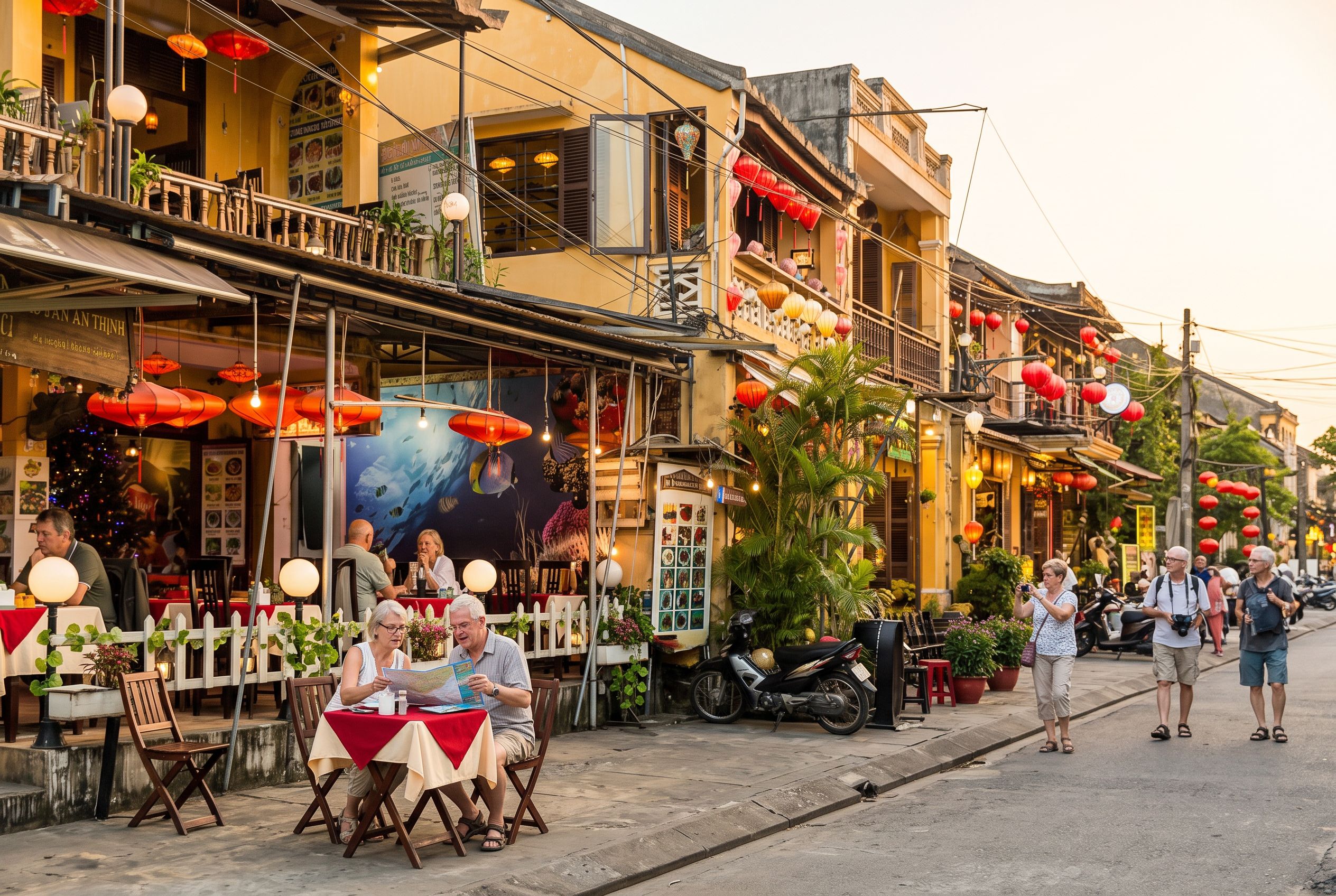
Go early. The official Ancient Town visitor hours run 9:00 a.m. to 9:30 p.m. in summer and 9:00 a.m. to 9:00 p.m. in winter, with vehicle restrictions in the pedestrian periods. The centre becomes crowded and stressful from late morning through evening, so the calmest approach is a dawn walk, a midday rest, and a short early-evening return.
The official heritage notice sets pedestrian or vehicle-restricted periods that improve comfort, with seasonal variations, and notes that Phan Chau Trinh Street has a separate evening restriction period. Those restrictions do not make every surrounding street traffic-free, so the side streets remain the easy retreat when the main shopping streets fill up.
The evening programme is the reason many visitors come. The official notice lists the "Night Town" project, which includes Bai Choi games, folk games, folk singing classes, pre-war music singing and street performances with traditional instruments. A floating-lantern release is held on the full-moon night of each lunar month. If the lanterns are the priority, see them early in the evening and then withdraw to a quieter street or riverside spot rather than staying for the peak.
 AI-edited
For the architecture itself, the shophouses, temples and the bridge have their own treatment in the guide to the Old Town's shophouses, temples and Covered Bridge.
What does the Ancient Town ticket cover, and what does it cost?
The official conservation authority asks visitors to buy a ticket before entering the heritage area. The published structure is 80,000 VND for the listed domestic ticket and 120,000 VND for the higher structure covering the general townscape, one major monument, one museum-system site and three additional sites. A ticket is bought once and is valid throughout a stay in Hoi An of up to three days.
Official counters sit at entrances including Tran Phu, Nguyen Thai Hoc and Le Loi; other sources also list Bach Dang and the An Hoi Bridge area. The authority states that if you have visited all the sites included in the ticket, you should keep the stub for easy access to the ancient town.
Concessions are narrow. The official notice lists a 50% discount for Vietnamese elderly people under the Elderly Law and several other Vietnamese categories, and exemptions for children under 16, people from poor households, journalists, researchers, members of the Vietnam Heritage Association and people with severe disabilities. It does not establish a general discount for foreign visitors aged over 65, and where a visitor qualifies for more than one benefit, only the 50% discount applies.
Ticket booths are reported at approximately 07:00 to 21:30 in summer and until 21:00 in winter, with heritage buildings open approximately 08:00 to 17:00 daily. Individual museums, assembly halls and historic houses may keep their own schedules, so verify the specific site before travelling. Tuổi Trẻ reported in February 2026 that Hoi An introduced 12 automated ticket kiosks with multilingual support for the Ancient Town, which should reduce queuing at staffed counters.
Is the Japanese Covered Bridge worth it, and how hard is the walk?
The Japanese Covered Bridge is one of Hoi An's principal monuments and is included among the ticketed heritage choices. The Ancient Town is compact and generally flat, and one tourism source describes it as relatively manageable for travellers with mobility limitations, while identifying uneven paving and steps into historic buildings as the main obstacles.
That is the honest picture. Street walking is flat overall but the paving is documented as uneven. Steps into the historic interiors are documented as a difficulty, and step-free routes are not documented for the named houses, halls, museums or the bridge. Lifts are not documented for the named heritage buildings, distances between attractions are not documented in the cited sources, and no source documents accessible toilets, wheelchair hire or a formal mobility-assistance service for the individual heritage sites.
Seating and rest points are not documented in the cited sources either, so plan on the assumption that you will be standing more than you expect. The defensible approach is to select only the buildings whose entrance conditions you can check in person, and to ask the official ticket counter about current closures and assistance. The Hoi An Museum at 10b Trần Hưng Đạo is listed with posted hours of 7:30 to 11:30 and 13:30 to 17:30 in a Tripadvisor listing updated in March 2026, with admission through the town's ticket system; the material does not document lifts, wheelchair access or guided tours specifically there, so treat accessibility as unconfirmed.
What happens at a tailor fitting, and how much standing is involved?
A tailor fitting is a seated, indoor, air-conditioned activity, which makes it the natural midday anchor of a Hoi An day.
What can be said with confidence is the shape of the experience. Fittings involve measurement, a first garment, and one or more adjustments, which means two or three short visits rather than one long one. That rhythm suits a hot afternoon: you are indoors during the worst of the heat, and you are not on your feet for the duration.
No recommendation is made here. Ask about turnaround time, the number of fittings included, and whether the shop can accommodate a seated fitting. Ask, too, whether the work is done on the premises or sent out, since that affects how quickly an adjustment can be made before you leave Hoi An.
Pair a fitting with the indoor cultural programme rather than with more walking. The official notice lists art performances at the Traditional Art Performance House, 66 Bach Dang Street, at 10:15 a.m., 3:15 p.m. and 4:15 p.m. daily, and a Japanese tea ceremony at the Japanese Culture Gallery, 06 Nguyễn Thị Minh Khai Street, at 9:30 a.m. and 4:30 daily. Both are seated and both fall inside the hours when the streets are busiest.
When should you take a boat on the river at dusk?
Dusk is the right hour, and the reason is the lanterns rather than the water. The Ancient Town's evening programme runs into the night, with the official visitor hours ending at 9:30 p.m. in summer and 9:00 p.m. in winter. A boat taken early in the evening gives you the lit riverbank without the peak-hour crowds on the quayside.
Confirm them locally, and confirm in particular whether the boat has a step-down boarding point, since boarding arrangements are not documented.
The evening folk games and street performances are listed from 7:00 to 8:30 p.m., and the pedestrian restriction periods in summer run from 5:30 p.m. to 9:30 p.m. and in winter from 5:30 p.m. to 9:00 p.m. That is the window when the riverbank is at its most photogenic and its most congested. A boat removes you from the congestion while keeping you inside the view.
If the full-moon lantern release is the draw, note that it falls on the full-moon night of each lunar month, which concentrates visitors on a single evening. A travel source reports that the Full Moon Lantern Festival takes place on the 14th day of each lunar month, but the supplied results do not provide an official visitor count for each event.
Is An Bang beach a good day for older travellers?
An Bang suits a slow day with seafood, cafés and very little sightseeing, and travellers describe it as quieter than the Old Town.
One practical point is documented and worth planning around. Hoi An municipality began work in March 2025 on an erosion-prevention and coastal-protection project running roughly 3.4 km from the river-mouth area toward Cù Lao Chàm and the northern edge of the Victoria Hotel, with submerged wave-reducing dykes, groynes and beach nourishment and completion scheduled for December 2026. Construction activity may affect parts of the Cửa Đại to An Bàng coastal zone. The report does not identify particular hotel closures or beach-access restrictions, so confirm beach access shortly before you go.
Travellers recommend the restaurants and loungers farther from the resort and beach-club concentration, which is also where the sand is likely to be less busy. A private car or a ride-hailing trip is the sensible way to get there rather than attempting the journey on foot.
If a beach day is the plan, the wider question of where to base yourself matters, and that is covered in the guide to staying in Hoi An when comfort comes first.
How do you avoid the midday heat and the evening crush?
Work to the documented hours rather than to instinct. Pedestrian periods run approximately 09:00 to 11:00 and 15:00 to 21:30, when cars and motorbikes are restricted. Heritage buildings open approximately 08:00 to 17:00. The centre is described as crowded and stressful from late morning through evening, so the middle of the day belongs indoors.
The heat figures explain why. June and July highs sit around 34°C, with May at 33°C and August at 34°C, and the humidity is described in traveller accounts as exhausting. A long-stay report describes typical days around 25°C with rainy days dropping to about 18°C, and recommends a lightweight raincoat, with inexpensive ponchos readily available locally.
The seated options for the hot hours are the museums, the assembly halls, the Traditional Art Performance House, the Japanese Culture Gallery, a tailor fitting, or a long lunch. The Hoi An Museum's posted hours of 7:30 to 11:30 and 13:30 to 17:30 fit a morning or a late-afternoon slot. The Museum of Folk Culture is described as a traditional two-storey wooden building at 33 Nguyễn Thái Học with a suggested visit time of 45 to 60 minutes; its two-storey layout may be relevant to visitors who avoid stairs, though the material does not document an official accessibility arrangement.
| Element | Documented hours | Condition |
|---|---|---|
| Ancient Town visitor hours | 9:00 a.m. to 9:30 p.m. | Summer |
| Ancient Town visitor hours | 9:00 a.m. to 9:00 p.m. | Winter |
| Evening pedestrian restriction | 5:30 p.m. to 9:30 p.m. | Summer |
| Evening pedestrian restriction | 5:30 p.m. to 9:00 p.m. | Winter |
| Heritage buildings | Approximately 08:00 to 17:00 | Daily, individual sites may differ |
| Ticket booths | Approximately 07:00 to 21:30 | Summer |
| Ticket booths | Approximately 07:00 to 21:00 | Winter |
For the evening crush, the same logic applies in reverse. The folk games and street performances run from 7:00 to 8:30 p.m., which is the peak. Arrive before it, or watch from a distance and leave before it ends.
How do you get to Hoi An, and what should you watch for?
Da Nang International Airport is the nearest major airport, approximately 30 km north of Hoi An, with a car transfer normally taking about 45 to 60 minutes depending on traffic. Hoi An has no railway station and no airport of its own. The documented airport advice specifically says a motorbike transfer is unsuitable for older travellers or people with mobility limitations.
Reported transfer options include a GrabCar at approximately 250,000 to 350,000 VND, a hotel-arranged private car at approximately 300,000 to 500,000 VND, and a Mai Linh or Vinasun taxi at approximately 300,000 to 400,000 VND, subject to the operator and traffic. Public bus Route 1 costs approximately 30,000 VND and takes about 60 to 90 minutes, but the documentation says the bus is not accessible. The Da Nang airport terminal is reported to have ramps and elevators, and accessible private vehicles must be booked in advance. Full transfer detail sits in the guide to flights, Da Nang and transfers.
On safety, the documented picture is that Hoi An is generally safe for visitors, with the principal practical risks being traffic, petty theft, scams and seasonal flooding rather than violent crime. A long-stay report describes a relative's tote bag being slashed and a phone stolen on a busy night, and recommends vigilance against pickpockets. Crossing roads requires attention to scooters and tourist traffic: move steadily, make eye contact with drivers, and stay alert for rented scooters. Crowds can also make taxis and walking difficult after dark.
Flooding is a documented seasonal concern, especially in low-lying Ancient Town and riverside areas during heavy rain, when floodwater can make streets slippery or temporarily impassable. Vietnam News reported that an exceptional 2025 flood submerged the Old Quarter and nearby eco-tourism sites and craft villages for three days, with more than 1,000 old houses including about 100 historic relics requiring inspection, cleaning or redecoration. A November 2025 report said the Old Quarter had reopened and that accommodation, shops and restaurants were gradually resuming operations, while some routes from Đà Nẵng were still under repair and subject to delays.
Emergency numbers documented are police 113, ambulance 115 and fire 114. The Quang Nam Tourist Support Center is listed at 49 Phan Chu Trinh, Hoi An City, and assists visitors with incidents, service problems and contact with relevant authorities. A tourist-support number of 1800 1091 is reported by a travel source, but the supplied results do not establish whether it is an official Hoi An municipal service.
How many days do you need, and what shape should they take?
Three days is a comfortable shape, and a rest day is a documented recommendation rather than a luxury. A traveller's account of a Hoi An tour with a 65-year-old companion suggests it can be completed in about half a day including a town walk and a coconut-basket excursion, unless the lantern-lit evening is a priority. Heat, humidity and repeated walking accumulate fatigue even for active travellers.
day one, the Old Town at dawn, taking in the heritage streets, temples and market early, then resting through the hottest hours and returning only if the lantern atmosphere appeals. Day two, a seated indoor day built around a tailor fitting, the Traditional Art Performance House and the Japanese Culture Gallery. Day three, An Bang beach for a slow day, or a longer excursion with a private vehicle.
Two neighbouring subjects have their own dedicated guides. If you want to build a wellness day into the trip, the guide to spa hotels and wellness resorts around Hoi An covers that ground. Cham Island, also called Cu Lao Cham, is listed as a Hoi An-area attraction with a VND 70,000 entrance fee and a VND 20,000 ecological fee in the cited travel source, but that source does not document step-free access, terrain difficulty, medical provision, cancellation rules, senior fares or operator assistance for older visitors, so those details should be confirmed directly with an operator before booking.
Rates and fares quoted in this guide are indicative and vary by season and booking channel. Confirm current prices, hours and access conditions locally before you travel.


