
Lake Como is one of those rare destinations that lives up to every postcard. But where you stay matters enormously—especially when you’re over 50 and comfort, accessibility, and a good night’s sleep rank as high as the views. This guide compares six towns to help you pick the right base for your style and needs.
The “Golden Triangle” of Bellagio, Varenna, and Menaggio dominates most itineraries, but each has a distinct personality. Add Como city, Tremezzina, and Lenno, and the choices multiply. We’ve focused on what matters most for travellers aged 50–70: walkability, transport links, hills and steps, noise levels, and who each town truly suits.
This is a town-by-town comparison, not a hotel review. (For specific senior-friendly stays, see our dedicated guides linked within.) Let’s find your perfect base.
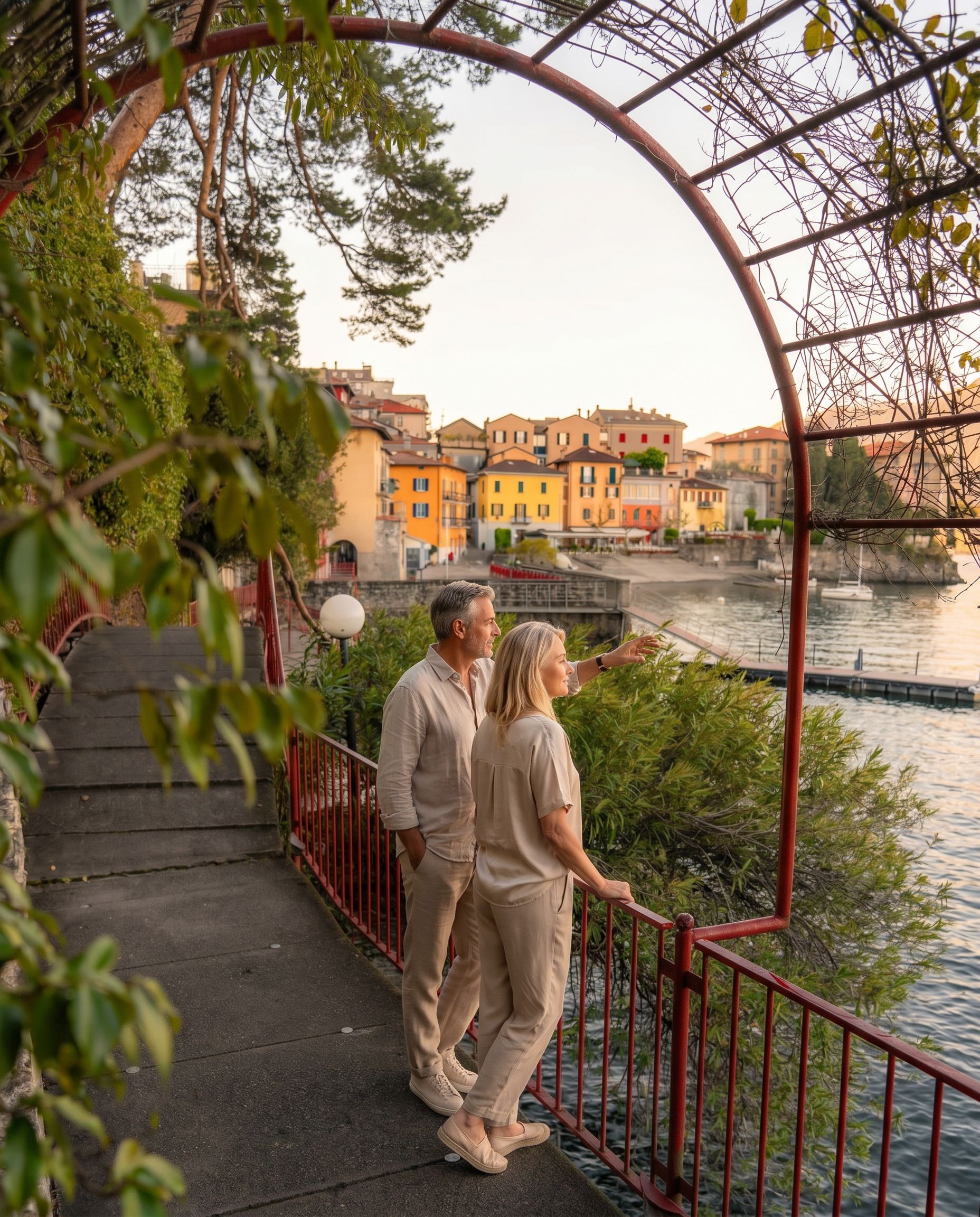 AI-edited
Which town has the best transport links?
Varenna wins for rail access, while Bellagio is the ferry hub. Como city offers the most connections overall, but Varenna’s direct Milan train makes it the easiest car-free choice for travellers arriving from the airport.
As of August 2026, Varenna-Esino is the only mid-lake station with a direct train from Milan: Trenord runs it from Milano Centrale about every hour, takes roughly 64 minutes and charges from €7.40 in second class, with reduced fares for over-65s. It is not, however, the lake’s only direct rail link — Milano Centrale reaches Como San Giovanni in about 40 minutes, and Milano Cadorna reaches Como Lago, on the waterfront, in about an hour. From Varenna station the walk down to the ferry dock takes ten minutes at most; Bellagio’s tourist office notes that the stepped shortcut can be skipped by following the main road instead. Bellagio has no train station; you must take a ferry from Varenna or a bus from Como. Menaggio sits on ASF bus line C110 between Como and Colico, but has no rail link.
Ferry frequency is highest in Bellagio, which serves as the central hub for Navigazione Laghi services. Varenna is 15 minutes away by boat or car ferry, and car ferries shuttle frequently between Bellagio, Menaggio and Varenna — but Como is another matter: the bus from Bellagio takes about an hour. Como city offers both trains to Milan and frequent ferries, plus bus connections to the western shore. For a full breakdown of airport transfers and train options, see Getting to Lake Como: Airports, Trains and Transfers – A Senior’s Practical Guide.
How walkable are the towns? Hills and steps explained
Menaggio and Lenno are the flattest options, with level promenades and fewer stairs. Varenna has a flat lakeside walkway but steep alleys uphill. Bellagio is the hilliest, with long staircases connecting the waterfront to upper streets.
This is the question that separates the comfortable base from the exhausting one. Lake Como towns were built centuries ago, and most cling to steep hillsides. Here’s what to expect:
- Varenna: The famous “Lover’s Walk” (passerella) runs along the water to the old town and is the gentlest stretch in the village — a joy to stroll, though no official source certifies it as step-free. The historic centre climbs steeply uphill via alleys with shallow risers—manageable but not step-free. The station is uphill too.
- Bellagio: The waterfront is flat, but the centre is a maze of steep stairs and inclines. The walk from the ferry to the upper town (where many hotels sit) involves significant climbing.
- Menaggio: The easiest going of the Golden Triangle towns. The Regione Lombardia describes a central square, a pedestrian area and a long lakefront walk, and the main streets are gentle slopes. A practical choice for those with mobility concerns.
- Lenno: Very flat lakeside area around the landing stage and the main square, and the village itself is small and easy to navigate. Villa del Balbianello is the exception: it sits at the end of a one-kilometre uphill path.
- Tremezzina: Spread along the lakeside road; mostly flat near the water but hilly as you move inland.
- Como city: The historic centre is flat and pedestrian-friendly. The newer areas have gentle slopes. Excellent for walking without exhaustion.
Atmosphere and noise: Which town suits your style?
Varenna is quiet and romantic, ideal for sleep quality. Bellagio is glamorous but crowded and noisy by day. Menaggio offers a relaxed, family-friendly vibe. Como city is lively year-round, while Lenno and Tremezzina are peaceful retreats.
Guest reviews consistently report that Varenna delivers the best sleep quality on the lake, with quiet nights that allow for deep rest. Its crowds are day-trippers who arrive and leave with the ferries — a review of the town’s lakeside promenade left on Google in October 2025 advises that “early morning or evening after the day trippers are best.” Bellagio, by contrast, is frequently criticised for daytime crowds and evening noise that disrupt relaxation.
Menaggio strikes a middle ground—busy enough to feel lively, but without the tourist crush of Bellagio. It’s particularly popular with families and older travellers who want convenience without chaos. Como city offers the most consistent year-round activity, including a Christmas market in winter, making it the best choice for off-season visits.
For those seeking true tranquillity, Lenno and Tremezzina are the quietest options. Lenno is tiny, with just a handful of restaurants and a stunning view of Villa Balbianello. Tremezzina is a collection of hamlets (including Lenno) that feel more residential than touristy. Both are ideal for a slow, restorative stay.
“Varenna is like a hidden gem on the shores of Lake Como — a place that gently slows you down and invites you to simply enjoy the moment. … There’s a special kind of magic in walking along the waterfront, where every step reveals a new breathtaking view — shimmering water, boats drifting by, and a peaceful silence that soothes the soul.” — from a Google review of Varenna’s Passeggiata degli Innamorati, April 2026
Which town is best for accessibility?
Menaggio and Lenno have the easiest lakefronts, while Bellagio and Varenna are two of the five stages on the Regione Lombardia accessibility itinerary for the lake. In every town the waterfront is the level part and the alleys climbing behind it are where the effort starts. Como’s old centre is flat, but its rebuilt lakeside promenade has steps and level changes.
There is no published accessibility score for Lake Como; the figure of 2.5 out of 5 that circulates online cannot be traced to any source. What does exist is an official route. Lombardia Facile, the accessibility portal of the Regione Lombardia, publishes a five-stage itinerary for the lake — Como, Lecco, Bellagio, Varenna and Menaggio — and states that the accessibility of every point of interest along it was checked on site by accessible-tourism specialists. The same page offers a useful rule of thumb: the boats set you down in the centre of each town, and the lakefront and the streets beside it are usually level and easy to walk, even for people with mobility difficulties. Menaggio does have real advantages — a pedestrian centre, a flat lakefront by the landing stage, and five taxi and private-hire firms listed by its tourist office — but it is one of five towns on that list, not the only one that works.
Lenno is similarly flat and compact around the ferry dock and the main square. The walk out to Villa del Balbianello is not: the FAI, which runs the villa, describes a one-kilometre uphill path, partly gravel, taking about 25 minutes, and says plainly that it is not suitable for prams or for people with mobility difficulties. The taxi boat from the Lido di Lenno exists for exactly that reason. Tremezzina’s lakeside road is flat, but the villas above it vary — Villa Carlotta calls almost its whole garden accessible to disabled visitors while noting several uphill paths.
In Varenna, the lakeside walkway is the easy part; the old town and many hotels are uphill, and so is the station, though the descent to the dock is under ten minutes and the steps on the way down can be bypassed by keeping to the main road. Bellagio is gentler at the water’s edge than its reputation suggests: the main landing stage is on Piazza Mazzini itself, and the town’s two landing stages sit five minutes apart in the centre of the old town. What is hard comes next — the stone stairways that the Regione Lombardia counts among Bellagio’s landmarks climb steeply from the square, the Salita Mella among them.
Como has the best overall infrastructure of the six, with a flat historic core, good pavements and accessible public transport — though the rebuilt lakeside promenade is a different matter, and local reporting has criticised it for steps, level changes and small bridges that make it hard to cover in a wheelchair. On hotels, the specialist operator Sage Traveling puts it bluntly: the terrain alone makes it challenging to find a truly accessible hotel in the area, and only a few combine a flat entrance, lifts and fully accessible rooms. Ask for the lift’s door width and cabin size in writing before you book.
Cost and value: Which town gives the most bang for your euro?
Varenna and Menaggio offer better value than Bellagio, with lower hotel rates and more affordable dining. Como city is mid-range. Lenno and Tremezzina are quieter and often cheaper, but with fewer dining options.
Bellagio commands a premium for its “pearl of the lake” reputation. Hotels, restaurants, and even boat hire are noticeably more expensive here. Varenna offers similar views and charm one price band below, as the table shows. Menaggio is also more affordable than Bellagio, with a wider range of mid-range hotels and apartments.
Como city sits in the middle: you’ll find budget options near the station and luxury properties along the lakefront. Lenno and Tremezzina are generally cheaper, but the trade-off is fewer restaurants and shops—you may need to take a ferry to Bellagio or Como for evening dining variety.
For a quick comparison, here is the ranking in price bands rather than figures — rates on Lake Como move too sharply with season, room category and booking channel for a single number to mean much:
| Town | Hotel (3–4 star, per night) | Dinner for two (mid-range) | Overall value |
|---|---|---|---|
| Bellagio | €€€ | €€€ | Low |
| Varenna | €€ | €€ | High |
| Menaggio | €€ | €€ | High |
| Como city | €€ | €€ | Medium |
| Lenno | € | € | High |
| Tremezzina | € | € | Medium |
Which town is best for exploring villas and gardens?
Lenno (Villa Balbianello) and Tremezzina (Villa Carlotta) are the top choices for garden lovers. Bellagio offers Villa Melzi. Varenna has the Castello di Vezio hike. Como city has Villa Olmo.
If villa gardens are your priority—and they should be—your base matters. Lenno puts you at the foot of Villa del Balbianello, whose terraced gardens and lake views are among the most photographed on Como; from the village it is a one-kilometre climb of about 25 minutes, or a short taxi-boat ride from the Lido di Lenno. Tremezzina is home to Villa Carlotta, famous for its spring azaleas and rhododendrons. Bellagio offers Villa Melzi, a 15-minute walk from the centre with a peaceful garden that avoids the crowds of Villa Carlotta.
For a full guide to these gardens, including opening hours, accessibility, and the best times to visit, see The Villa Gardens of Lake Como: A Senior’s Guide to Carlotta, Balbianello, Melzi, and Monastero.
Varenna’s Castello di Vezio is a steep uphill walk of about 30 minutes and rewards with a 360-degree view of the lake from its tower; the falconry that once drew visitors has been permanently discontinued since the vandalism of October 2022, and the castle closes in rain. In Como, entry to the park of Villa Olmo is free, but the city describes the park as only partly accessible and closes it during temporary exhibitions and events — and the villa itself is currently shut for restoration.
What about seasonal considerations?
Como city is the best winter base, with year-round activity and a Christmas market that runs until 6 January. Varenna and Bellagio are quieter from early October to late March, when Navigazione Laghi switches to its reduced winter timetable. Spring and autumn offer the best balance of good weather and manageable crowds.
Navigazione Laghi runs its summer timetable for boats and ferries from 29 March to 4 October; outside that window a reduced timetable takes over, so departures start thinning from early October rather than from November. Bellagio and Varenna can feel very quiet through the winter—charming if you want solitude, but limiting if you want dining and entertainment options. Como city remains lively: the Christmas market sets up in Piazza Perretta from 22 November, and the Città dei Balocchi festivities run until 6 January.
For travellers 50–70, the sweet spot is late April to June or September to early October. The weather is mild, the gardens are in bloom (spring) or the summer crowds have thinned (autumn), and the summer ferry timetable is still running until 4 October. July and August are intensely crowded, especially in Bellagio, with long queues for ferries and packed restaurants.
Which town should you choose?
Choose Varenna for quiet romance and train access; Bellagio for glamour and ferry hub convenience; Menaggio for flat terrain and practicality; Como city for year-round activity; Lenno or Tremezzina for peaceful villa-focused stays.
Here’s a quick decision guide:
- Varenna: Best for car-free travellers, couples, and those who prioritise sleep quality. Flat promenade but hills beyond. Direct train from Milan.
- Bellagio: Best for first-timers who want the “postcard” experience and easy ferry access across the mid-lake. Busy, expensive, and steep once you leave the water.
- Menaggio: Best for travellers with mobility concerns, families, and those wanting a relaxed, practical base. Flat terrain, good ferry links — and a hospital in the town: the Ospedale Erba-Renaldi in Via Virginia Casartelli runs a 24-hour emergency department.
- Como city: Best for winter visits, for city amenities alongside lake views, and for anyone who wants a major hospital nearby — the Ospedale Sant’Anna at San Fermo della Battaglia is a second-level emergency centre (DEA di II livello) with a round-the-clock emergency department.
- Lenno: Best for garden lovers and those seeking total tranquillity. The village is tiny, quiet and flat; the climb to Villa del Balbianello is the one exception, and a taxi boat takes that climb out of the day.
- Tremezzina: Best for villa-focused stays (Carlotta and Balbianello) with a residential feel. Mostly flat lakeside.
For a broader overview of what to see and do from any base, see Lake Como’s Highlights, Chosen for the Over-50s.
Whichever town you choose, Lake Como rewards slow travel. Allow time to sit by the water, watch the ferries come and go, and enjoy a long lunch with a view. That’s the real luxury of this lake.


